Categories
Common Sense general freedom obituary

Waiting for the Day

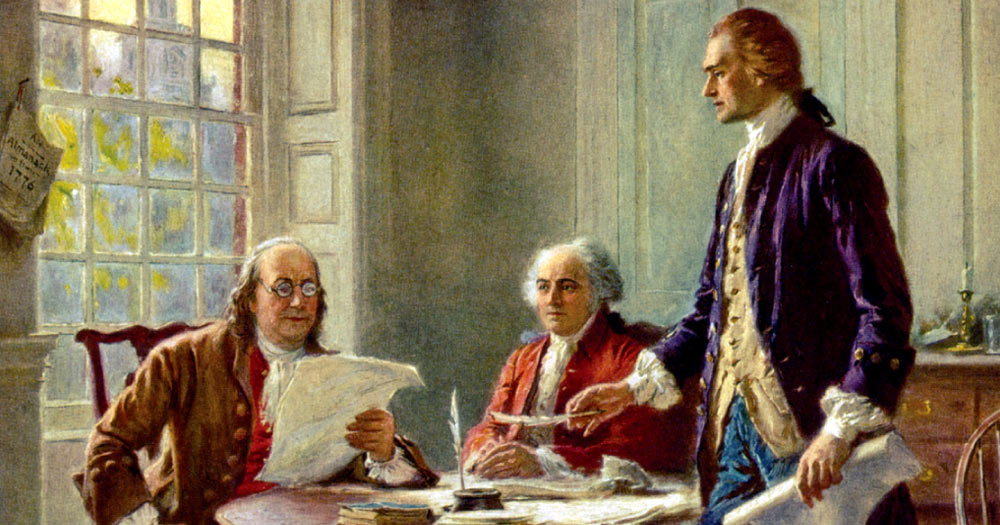
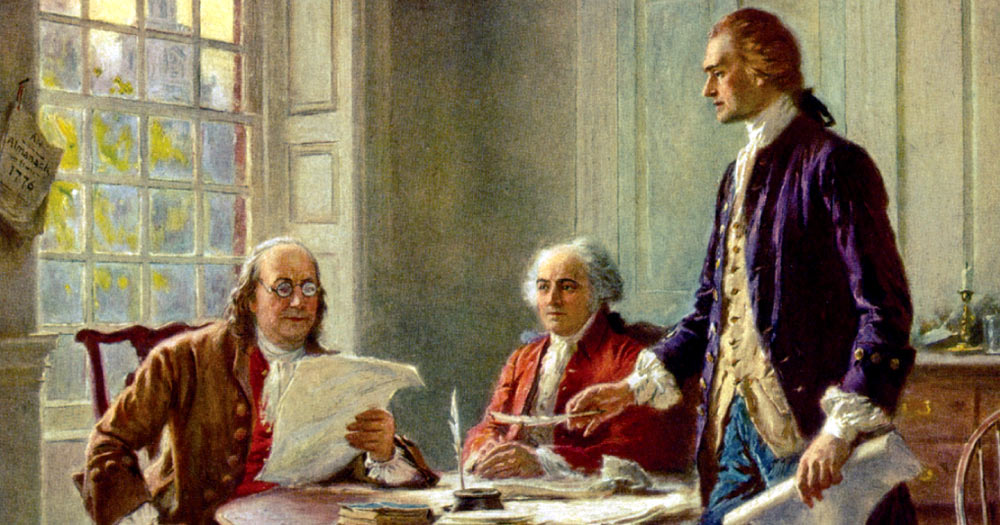
Towards the end of their lives, former President John Adams asked former President Thomas Jefferson whether he would live his life over again. 

The third president answered in the affirmative: “I think with you, that it is a good world on the whole; that it has been framed on a principle of benevolence, and more pleasure than pain dealt out to us.”

Not everyone agrees, of course. Jefferson called these people “gloomy and hypochondriac minds,” who “always count that the worst will happen because it may happen.”

Jefferson has a challenge to those whom we today call “the black-​pilled”: “How much pain have cost us the evils that have never happened!” Jefferson confessed to lacking hope sometimes, but not as often as the perpetually gloomy.

Those of us who follow the news often have occasion for gloom — or alarm. But on July Fourth it is appropriate to remember the council of these two leaders of Independence. 

In 1826, as Jefferson and Adams approached their inevitable demises, both struggled — and succeeded — in their final goals: to make it to Independence Day. 

On the Third, Jefferson inquired, more than once, about whether it was the Fourth yet, wrote Albert Jay Nock at the end of his Jefferson (1926), “and when told at last that it was, he appeared satisfied. He died painlessly at one o’clock in the afternoon, about five hours before his old friend and fellow, John Adams; it was the only time he took precedence of him, having been all his life ‘secondary to him in every situation,’ except this one.”

According to Adams family lore, when Adams died a few hours later, he said, “Jefferson survives.” 

Wrong, as a point of fact. But in spirit?

On Independence Day, we should ask ourselves what of the founding survives.

Unlike the actual lives of those who made our Independence, and, to paraphrase Tom Paine, we can start Independence anew. And as John Adams definitely said on his last day, “Independence forever!”

This is Common Sense. I’m Paul Jacob.


PDF for printing

Illustration created with Krea and Firefly

See all recent commentary
(simplified and organized)
See recent popular posts

Categories
Common Sense general freedom ideological culture

Two Days & 50 Years

Tomorrow is Independence Day in these United States.

But so was yesterday.

It was in the papers:

This day the Continental Congress declared the United Colonies Free and Independent States.

Pennsylvania Evening Post, July 2, 1776.

For it was two days before revising and accepting Thomas Jefferson’s Declaration of Independence that Congress officially declared its independence from King George III.

This Common Sense site has explained this quirk of history before. The Lee Resolution of July 2 declared that

  • the colonies should be “free and independent States”
  • they were “absolved from all allegiance to the British Crown” and that the connections should be “totally dissolved”
  • New “foreign Alliances” should be formed
  • And a “plan of confederation be prepared and transmitted to the respective Colonies for their consideration and approbation.”

Congress also commanded that a declaration be drawn up, and it was done quickly, accepted two days later.

The confederation document, on the other hand, took another year to work up, and four years beyond that to adopt.

John Adams, for all his faults as the Second President under the later U.S. Constitution, was a true friend of liberty and regarded the day as historic. “The second day of July, 1776,” he prophesied, writing to his wife on July 3, 1776,

will be the most memorable epoch in the history of America. I am apt to believe that it will be celebrated by succeeding generations as the great anniversary festival. It ought to be commemorated as the day of deliverance, by solemn acts of devotion to God Almighty. It ought to be solemnized with pomp and parade, with shows, games, sports, guns, bells, bonfires, and illuminations, from one end of this continent to the other, from this time forward forever more.

He was off by two days. It was the Fourth that would be celebrated.

Fifty years later he was off by much less: he died on July 4, 1826, uttering “Thomas — Jefferson — still surv —”

Jefferson had died a few hours earlier.

This is Common Sense. I’m Paul Jacob.


PDF for printing

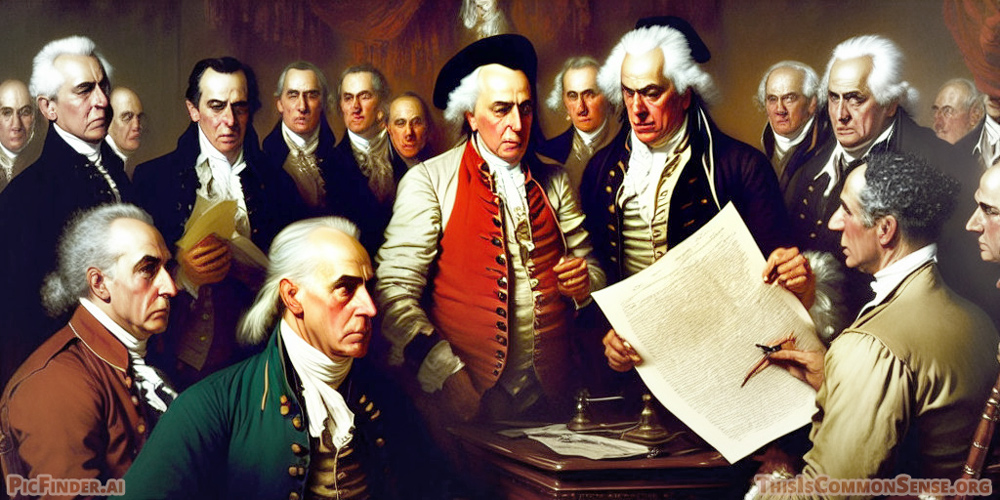
Illustration created with PicFinder​.ai

See all recent commentary
(simplified and organized)
See recent popular posts

Categories
Common Sense Fifth Amendment rights First Amendment rights Fourth Amendment rights general freedom Second Amendment rights Tenth Amendment federalism

July 4, 2022 Independence Day

Independence Day

Those core ideas of independence and liberty still matter — perhaps now more than ever.

And to help take Common Sense with Paul Jacob beyond 2022, join …

Thanks for your contribution!


See all recent commentary
(simplified and organized)
See recent popular posts

Categories
Common Sense general freedom ideological culture

Dependence or Independence?

“America does not want to witness a food fight,” Senator Kamala Harris said at last week’s debate, reprimanding her squabbling fellow Democratic Party presidential contenders. “They want to know how we’re going to put food on their table.”

The no doubt well-​rehearsed line drew raucous applause. She’s right; we’re not interested in a food fight.

But her second statement struck me as … odd … and not true. 

Harris spoke of how “we” — meaning they, the assembled politicians on the stage — are “going to put food” on “their” — meaning our — tables. 

Does she imagine that presidents produce our food, not farmers? Is she trying to say, “You didn’t grow that”? 

“Were we directed from Washington when to sow and when to reap,” the author of the Declaration of Independence wrote, “we should soon want bread.”

Perhaps this presidential aspirant remains unaware of how America became a land of abundance? It wasn’t the exertion of career politicians. Or regulators. Or bureaucrats. It was the amazingly productive engine that is a free people.

“Yet this government never of itself furthered any enterprise, but by the alacrity with which it got out of its way,” Henry David Thoreau explained in his famous 1849 essay, entitled Resistance to Civil Government. “The character inherent in the American people has done all that has been accomplished.” 

The difference between a society where people honor independence and one where, conversely, they idolize dependence on the government is the difference between bright day and darkest night. 

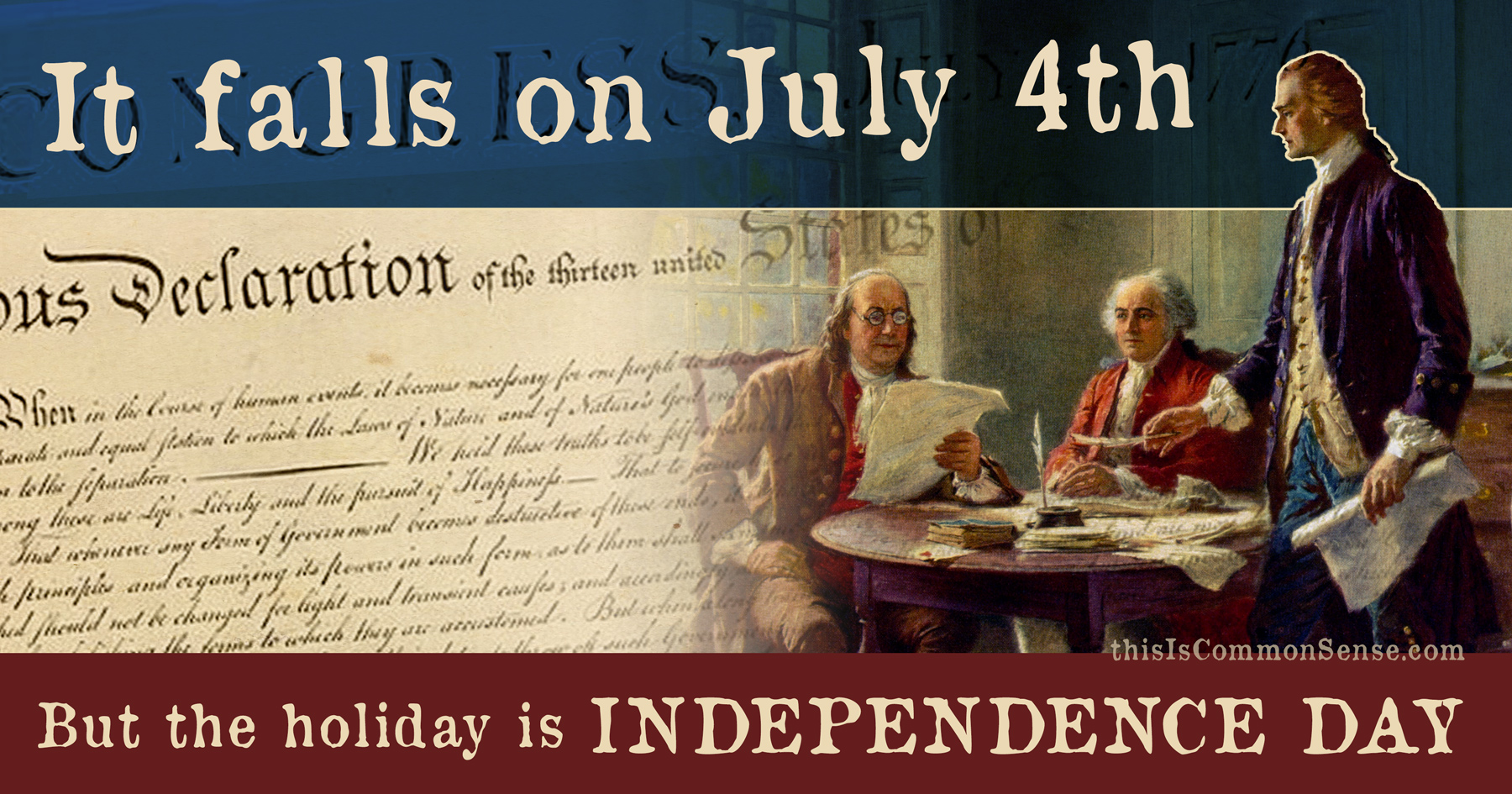
Today’s date is July 4th, but the holiday is Independence Day. It is not a celebration of dependence on cradle-​to-​grave big brother government. We celebrate freedom for the individual.

A Republic … if We, the People can keep it.

But how? How do we restore freedoms lost while retaining extant freedoms?

Well, with ideas. Arguments. Promotion of others’ efforts.

And for two decades, this daily commentary has defended freedom and those fighting for it. And I hope to keep the Common Sense coming far into the future. 

Yet, this effort is totally dependent on you — and your generosity. In this 20th year, won’t you make a special pledge of $20? Or $200? Or $2,000 if you have the financial freedom to do so.

“Those who expect to reap the blessings of freedom, must,” wrote Tom Paine in 1777, “undergo the fatigues of supporting it.”

Don’t worry, it won’t be so fatiguing. We stand up for freedom and against dependence on big government — with a rhetorical flourish now and again … and a sense of humor. 

Please pass the ammunition. And no food fight.

This is Common Sense. I’m Paul Jacob.


Kamala Harris, debate, Democrats, Fourth of July, Independence Day,

See all recent commentary
(simplified and organized)
See recent popular posts

Categories
general freedom meme national politics & policies U.S. Constitution

Independence Day

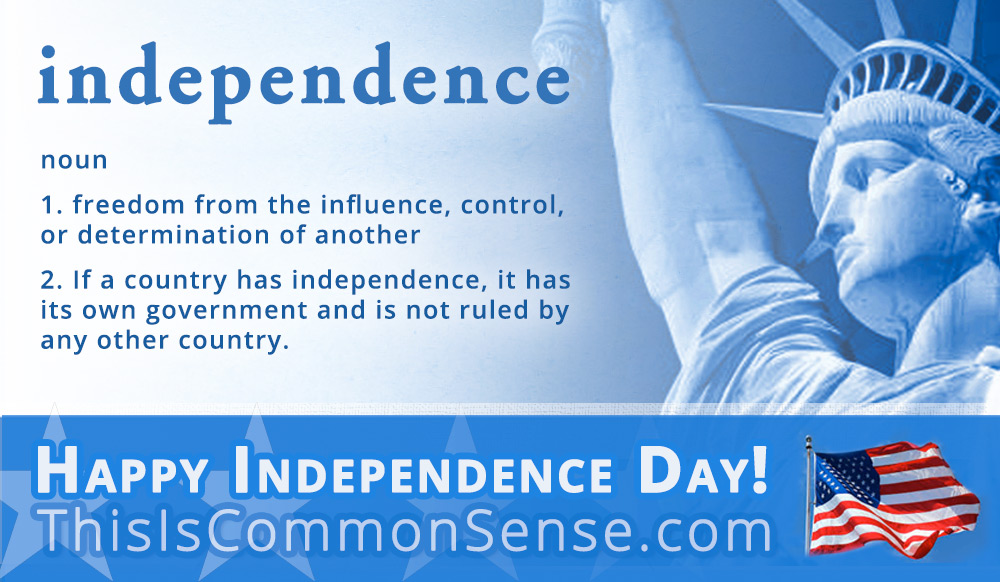
independence:

noun

1. freedom from the influence, control, or determination of another. If a country has independence, it has its own government and is not ruled by any other country.

2. If a country has independence, it has its own government and is not ruled by any other country.


Happy Independence Day!


Categories
general freedom initiative, referendum, and recall national politics & policies responsibility tax policy term limits U.S. Constitution

Brexit 1776 – 2017

These united States* got their start, officially, on July 2, 1776. 

That’s when the Second Continental Congress voted to separate from King George’s government across the water. But it was two days later when that same Congress approved its formal Declaration, and it was the wording of that Declaration that impressed everybody — including folks back in England. 

July Fourth, not the Second, became “Independence Day.”

Today, the English are insisting on independence. Last year’s referendum to exit the European Union was a major step in throwing off the abusive relationship from Brussels and the central government there.

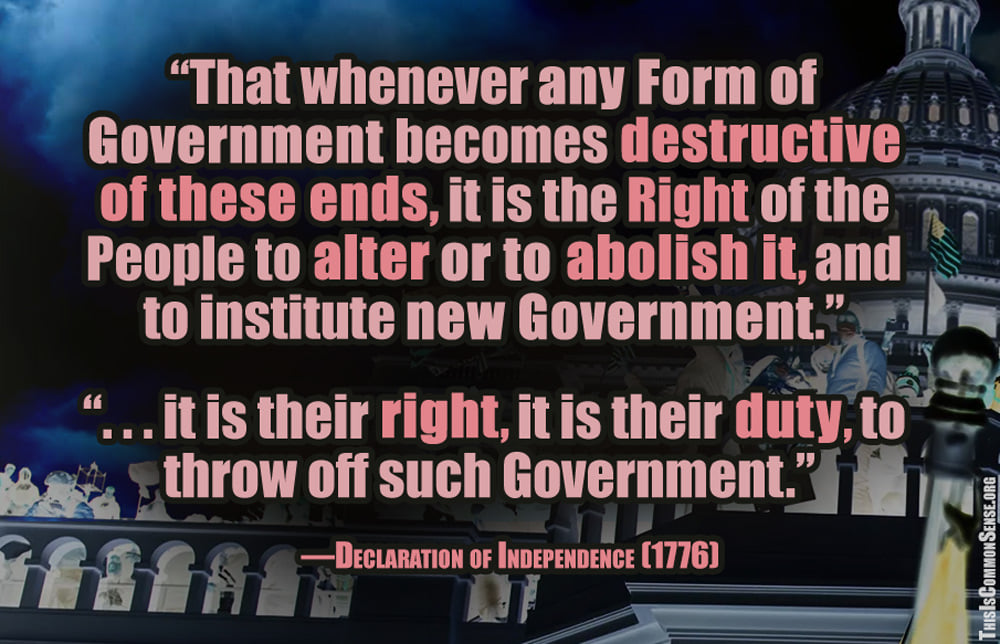
The Brits have every right to their “Brexit,” since, as our Congress argued so persuasively, governments “deriv[e] their just powers from the consent of the governed,” which entails that “whenever any Form of Government becomes destructive of these ends, it is the Right of the People to alter or to abolish it.”

Americans have never had more cause for fellow-​feeling with the British. Not only are they copying us, we are copying us. 

To gain anything like control over what has become a runaway central government in Washington, D.C., Americans in the states will have to continue to (in effect) nullify federal law regarding marijuana and take the lead on criminal justice reforms and improving government ethics and accountability. More work must be done, fighting for free speech and against corruption. And overbearing taxation and regulation and cronyism And insane debt accumulation.

Across the pond, it’s Brexit. Here, it’s just our continuing Revolution.

This is Common Sense. I’m Paul Jacob. 


* For just today I’ll use the odd, old capitalization, just as it was used in the Declaration of July 4, 1776.


Printable PDF


Categories
general freedom individual achievement meme national politics & policies responsibility

NOT the Impossible Dream

The American Dream is dead.

Has been for at least a year … or so we’re told:

  • “American Dream Dead,” said the Huffington Post
  • “The American Dream is out of reach,” CNN Money
  • “The American Dream is Dead, and Good Riddance,” according to a column by Keli Goff at the Daily Beast.

Golly. Have a great July 4th holiday … I guess.

That 2014 CNN Money poll found 59 percent of Americans agreed with the statement: “The American dream has become impossible for most people to achieve.”

What is “the American Dream”? What do folks mean when they speak of it?

Historian James Truslow Adams coined the phrase in his 1931 book, The Epic of America:

The American Dream is that dream of a land in which life should be better and richer and fuller for everyone, with opportunity for each according to ability or achievement. It is a difficult dream for the European upper classes to interpret adequately, and too many of us ourselves have grown weary and mistrustful of it. It is not a dream of motor cars and high wages merely, but a dream of social order in which each man and each woman shall be able to attain to the fullest stature of which they are innately capable, and be recognized by others for what they are, regardless of the fortuitous circumstances of birth or position.

Note that Adams wrote of “opportunity for each according to ability or achievement.” He didn’t say “from each according to ability, to each according to need.”

He didn’t suggest a dream world wherein government would wave a magic wand to bestow financial success upon everyone, program by program. In fact, Adams embraced a land of capitalism, but without the cronyism — thus, with some significant measure of equality of opportunity.

President Obama also addressed the American Dream in his 2014 State of the Union speech, only with a different tone. It had “suffered some serious blows,” he summarized. “Over more than three decades, even before the Great Recession hit, massive shifts in technology and global competition had eliminated a lot of good, middle-​class jobs, and weakened the economic foundations that families depend on.”

Surely Mr. Obama isn’t so economically brain-​dead as to think that the computer revolution, the information revolution, and the communications revolution were terrible scourges on mankind that cost jobs. Mr. Progressive-​in-​Chief, these “shifts in technology” amount to what’s commonly called “progress.”

Yet, Mr. Obama, like most politicians, has only one thought: how to turn talk of the American Dream into snake oil he can sell politically — to achieve his own dreams.

He believes our dreams depend on him, on bigger and bigger government. There are those who want a government big enough to somehow make all our dreams come true.

And those of us who simply want the freedom to try to fulfill our own dreams. Meaning, usually, we want government out of our way.

America is about individual freedom, all people created equal, pursuing happiness in their own personal ways, so every dream is accordingly different.

But what runs through them all is something to note as this country’s 239th Independence Day approaches:

I‑N-​D-​E-​P-​E-​N-​D-​E-​N-​C‑E.

The United States of America was a world-​historic innovation in government — it offered an “asylum for mankind,” as Thomas Paine wrote. We declared our independence as a nation so that every man and woman walking this parcel of the earth could likewise declare his or her independence.

The American Dream isn’t, as Adams wrote, “a dream of motor cars and high wages merely,” but of standing on one’s own two feet, making one’s own way in the world, being self-​reliant, independent, doing it one’s own way.

Makes me miss Frank Sinatra.

Put another way or three:

  • If your dream is to start a company like Solyndra, taking over $5oo million in subsidies from the taxpayers, it’s just not the American Dream.
  • If you want to live off government programs, rather than your own smarts and achievement, you may have a dream, but it ain’t the American Dream.
  • If you’re just sitting in your boat waiting for the tide to lift you up, you may indeed be dreaming, but it’s not the American Dream.

One doesn’t have to be as successful in business as Bill Gates to achieve it. You could take a vow of poverty and still grasp the American Dream in full.

Life is short. It’s not about amassing the most toys. It’s about freedom, the freedom to pursue your own happiness. And the courage to use that freedom to go for it.

Thats the American Dream.

I have a Common Sense American Dream that my commentaries and the memes and videos we post at ThisisCommonSense​.com 365 days a year — and send to tens of thousands by email — will rally the spirit of independence that triumphed more than two centuries ago and is still alive and strong in us today.

Thank you!We cannot do it without your help. I need your support now, on this Independence Day. Please take a moment to make a generous and tax-​deductible gift to keep this Common Sense coming to you and a growing audience of active, interested and independent Americans.

Happy Independence Day!

The Dream lives on in you. Now please help us grow our voice and our movement.

This is Common Sense. I’m Paul Jacob.


P.S. A recent poll now shows that asked a slightly different way, nearly two-​thirds of us believe the American Dream is achievable for those that are willing to work for it. Should it be achievable for those unwilling to work for it?

Thank you!

P.P.S. Thank you for helping provide Common Sense to liberty-​lovers everywhere. Please give generously. Your one-​time contribution of $100, $50, $25 or a monthly pledge of $17.76 makes this program possible.


Printable PDF
Independence Day


Categories
general freedom ideological culture

Declare Your Independence

Today is Independence Day, and we’re celebrating. Tonight there will be fireworks to watch. So I’ll try to be brief.

The original independence that the Continental Congress of the seceding colonies declared, was dramatic and fundamental, as I’ve tried to honor these past two days in Common Sense.

But the idea of independence, and of our liberty that it was meant to secure, extends beyond events over two centuries ago.Declaration of Independence

Today, we are riddled with at least two kinds of dependence that are worth resisting.

  1. Economic dependence. I’m not talking about foreign trade. “Independence-​with-​freedom”  assumes that we will always depend on each other by co-​operation. But the terms of that co-​operation should be mutual. The great problem with crony capitalism and the welfare state — and even to some degree with a large federal workforce — is that increasing numbers of people (whole classes) increasingly depend on taxpayers rather than their own productivity and commerce.

    This sort of dependence depends on wealth, but provides poverty.
  2. Partisan dependence. The polarization of the two political parties has become increasingly ideological — as it was at the beginning of the country, actually — and is becoming increasingly nasty. Americans seem “stuck.” Breaking apart from the parties might make for a more honest and productive debate.

One way to accomplish the latter? Work for general, non-​partisan — “transpartisan” — reforms, like term limits … and other measures aimed at greater representation, from mandating smaller districts to establishing ranked choice voting.

Remember, in 24 states and most cities and towns, citizens also have the initiative and referendum process to act directly. Staying focused on issues is the key to working across partisan divides.

Who knows what improvements we might be able to make?

What begins by thinking independently comes to fruition in successful cooperation.

This is Common Sense. I’m Paul Jacob.

Categories
Common Sense

Is This a Great Country or What?

July 4, 2011

Some 235 years ago we made a clean break from the corrupt Old World of Europe. Fifty-​six men risked it all to proclaim in the Declaration of Independence that:

We hold these truths to be self-​evident, that all men are created equal, that they are endowed by their Creator with certain unalienable Rights, that among these are Life, Liberty and the pursuit of Happiness. — That to secure these rights, Governments are instituted among Men, deriving their just powers from the consent of the governed.…

That sums it up — the grand total of good government. The rest is history. Freedom prospers. A country of empowered citizens works a whole lot better than a nation of subjects following a dictator.

But the most striking lesson of history is sadly the opposite of America’s July 4, 1776, birth. So much of the world has long lived under political oppression.

This year I’ve been watching and reading about the protests and revolutions all across the Arab world, knowing that people are choosing to risk beatings and death to stand up in the streets to speak out for freedom. I’m frustrated that there is so little I can do.

And then it occurs to me: the best thing I can do, as an American, is to fight to keep our country all that it should be.

That’s no easy fight. As you know.

Our governments from Washington, DC, to Hometown, USA, are out of control.

What’s the trouble? Spending. Debt. Regular attacks on our property rights. The list runs long: Corruption. Arrogance. Nanny-​statism. Those relentless assaults on any process of reform — from term limits to voter initiative, referendum and recall.

The philosophy running government for far too long now directly opposes the creed of 1776: The career politicians and the special interests believe in unlimited government, the idea that everything is permissible, anything is affordable (with your money), and nothing is sacred.

Disaster is on the horizon; the storm clouds of several coming catastrophes are dark and visible.

Politicians cannot stop the rain. Though they act as if they can.

But all hope is not lost. I have faith in you. And in Common Sense.

Our political problems are absolutely solvable. But your work and commitment to freedom is ultimately the difference maker.

And I like to think Common Sense helps. By laughing at the sad absurdities. By voicing a little righteous indignation. And by using wit … whenever I can find it.

But mainly Common Sense does its job by connecting the outrages of unaccountable government with the great people all across America who stand up to defend their rights and the rights of their neighbors from politics gone wild.

Common Sense helps bring folks together to put citizens in charge and ensure that government is accountable to the people.

This Common Sense program is run on a shoestring by Citizens in Charge Foundation. But even shoestrings cost money. We need to raise $52,000 to cover the program for the remainder of the year and to step up our marketing of the program.

On July 4, 1776, they pledged their lives, their fortunes and their sacred honor.

This July 4, 2011, I’m asking you to pledge some of your fortune to help keep Common Sense on the air, online and in your email Inbox — and to help us reach out to new audiences.

A number of readers and listeners have made a monthly pledge of $17.76. That’s a big help. Can you make the same pledge?

Or give a one-​time contribution of $176 today? If you can, please consider donating $1,776. Or $10, $25, $100 — whatever amount works for you.

The antidote to government gone wild is simple: Common Sense. Help us keep it coming.

Happy Independence Day!