Categories
crime and punishment general freedom ideological culture media and media people moral hazard nannyism national politics & policies privacy responsibility Second Amendment rights too much government U.S. Constitution

He Applied Himself

“I need to make this count,” wrote a young man in Everett, Washington.

Unfortunately, it looks like he wasn’t attempting a big career-oriented project. He was planning a mass shooting.

“I need to get the biggest fatality number I possibly can,” is one of many damning journal passages the police have made public. Apparently he had settled on attacking the high school he attended. “I’ve been reviewing many mass shootings/bombings (and attempted bombings) I’m learning from past shooters/bombers mistakes.”

Ambition and rigor: missapplied.

Fortunately, his grandmother read his journal and discovered a rifle in his guitar case. She turned him into the police the Tuesday before the Florida shooting I wrote about last week. And maybe just in time.

Meanwhile, last week’s Parkland, Florida, shooting dominates the headlines. Fellow students and neighbors of the Florida shooting victims have ramped up their condemnations and demands — including at a horrorshow “town hall” on CNN.

Yet the nature of the difficulties in preventing such atrocities has become lost in the rhetoric and anger.*

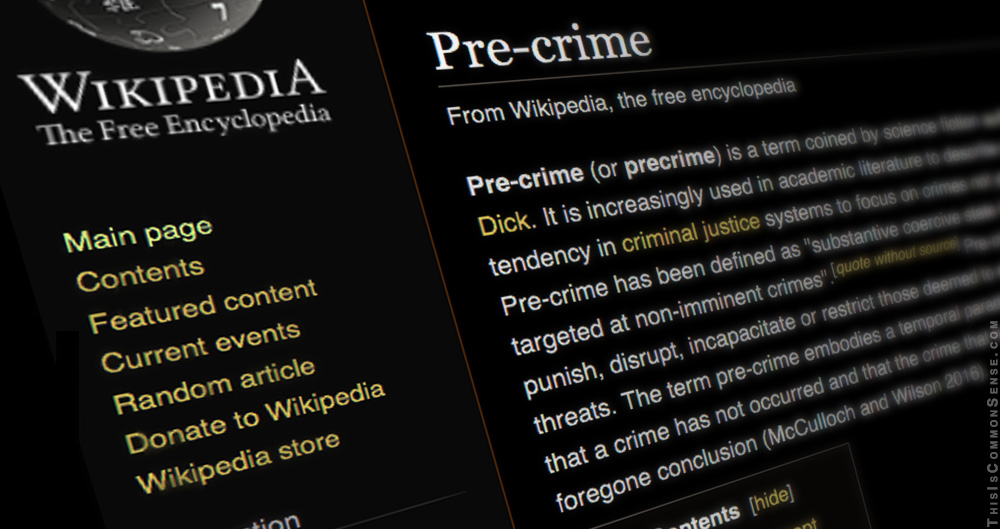
In a free society, we cannot arrest people before they commit a crime. In the Everett case, officials were “lucky”: despite the young man’s lack of a criminal record, they were able to charge him with a burglary they allege he committed the day before arrest — and his extensive planning notes are being taken as evidence for intent. He’s also been charged with attempted murder.

We should be in inquiry mode, right now. It could be helpful to know the exact motivations for both the Florida shooter and the Everett wannabe — and similar cases.

This is Common Sense. I’m Paul Jacob.


* Law enforcement is tasked with uncovering spree shooting plots today — and to protect, too. But the armed, uniformed school resource officer at the Parkland high school failed to protect. He heard the gunshots but never entered the building, while the shooter killed 17 innocents.


PDF for printing


Categories
Accountability crime and punishment folly general freedom local leaders moral hazard nannyism national politics & policies Popular privacy Regulating Protest too much government

The Last Straw

How much should we fine waiters who destroy our planet?

For how long should they go to jail?

I don’t know where you would hold such an evildoer after the earth has been destroyed. Or where he’d go when released. But we’re speaking hypothetically. Assume that planet-destroyers can be imprisoned on the moon, which let’s just say still orbits the earth’s decimated remains. Or assume that after being destroyed, the planet can be reconstructed. After serving his sentence, then, the waiter would be released to a reconstructed earth.

In that case, a maximum $1,000 fine as suggested by Ian Calderon, Democratic majority leader of the California State Assembly, seems only fair. However, a maximum of six months in jail is excessive. In my opinion, planet-destroying waiters should suffer no more than 100 days in jail.

Calderon has proposed a bill, AB-1884, to fine and/or imprison waiters who offer unsolicited plastic straws to restaurant patrons. In response to criticism of his silly and vicious bill, Calderon says hey, it’s “NOT a ban” on straws! Oh, okay. Anyway, “Penalties are based on the code section the bill is currently in, which it will be amended out of,” which sounds like Calderon was prior to the uproar . . . what, joking?

As long as we’re amending, let me amend my own implication that people who offer, use, make or sell plastic straws* are in fact helping destroy earth. Just kidding!

The earth will survive plastic straws. Will it survive the Calderons of the world?

Open question.

This is Common Sense. I’m Paul Jacob.


* Not that I’m confirming or denying ever using one myself.


PDF for printing


Categories
general freedom media and media people national politics & policies too much government U.S. Constitution

Happy Birthday, America!

What? Oh, sure, I know the United States of America has its birthday on July 4th, that day in 1776 when the Second Continental Congress adopted the Declaration of Independence.

Let’s agree I’m early. (Oh, how I wish it were July.)

But the interesting thing about history is how we get to those moments wherein the great “we” declare our independence or fill the streets or storm the beaches — or the polls. The many big, important days that lead to THE day.

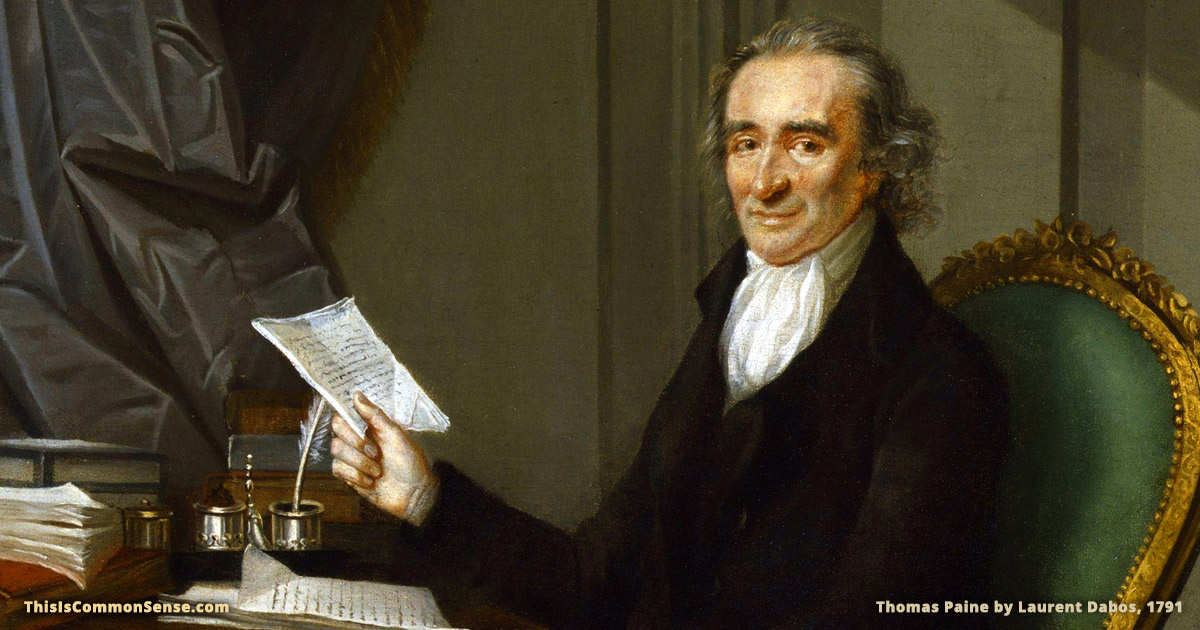
Today is such a date, because 242 years ago on January 10, 1776, Thomas Paine published Common Sense. Without this day 242 years ago, we wouldn’t have had Independence Day six months later.

Using common and direct language, and speaking to all the “inhabitants of America,” Common Sense made the case for both independence from Britain and the establishment of a democratic republic. Boy, did it make the case. On a per capita basis, Paine’s pamphlet is the bestselling American publication in history.

His pamphlet or parts were read publicly, reprinted in newspapers and spread throughout the colonies. This common man — barely an American,* having landed on our shores in November 1774 — used the universal language, speaking truth to power.

“Every spot of the old world is overrun with oppression,” Paine told his fellow Americans. “Freedom hath been hunted round the globe. Asia, and Africa, have long expelled her. Europe regards her like a stranger, and England hath given her warning to depart. O! receive the fugitive, and prepare in time an asylum for mankind.”

The original idea of these United States was freedom.

And that, my friends, is Common Sense. (I’m Paul Jacob.)


* Of course, this makes Paine almost quintessentially American.


PDF for printing


Categories
crime and punishment folly free trade & free markets general freedom nannyism too much government

Beaver State Bliss

The Great State of Oregon is not at DEFCON 1. Nor are Beaver State residents gnashing their teeth over a new law that went into effect earlier this week.

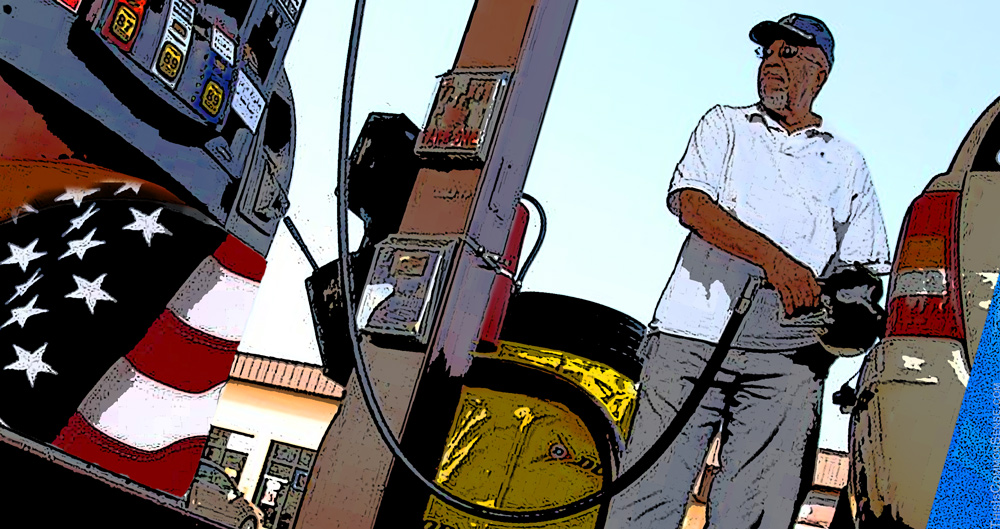
News reports proclaimed: “People in Oregon are freaking out about the thought of pumping their own gas under a new law.” But don’t believe everything you read.

For starters, Oregon’s new law doesn’t actually force anyone to do anything. It merely allows “retailers in counties with a population of less than 40,000 . . . to have self-service gas pumps.”

But a Facebook post by KTVL CBS 10 News in Medford took it an apparently frightening step further, asking, “Do you think Oregon should allow self-serve gas stations statewide?” The post went viral nationwide because of responses such as this:

I’ve lived in this state all my life and I REFUSE to pump my own gas . . .

This [is] a service only qualified people should perform. I will literally park at the pump and wait until someone pumps my gas.

Oregon is one of only two states — New Jersey, the other — where gas stations are banned from permitting customers to put gas in their own cars. Folks in the other 48 states have managed, as one Facebooker explained, “to pump gas without spilling the whole tank and triggering a Star Wars-style explosion.”

Still, if Oregonians so revere their regulatory regime, protecting them from the indignity of pumping gas, why change the law even partially?

Well, for economic reasons. As you might expect, gas stations across rural Oregon were closing at night, stranding many motorists.

Freer markets offer greater protection for real people . . . those not too perplexed by the prospect of pumping their own petrol.

This is Common Sense. I’m Paul Jacob.


PDF for printing


Categories
crime and punishment First Amendment rights general freedom government transparency ideological culture media and media people moral hazard nannyism national politics & policies too much government

No Joking Matter

He thought he was just horsing around.

Using the popular app WeChat, a Chinese construction worker supervisor Chen Sho Uli made a gossipy joke about government officials while chatting in a chat group. But being too casual about what you say — and where — can be dangerous in China. For his sin Chen was incarcerated for several days.

Picking quarrels” is another no-no in the country.

In lieu of Orwell’s telescreen in every room, modern Internet technology enables repressive governments to punish citizens for thoughtcrime that becomes app-speech crime. If the Chinese government can spy on you, it will. And penalize you for remarks it deems offensive to the dignity of the state.

Because of such repression, blogger Stephen Green observes that “strong encryption is everybody’s friend — except the tyrant’s.”

Agreed. Encryption is an important line of defense.

But some societies require this more than others, because harmless, incidental communications are not equally attacked by government, from country to country. Which means that encryption is actually a second line of defense.

The first is a cultural and political tradition respecting individual rights.

For one thing, robust encryption helps only those who engage in hyper-careful private discourse, or hyper-careful anonymous public discourse. Encryption won’t help thinkers of controversial thoughts who wish to express those thoughts publicly and under their own name. Everywhere we can, then, we must strengthen both the technological and cultural defenses of open discourse — recognizing that the latter is the more crucial and fundamental.

This is Common Sense. I’m Paul Jacob.


PDF for printing


Categories
general freedom individual achievement

Desert Royalty

I know people who are trying to set up their own countries. Folks at the Seasteading Institute, run by Milton Friedman’s grandson, Patri, are preparing for a floating civilization. But that scheme depends on homesteading the open sea.

Land would be easier, no?

Trouble is, there is not much land on the planet unclaimed by any modern state.

But there is at least one.

Which is where Suyash Dixit comes in. Mr. Dixit, described as an “Indian adventurer” at The Telegraph, “has declared himself the ruler of an unclaimed strip of land in North Africa and is encouraging interested parties to apply for citizenship,” writes Mark Molloy.

That “strip” of land (I’d call it a “patch,” since it looks like an irregular quadrilateral to me) is Bir Tawil. As a result of the vagaries of the British Empire’s map drawing and re-drawing efforts, and the subsequent push and pull of local politics, neither bordering nation (Egypt and Sudan) claims it as theirs.

Oops.

But their oops is Mr. Dixit’s opportunity. He hired a cab (paying a huge fare, he says) and travelled to and around the uninhabited region.

No one lives there. There is not much but desert sand and rock. But it is technically livable.

According to Dixit, the “ethics and rules” of ancient civilizations required that “to claim a land” one must “grow crops on it. I have added a seed and poured some water on it today. It is mine.” He calls Bir Tawil the Kingdom of Dixit, now, and has dubbed himself (à lá Game of Thrones?) “Suyash Dixit, first of my name.”

You can find him on Facebook as @KingSuyashDixit.

This is Common Sense. I’m Paul Jacob.


PDF for printing


Categories
Accountability education and schooling folly general freedom moral hazard nannyism national politics & policies responsibility too much government

Eternally Postponing Responsibility

There is a common sense element to economics. We ignore it at our peril. So let’s take a cue from the Democratic Party’s current and de facto leader, Bernie Sanders.

Turn to Denmark for a model.

The Nordic state has what Bernie wants: higher education “free for all.” But there are . . . costs involved.

It turns out that “some Danes, especially older citizens already in the labor force,” explains Business Insider, “say the extra freedom can eliminate a crucial sense of urgency for 20-somethings to become adults. The country now deals with ‘eternity students’ — people who stick around at college for six years or more [not to mention advanced degree work] without any plans of graduating, solely because they don’t have any financial incentive to leave.”

Hardly a shock. Young Danes would not be the first to see in college life what satirist Tom Lehrer identified as the prolongation of “adolescence beyond all previous limits.”

Give young people an incentive to suck up resources year after year, and some will certainly take you up on that.

It’s hard to counter, too. The Danish “eternity student” problem remains even after taking policy steps to discourage it.

Business Insider ends its report by quoting an expert who insists that “motivation to succeed in your studies is in no way linked to whether you’re paying for your tuition or not.”

Yup, that’s what proponents of “free” education keep telling us. But there is more at play here.

Responsibility is on the line. Adulthood is about responsibility. Free tuition is about postponing responsibility.

Do we really want to go further in that direction?

This is Common Sense. I’m Paul Jacob.


PDF for printing


Categories
crime and punishment general freedom ideological culture moral hazard nannyism national politics & policies Second Amendment rights too much government U.S. Constitution

The Good vs. Freedom?

Politicians regularly argue for new “gun control” laws, even while ignoring the execution and enforcement of laws already on the books.

Exhibit A, as I wrote at Townhall.com yesterday, is the failure of the military to provide the FBI with the information that would have blocked the Sutherland Springs church shooter from getting his guns.

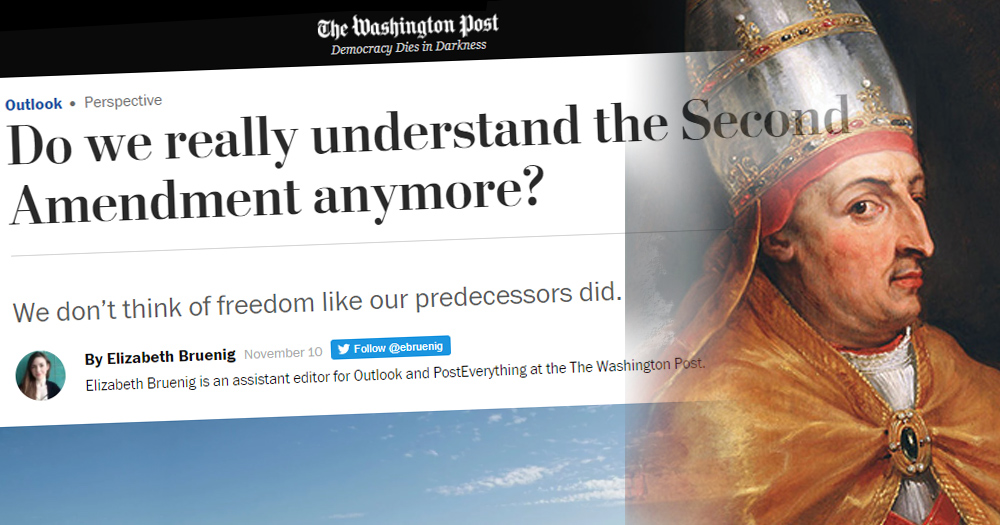
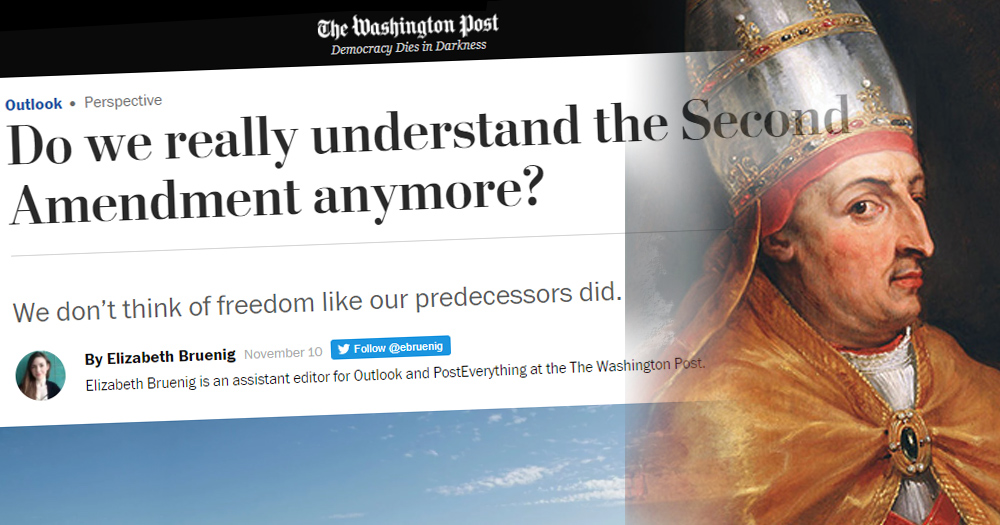
Meanwhile, in the Washington Post’s Outlook section, Elizabeth Bruenig takes a more . . . philosophical perspective. She contends that “Western thought moved from seeing freedom as a means to an end — what philosophers call ‘the good’ — to seeing freedom as an end in itself. Thanks to our liberal heritage, we regard freedom as an intrinsic good, perhaps the highest one of all. The more of it we can get, the better off we are. Right?”

Right!

But Bruenig’s answer isn’t in the affirmative.

Instead, she points to Vatican elections during the Middle Ages in which “canon law enshrined the right of eligible individuals to cast their votes. But their choices . . . could simply be overturned [by church officials]. Freedom mattered, in other words, but was always subordinate to the highest good, which could sometimes place limits on liberty.”

Ah, the Post advises us to embrace the Middle Ages . . . just so our freedom doesn’t get out-of-hand.

Bruenig also thinks that “we largely lack the framework to ask what gun ownership is for. . . .”

Huh? The Second Amendment answers that gun ownership is “necessary to the security of a free state.”

In terms of both scholarship and insight, the Founders’ constitutionalism far outshines the Post’s shiny new neo-medievalism.

This is Common Sense. I’m Paul Jacob.


PDF for printing


Categories
Accountability crime and punishment free trade & free markets general freedom ideological culture moral hazard nannyism national politics & policies property rights responsibility too much government

The Owners of Twitter Have Rights

Roger Stone is suing Twitter for kicking him out.

Without saying exactly why they booted him, Twitter implies that the reason is abusive language. For his part, Stone accuses the social media giant of targeting right-wing tweeters while letting left-wing tweeters off the hook for the same or worse alleged wrongdoing.

I’ll stipulate that Stone is justified in accusing Twitter of rank, ideologically motivated hypocrisy in applying its micro-blog policies. But he’s wrong to sue.

As I have argued before — indeed, just yesterday — government should not regulate Internet forums and should not compel Twitter or other firms to provide a soapbox for anybody else. The only relevant legal issue here is whether Twitter has violated a contract. But Twitter does not agree to let anyone use its services unconditionally. And I don’t think that Stone is alleging any violation of contract.

Our right to freedom of speech does not include the right to force others to give us access to their property in order to exercise that freedom. Nor do the rights of any individuals to use and dispose of their own property disappear if they happen to create a very big and successful enterprise. There are many ways to try to make Twitter pay for bad policies without using force against the company, including boycott and direct competition.

I agree with the guy who said that one’s right to freedom is not contingent upon a guarantee “that one will always do the right thing as others see it.”

This is Common Sense. I’m Paul Jacob.


PDF for printing


Photo by Nigel on Flickr


Categories
meme too much government

Freedom, not Force