Categories
international affairs political economy regulation

Rents After the Chainsaw

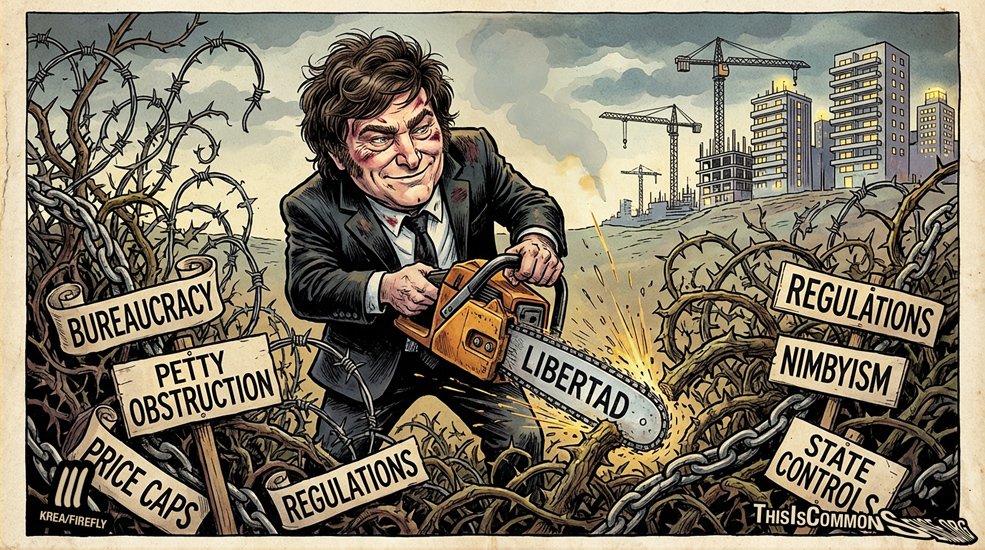
Argentina’s Ministry of Deregulation — yes, it now has one — reports that by June 2024, little more than half a year after chainsaw-​wielding libertarian candidate Javier Milei won the presidential election, the housing market boomed … into a magnificent recovery.

Back in March, Reason magazine observed that listings on the Argentinian real-​estate platform Zonaprop had increased from 5,500 before Milei’s deregulation “to 15,300 today, a staggering 180 percent rise.”

Why the big jump?

Strict national rent controls had been imposed in 2020, by the previous administration. When Milei lifted them, replacing them “with nothing,” tenants and landlords could then make whatever arrangements they could agree upon.

One method of evading the punishing controls had been switching to an Airbnb model of renting, with contracts renewable every three months. Such expedients were almost mandatory … given Argentina’s galloping inflation. But they introduced their own kinds of uncertainty.

Owners also took units off the market.

Annual rentals plummeted under this anti-​market regime. In late 2023, Valentina Morales saw maybe “12 apartments advertised in the entire Palermo neighborhood,” a region with a population of almost 250,000.

Rents on the few apartments available with annual contracts skyrocketed. Tenancies were required by regulation to last for three years, with arbitrary and unrealistic caps on rent increases. And rent had to be paid only in pesos. But since inflation did not pause under the pre-​Milei regime, owners were forced to guess how high inflation would go over the three years … and they charged accordingly.

Now? All such nonsense is gone.

This is Common Sense. I’m Paul Jacob.


PDF for printing

Illustration created with Krea and Firefly

See all recent commentary
(simplified and organized)

See recent popular posts
Categories
free trade & free markets general freedom too much government

Supermarket Slavery

How to sue supermarkets for shutting down:

One. Move to San Francisco.

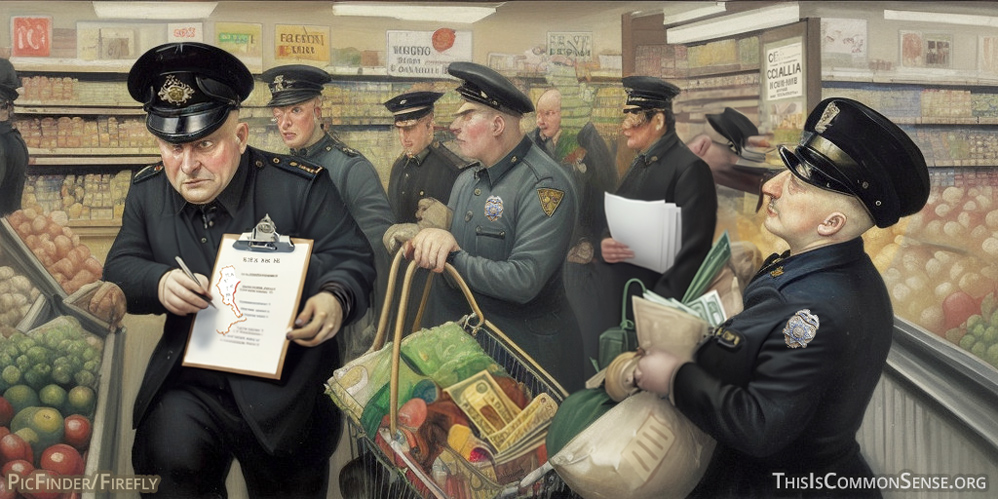
Two. Support a proposed ordinance “amending the Police Code to require large supermarkets to provide six months notice to their customers and the City before permanently closing, and to explore ways to allow for the continued sale of groceries at the location.”

Three. If the ordinance passes, wait for a large supermarket to go out of business without having known six months in advance that it would need to do so.

Four. Sue.

That the proposed law would amend the police code is perversely apt. The idea is use the state’s police power to penalize ending an activity that as a free man, not a slave, you have no obligation to continue.

Ending any project may inconvenience people who benefit from what you’re doing. But unless you are bound by contract, these other people have no right to your further efforts. 

Not for six months, not for six seconds.

The San Francisco ordinance would exempt supermarkets that must close because of a natural disaster or other circumstance not “reasonable foreseeable.” These exemptions don’t solve the problems that the ordinance could cause for innocent businessmen. As Reason magazine notes, any stores that closes “without providing the proper notice” could still be sued for damages, supposedly exempted or not.

In the 1980s, when this notion was originally proposed (unsuccessfully), supermarket executives argued that making it harder for them to shut down would also discourage them from opening a store to begin with.

True. But that’s just common sense.

I’m Paul Jacob.


PDF for printing

Illustration created with PicFinder and Firefly

See all recent commentary
(simplified and organized)

See recent popular posts
Categories
free trade & free markets media and media people political economy

Dollar Store Plague

Tucker Carlson said harsh things about “Dollar Stores” and “libertarian economics” on Glenn Greenwald’s System Update for December 16, as summarized in the show’s tweet:

“Libertarian economics was a scam perpetrated by the beneficiaries of the economic system that they were defending …

I think you need to ask: ‘Does this economic system produce a lot of Dollar Stores?’

And if it does, it’s not a system that you want, because it degrades people — and it makes their lives worse and it increases exponentially the amount of ugliness in your society.

And anything that increases ugliness is evil.

So if it’s such a good system, why do we have all these Dollar Stores?”

At Reason, Liz Wolfe fell for the same trap that has apparently ensnared Mr. Carlson. She defended progress in the U.S. since the time he was born. What? 

Contra Liz Wolfe, and in defense of Tucker, I’d say we are indeed living in tough times. Inflation’s way up, the birth rate is down, life-expectancy’s dropping, and a whole lot of Americans struggle to pay bills and keep even, financially, much less “get ahead.” The proliferation of dollar stores shows that the upscale stores are too expensive for too many.

They are a refuge for the poor.

But are they evilly uglifying, though? 

Perhaps not as pretty as Safeway or Target, but they’re clean and you can buy a can of soup for four bits, a dollar less than at an upscale market.

Are the rise of discount consumer goods stores, like Dollar Tree and Dollar General, especially hideous and indicative of a blow to … the American spirit? 

Seems more revelatory of a weird elitist streak in Tucker.

And what does libertarian — free-​market — economics have to do with it? Libertarian economists have opposed all the major drivers of the current system: central banking, deficit spending, sovereign debt accumulation, taxation for redistribution, subsidy. The policies that have truly “hollowed out” the last semblance of progress.

But Tucker blames libertarian economists’ defense of equity markets for not only social decline but Dollar Stores.

He’s fallen for the progressives’ perennial scam: see a problem in our mixed economy and blame the freer part … not the role of elitist schemers with political power.

This is Common Sense. I’m Paul Jacob.

dollar store, decadence

PDF for printing

Illustration created with PicFinder and Firefly

See all recent commentary
(simplified and organized)

See recent popular posts
Categories
tax policy too much government

For a Thousand Years

Time for a gas-​tax holiday. 

When the people lie prostrate, when the people groan under heavy burdens, when the people just can’t take it anymore — and when an election is coming up — that is the time for politicians to relieve everyone’s burden.

A bit.

Treasury Secretary Janet Yellen favors considering a temporary gas-​tax holiday to emulate some of the states. Reviving the Keystone oil pipeline — no, not something to consider, she says. But she’s okay with a brief gas-​tax break.

Let’s do better.

I propose a millennium-​long gas-​tax holiday, government-​barriers-​to-​drilling holiday, regulation-​of-​all-​industries holiday. Under my plan, government gets all the way out of the way of all markets so we can all be as prosperous as possible, whether or not a big economic crisis is underway.

But would there be any such crises — long-​term and intractable economy-​wide crises, I mean — if my plan were enacted?

When government does everything possible to injure the economy and prevent recovery, it takes a long time for markets to bounce back from shocks. If ever.

Un-fetter the markets, though, and economic actors would be able more rapidly to adjust to major jolts. If gas imported from overseas plummets, producers could then quickly adapt by expanding production. They cannot readily do so now because government imposes so many barriers.

The politicians’ preference for modest, namby-​pamby reprieves are not only substantially weak, they send the wrong signals. They get doled out as if government were doing us a special favor … by not beating us up so badly for a very little while.

We need freedom. On an ongoing basis.

This is Common Sense. I’m Paul Jacob.


PDF for printing

See all recent commentary
(simplified and organized)

See recent popular posts
Categories
general freedom too much government

The $165,000 Question

How far will the enemies of liberty go?

Well, almost all the way to armed robbery, for the latest outrage by foes of individual rights looks an awful lot like just that, plain armed robbery. 

The victims? 

The owners and staff of Atilis Gym in Bellmawr, New Jersey.

On January 13, at the behest of Governor Phil Murphy, state officials seized the assets of the gym. These assets included $165,000 in the business’s bank account, all of which, says co-​owner Ian Smith, had come from donations and online sales of T‑shirts and other apparel.

For months, the owners of Atilis have been involved in a pitched battle with the state of New Jersey over orders to shut down the gym, which they have kept open despite those orders (for which disobedience they were arrested in July). Atilis has been pursuing litigation to overturn the order, revocation of its license, and fines ($15,000+ per day) that the state has imposed to punish the defiance.

Smith is asking for our help as he and his business partner confront Leviathan.

“This was never about protection, it was always about control,” he says. “Please continue to support us in any way possible. Please share as much as you possibly can this story and help us continue our fight.”

Visit the Atilis Gym website to buy merchandise, and visit the gym’s GoFundMe page to “support the efforts to reopen and stay open” and to help staff and members cope with the financial hardships imposed by the shutdown order.

And subsequent armed robbery.

This is Common Sense. I’m Paul Jacob.


PDF for printing

See all recent commentary
(simplified and organized)

See recent popular posts

Categories
Accountability folly free trade & free markets general freedom moral hazard property rights responsibility too much government

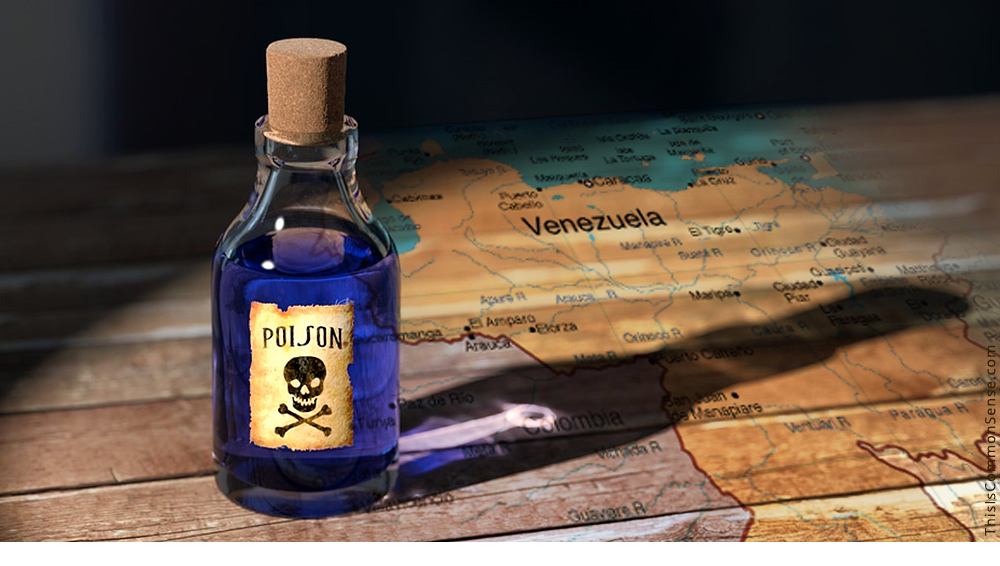
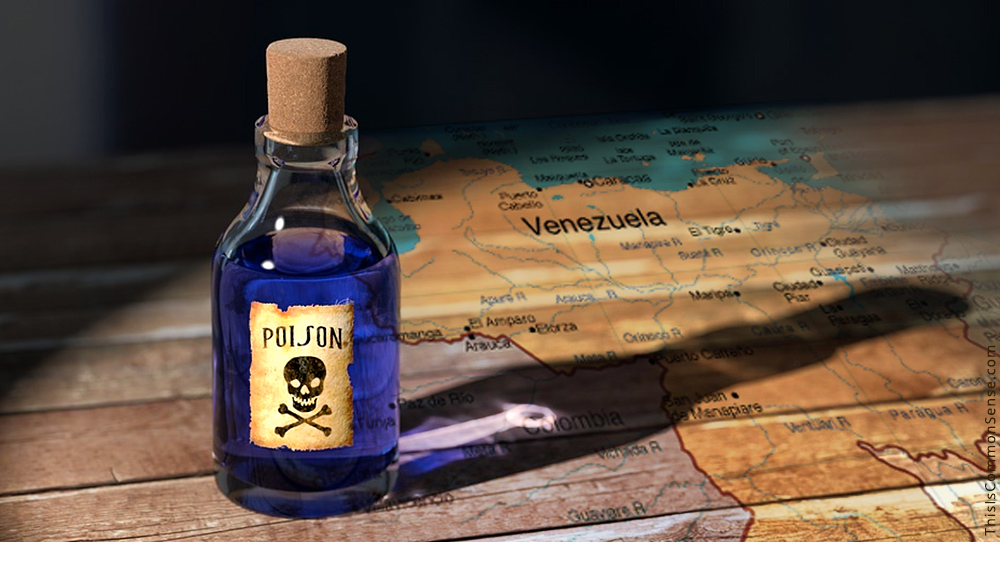
Poison Is Poisonous

Venezuela’s socialist economy has been collapsing. 

No big mystery. If, out of hostility to capitalism, a society keeps destroying everything that production, trade, and prosperity depend upon, the economy suffers. The benefits of markets don’t flow no matter what.

One assault has taken the form of hyperinflation — runaway printing of currency, done in part to dissolve government debt. Many Venezuelans are resorting to barter. It’s easy to understand why. 

Or is it? A Reuters reporter says that economists say that “the central bank [of Venezuela] has not printed bills fast enough to keep up with inflation, which … reached an annual rate of almost 25,000 percent in May.”

So go faster!?

Dude. Dude. The massive expansion of Venezuela’s money supply is what’s causing massive jumps in prices. Just like any other economic good, the medium of exchange is subject to the laws of supply and demand.

Other things being equal, enormously increasing a supply of a good will enormously lower its market value or price. Money, too, has a price — in terms of the non-​monetary goods being bought. If the pre-​hyperinflation price of a dollar in terms of bread is one loaf and the post-​hyperinflation price is one bread crumb, you won’t reverse the decline by printing even more dollars or bolívars even faster.

If you’re ingesting poison, you can’t fight the effects by being poisoned more and harder. The very first thing to do is stop ingesting the poison.

This is Common Sense. I’m Paul Jacob.


PDF for printing


Categories
Common Sense folly free trade & free markets general freedom ideological culture media and media people moral hazard nannyism national politics & policies

Evil Capitalists Hook Brazil On Eating

Have you heard the latest? 

More and more peoples around the world these days have the unfortunate misfortune of having adequate food — not merely vegetables either!! — thanks to the ruthlessly profit-​seeking food producers and their unconscionable engagement in the division of labor, capital accumulation, and international trade. 

It’s right there in The New York Times, which is, as you know, the paper of record. 

“DealBook: How Big Business Got Brazil Hooked on Junk Food.”

Dastardly! Those Big American Businessmen must have kidnapped the Brazilians, strapped them into chairs, and pumped Doritos into those poor souls with a syringe. Heaven knows, the fecklessly irresponsible Brazilians can’t be held responsible for their own diets.

How bad is it? 

This bad: “As growth slows in wealthy countries, Western food companies are aggressively expanding in developing nations, contributing to obesity and health problems.”

One expert quoted in the story (no hungry people consulted) says, “Part of the problem … is a natural tendency for people to overeat as they can afford more food.” 

Worse than Hurricane Irma!

Thanks to the Times’s aggressive investigative journalism, we know that these brazenly food-​selling companies do not even nag their international customers to be careful about their diets. Ergo, it’s chips and other indiscriminately convenient snacks for everybody, no strings attached. 

It’s become all too easy to be well-​fed and overfed and mis-fed. 

Thanks a lot, capitalism.

Oh for the good old hunting-​and-​gathering days when human beings spent much of their time starving, and the world had the human population of Binghamton. No problem with anyone gorging on Twinkies and Doritos back then. No problem of epidemics of corpulence.

We’ve lost that swell paradise … perhaps forever. 

This is Common Sense. I’m Paul Jacob.


PDF for printing


Illustration based on original photo by David Goehring on Flickr.


Categories
Accountability folly free trade & free markets general freedom initiative, referendum, and recall local leaders moral hazard porkbarrel politics responsibility too much government

Go Nats?

Just a few miles away from where I live sits the stadium of the Potomac Nationals. I’m a fan. I’d hate to see the team we call the P‑Nats leave. 

But … Hasta la vista.

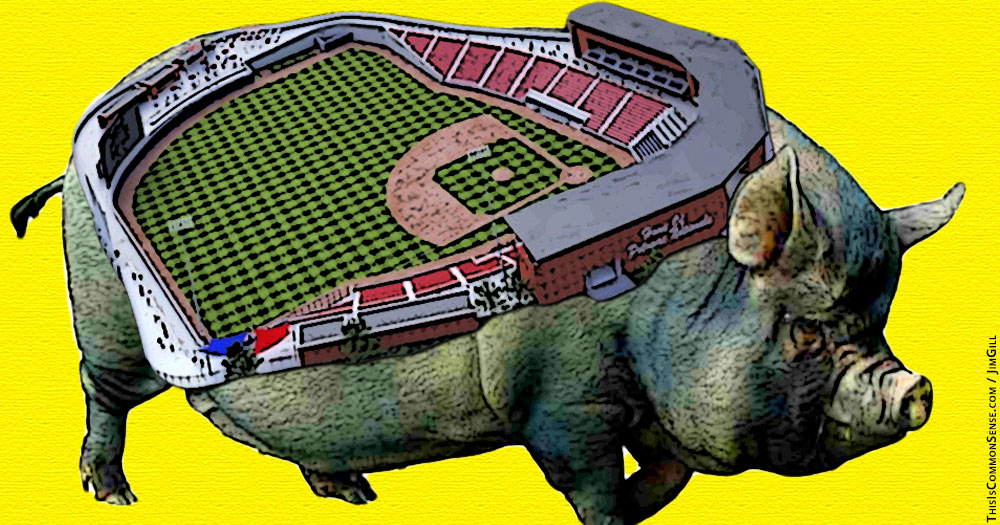
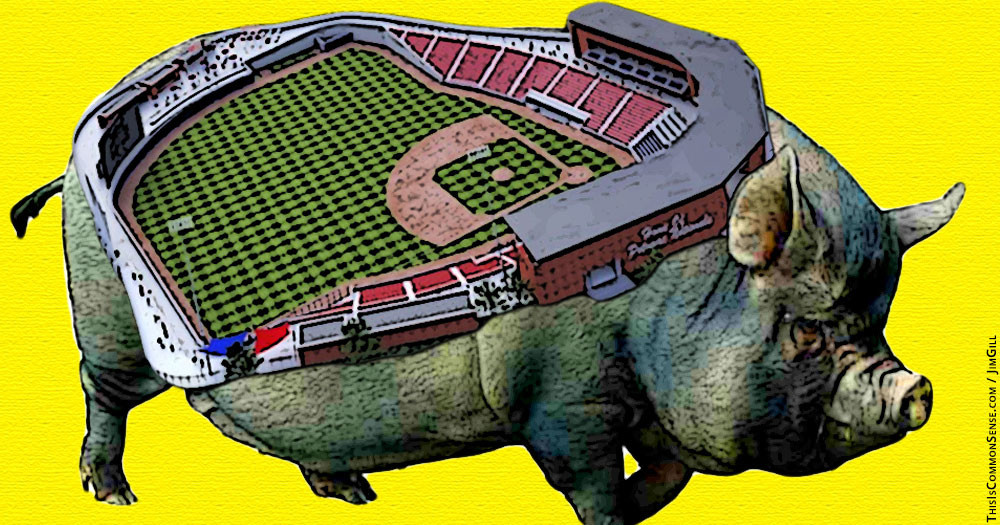
The owner of this minor league affiliate of Major League Baseball’s Washington Nationals is demanding a new stadium. He threatens to move out of Prince William County, Virginia, if he does not get it. 

The Prince William County board of supervisors has already expressed interest in floating bonds to raise the $35 million the fancy new stadium would require — with the privately owned team paying the money back, with interest, over the next 30 years. 

Compared to other crony-​ish deals around the country, not such a terrible taxpayer swindle. Still, zillions of wrongs don’t make this right. County taxpayers would be on the hook in case of default. And if the marketplace believed the team could actually make such payments, a bank or other investors would come to the rescue.

Thankfully, a monkey wrench has been thrown into the deal. A county supervisor has proposed that voters should get a chance to decide, via a November referendum. The board of supervisors will consider the referendum tonight. 

Voters should get the final say. But if there is a referendum, as much as I love having the team here, I will vote NO. I don’t cotton to forcing others to pay for my preferred entertainment. 

Government has certain legitimate roles. Subsidizing sports is not one. 

Even if the new stadium would be closer to my home than the old one.

This is Common Sense. I’m Paul Jacob.


Printable PDF


Categories
Accountability free trade & free markets general freedom local leaders media and media people nannyism national politics & policies porkbarrel politics responsibility tax policy too much government

Ballots & Books

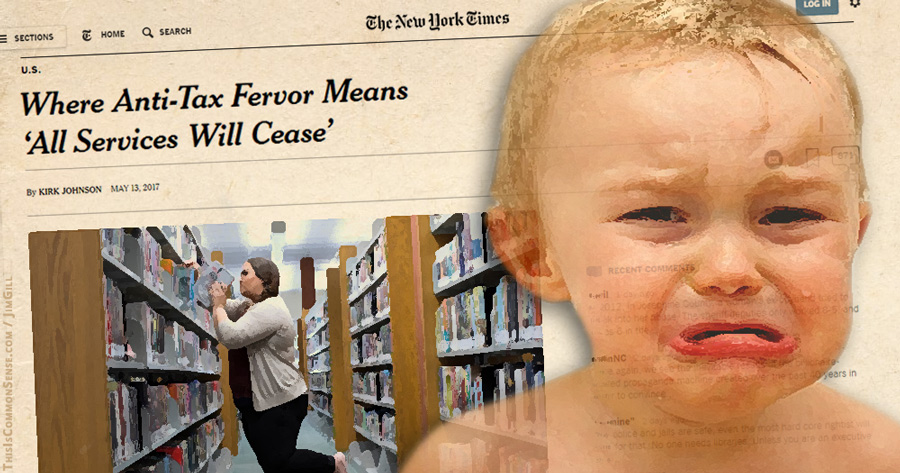
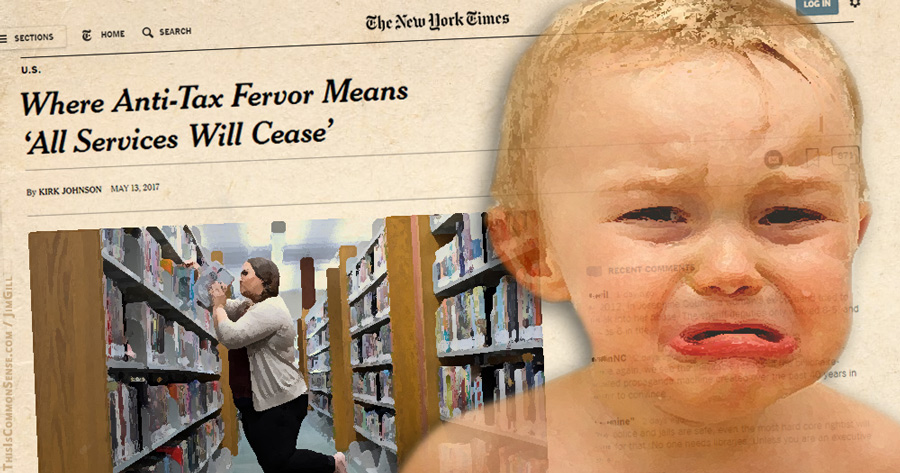
The people of Roseburg, Oregon, aren’t paying enough in taxes. That’s the upshot of Kirk Johnson’s recent New York Times article, “Where Anti-​Tax Fervor Means ‘All Services Will Cease.’”

“For generations in America,” readers are informed, “small cities … declared their optimism and civic purpose with grand libraries that rose above the clutter of daily life and commerce.” 

And then, the unthinkable: “last fall, Douglas County residents voted down a ballot measure that would have added about $6 a month to the tax bill on a median-​priced home and saved the libraries from a funding crisis.”

How dare voters so vote? Didn’t they know the Times wanted those libraries fully funded? Where was the “optimism and civic purpose” of Roseburgians?

“We pay enough taxes,” said auto mechanic Zach Holly.

“The trust is gone from people who are paying the bills,” acknowledged an elected commissioner one county over.

Even Jerry Wyatt, who voted for the library tax, decried that, “There’s no end of waste” in government, adding, “We need less people on the county payroll.”

Meanwhile, the Times reporter explained that “few places” are confronting “the tangled implications … more vividly than in southwest Oregon.” It’s not merely “lights out, one by one, for the [library] system’s 11 branches.” There have also been “cuts to the sheriff’s budget … [ending] round-​the-​clock staffing.” 

“If a crime is reported after midnight there,” Johnson wrote, “best not hold your breath for a response.” 

This is “what happens when citizens push the logic of shrinking government to its extremes.” 

To the extreme, eh? Hmmm. Doesn’t seem bad at all. 

Douglas County voters made a free choice about libraries and taxes. 

Close the book on it.

This is Common Sense. I’m Paul Jacob.


* There have also been worthwhile innovations in county government due to the budget cuts. Nearby Curry County combined its juvenile justice department with its parks department to save scarce funds. Then, the parks department began using juvenile offenders to clean up the parks. By engaging teenagers in meaningful work, the policy pushed recidivism rates way down and now Curry County has one of the lowest rates of youths committing a second offense.


Printable PDF


Categories
Accountability free trade & free markets general freedom national politics & policies property rights responsibility

Juicer Choosers

We all have our complaints about this company or that, this product or that.* And it is popular to rag on “consumerism” and the emptiness of “capitalism.” But put it into perspective: me “wasting money” on, say, an expensive juicer is nowhere near as offensive — that is, worth a rant, an excoriation, a philippic — than the government wasting money on … anything else. 

Or, for that matter, on juicers.

At this point, you may be wondering, “what’s with this juicer business?” 

Well, it is all about the hullabaloo regarding, er, a juicer business!

Juicero, to be precise.

The well-​funded-​at-​startup Silicon Valley biz makes the expensive Juicero Press. And news. Newsweek and Washington Post were just two major media outlets to lay into the company. They characterized Juicero and its product as a symbol of all that’s wrong with Silicon Valley.

Wow. What weight for one niche-​market company to bear.

While journalists in print and online fret over how Silicon Valley offers up empty gewgaws and gadgets for the “temporarily rich” — a few decades ago members of this class were excoriated as Yuppies — over at Star Slate Codex Scott Alexander reminds us that Silicon Valley does all sorts of things. 

One juicer cannot stand for everything else.

Besides, when “Capitol Hill screws up, tens of thousands of innocent Iraqis get killed,” Alexander writes. When “Silicon Valley screws up, people who want a pointless Wi-​Fi enabled juicer get a pointless Wi-​Fi enabled juicer.”**

Forcing many people to pay for dubious-​at-​best products, or enticing a few people to pay for harmless luxuries? You see why I prefer the latter. 

This is Common Sense. I’m Paul Jacob.


* You should listen to me curse my computers! Or, on second thought, no. You shouldn’t.

** “Which by all accounts,” Alexander concludes, “makes pretty good juice.” Even if squeezing the company’s frozen packets yourself works just as well.


Printable PDF