Categories
election law partisanship

Values of the DFL

Republicans and Democrats in Minnesota held party caucuses last week, featuring straw polls in the governor’s race. Grassroots politics!

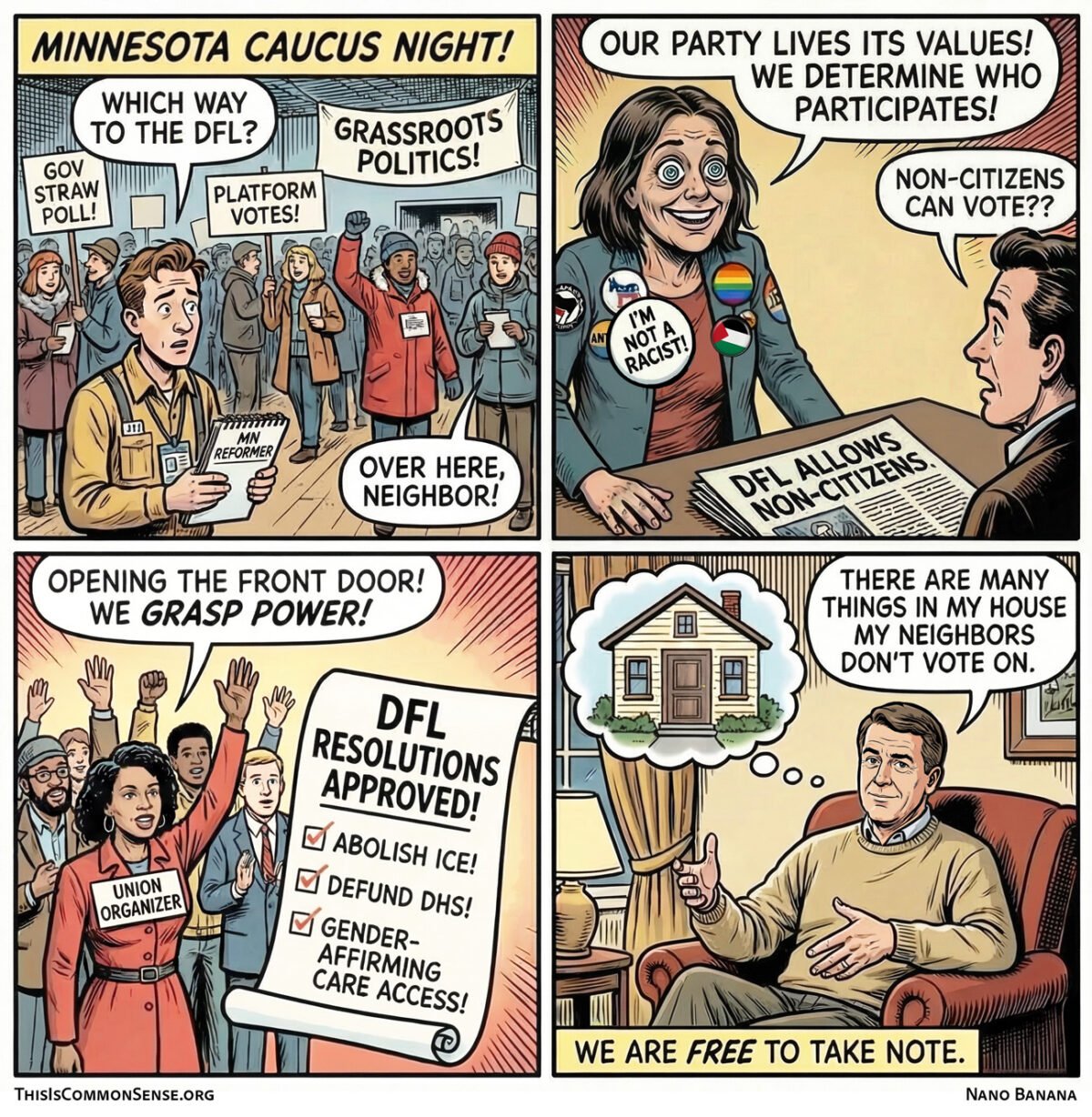
“Caucus attendees can also vote on potential changes to the party’s platform,” The Minnesota Reformer informed readers before the big night, reporting afterwards that caucusgoers “approved a bevy of resolutions to alter the DFL’s party platform, including abolishing U.S. Immigration and Customs Enforcement, defunding the Department of Homeland Security and assuring people have access to gender-​affirming care.”

Then I discovered that Democrats — called the Democratic-​Farmer-​Labor Party (DFL) in Minnesota — allow noncitizens to participate and vote in their caucuses. 

Four years ago, a three-​judge appeals court panel ruled that the “criminal penalties of Minnesota Statutes … which punish unlawful voting as a felony, do not apply to voting in precinct caucuses.” 

That led then-​DFL Party Chair Ken Martin to announce: “Our party can finally live its values.” Responding to reporters, Martin had explained at the time that “we are governed under our own First Amendment freedom of association rights and we can determine whoever we want to participate in the party.”

Okay. “Immigrants who aren’t U.S. citizens can caucus and become convention delegates,” a change approved unanimously by the party’s executive committee, according to Minnesota Public Radio News.

“By opening the front door to historically excluded neighbors,” argued Emilia Gonzalez Avalos, a noncitizen union organizer from Mexico, the DFL is “making sure that those affected by the issues in our platforms have a say in the process and can grasp power to truly hold our own side accountable to our shared vision.” 

There are many things in my house, upon which I don’t let my neighbors vote. The DFL is free to do as it wishes in its own elections.* We are free to take note.

This is Common Sense. I’m Paul Jacob.


* This from the Minnesota Reformer is interesting: “As the Office of Secretary of State makes clear, these are party-​run functions, but the results of the straw polls will be posted on the Secretary of State’s website.” If state law doesn’t apply because the parties are private associations, then why is the Secretary expending resources to report the votes? 

PDF for printing

Illustration created with Nano Banana

See all recent commentary
(simplified and organized)
See recent popular posts
Categories
election law

Over-​Regulated or Regulations Over?

Critiques of campaign finance regulations (CFR) often focus on particularly egregious applications or expansions of the regulations.

That’s fine. When somebody who is hammering us on the head starts hammering even harder, it’s okay to object. 

We should make clear, though, that we object to being head-​bashed at all, not just the latest intensification.

In an amicus brief submitted to the Supreme Court National Republican Senatorial Committee v. FEC, the Institute for Free Speech and the Manhattan Institute are tackling CFR-​rationalized repression of speech (CFRRS) as such.

“By conflating election campaign speech with the mechanics of running elections,” IFS says, “the Supreme Court has allowed the government to trample the First Amendment through campaign finance laws.”

This has been going on at least since the Supreme Court’s 1976 ruling in Buckley v. Valeo.

The current case, NRSC v. FEC, pertains to federal limits on coordinated spending by political parties, which is allowed in many states. IFS punches holes in the excuses for this instance of CFRRS but also stresses the bottom line.

“The brief argues that the federal government lacks the power to regulate this type of speech in the first place.… The Constitution grants Congress the power to regulate the times, places, and manner of electing federal officials. But … speech about candidates is not the same thing as the election itself, and the Elections Clause does not give Congress authority to regulate core political speech.”

Obviously. May at least five out of nine justices grasp this also.

This is Common Sense. I’m Paul Jacob.


PDF for printing

Illustration created with Krea and Firefly

See all recent commentary
(simplified and organized)
See recent popular posts

Categories
crime and punishment Voting

The Dog That Didn’t Vote

“Ruff! Ruff ruff ruff! Ruff ruff! Ruff ruff ruff! Growl!”

Translation: “I’m just a dog! I was framed! I had nothing to do with it! I oppose fraudulent voting on principle! Growl!”

The culprit is the dog’s owner, an Orange County, California woman, Laura Lee Yourex.

In 2021, Yourex mailed in a ballot in the name of her dog — not Lucky or Fluffy but “Maya Jean Yourex,” which cognomen the canine, no longer with us, is also on record as disavowing. We’ll call the dog MJ for short and leave your ex out of it.

In 2021, the MJ ballot was accepted. When Laura Lee tried the same thing in 2022, the ballot was rejected. The 2021 election was state level. For state elections, California eschews the voter-​verification requirements of federal elections.

According to a local official: “Proof of residence or identification is not required for citizens to register to vote in California elections nor is it required to cast a ballot in state elections. However, proof of residence and registration is required for first-​time voters to vote in a federal election.”

You see the problem.

Laura Lee Yourex faces up to six years in prison.

Voter fraud doesn’t exist, we’re told whenever there’s another report of such fraud — except maybe just a little. 

But if we keep adding up documented instances, we’ll come up with a bigger number than “just a little” (I’ll let mathematicians notate that in symbols) and that’s not counting legalized voter fraud and fraud that people got away with.

This is Common Sense. I’m Paul Jacob.


PDF for printing

Illustration created with Krea and Firefly

See all recent commentary
(simplified and organized)
See recent popular posts

Categories
national politics & policies representation

Must the War Go On?

“There is an easy way to end the gerrymandering wars,” a new video by The Recount asserts,and no one is talking about it.”

Except them. And us. And others

“We need more members of Congress,” the anonymous male narrator continues. “This might sound weird, especially since most of us don’t exactly love the ones we have now. But the reality here is simple: the U.S. has the worst ratio of citizens to elected representatives of every developed democracy in the world.”

It’s true. Congressional districts have been capped at 435 since 1929’s Permanent Apportionment Act. That year, the average congressperson represented 243,000 people. That’s too many. But today, the average congressperson represents 761,000 people.

“So uncap the house,” Jeff Mayhugh and A.D. Tippet argue in The Hill, “and rein in gerrymandering at least a bit.

“Our founders believed that smaller congressional districts would lead to a better relationship between citizens and their government,” the authors contend. “Gerrymandering undermines this idea by splitting neighbors from each other or packing them in districts with others from the same party to secure a seat for the political party in control.”

And then there’s this: “Smaller districts are more representative and also harder to manipulate.”

“With more seats, districts can be smaller and more representative of smaller enclaves and communities,” explains the video presentation, “and when that happens, the chances of Republicans winning seats in Massachusetts or Democrats winning seats in South Dakota goes up.”

Entitled “Why Expanding Congress Would End Gerrymandering,” The Recount’s video also correctly points out that creating a smaller representative-​to-​voter ratio by increasing the size of the House is “fully within Congress’s power” and “doesn’t take a constitutional amendment.”

But it would take a great deal of citizen … push.

This is Common Sense. I’m Paul Jacob.


PDF for printing

Illustration created with Krea and Firefly

See all recent commentary
(simplified and organized)
See recent popular posts

Categories
election law term limits

Texas Range War

Fifty-​one Democrats have left the Republic — er, State — of Texas.

Well, 51 Democratic state legislators have run past the border, all to prevent a redistricting scheme. They constitute a minority in the House, but without them a quorum cannot be reached. 

Think of it as a form of filibuster.

Or “voting with their feet.”

“Texas House Speaker Dustin Burrows announced that a quorum had not been met after roll call,” an Epoch Times article tells us, going on to say that “House members then approved a motion for the speaker to sign warrants ‘for the civil arrest’ of the members who said they would not be there.”

Since the fleeing pols are in other states, I don’t see how that can work out.

Meanwhile, New York Governor Kathy Hochul has taken her fellow Democrats’ side and said that she would re-​district New York in favor of Democrats. “We’re not going to tolerate our democracy being stolen in a modern-​day stagecoach heist,” she said, using a colorful metaphor.

Other Democratic states have fallen in line, upgrading the gerrymandering crisis from heist to feud.

Twenty-​five years ago I wrote that “courts have struck down districts drawn to get a certain racial outcome, but have turned a blind eye to districts that arbitrarily favor one party over another. The solution to incumbents monopolizing our elections is term limits. But another key factor in promoting democracy is to stop the politicians from drawing rigged districts that squelch competition.”

Term limits sure would help, by de-​stabilizing the “property rights” the two parties feel in their favored districts with old hands firmly tied to their estates.

It’s the wild, wild worst out there.

This is Common Sense. I’m Paul Jacob.


PDF for printing

Illustration created with Krea and Firefly

See all recent commentary
(simplified and organized)
See recent popular posts

Categories
election law Voting

Letting Noncitizens Vote?

“All of us want to make sure only U.S. citizens are voting in our elections,” Michigan Secretary of State Jocelyn Benson told NBC’s Meet the Press before last year’s election. She assured the national audience that she and other Secretaries of State were following the law and “ensuring that only valid votes are counted in our states. 

“We are doing all that we can and more to ensure — as the facts show in all of our states — that only U.S. citizens are voting.”

Problem is, Secretary Benson did not ensure that only U.S. citizens voted in Michigan. Under her stewardship, we now know that noncitizens did indeed vote. 

Last November, a Chinese student at the University of Michigan registered and voted. The reason we know this is that the foreign student apparently thought better of it and asked officials for his ballot back. 

Too late, though, for Haoxiang Gao’s vote had already been counted. Last week, Gao missed a court hearing and a bench warrant was issued for his arrest. (Will Beijing send him back to stand trial?)

Since that one, lone, incredibly rare, don’t‑worry-your-pretty-little-head-about-it incident, officials have discovered another 15 votes cast by noncitizens. 

Also last week in Michigan, House Joint Resolution B was defeated. This measure would have clarified only citizens as eligible voters, requiring proof of citizenship to register to vote and photo ID to vote. Democrats, including Secretary Benson (now a candidate for governor), opposed it fiercely. 

Yet, you guessed it, something else happened last week: Americans for Citizen Voting-​Michigan filed an initiative petition to place the Citizen Only Voting Amendment, passed overwhelmingly so far in 14 states, on the ballot in the Great Lakes State. Polling back in January showed 82 percent of likely voters favor the measure. 

“Leaving holes in the process that easily allow noncitizens to vote disenfranchises citizens,” said Kurt O’Keefe, the committee’s treasurer. “We need to make sure that only U.S. citizens can vote in our elections. This initiative does the job.”

This is Common Sense. I’m Paul Jacob. 


Note: I’m the national chairman of Americans for Citizen Voting. 

PDF for printing

Illustration created with Krea and Firefly

See all recent commentary
(simplified and organized)
See recent popular posts

Categories
Accountability Voting

The Five Million Fix

Thanks to its analyses of voter rolls and numerous lawsuits, Judicial Watch can now report that, over the last several years, about five million names have been struck from voter rolls in almost a dozen states and localities.

These names unlawfully appeared on the rolls because of invalid voter registrations, as validity is defined in the National Voter Registration Act Of 1993.

According to the Act, each application to register “must state each voter eligibility requirement (including citizenship), contain an attestation that the applicant meets each requirement, state the penalties provided by law for submission of a false voter registration application and require the signature of the applicant under penalty of perjury.”

Thanks to Judicial Watch, 735,000 ineligible names have been removed from Kentucky voter rolls since 2019; 918,139 ineligible names have been removed from New York City voter rolls since 2022; and over a million ineligible names have been removed from the voter rolls of Los Angeles County.

These efforts have also led to the removal of ineligible names from the voter rolls of Ohio, Pennsylvania, Colorado, North Carolina, and outside of LA in California.

It hasn’t always been smooth sailing for the organization. In Maryland, for example, the State Board of Elections promulgated a rule to criminalize the use of registration lists to investigate voter fraud. A district court ruled that the rule violated the law.

Voter fraud is a problem, and it hasn’t been fixed yet. Thanks to Judicial Watch for making a big dent.

This is Common Sense. I’m Paul Jacob.


PDF for printing

Illustration created with Krea and Firefly

See all recent commentary
(simplified and organized)
See recent popular posts

Categories
election law Voting

Trump to Save Elections?

“Election fraud,” said the president. “You’ve heard the term? This will end it, hopefully.” 

The “This” being an Executive Order dated March 25, 2025, entitled “Preserving and Protecting the Integrity of American Elections.”

Interestingly, the opening unfavorably compares the American ways of voting with foreign nations. 

“In tabulating votes, Germany and Canada require use of paper ballots  counted in public by local officials,” the order explains, “which substantially reduces the number of disputes as compared to the American patchwork of voting methods that can lead to basic chain-​of-​custody problems.” The document adds that “countries like Denmark and Sweden sensibly limit mail-​in voting to those unable to vote in person and do not count late-​arriving votes.”

“It is the policy of my Administration to enforce [2 U.S.C. 7 and 3 U.S.C. 1] and require that votes be cast and received by the election date established in law,” Trump’s order states.

Well, California might have to start reporting the results of congressional races in under a month.

More consequently, the EO directs “the Secretary of Homeland Security” and “the Secretary of State” to “ensure that State and local officials have … access to appropriate systems for verifying the citizenship or immigration status of individuals registering to vote or who are already registered.”

The exact opposite policy from Biden’s refusal to help those seeking to enforce citizen-​only voting policies.

In full disclosure, as chairman of Americans for Citizen Voting, I helped eight states pass Citizen Only Voting Amendments last November — and six states previously. This year, South Dakota’s legislature has already placed an amendment on the 2026 ballot and, yesterday, Kansas did likewise. 

Democrats continue to push for non-​citizen voting, which liberal courts in California and Vermont have upheld for cities, and to oppose these state amendments. But last week, New York State’s highest (and quite liberal) court struck down New York City’s noncitizen voting ordinance.

This is Common Sense. I’m Paul Jacob. 


PDF for printing

Illustration created with Krea and Fireflly

See all recent commentary
(simplified and organized)
See recent popular posts
Categories
ideological culture Voting

Blood in the Streets?

“When you think about how dangerous it is to raise an issue like this,” Davis Hammet, president of Loud Light Civic Action, explained to a Kansas State House committee, “whenever something doesn’t need to be addressed — because you’re going to create a lot of public attention, a lot of debate on this, and very likely — not to say that anyone here, this is their intention — but there’s [sic] almost three million people in the state, some folks will have very xenophobic and potentially violent outlooks on immigration.”

Hammet then asked legislators to “consider the Garden City bombing plot,” a 2016 case in which three Kansas men were arrested and convicted of conspiring to bomb a housing complex with many Somali immigrants.

Wait … what issue — “like this” — is he talking about? 

Mr. Hammet testified against House Concurrent Resolution 5004, a constitutional amendment introduced by Rep. Pat Procter, clarifying that only U.S. citizens are eligible voters in all Kansas elections, state and local.

“This legally and practically won’t do anything,” asserted Hammet.

Far from the truth, legally. 

Kansas has the same language in its constitution’s suffrage provision as California and Vermont, where courts have upheld the constitutionality of noncitizen voting at the local level. Plus, by placing citizen-​only voting in the state constitution, Kansans can guarantee their power to vote yes or no before any future state legislature or city council could legalize non-​citizen voting.

Twenty-​one cities across the U.S. now give the vote to noncitizens, most also allow those here illegally to vote. Meanwhile,in recent years nearly 30 million Americans in 14 states have voted by whopping margins to enact Citizen Only Voting Amendments like HCR 5004, eight of those states last November

“But it could create fuel on the fire for some radical groups,” speculates Hammet, “to feel like they’re motivated to take improper actions.”

Yet so far without a single fatality! No fisticuffs or riots or bombings attributed to the debate or the public vote. Not one incident. 

Hammet may sound high-​minded, throwing around words like “xenophobic,” but note his paranoia about his fellow citizens handling political issues. Moreover, he fails to recognize that the policy he sees as “anti-​immigrant” is, in actual fact, overwhelmingly supported by immigrants.

So, who’s the xenophobe?

This is Common Sense. I’m Paul Jacob.


Note: HCR 5004 passed that committee and then passed the House on a vote of 98 to 20. The amendment now awaits action in the Kansas State Senate in order to be referred to the voters.

PDF for printing

Illustration created with Flux and Firefly

See all recent commentary
(simplified and organized)
See recent popular posts
Categories
ideological culture Voting

Don’t Kill Yourself

As Donald Trump appeared to be winning last night, the number of Twitterers who proclaimed a hankering or a design to kill themselves rose dramatically. Michael Malice and others found humor in it, but it’s a super-​saddening development, if you ask me.

These Kamala Harris voters are not really going to kill themselves. It is just something to say on Twitter.

I really hope I’m not wrong about this.

I’ll leave to others the counsel of life. That is the job of friends and family and emergency hotline dispatchers. My counsel is different: talking about suicide because your candidate lost is undemocratic. If the authoritarian pronouncements of both major candidates alarmed you about the danger of anti-​democratic trend, this fad should raise the alarm several decibels.

The whole point of democracy is to allow a transition of power sans bloodshed. And that requires both contenders and supporters not to shed each other’s blood … or their own. When they fail.

It’s a requirement. Not to over-react.

The losers have to accept the loss, and the winners have to refrain from using the state to punish the losers further. 

It’s sort of that simple.

Resignation is key, as scientist Lawrence M. Krauss (@LKrauss1) indicated: “Going to bed, reasonably resigned to Trump win at this point as it seemed to me from a distance for some time. He may be a nut, a liar, and a crook, but the bright side is a likely boost free speech and due process at unis and bump in tech sector, if we survive the rest.”

We will survive. If Trump wins the Electoral Vote (I’m going to bed, too, before a final determination), or if Harris does.

This is Common Sense. I’m Paul Jacob.


PDF for printing

Illustration created with Midjourney

See all recent commentary
(simplified and organized)
See recent popular posts