Categories
deficits and debt partisanship too much government

Upstart?

The spectacular fallout between Donald Trump and Elon Musk over the Big Beautiful Bill in particular (but deficit spending and debt accumulation in general) promises political watchers a big, ugly brawl.*

Now, billionaire Musk appears to be serious about his proposed “third party,” the “America Party.” A name perfectly designed to ruffle Trumpian feathers. It might steal some of the thunder of “America First” and “Make America Great Again.”

The president mocks the notion, saying that third parties “have never succeeded in the United States.”

Well, that is not exactly true. For a long time, it was second parties that had problems. 

The first party, the Federalists, basically lost for a generation, finally withering away against the onslaught of that most American party of all, the Democratic-Republican. 

When the victorious party reformed under the leadership of Andrew Jackson and Martin Van Buren to become the Democratic Party, the Whig Party emerged to counter-​act Jackson’s imperial presidency. The Whigs had some success — if with a string of presidents almost no one remembers — only to lose ground to Democrats and then a whiggish replacement, the Republican Party.

Yes, Trump’s own party was a “third” party once.

And it achieved power largely because the Democrats split into two for the 1860 election, leaving a sectional plurality candidate (Abraham Lincoln) to win the Electoral College as a Republican.

In modern times, Republicans and Democrats have ably squelched challenger parties

So Trump’s right — in spirit.

Now enter Andrew Yang, enthusiastic for the upstart. But how can his Universal Basic Income agenda fit with Elon’s fight against over-spending? 

This is Common Sense. I’m Paul Jacob.


* Though, some wonder if the Trump-​Musk feud isn’t all an act.

PDF for printing

Ilustration created with Krea and Firefly

See all recent commentary
(simplified and organized)
See recent popular posts


Categories
general freedom ideological culture partisanship

Krauthammer’s Law

It seemed like wisdom in 2002: “To understand the workings of American politics, you have to understand this fundamental law: Conservatives think liberals are stupid. Liberals think conservatives are evil.” The late Charles Krauthammer expounded this “law” in a column entitled “The central axiom of partisan politics.” 

I am no longer sure this was ever correct, and am confident it doesn’t apply to American politics now.

First off, the enemy of conservatives may have been “liberals” 150 years ago. But not now. The proper word is “progressive,” not “liberal,” and to those who follow the to and fro of substantive policies, the most classically liberal people right now are conservatives.

And “conservatives” is not the right word, either, is it? Progressives hate hate hate the dominant strain in the Republican Party, the Trumpians. Well, Trump isn’t now, nor has he ever been, a “conservative,” though some of his actions during his term in office, were more conservative than any other Republican president of our time. What Trump and his followers now oppose is the “insider-​ism” of big government, with Democrats constituting the dominant force of the administrative state and, yes, the Deep State. That is the nature of Republican populism.

Another problem with Krauthammer’s Law is that progressives have always looked upon conservatives and decentralist populists in the dread Republican Party as both evil and stupid.

But it’s worse: both sides, today, look upon the other as both stupid and evil. 

The real question then, to anyone who ideologically distances himself from leaders on both sides, is to discern whether both sides are right about each other.

And, it follows, wrong about themselves.

This is Common Sense. I’m Paul Jacob.


PDF for printing

Illustration created with PicFinder and Firefly

See all recent commentary
(simplified and organized)
See recent popular posts

Categories
ballot access national politics & policies political challengers

The “We the People” Party Pooper

The only substantial challenger to the two parties, this presidential campaign season, has been Robert F. Kennedy, Jr. 

The son of a presidential primary frontrunner in 1968, and nephew of the 35th President of the United States — both assassinated — has been an environmental litigator and vaccine skeptic for years, and, unlike Presidents Biden and Trump, has publicly and fundamentally criticized the handling of the recent pandemic.

Though a Democrat for years, he was marginalized by the Democratic Party — an efficient machine for an astoundingly monolithic power center — and last October decided not to run as a Democrat. 

So he’s gathering signatures, creating parties, all sorts of schemes to make good on his promise of being on the ballot in every state of the union.

As Ron Paul’s last-​minute ballot access coordinator in 1988, I know how difficult that is. The two parties have only continued to tighten their grip on American election “rules.” If you were wondering why Bobby Kennedy made his Veep choice so early and picked wealthy Silicon Valley lawyer Nicole Shanahan, the reason is that many states require a Vice Presidential running mate to be on the petition before signatures are gathered.

RFK, Jr., was forced to jump the gun. Plus, now a candidate, there are no campaign finance limitations on Shanahan putting her personal wealth into the effort. 

Interestingly, RFK has formed a “national” political party, the “We the People Party,” which has established footholds in California, Delaware, Hawaii, Mississippi, and North Carolina. He has also formed The Texas Independent Party and is on the ballot as an Independent in Hawaii, Nevada, New Hampshire, and Utah.

While in recent years there has been tremendous focus on how people vote, look at all the hurdles and walls still facing the who, if that candidate exists outside the major-​party duopoly, a victim of all its silly, anti-​democratic laws.

Maybe that’s one way Kennedy’s campaign can “do good,” by highlighting an issue neither party cares about: free and fair elections.

This is Common Sense. I’m Paul Jacob.


PDF for printing

Illustration created with PicFinder and Firefly

See all recent commentary
(simplified and organized)
See recent popular posts

Categories
insider corruption national politics & policies partisanship

Breaking the Jell‑O Mold

American politics has become amazingly “gerontocratic.” 

Congress is run by really old people, the faces of the Supreme Court Justices are as wrinkled as the Constitution they allegedly serve, and the oldest U.S. president in our history is a Silent Generation stumbler with one foot in the grave and the other in his mouth. 

Enter Sen. Kyrsten Sinema, sporting an “I” and not an “R” or a “D” next to her name, followed by a hyphen and the state from which she hails: “AZ” for Arizona. She won office as a Democrat in 2018 but with some ballyhoo left her party last December. Wikipedia says she still caucuses with the Democrats, but in recent reporting Sinema has denied this: “I’m formally aligned with the Democrats for committee purposes,” Sinema was quoted in The Daily Wire. “But apart from that I am not a part of the caucus.”

Indeed, she stopped going to the Democrats’ bi-​weekly caucus lunches because, as she puts it, they are “ridiculous”: “Old dudes are eating Jell‑O, everyone is talking about how great they are.”

Ah, Washington!

“The Northerners and the Westerners put cool whip on their Jell‑O, and the Southerners put cottage cheese,” she adds, laying it on a bit thick.

While Senator Sinema makes much of her status as an Independent, and the increasing popularity of that stance in her home state, getting re-​elected without a major party is tricky business. Politico quotes Sen. Mitt Romney (R‑Utah) as being on the verge of endorsing her, as well as expressing hopes that Republicans can seduce her to the GOP side.

There is nothing wrong with slurping down Jello, per se. The real problem is unbridled power that calcifies our career politicians … and with them our political system.

We need term limits. If not age limits.

This is Common Sense. I’m Paul Jacob.


PDF for printing

Illustration created with Midjourney and PicFinder​.ai

See all recent commentary
(simplified and organized)
See recent popular posts
Categories
ideological culture national politics & policies political challengers Voting

Good Night, Mr. Fetterman

In popular political culture, it’s the Republican Party that’s historically been fettered with the moniker of “The Stupid Party.” 

That’s what liberal philosopher and economist John Stuart Mill called Britain’s Tories, and affixing the “stupid” label to conservatives has been important for intellectuals ever since: it’s one way they feel good about themselves. 

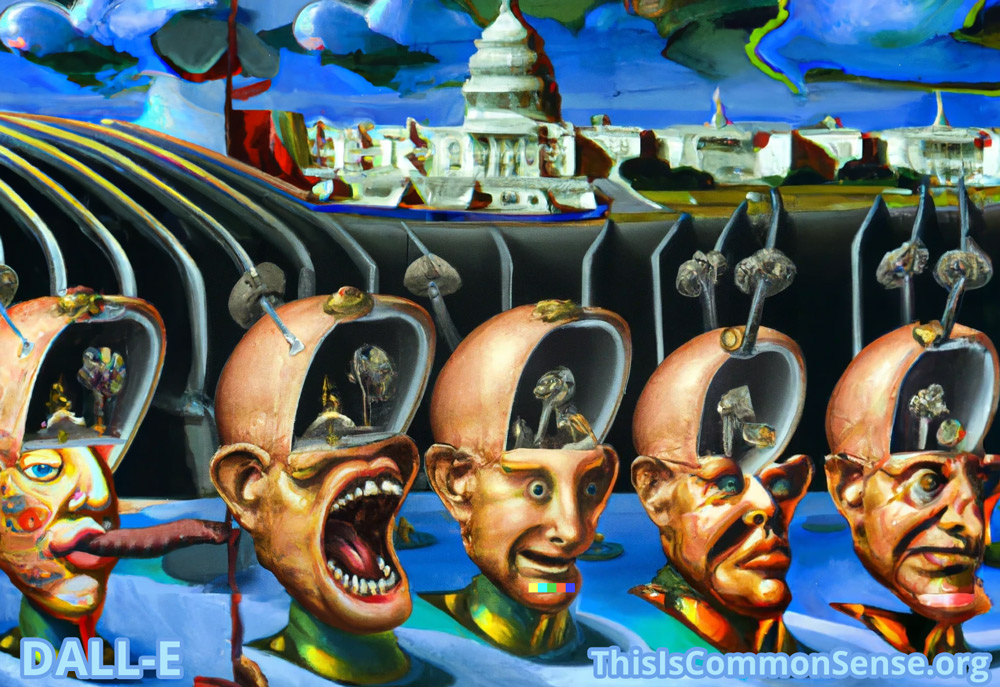
We can argue about the (in)justice of the accusation till the cows come home and go out to pasture again, but it’s the Democrats who are pushing brain-​damaged leaders, not Republicans.

I’m not just referring to President Joseph Robinette Biden’s many out-​of-​mind moments. I’m also talking about Pennsylvania Lt. Gov. John Fetterman’s run for the U.S. Senate.

The man suffered a stroke last spring, and has mostly been hiding out in the proverbial Biden Basement ever since. But on Tuesday he appeared on stage to debate his Republican opponent Dr. Mehmet Oz

Fetterman’s mental impairment? Obvious.

He began with the immortal clumsiness of “Good Night” rather than “Good Evening,” and stumbled through question after question. His handling of the minimum wage issue was slow-​witted, and his awkward and robotic — and so obviously deceptive — repetitions regarding fracking sent shivers down my spine.

It’s not my purpose to make fun of people with brain injuries. But it is my role to call attention to the apologetics by Democrats (and the center-​left/​far-​left news media) for their candidate, and their pretense that Fetterman’s just fine. 

He isn’t. Biden isn’t. 

And this says something about where Democrats are — intellectually; spiritually.

Very not fine.

This is Common Sense. I’m Paul Jacob.

US Capitol Building, brain damage

On Rumble: 


PDF for printing

Illustrations created with DALL‑E

See all recent commentary
(simplified and organized)
See recent popular posts

Categories
judiciary national politics & policies

Constitutionalize the Court

“To undo the damage Republicans did by stealing multiple Supreme Court seats,” argues Demand Justice, “we should immediately add seats to the Supreme Court and appoint justices who will restore balance.”

“Stealing”? That’s hyperbolic, to say the least. The Senate used its constitutional prerogative by refusing to approve President Obama’s nomination of Merrick Garland in 2016 and four years later by swiftly voting to confirm Justice Amy Coney Barrett.

The group’s proposal? Add four new justices. 

Facing a 3 to 6 justice deficit (Dem-​nominated vs. GOP-​nominated), many Democrats and groups like this one have settled on adding four.

For “balance.” 

Which means, to them, going from the minority to the majority.

And you thought Democrats weren’t good at math!

Last week, President Biden announced a commission to look into this “court packing” notion, as well as other possible changes to the High Court, including term limits. 

“My colleagues and I need not wait for the findings of a commission,” offered Rep. Mondaire Jones (D‑N.Y.). It is “obvious,” he added, “we must expand the Supreme Court, before it’s too late.”

That is, before the next election or a resignation or tragic death of a single D‑Senator might flip the Senate to Republican control. 

“Adding seats is straight-​forward and easy,” reminds Demand Justice, correctly explaining that the Constitution specifies no number, “so Congress can change it at any time.”

Yes, even with the slimmest of congressional majorities Democrats could completely re-​make the High Court. Without a single Republican vote. 

A partisan takeover of the Supreme Court is way too “easy” — until we place the number of justices firmly in the Constitution, away from poisonous partisan politicians. 

It’s the most urgent reform of all.

This is Common Sense. I’m Paul Jacob.


PDF for printing

See all recent commentary
(simplified and organized)
See recent popular posts

Categories
national politics & policies partisanship

Our Rules or Theirs?

Last Thursday, President Biden signaled “that he would be willing to consider supporting the elimination of the filibuster,” CBS News reported following his first news conference, “if Senate Republicans use it to block Democratic legislative priorities from receiving a full vote on the Senate floor.”

“If”? Stopping the majority party from taking its legislation to a floor vote without a 60-​vote supermajority to end debate is what the filibuster does.  

The president, a Democrat, is saying the filibuster is OK … as long as Republicans don’t use it.

You will of course not be shocked to learn that Biden has been a longtime, adamant supporter of the filibuster. In 2005, he gave an impassioned defense, arguing, “At its core, the filibuster is not about stopping a nominee or a bill — it’s about compromise and moderation.”

Biden called the GOP attack then a “fundamental power grab” and said his oration “may be one of the most important speeches for historical purposes that I will have given in the 32 years since I have been in the Senate.”

Yet, the filibuster is not in the Constitution. 

It is simply a Senate rule. And the majority party in the Senate can thereby fiddle with it. 

I’m not so much wed to the filibuster as I am wed to the idea that the rules with which Washington insiders wield power serve us and not just themselves. 

The filibuster should be made official in law or Constitution precisely so politicians cannot change it on whim or passion. 

Or it should be ended. But not before one party (or both) actually campaigns to end it, so that the American people can weigh in. Because these must be our rules if it is to be our government. 

This is Common Sense. I’m Paul Jacob.


PDF for printing

See all recent commentary
(simplified and organized)
See recent popular posts
Categories
national politics & policies paternalism

Georgia on My Mind

Georgia, oh Georgia
No, no, no, no, no peace I find …

So opens James Brown’s famous song — also an iconic hit for Ray Charles.*

As the rest of the country quiets down, post-​election, that crooned-​about lack of peace continues to echo in the Peach State as if in a deep, vast cavern. Two U.S. Senate seats now go to a January 5th runoff election, which will decide partisan control of Congress’s upper chamber.

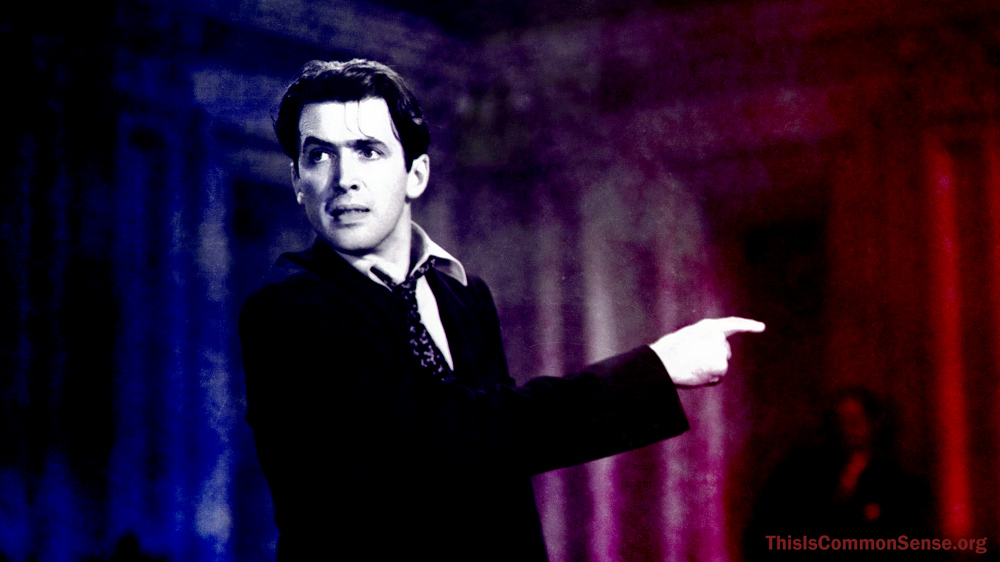
Democrats control the House and — barring some Hail Mary effort likely to require Mary’s own participation — they will take the White House as well. In the Senate, Republicans currently hold a 50 – 48 lead, but if Democrats win both of these razor-​close races in a state won narrowly by Democrat Biden, the Senate majority, too, will be theirs … by virtue of Vice-​President Kamala Harris’s tie-​breaking vote.

Whether held by Republicans or Democrats, unitary one-​party control of the federal leviathan could prove extraordinarily consequential … in a frightening sort of way.

“[T]he federal government works better when divided, not unified,” argues the Cato Institute’s Steve H. Hanke, citing divided government as less likely to go to war, more likely to pass sustainable reforms and noting that “federal spending tends to be lower with divided governments.”**

Other reasons include existential threats to our little experiment with citizen-​controlled government. 

Having threatened to completely abolish the Senate filibuster rule, Democrats with a slim majority could then pack the Supreme Court — adding new justices to gain a majority, using one election to nullify elections going back decades. And forever partisanizing and politicizing our independent judiciary. 

Just an old sweet song — and the future of America — Keeps Georgia on my mind.

This is Common Sense. I’m Paul Jacob.


*  We made a terrible mistake. Hoagy Carmichael is the author of “Georgia on My Mind,” not James Brown. Here is a version of the song performed by Carmichael. PJ

** For these reasons, to keep divided government, third-​place finishing Libertarian candidate Shane Hazel should endorse Republican David Perdue against Democrat Jon Osskoff. Hazel garnered 2.3 percent of the vote, while Perdue fell only 0.3% short of winning a majority and precluding the runoff.

PDF for printing

See all recent commentary
(simplified and organized)
See recent popular posts

Categories
national politics & policies

Of Bats and Debates

How batty is 2020’s politics?

Adding one absurdity upon another, a minor party candidate got attention this weekend for something even more bizarre than Biden’s bumbling or Trump’s trolling:

She got bit by a bat and is now undergoing painful treatment for rabies.

Her name is Jo Jorgensen, Libertarian Party presidential candidate. 

So far, reports on this development have focused on her Twitter account, where jokes abound. 

But what dominates her Twitter feed are the usual-​for-​Libertarians demands that she be included “in the debates.”

What debates?

Is anyone certain that there will be debates at all? Behind in the polls, Donald Trump seems eager to debate, but … Joe Biden?

Well, the Biden camp has agreed to three debates and the candidate says he is “so forward looking [sic] to have an opportunity to sit with the president, or stand with the president, in debates.” But Trump wants more.

And some Democrats want none, for in that same interview (which has gone more viral than rabies), as elsewhere, Biden made so many bizarre gaffes that most folks are beginning to assume that, against the Donald, Biden might wilt worse than a vampire in sunlight.

Biden, who will not even attend his own ostensible nominating convention, remains largely sequestered, under cover of panicky pandemic protocols. Unless the Democrats somehow replace him, the odds of there being debates at all seem low. 

And if Trump’s too much for Biden, what is a Libertarian to the two major parties? The Libertarians have been excluded for a reason.* Introduction of substantive, orthogonal-​to-​the-​duopoly ideas into a national debate might show the major parties for what they are: cognitively challenged.

What a year! Bats.

This is Common Sense. I’m Paul Jacob.


* Amusingly, Donald Trump called the exclusion of challenger parties “disgraceful” … back when he was in the Reform Party. I doubt he’d be on board the #LetHerSpeak campaign today — unless he was certain there would be no debates.

PDF for printing

See all recent commentary
(simplified and organized)
See recent popular posts
Categories
Accountability ballot access folly general freedom media and media people national politics & policies Regulating Protest too much government

The Two-​Product Economic System

What if our economy worked like our political system?

Only two major companies would provide any particular product for sale. But don’t worry — we’d still have a solid choice between “This Product Is Obnoxious” and “I Don’t Trust This Product.”

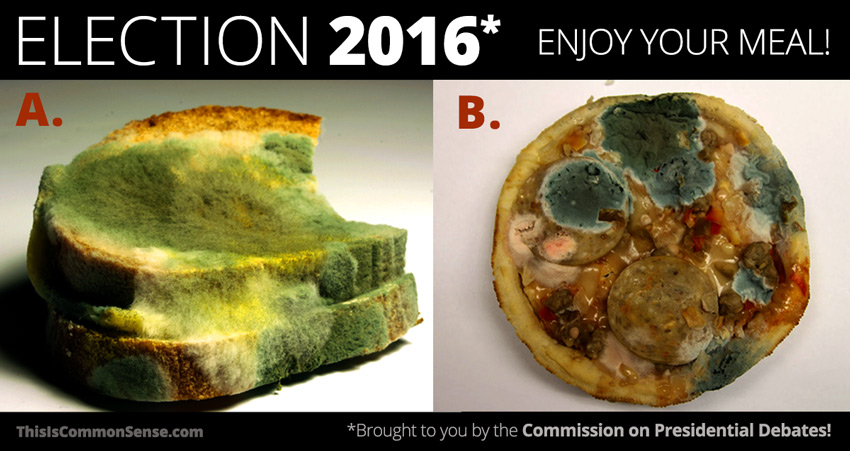
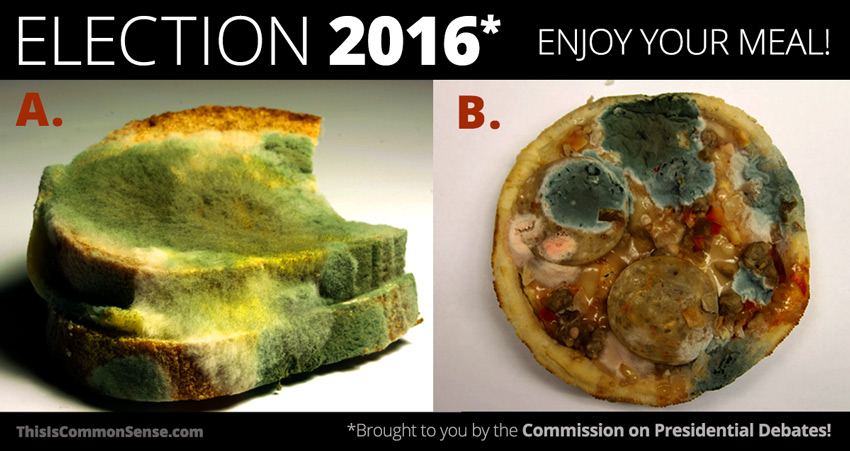
Those two companies would create a non-​profit entity — a Commission on Product Debates — empowered to determine the rules under which any upstart company could present its “third-​choice” product to consumers.

That Commission would prevent any third-​choice product from standing on the marketplace stage where consumers could compare it face-​to-​face with the two established choices … until it captured 15 percent of the market.

Last week, in real life, the Commission on Presidential Debates announced that its upcoming September 26th debate would feature only Republican Donald Trump and Democrat Hillary Clinton.

Neither Libertarian Gary Johnson, averaging 8.4 percent in the five commission-​approved polls, nor Dr. Jill Stein, the Green, at 3.2 percent, met the 15 percent threshold set by the Commission.

Forget that polls also show nearly two-​thirds of consumers — er, voters, want Johnson and Stein in the debates. You can’t win ’em all.

Or any at all … if you can’t take your product to market. And the presidential debates are an essential space in today’s political marketplace.

No third-​party or independent presidential candidate has been allowed on that debate stage since Ross Perot qualified in 1992, at the time polling at 8 percent — below Johnson’s current percentage.

That was before the Commission required a polling threshold. After those debates, one in five Americans voted for Perot on Election Day.

Duopolies do not serve us well. They cannot. That is not even their aim.

This is Common Sense. I’m Paul Jacob.


Printable PDF

election, duopoly, rotten choices, Hillary Clinton, Donald Trumpk