Categories
Common Sense folly free trade & free markets general freedom ideological culture media and media people moral hazard nannyism national politics & policies

Evil Capitalists Hook Brazil On Eating

Have you heard the latest?

More and more peoples around the world these days have the unfortunate misfortune of having adequate food — not merely vegetables either!! — thanks to the ruthlessly profit-seeking food producers and their unconscionable engagement in the division of labor, capital accumulation, and international trade.

It’s right there in The New York Times, which is, as you know, the paper of record.

“DealBook: How Big Business Got Brazil Hooked on Junk Food.”

Dastardly! Those Big American Businessmen must have kidnapped the Brazilians, strapped them into chairs, and pumped Doritos into those poor souls with a syringe. Heaven knows, the fecklessly irresponsible Brazilians can’t be held responsible for their own diets.

How bad is it?

This bad: “As growth slows in wealthy countries, Western food companies are aggressively expanding in developing nations, contributing to obesity and health problems.”

One expert quoted in the story (no hungry people consulted) says, “Part of the problem . . . is a natural tendency for people to overeat as they can afford more food.”

Worse than Hurricane Irma!

Thanks to the Times’s aggressive investigative journalism, we know that these brazenly food-selling companies do not even nag their international customers to be careful about their diets. Ergo, it’s chips and other indiscriminately convenient snacks for everybody, no strings attached.

It’s become all too easy to be well-fed and overfed and mis-fed.

Thanks a lot, capitalism.

Oh for the good old hunting-and-gathering days when human beings spent much of their time starving, and the world had the human population of Binghamton. No problem with anyone gorging on Twinkies and Doritos back then. No problem of epidemics of corpulence.

We’ve lost that swell paradise . . . perhaps forever.

This is Common Sense. I’m Paul Jacob.

PDF for printing


Illustration based on original photo by David Goehring on Flickr.
 

Categories
free trade & free markets general freedom media and media people moral hazard nannyism property rights too much government

Of Salt and Socialism

Nearly 75 percent of Venezuelans have lost 19 pounds or more in 2016. “People have become so desperate,” the Miami Herald reported recently, “that they are butchering and eating flamingos.”

While acknowledging the problem, TeleSUR, a television network based in Venezuela and funded by governments including Cuba, Ecuador, Nicaragua, and Venezuela, called the Herald’s story “kooky” and suggested taking reports “like alleged flamingo eating with a grain of salt.”

If, in socialist Venezuela, one could find a grain of salt.

In America, salt is necessary, too, when listening to our socialist Hollywood celebs blather about their kooky diets, for which some are blaming President Trump.*

Socialism kills. The deprivations in Venezuela are no joke, for along with economic chaos, Venezuelans are experiencing political repression on a grand scale. A new report from Luis Almagro, secretary general of the Organization of American States (OAS), documents the thousands arrested for protesting or “having posted something against the national government or a public official on Twitter.” The report details the “curtailment of civil, political and electoral freedoms” and “torture” and “censorship.”

Almagro calls for the suspension of Venezuela’s membership in the OAS, which is long overdue. The Human Rights Foundation demanded that nine years ago.

The Obama administration opposed such a move, as the Washington Post editorialized, in order to pursue “a legacy-making détente” with “the Castro regime in Cuba.”

At Townhall,** I urged Trump to support the effort to boot Venezuela out of the OAS, which might provide some assistance toward political change there . . . and Venezuelans eating more.

And perhaps to socialists in Hollywood and elsewhere eating crow . . . but not flamingo.

This is Common Sense. I’m Paul Jacob.


* I covered this last week, when I compared their Trump Diet nonsense to the “Maduro Diet,” named for Venezuelan President Nicolás Maduro, the socialist dictator presiding over the complete economic collapse of what, prior to socialism, had been South America’s richest country.

** From which this Common Sense is adapted.


Printable PDF


Categories
Common Sense folly free trade & free markets general freedom ideological culture meme national politics & policies

Funny how that happened…

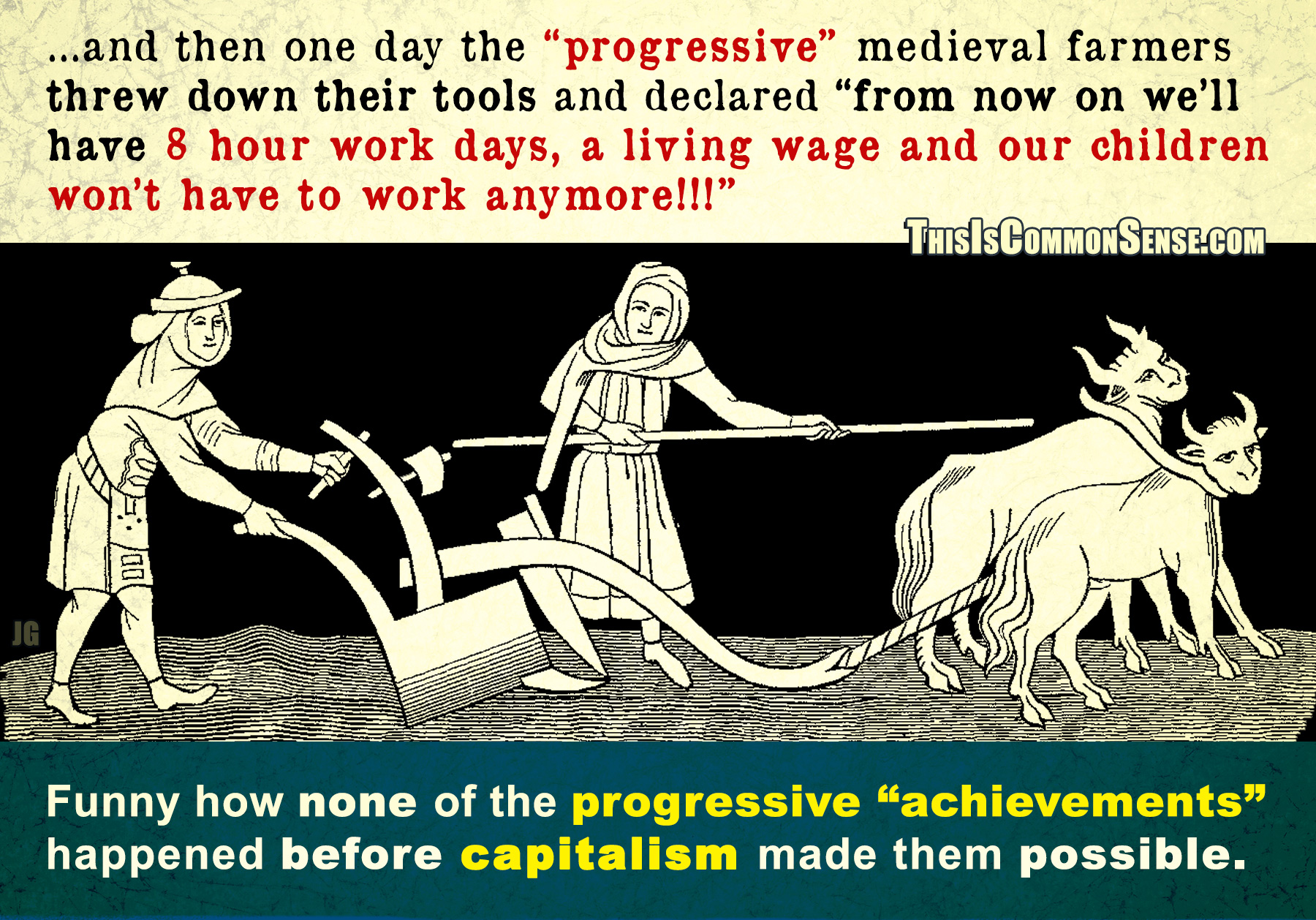
Funny how none of the progressive “achievements”happened before capitalism made them possible.


Click below for high resolution version of the image:

capitalism, progressivism, progressive, politics, child labor, 8 hour work day, living wage, achievements, accomplishment, meme, illustration


Categories
folly free trade & free markets general freedom ideological culture national politics & policies

Guilt and Association?

A few days ago, the Barna Group released the results of its latest poll, asking “Americans whether capitalism or socialism align better with the teachings of Jesus,” explains The Hollywood Reporter. The results are that “socialism won 24 percent compared to 14 percent, with the rest answering ‘neither’ or ‘not sure.’”

And what about the year’s big race?

“When asked which presidential candidate’s policies aligned closest to the teachings of Jesus, Sanders was on top with 21 percent, compared to 9 percent for Hillary Clinton and 6 percent for Donald Trump.” Ted Cruz, no longer in the race, fared better than Hillary, but below Bernie, at 11 percent.

Now, it is worth mentioning that more significant polling on issues relating religion to politics has been done by Barna. Still, the commentary over at Fox on this poll was . . . interesting.

On Bill O’Reilly’s show, Monica Crowley made the crucial distinction between Jesus’ command to give to the poor and modern socialists’ demands to take from some, through taxation and by force, to give to others.

O’Reilly himself, however, went on a bizarre and joking riff about “buying his way to heaven” by leaving his wealth to charity . . . after he dies.

Looking over these poll numbers, I can only conclude that advocates of a free society have much work to do convincing Americans of the justice and benevolence of free markets, of “capitalism.”

And Christians have their work cut out for them, too . . . at the very least to disencumber themselves from the stench of socialist states and the brutal force those states inevitably rest upon.

This is Common Sense. I’m Paul Jacob.


Printable PDF

Christianity, socialism, capitalism, Christ, poll, illustration


Categories
insider corruption political challengers too much government

Protesting “Capitalism”?

While Americans appear mildly unsettled or perhaps “ticked off” about recent government revelations, elsewhere in the world citizens move from “unease” to “unrest” and outright “protest.”

The protests that erupted first in Turkey and now in Brazil and elsewhere are filled with the ranks of the young, not a few of whom have noticed something: They are getting a raw deal.

Many of their issues are meat-and-potatoes: lack of jobs, burdensome student debts and, in Brazil, a bus fare rate increase made ugly in the context of cost overruns in taxpayer support for the World Cup and Olympics.

The young Turks protested, at first modestly, over planning for a park, but a harsh police crackdown led to more widespread marches, sit-ins, and demonstrations — which now often bring up questions of the current administration’s repressive anti-modernist, anti-freedom agenda.

This more heroic theme resonates elsewhere, too.

In Bulgaria the issue most protested appears to be police brutality and the general spirit of repression. In Latin America, opposition to corruption has moved from old stand-by to vital question of the day.

The saddest statement I heard was this appraisal, hailing from the BBC, of the general climate: “today capitalism is becoming identified with the rule of unaccountable elites, lack of effective democratic accountability, and repressive policing.”

Well, that’s not laissez faire capitalism that’s failed, but crony capitalism. Laissez faire’s truly free markets require a rule of law, the suppression of government corruption, and effective public accountability.

But that’s not what’s dominant. America itself serves, today, not as a beacon of liberty but of institutional control, of crony capitalism.

We need to protest that here, again, in the U.S.

This is Common Sense. I’m Paul Jacob.

Categories
video

Video: Whole Foods Branded Capitalism?

Food for thought, capitalism for food . . . and everything:

Categories
free trade & free markets

Inventing Objections

The Times published a wispy report on how Samsung has announced not that they are about to release a “smart watch” — a watch with computer functions — but only that they are working on one. Presumably, Samsung hopes to preclude the notion that the company is simply copying Apple, which is rumored to be developing a smart watch.

One reader — call him Mr. X — claims to be “saddened” by this evidence of market rivalry. He feels it’s “sad to witness” both Samsung’s alleged copying of Apple (or of other companies already making smart watches) and Apple’s forthcoming attempt to “force” smart watches on us.

Perhaps unbeknownst to himself, X’s lament implies that the whole market process is a continuous tragedy, only occasionally interrupted when sweeping novelty comes along.

Not so.

How often is a major new product category invented, after all? Farmers sell wheat—must they offer a new strain of wheat for their efforts to be valuable? What about napkin manufacturers? Car makers? Computer makers? Should we shed tears when anybody competes with anybody else in the same decades-old or centuries-old product category?

Inventions are great. But not everything on the shelf must be a brand-new kind of product to be well made and worth getting. Incremental improvements matter too. If companies took X’s complaint seriously, their ability to provide goods and services would be thwarted.

What we want from the “competition” is usually not “the new” but the slightly better, or the substantially less expensive.

Capitalism owes its essence to copycats as well as innovators.

This is Common Sense. I’m Paul Jacob.

Categories
free trade & free markets

Walmart to the Rescue!

Walmart is still taking kicks, especially in New York City. But as local politicians, union activists, and business bigots (people who develop hatreds for other people’s wage and consumer choices) continue to harass the company, it’s worth taking a step back and appreciating what it does right.

Indeed, it is so successful that it’s worth exporting. Or so suggests economist Tyler Cowen in an interesting interview on the Arabic Knowledge@Wharton website, where he says that companies like Walmart are exactly what the “poor people of Africa” need. Why? These big corporations make food

more accessible and more reliable. It’s not just the pricing at any one point and time. It’s what happens in the very worst periods. Companies like Walmart are very, very good at keeping up supply and being regular.


Anti-Walmarters in first-world countries tend to forget how bad everyday life is in poor countries, except when they are trying to find ways to increase foreign aid or pitch a Live Aid concert. They take for granted not only our vast markets, but the Industrial Revolution and our several agricultural revolutions.

And there’s the rub, for the Third World. The “Green Revolution” that staved off mass starvation in the 1970s, ’80s, and ’90s, has “somewhat slowed down,” says Cowen.

This is an unreported story. Crop yields are stagnant. It isn’t a problem we can solve overnight but it’s really one of the biggest problems in the world. It hardly gets any publicity. But for poor people in India, the Middle East and parts of Africa, it really matters.

So Walmart could really help.

But then, so would an end to Third World kleptocracy and its replacement by a rule of law.

This is Common Sense. I’m Paul Jacob.

Categories
free trade & free markets video

Video: Crony Capitalism

Not all capitalisms are created equal:

I prefer the term “free market” to the word “capitalism” because it emphasizes a system that is “free” rather than one feature of it, capital. Capital is a critical aspect of every economic system. But freedom is something we can add to our current mess to bring not only more wealth, but a more feasible order. And sense of justice.

Kudos to Annette Meeks at the Freedom Foundation of Minnesota for highlighting crony capitalism.

Categories
free trade & free markets

How They Did It

For 70 days, 33 Chilean miners were trapped a half mile below the surface of the earth —  “swallowed into the bowels of hell,” as one miner says — waiting for rescue. A billion viewers watched as they finally began to emerge to safety.

A fierce determination at both ends of the slowly constructed shaft aided the rescue. The miners had to outlast the first few weeks of despair, when they had scant information about the rescue mission. Throughout the ordeal they maintained the mine and their own morale. The rescuers had to figure out how to first get supplies to the miners and then create the narrow but stable shaft through which the miners could escape, as all 33 of them did.

A less-noted aspect of the story is that the rescue could not have happened without technology that did not exist even a quarter century ago. This included everything from the powerful drill bit donated by Center Rock Inc., a Pennsylvania company, to copper-fiber socks that consumed foot bacteria. But especially that drill bit.

Wall Street Journal columnist Daniel Henninger observes that Center Rock’s drill bit exists because of the firm’s pursuit of profit in an economy where pursuit of profit is possible. It exists because of what Henninger calls the “profit=innovation” dynamic. Indeed, capitalism saves lives every day; markets make our lives better and sometimes makes our lives possible.

You don’t have to mine very hard to get a moral out of the story.

This is Common Sense. I’m Paul Jacob.