Categories
crime and punishment Regulating Protest

Force Over Reason

L.A. is in flames again, with rioting, looting, attacks on police (with “commercial grade fireworks”) and against the much-​despised ICE agents. At issue, they tell us, are the horrible things ICE does to illegal entrants into the United States — kidnap them, say; or deport them, as the government puts it — and this requires.…

Well, what does it require in response? Open battles with the feds? 

As in the 2020 BLM riots, rioters are attacking federal buildings, with attempts at violent entry.

This is no way to persuade Americans of much of anything — other than that force triumphs over reason. 

So little wonder that the U.S. president chose to meet force with force by sending in the National Guard. Trump’s explanation on Truth Social qualifies as Classic Trump (not New Trump): “If Governor Gavin Newscum, of California, and Mayor Karen Bass, of Los Angeles, can’t do their jobs, which everyone knows they can’t, then the Federal Government will step in and solve the problem, RIOTS & LOOTERS, the way it should be solved!!!”

Federalizing the Guard will be fought in court — like everything else — but it appears to be yet another case in which folks argue that President Trump does not have the lawful authority … only come to find out that Congress does constitutionally enjoy said power but unaccountably legislated it away to the president. 

Rita Panahi of Sky News Australia covered the mayhem in her “Lefties Losing It” segment. “And while the Mexican flag was proudly flying throughout these protests, the American flag was nowhere to be seen,” Ms. Panahi observed, “unless it was being set alight.” 

Protesters waving the flag of the foreign state they’ve fled?!?!? 

That’s not Common Sense. I’m Paul Jacob.


PDF for printing

Illustration created with Krea and Firefly

See all recent commentary
(simplified and organized)

See recent popular posts
Categories
Accountability ballot access folly general freedom ideological culture initiative, referendum, and recall media and media people national politics & policies political challengers responsibility U.S. Constitution

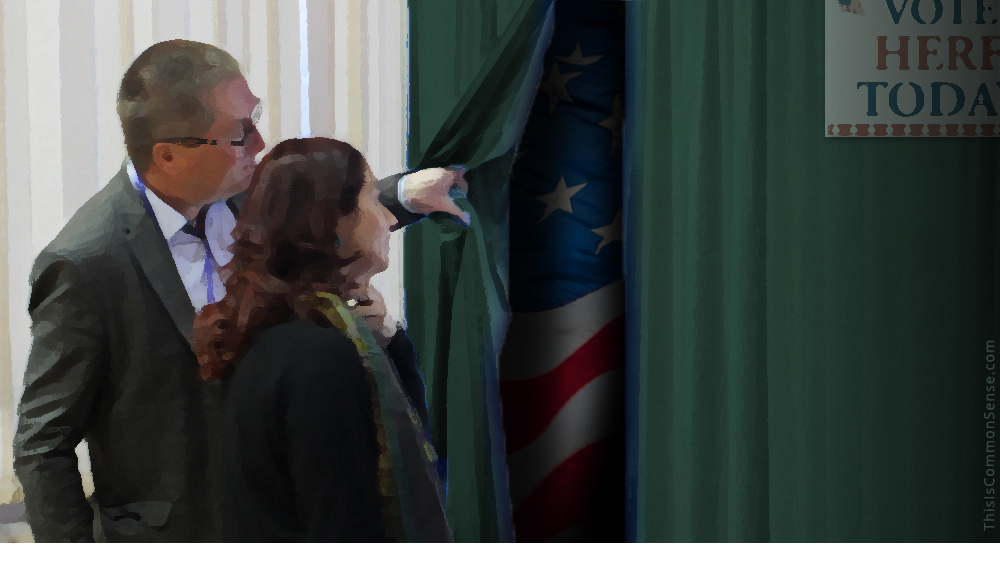
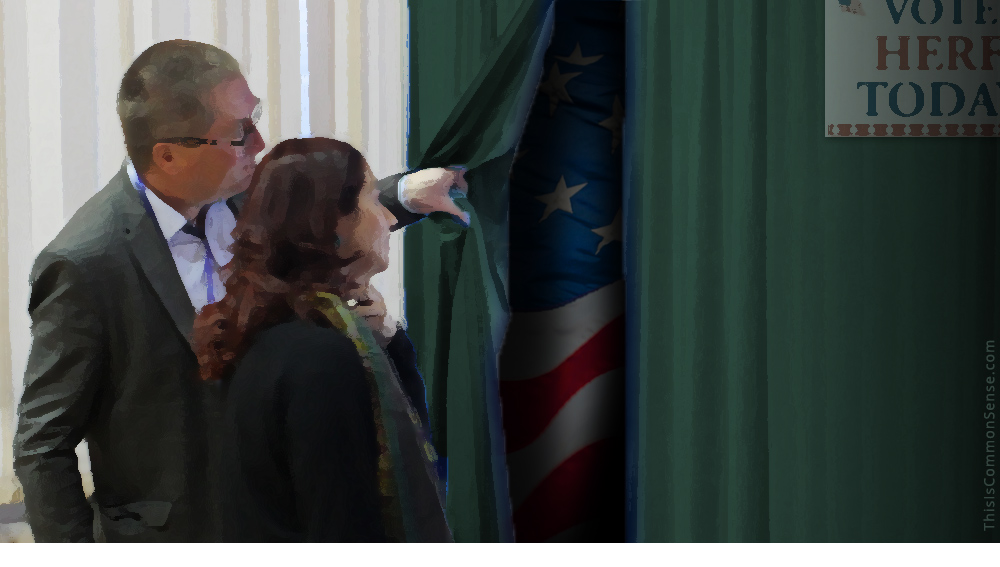
Should Non-​Citizens Vote?

“A lot of people would like to say this is an immigration issue. It’s really not,” offered Gary Emineth, the head of North Dakotans for Citizen Voting and a candidate for state senator. 

“It’s really about preserving the right for U.S. citizens, and in our case, North Dakota residents, to only be the voters in all elections across the state of North Dakota,” added Emineth. “And that’s why we want it in the constitution.”

Turning in more than 35,000 voter signatures on petitions last Friday, Emineth and others placed a constitutional amendment on this November’s ballot that, if passed, would make voting the exclusive right of U.S. citizens in North Dakota.

Elsewhere in the country, Emineth points out, non-​citizens are already voting — in Chicago and San Francisco, and in 11 cities across Maryland. Moreover, campaigns are underway across the country to give non-​citizens the vote — in California, Connecticut, New York City, Boston and Montpelier, Vermont.

Opponents claim the North Dakota measure is completely unnecessary, as the state doesn’t currently allow non-​citizens to cast a ballot, nor has any city yet attempted to allow non-​citizens to vote. But Emineth’s goal is to keep it that way.

Moreover, University of North Dakota Law Professor Steven Morrison acknowledged to The Forum in Fargo that “the proposed amendment does clean up what could be a grammatical loophole since the word ‘every’ doesn’t conclusively exclude non-​citizens from voting.…”

It is a very simple proposition: Do you want voting to be the exclusive right of U.S. citizens? Or should non-​citizens be allowed to vote?

Coming to a ballot near and Fargo.*

This is Common Sense. I’m Paul Jacob.


* With some help from Liberty Initiative Fund.


PDF for printing


Categories
Accountability folly general freedom ideological culture media and media people moral hazard responsibility

Too Big for Breaches

“Any reporter who has covered Europe in the last decade has written a dozen articles or more,” The New York Times informs us, “about how one crisis or another has exposed the fundamental unsustainability of the European Union.”

I hadn’t noticed. Until recently, haven’t reporters and commentators been downplaying Europe’s looming crisis? But they cannot pretend “far right” separatist, decentralist and nationalist movements are marginal any longer, not after strong showings for Geert Wilders in The Netherlands and Marine Le Pen in France, and the Brexit vote. 

Now everybody seems to be panicking. 

Even the Times is half-​predicting an end to what it calls the “European Experiment.”

The Times identifies the tension as arising from “calls for keeping out secondary migrants and demands to keep internal European borders open. It’s a version of the contradiction within the European Union itself: between an open union and a collection of sovereign states.”

Beneath all the brouhaha about freedom of movement across breached borders lies the real contradiction: between massive welfare states on the one hand and, on the other, freedom of movement, speech and all the rest.*

When governments offer freebies, they entice people into un-​productive or at least sub-​productive lifestyles. Which is not sustainable, especially when extensive. How many productive people must support how many unproductive people?

Then throw those domestic programs open to millions of migrants who lack even rudimentary language and First World skills? That’s how states subsidize their societies’ destruction.

Europe’s governments are way too big for their border breaches.

If you want traditional freedoms, you have to pare down government.

This is Common Sense. I’m Paul Jacob.


*Between social democracy (socialism lite) and the old liberal order.


PDF for printing


Categories
folly free trade & free markets meme moral hazard national politics & policies

Trump’s Dangerous Idea

A lot of people were impressed by the reasonableness of Donald Trump’s foreign policy speech yesterday … despite the usual hyperbolic promises of “best” and “great” and “beautifully.”

Its general tenor? Refreshing. Rejecting post-​Cold War foreign policy for a return to “national interest” and “America first”? Long overdue. Like Trump, I think we should eschew nation building.

But still there is that one big problem: Trump is a mercantilist. He believes in protectionism. He thinks that trade has to be “fair” in order to benefit both participants. He thinks NAFTA and similar trade agreements (which generally promoted trade while still reserving a lot of room for government futzing about) are what hurt American industry. Trump is always blaming the “bad deals” made with Mexico and China, rather than placing the blame where it squarely belongs, on

  • America’s world-​high corporate income tax, and
  • chaos of regulatory excess, and
  • impenetrable tax code.

But protectionism makes sense to a lot of people. They are incredulous when they hear the (well-​established) idea that free trade — even unilateral free trade — is a benefit to the people who live under it.

Surely, they snort, when you target aid or protection to some industries, you are doing good, right?

Wrong. Oh, yeah, of course protectionism protects the chosen few, the advantaged. That’s what it obviously does. But it doesn’t protect the general interest – consumers pay more and producers allocate resources to less valued uses.

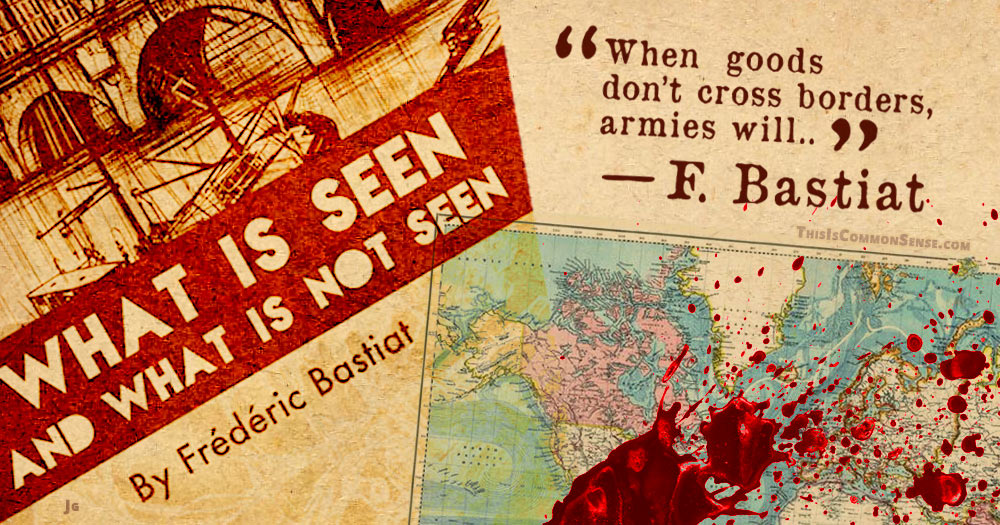
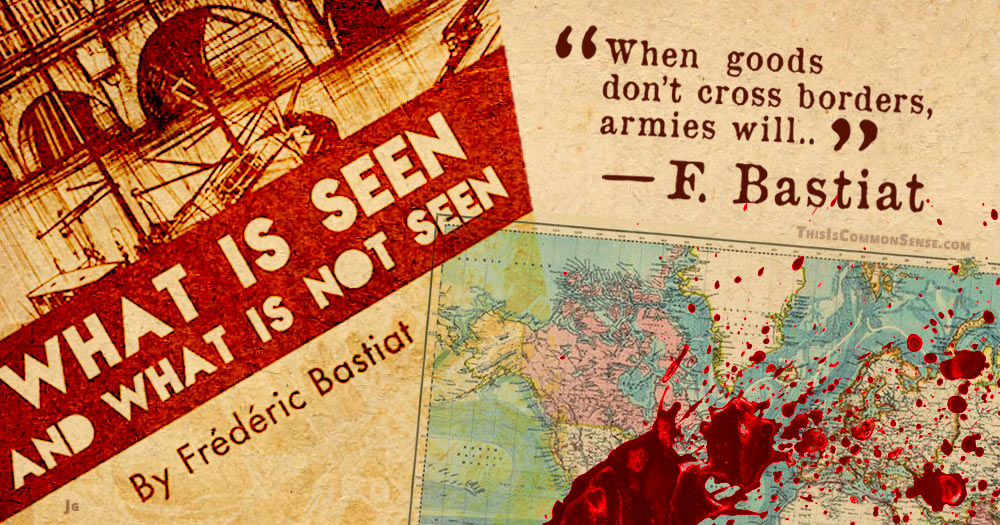
You have to look beyond the obvious (“the seen”) to get the full picture (“the unseen”).

Trump’s at his most dangerous right here — forget his loose talk — by continuing to pretend that protectionism helps America.

We cannot afford another Smoot-​Hawley.

This is Common Sense. I’m Paul Jacob.


Printable PDF

Donald Trump, trade, protectionism, Donald Trump, war, borders, Bastiat


Common Sense Needs Your Help!

Also, please consider showing your appreciation by dropping something in our tip jar  (this link will take you to the Citizens in Charge donation page… and your contribution will go to the support of the Common Sense website). Maintaining this site takes time and money.

Your help in spreading the message of common sense and liberty is very much appreciated!


Categories
media and media people national politics & policies

Border Problems, Solutions?

Bill Maher began the panel segment of his latest Real Time with Bill Maher episode taking on the “children at the border” problem. He identified the underlying cause: drug cartels.

His solution? Legalize all psychoactive drugs, particularly cocaine.

Wait a minute. The best response to a border crisis is to legalize drugs?

Seems orthogonal to the issue. “Out of left field.”

Which is not to say I don’t support legalizing drugs. But I try not to bring it up every discussion. Could Maher have drugs a tad too much on his brain?

Be that as it may or may not, for the facts I then turned to … Cato Institute.

Only to have the good folks at Cato back up Maher’s assertions.

On July 8, Ted Galen Carpenter, a Cato senior fellow, pinpointed the growth in drug cartels’ power in Central America as central to the whole issue. The drug cartels are “driving vulnerable populations northward to the United States to enhance their own profits.”

But the whole picture is more complicated.

A month earlier, Alex Nowrasteh, Cato’s immigration policy analyst, focused on two American border policies that “likely” and “unintentionally” incentivized “some of the migration and the smugglers that carry many of the migrants,” leading to the current debacle of thousands of unaccompanied minors now being housed — in poor conditions — in detainee centers.

True to form, Nowrasteh notes that “some American politicians who blame American law for the surge actually voted for that American law in the past.”

Which is more horrifying: The idea that politicians make things worse? Or that comedians make more sense than our elected representatives?

This is Common Sense. I’m Paul Jacob.