Categories
First Amendment rights general freedom ideological culture

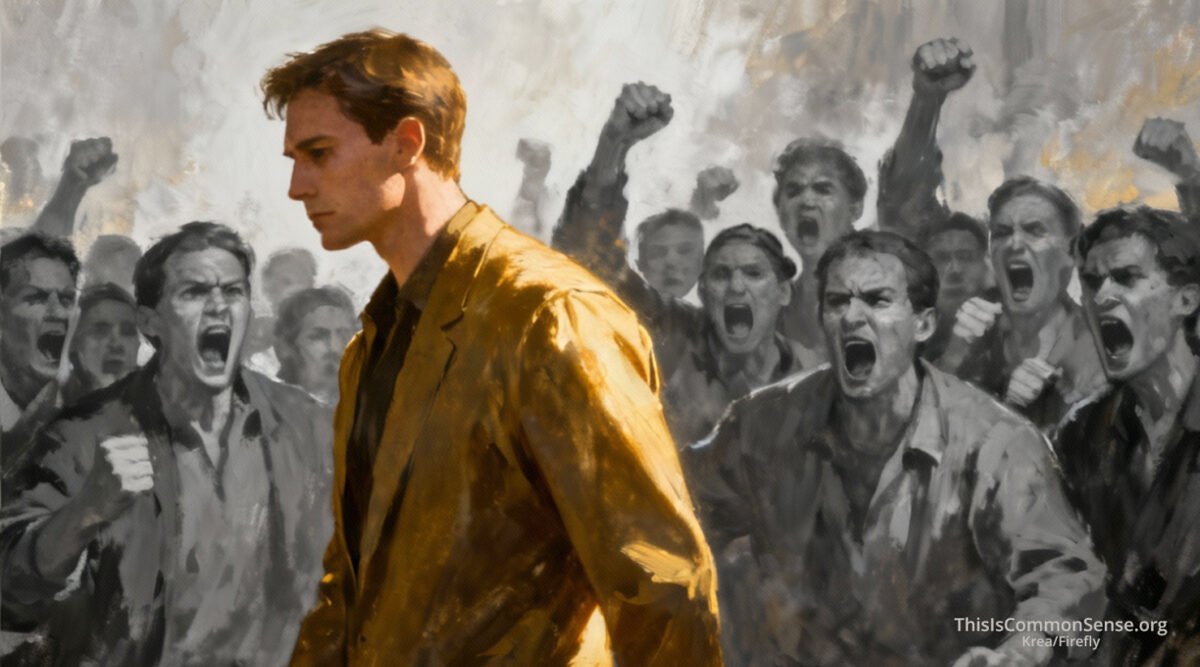
Two Ways of Walking Away

“The First Amendment prohibits the government from restricting free speech,” explained Michael J. Reitz in The Detroit News. But what about individuals and non-​government groups? 

“Free speech doesn’t compel you to listen. You can walk away,” Mr. Reitz goes on to say.

In the piece, reprinted by the Mackinac Center for Public Policy, Reitz wonders, however, whether this “agree to disagree” attitude is enough to keep free speech alive. He believes that “as a society, we show our commitment to free speech through our willingness to listen, discuss and debate. It’s not consistent to say I value another person’s right to speak if I refuse to engage.”

A liberal attitude — in a social, perhaps non-​political sense — is what Reitz advises: tolerant of differences; not prone to anger at hearing an opposing view; engaging logically and fairly with differing opinions; but free to take it or leave it without fearing recrimination, retribution or retaliation.

This right to walk away may define free speech, but Reitz argues that we mustn’t all walk to our bubbles in anger.

An old saw, recently popularized, insists that “we have freedom of speech, but we don’t have freedom from the consequences of speech.” In a free society, you may say what you like on your property, on your dime, but some people may shun you. Or fire you. And that’s OK.

What’s not an acceptable “consequence” of freedom of speech? Being silenced by the government, or the mob, either with petty violence or maximum force. Too many people use the “no freedom from consequences” cliché as an excuse to harass people at their work. Or bank. This is where it gets difficult. 

Since one neither has a right to a specific job nor to force a bank to accept one’s money on account, purely social pressure to de-​bank, de-​platform, or get someone fired, fits in a free society. But is Reitz correct that, legality aside, when such social pressure is common, and one-​sided, free speech is doomed?

Perhaps society is doomed, in multi-​lateral wars of us vs. them. 

This is Common Sense. I’m Paul Jacob.


PDF for printing

Illustration created with Midjourney and Firefly

See all recent commentary
(simplified and organized)

See recent popular posts
Categories
education and schooling First Amendment rights

XX Marks the Offense

Educators, used to tyrannizing the young, are too often tempted to turn their powerlust to their charges’ parents. Yesterday, I discussed Michigan educators keeping their curriculum secret from members of their community. Today we turn to the way officials at Bow High School in New Hampshire have treated Kyle Fellers, Anthony Foote, Nicole Foote, and Eldon Rash. 

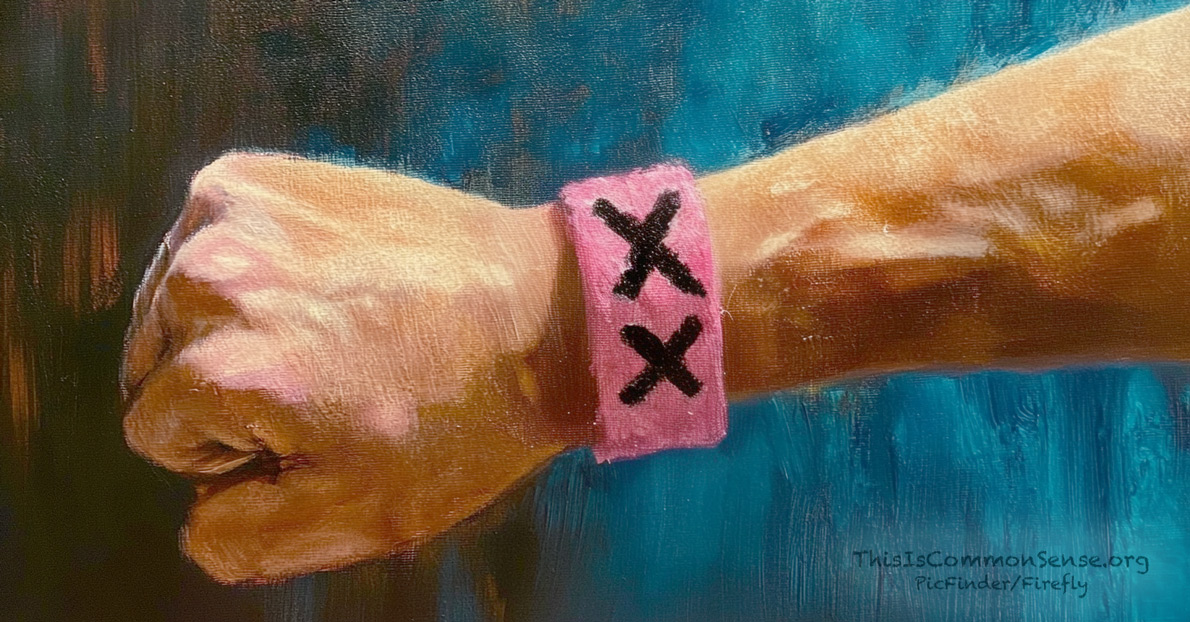
These parents and a grandparent attended a girls’ soccer game while non-​disruptively wearing wristbands labeled XX to protest a policy allowing a boy to play on the opposing team. The “XX” refers to the sex chromosomes of females.

Because Fellers, Foote, Foote, and Rash wore the wrong apparel, school officials and a police officer told them to remove the wristbands or leave. When they refused, the school scolders threatened them with arrest for “trespassing.”

For attending a game where their kids were playing?

The school later banned two of the wristband-​wearers from school grounds and events, among other things making it harder for them to pick up their kids after a game.

“The idea that I would be censored and threatened with removal from a public event for standing by my convictions is not just a personal affront — it is an infringement of the very rights I swore to defend,” says Andy Foote, who has a long career in the Army under his belt.

Now, with the help of the Institute for Free Speech, the renegade wristband-​wearers are suing the school in hopes that it will, on First Amendment grounds, be enjoined from restricting “nondisruptive expression of political or social views at extracurricular events.…”

This is Common Sense. I’m Paul Jacob.


PDF for printing

Illustration created with Midjourney and Firefly

See all recent commentary
(simplified and organized)

See recent popular posts
Categories
First Amendment rights general freedom ideological culture

GOP, ACLU, and NRA Together Again

Occasionally, the stars align and adversaries become allies.

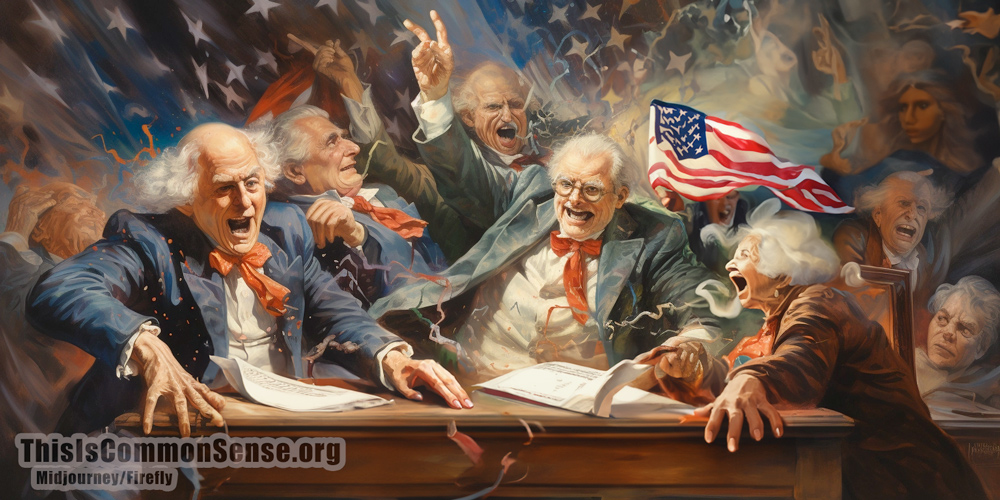
So it is that dozens of Republican congressmen have filed an amicus brief to support an NRA lawsuit against Maria Vullo, a former New York State regulator of the financial services industry. And so it is that the NRA will be represented before the Supreme Court by the American Civil Liberties Union.

After the 2018 Parkland shooting, Vullo pressured financial service companies to boycott organizations like the National Rifle Association that advocate Second Amendment rights.

The NRA sued, contending that Vullo had acted against their First Amendment rights. When the Supreme Court agreed to take their case, the NRA thought: who better to represent us before the justices than the ACLU?

The ACLU, which has not always been consistent in defending free speech, agreed.

Its national legal director, David Cole, says that “the ACLU has long stood for the proposition that we may disagree with what you say but will defend to the death your right to say it.”

Although this case is also about speech, more directly it is about using governmental force to try to stop people from conducting peaceful financial transactions.

If such intimidation of financial companies — or, what is being challenged in separate litigation, of social media companies — were allowed to stand, government would be fully unleashed to threaten market actors in order to prevent constitutionally protected actions and speech that officials dislike.

Our constitutional rights made meaningless.

This is Common Sense. I’m Paul Jacob.


PDF for printing

Illustration created with Midjourney and Firefly

See all recent commentary
(simplified and organized)

See recent popular posts
Categories
crime and punishment First Amendment rights Internet controversy

Court Invokes First Amendment

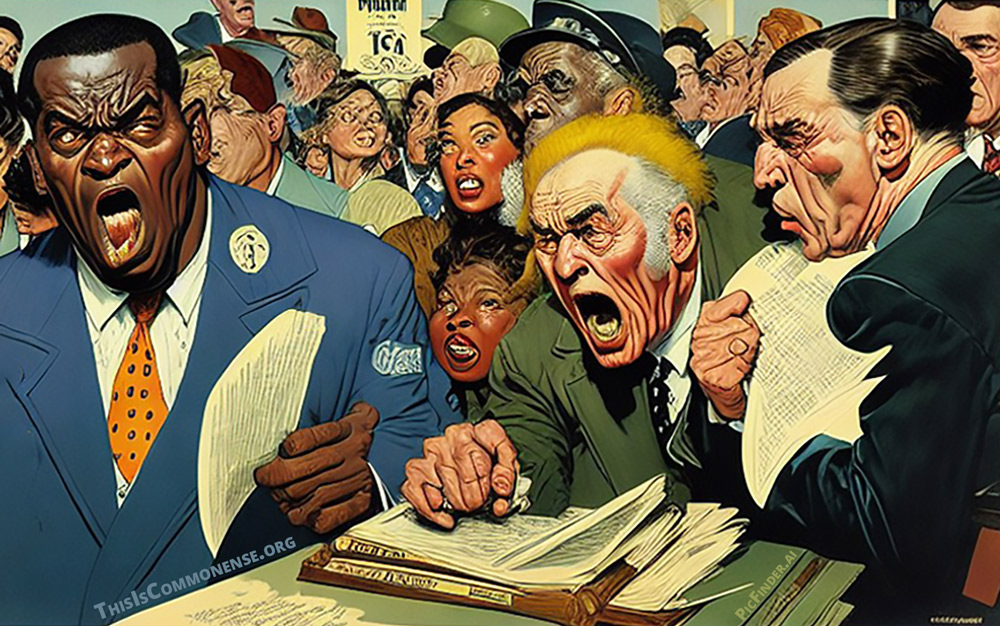
This is where we’re at. We must be in suspense about whether a judge will object when governments act to repress speech in the name of combatting “misinformation,” “disinformation,” or “hate speech.”

Fortunately, Judge Andrew Carter sees the obvious and has blocked a new New York State law to regulate “hateful” online speech. The law was challenged by anti-​censorship video platform Rumble and the Foundation for Individual Rights and Expression.

Carter says: “The First Amendment protects from state regulation speech that may be deemed ‘hateful,’ and generally disfavors regulation of speech based on its content unless it is narrowly tailored to serve a compelling governmental interest.”

The alleged “compelling governmental interest” exception is vague and not really consistent with the First Amendment. But the judge otherwise makes sense.

Laws like New York’s constitute a cart blanche for government to repress speech — any speech.

Any controversial words can be labeled hateful, misinformative, disinformative. People have been censored for asseverating that there are only two sexes, that the COVID-​19 injections aren’t really vaccines, that the U.S. shouldn’t send more than $100 bazillion to Ukraine, etc.

It’s hatefully misinformative disinformation to proclaim that debates about such questions are impermissible. But people in any case have a right to be wrong; others, the right to refute them.

When the truth is on your side, you have an advantage. But you can’t beam your understanding into the minds of others.

You must be free to speak.

This is Common Sense. I’m Paul Jacob.


PDF for printing

Illustration created with PicFinder​.ai

See all recent commentary
(simplified and organized)

See recent popular posts
Categories
crime and punishment First Amendment rights general freedom

The FBI Is Misinformed

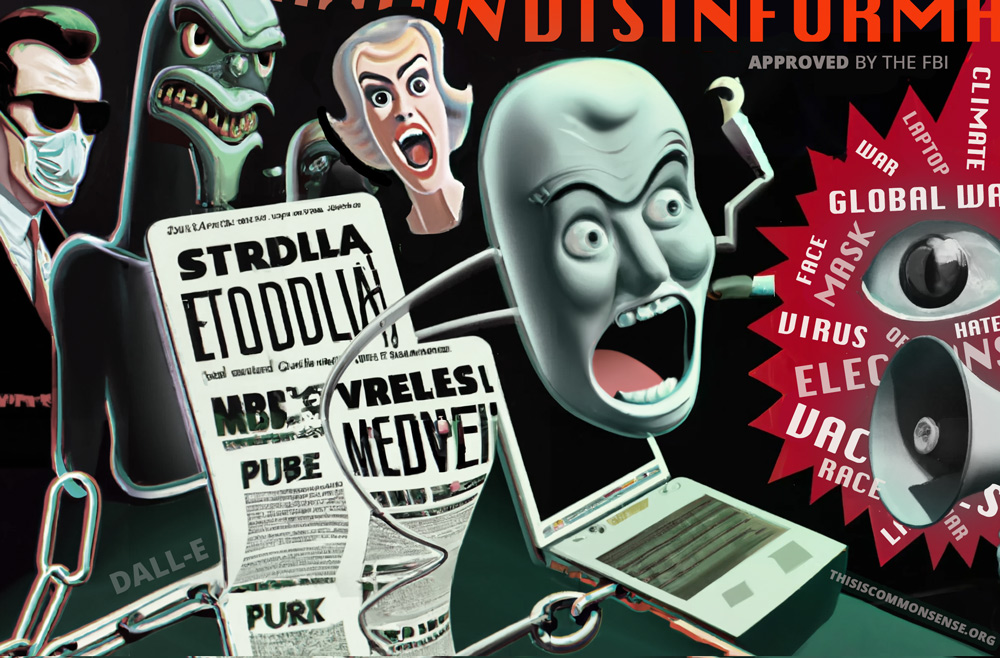
The FBI is misinformed if it thinks that prosecuting persons who misinform solely for misinforming is consistent with freedom of speech.

The utterance of false statements, whether unknowingly or willfully, is nothing new in human history. And such utterances are impossible to avoid in any kind of discourse — for example, political debates — in which people disagree with each other about facts as well as values.

Indeed, one often hears both true things and false things. We must evaluate claims as best we can, using observation, logic, common sense and so forth.

But, somehow, the FBI has decided that “misinformation” and “disinformation,” chronic in campaign ads, political pronouncements, and domestic quarrels, are a crime when communicated in the context of an election.

An FBI document leaked to Project Veritas wants to explain “What Are Election Crimes.” This document lumps misleading speech with such actual crimes as electoral fraud and intimidation of voters.

Robert Spencer has questions about this assumption for the FBI’s, ahem, Election Crimes Coordinator, Lindsay Capodilupo. For example, how does the FBI determine what is and is not misinformation? Will there be an appeals process given the fact that certain notorious so-​called “misinformation” — like the once-​upon-​a-​time contested claim that Hunter Biden’s laptop is indeed Hunter Biden’s laptop — has turned out to be true information?

And — most important — how can wrongspeak as such be classified as any kind of crime in light of the First Amendment?

Stay tuned for the FBI’s answers. But not with bated breath, okay?

This is Common Sense. I’m Paul Jacob.


PDF for printing

Illustration created with DALL‑E

See all recent commentary
(simplified and organized)

See recent popular posts
Categories
First Amendment rights national politics & policies

Public-​Private Censorship Partnership

When government pays people to help censor critics of its policies and talking points, this makes it even more obvious that it’s acting to repress speech and violate the First Amendment.

Thanks to a recent lawsuit against the Biden administration, we have been seeing emails confirming that government officials routinely ask Big Tech to censor this and that.

Now, Just the News reports that government agencies and liberal groups such as Common Cause and the Democratic National Committee worked with a consortium of private groups — the Election Integrity Partnership — during the 2020 election season to target and censor social media posts.

The EIP “set up a concierge-​like service in 2020 that allowed federal agencies like Homeland’s Cybersecurity Infrastructure Security Agency and State’s Global Engagement Center to file ‘tickets’ requesting that online story links and social media posts be censored or flagged by Big Tech.”

About 35 percent of the many posts EIP flagged in 2020 were sanctioned in some way by Big Tech.

Millions of tax dollars have been funneled to consortium members to fund these efforts to censor “misinformation,” i.e., speech that government officials disapprove of.

The EIP remains active in 2022.

Of course, politically controversial speech is just the kind of speech that the Founders were concerned to protect. Madison and Mason didn’t expect that the ability to publicly debate whether Bach is better than Beethoven or the best way to shingle a roof would ever be in great jeopardy.

This is Common Sense. I’m Paul Jacob.


PDF for printing

Illustration created with DALL‑E

See all recent commentary
(simplified and organized)

See recent popular posts