Categories
Thought

Gustave Le Bon

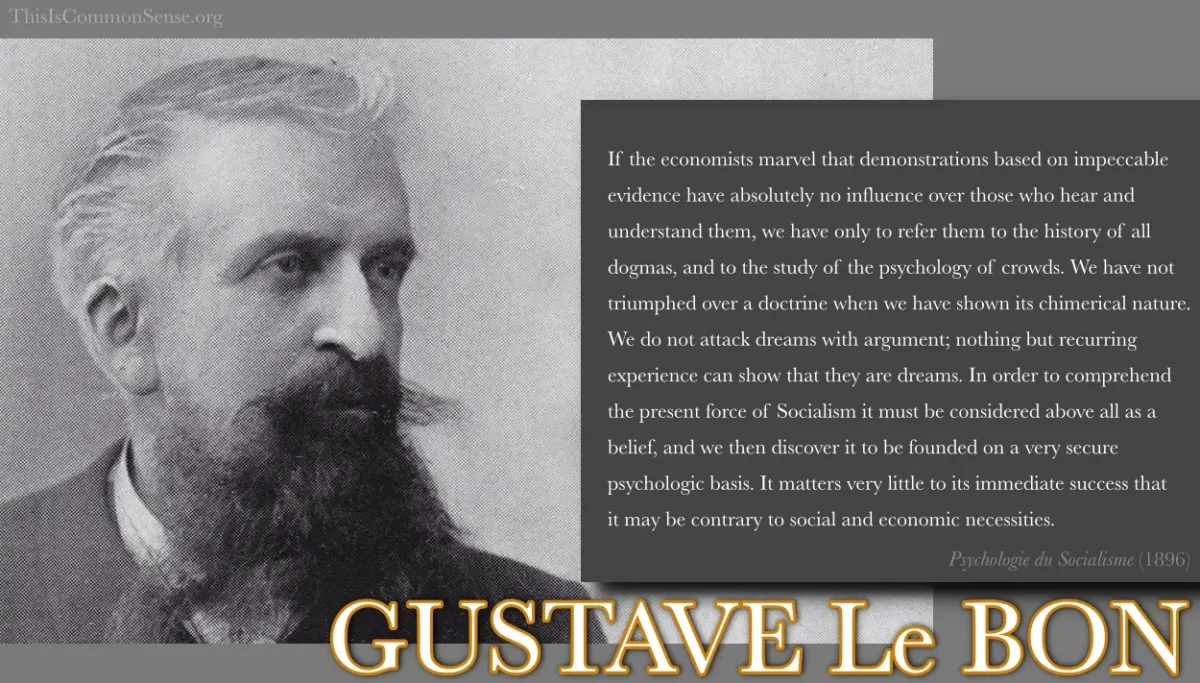
If the economists marvel that demonstrations based on impeccable evidence have absolutely no influence over those who hear and understand them, we have only to refer them to the history of all dogmas, and to the study of the psychology of crowds. We have not triumphed over a doctrine when we have shown its chimerical nature. We do not attack dreams with argument; nothing but recurring experience can show that they are dreams. In order to comprehend the present force of Socialism it must be considered above all as a belief, and we then discover it to be founded on a very secure psychologic basis. It matters very little to its immediate success that it may be contrary to social and economic necessities. The history of all beliefs, and especially of religious beliefs, sufficiently proves that their success has most often been entirely independent of the proportion of truth that they might contain.

Gustave Le Bon, Psychologie du Socialisme (1896), translated as The Psychology of Socialism (1899).
Categories
Today

New Monarchy, New Republic

On November 12, 1905, Norwegians established, by referendum, a monarchy — not a republic. Exactly 14 years later, to the day, Austria became a republic.

Categories
defense & war international affairs

Strongly Stated Ambiguity

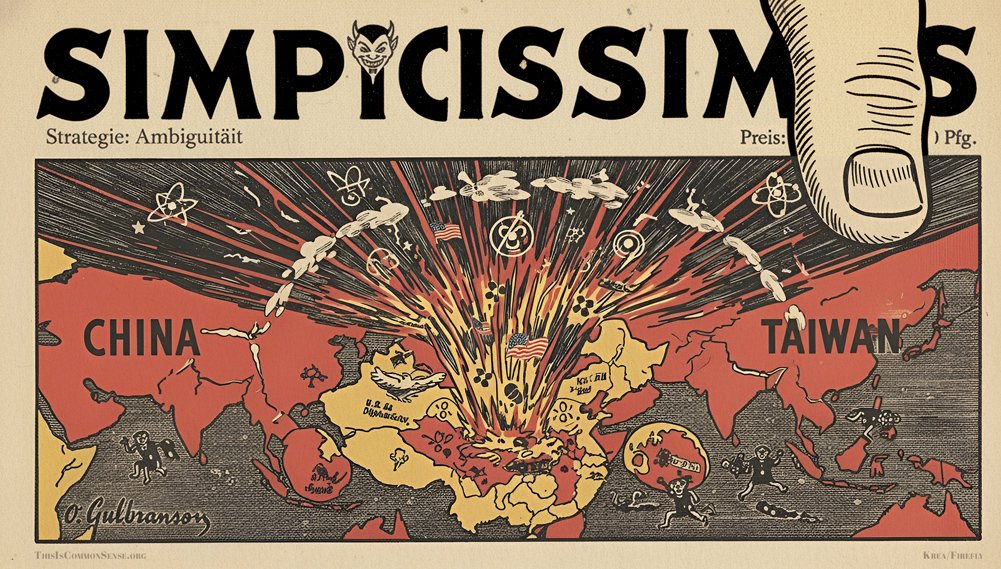
“Because they know the consequences,” President Donald Trump told Norah O’Donnell on CBS’s 60 Minutes the Sunday before last, after meeting with Chinese leader Xi Jinping in South Korea. 

“The Chinese military is encroaching on Taiwan’s sea lanes, its airspace, its cyberspace. I know you have said that Xi Jinping wouldn’t dare move militarily on Taiwan while you’re in office. But what if he does?”asked O’Donnell. 

“Would you order U.S. forces to defend Taiwan?”

Mr. Trump’s reply was ambiguous: “You’ll find out if it happens.” 

Labeled “strategic ambiguity,” U.S. policy regarding a threatened Chinese invasion of Taiwan has long been undeclared, designed to keep China guessing as to our intentions without giving Taiwan a military guarantee.

But then the president added, “And he [Xi Jinping] understands the answer to that.”

The Chinese regime “knows,” Trump explained to O’Donnell, “they understand what’s gonna happen.” He further declared that Xi “has openly said, and his people have openly said at meetings, ‘We would never do anything while President Trump is president.’” 

Mr. Trump’s most surprising disclosure was that Taiwan “never came up” in his two-hour talk with the Chinese ruler, with the president insisting that Xi “never brought it up” “because he understands” “very well” “what will happen.” 

Indeed, military might is the only thing that Xi and the Chinese Communist Party understand

As I argued on Around the World With Dane Waters last week, a Chinese takeover of Taiwan would be economically and strategically catastrophic for Asia and the world. Not to mention, disastrous for freedom.

This is Common Sense. I’m Paul Jacob. 


PDF for printing

Illustration created with Krea and Firefly

See all recent commentary
(simplified and organized)
See recent popular posts

Categories
Thought

F. Marion Crawford

A man who believes he is beaten is already more than half conquered.

Francis Marion Crawford, Mr. Isaacs (1882), Chapter VIII.
Categories
Today

Eleven/Eleven/Eleven

On November 11, 1889, the State of Washington was admitted as the 42nd State of the United States.

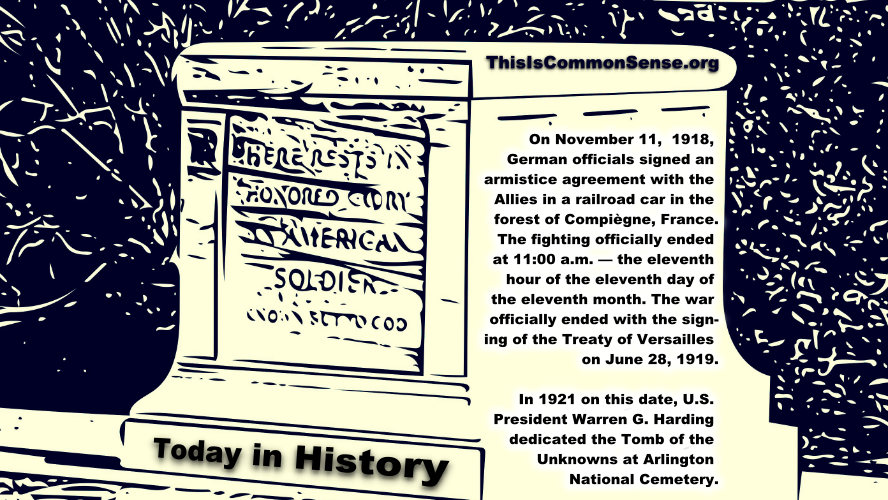
In 1918, German officials signed an armistice agreement with the Allies in a railroad car in the forest of Compiègne, France. The fighting officially ended at 11:00 a.m. — the eleventh hour of the eleventh day of the eleventh month. The war officially ended with the signing of the Treaty of Versailles on June 28, 1919.

In 1921 on this date, U.S. President Warren G. Harding dedicated the Tomb of the Unknowns at Arlington National Cemetery.

Categories
election law Voting

A Puzzling Protest

Talk about a blowout: a few days ago, Texans overwhelmingly supported Proposition 16 to amend their state constitution to clarify that noncitizens cannot vote in state and local elections in Texas. The vote: Yes, 72%; No, 28%.

Not everybody is happy.

Jeff Forrester, who happens to be running against Rep. Candy Noble, a major sponsor of this very amendment — just a coincidence I’m sure — professes confusion about why anybody would care about this question. He asserts that the state constitution already prohibits noncitizen voting and has flung himself into a major Twitter-X tussle over the matter with the group I lead, Americans for Citizen Voting.

Per Forrester, the Texas constitution “already states that no one other than U.S. citizens can vote” in Texas elections.

But as we point out, prior to passage of the present amendment, the state constitution only explicitly protected the rights of U.S. citizens to vote. It did not “reserve the right to vote to only [U.S.] citizens. . . . It didn’t prohibit Dallas from giving the right to noncitizens to vote in local elections.”

Similarly deficient provisions in the constitutions of other states have also failed to prevent cities from allowing noncitizen voting on local matters. Now, with passage of Prop 16, there is no way for noncitizens to legally vote in Texas.

Those who assert that the Prop 16 amendment is pointless protest too much. If it’s so durn redundant, why isn’t the response to this voter-endorsed clarification simply a shrug?

Instead, we get finger-wagging opposition.

Very “mysterious.”

This is Common Sense. I’m Paul Jacob.


PDF for printing

Illustration created with Krea and Firefly

See all recent commentary
(simplified and organized)
See recent popular posts

Categories
Thought

Robert Heilbroner

It turns out, of course, that Mises was right. The Soviet system has long been dogged by a method of pricing that produced grotesque misallocations of effort. The difficulties were not so visible in the early days of Soviet industrialization or in the post-Second World War reconstruction period. The dams and mills and entire new cities of the nineteen-thirties astonished the world, as did the Chinese Great Leap Forward of the nineteen-fifties, which performed similar miracles from a still lower base. But those undertakings, like the building of the Pyramids or the Great Wall, depended less on economic coordination than on the political capacity for marshalling vast labor forces. Inefficiency set in when projects had to be joined into a complex whole — a process that required knowing how much things should cost. Then, as Mises foresaw, setting prices became a hopeless problem, because the economy never stood still long enough for anyone to decide anything correctly. 

Robert Heilbroner admitting, seven decades after Ludwig von Mises published “Economic Calculation in the Socialist Commonwealth” (1920), that central planning boards could not order goods by value, since there existed no private property and capital markets with which to do the task; in “After Communism,” The New Yorker (September 3, 1990). Heilbroner was a life-long socialist and author of the popular history of economics, The Worldly Philosophers (1953).
Categories
Today

Cry of Independence

On November 10, 1821, the First Cry of Independence in the small, interior town of Villa de los Santos, occurred in Panama. The November 10 date has since become Panama’s “Cry of Independence Day” in the country.

Categories
Update

Eleven Down

It has been two months. On September Fifth of this year, Paul Jacob brought up the strange case of mysterious deaths of politicians for the anti-establishment Alternative für Deutschland party, in Germany. Dr. John Campbell discussed the odds on YouTube:

But it is no longer just six or seven AfD politicians who died suddenly before the recent election.

Four more have died:

Categories
Thought

Ludwig von Mises

Without economic calculation there can be no economy. Hence, in a socialist state wherein the pursuit of economic calculation is impossible, there can be — in our sense of the term — no economy whatsoever. In trivial and secondary matters rational conduct might still be possible, but in general it would be impossible to speak of rational production any more. There would be no means of determining what was rational, and hence it is obvious that production could never be directed by economic considerations. 

Ludwig von Mises, “Die Wirtschaftsrechnung im sozialistischen Gemeinwesen,” Archiv für Sozialwissenschaft und Sozialpolitik, volume 47, issue 1, pp. 86–121, translated into English by S. Adler as “Economic Calculation in the Socialist Commonwealth,” for F.A. Hayek, editor, Collectivist Economic Planning (1935).