Categories
crime and punishment general freedom national politics & policies privacy responsibility Second Amendment rights too much government U.S. Constitution

Don’t Bring Pepper Spray to a Gun Fight

“My students are my kids . . . and I want to be able to protect them just like I would protect my own son,” says the Oho teacher, who participates in a program called FASTER Saves Lives. (“FASTER” stands for Faculty/Administrator Safety Training & Emergency Response.)

Since 2013, FASTER Saves Lives has trained teachers and other school employees to carry and shoot firearms. Although many lawmakers and school officials around the country oppose letting teachers bear arms in the classroom, a growing number sanction the practice.

It makes sense. Is there any better way to prepare for the possibility of having to defend your life and your students’ lives against an armed assailant bent on mass murder? (We can set aside the notion that aspiring murderers will scrupulously respect gun-control laws.)

People do have counterproposals. Congressional candidate Levi Tillman urges arming teachers with pepper spray. Well . . . there are problems, as blogger Tom Knighton elaborates. How do you get close enough to use the pepper spray before the killer squeezes the trigger again? What if he sees you coming?

And suppose you do spray the attacker? He won’t be immediately incapacitated. He may even be unaffected.

Some brave people have stopped a gunman by tackling him in mid-rampage. Great . . . if you have the ability and opportunity to do that.

On the other hand, suppose you’re neither strong nor nimble but can shoot, carry a gun, and shoot back — when the assailant is on the floor, bleeding: no more threat.

This is Common Sense. I’m Paul Jacob.


PDF for printing

Categories
Accountability crime and punishment general freedom government transparency individual achievement media and media people moral hazard national politics & policies privacy Snowden U.S. Constitution

Happy Birthday, Edward Snowden

Edward Snowden turns 35 today and begins another year as a fugitive stuck in Russia.

Five years ago, he fled the country to Hong Kong, meeting with The Guardian’s Glenn Greenwald and documentary filmmaker Laura Poitras to discuss documents he had released showing illegal National Security Agency collection of our phone records, social media posts and mega other metadata.

It is not merely Snowden who calls the NSA’s programs unconstitutional, or me, but how a federal judge ruled.

Remember when James Clapper, President Obama’s Director of National Intelligence, wittingly misled Congress by claiming our private information was not being swept up, except “unwittingly.” We only know that Clapper fibbed because of what Snowden divulged.

“[T]he breaking point was seeing the Director of National Intelligence, James Clapper, directly lie under oath to Congress,” Snowden has explained. “There’s no saving an intelligence community that believes it can lie to the public and the legislators who need to be able to trust it and regulate its actions.”

Clapper is free, collecting his pension. Snowden has been indicted under the Espionage Act, which unconstitutionally limits his defense.

Snowden sure has paid for his courage. He was making very good money, and living with his girlfriend in Hawaii, when he decided he had a duty to alert us to our government’s lawlessness — at the cost of his livelihood, his future, his very life, perhaps.

While our leaders call him a traitor, I call him “friend.”*

Edward Snowden is a friend of every American who cherishes our Fourth Amendment right “to be secure in [our] persons, houses, papers, and effects, against unreasonable searches and seizures.”

Freedoms the government was secretly stomping upon.

It is time to bring him home.**

Ed Snowden, thank you for your service. Happy Birthday!

This is Common Sense. I’m Paul Jacob.



* I feel a connection to Mr. Snowden, and have an inkling of what it’s like to do what you believe is right and to find yourself wanted by the government, on the run, far from home.

** Snowden deserves a presidential pardon. But he has said he would even return to face prosecution, provided the charges did not preclude him from defending his actions in open court.


PDF for printing


Categories
Accountability crime and punishment general freedom ideological culture media and media people moral hazard nannyism national politics & policies privacy Regulating Protest Second Amendment rights U.S. Constitution

Brownells Defends Itself

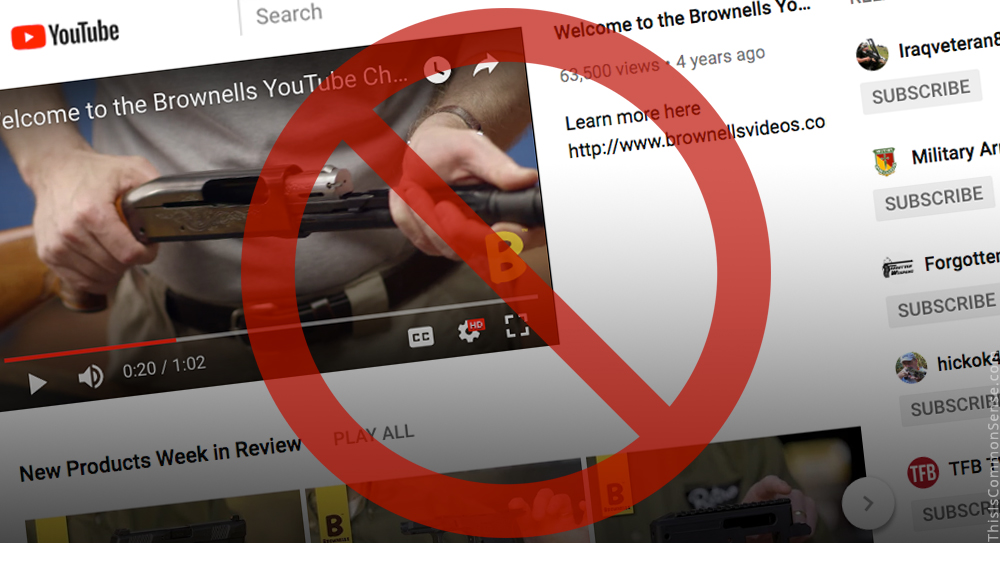
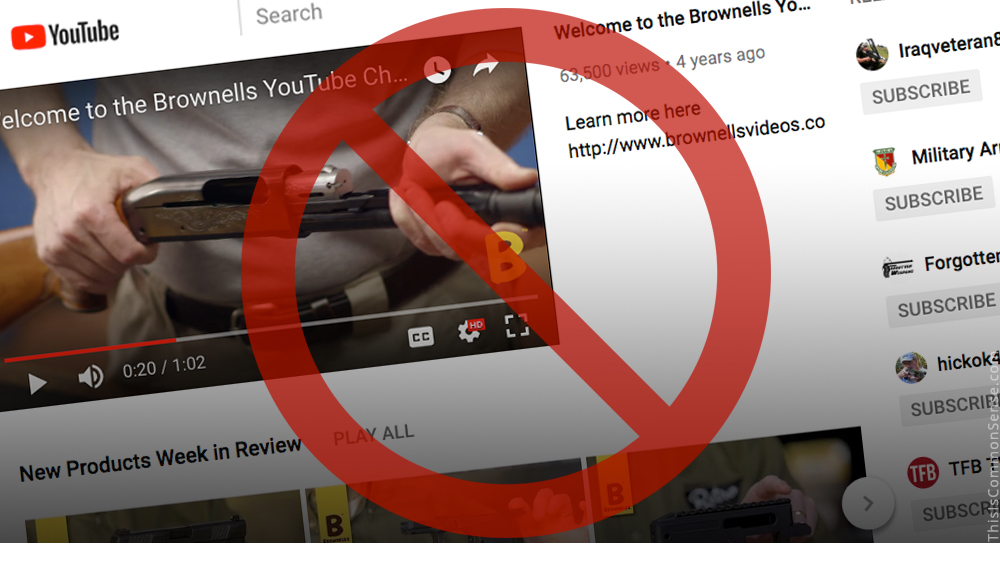
I’m glad to be able to say this: Brownells has, present tense, a YouTube channel. Especially glad because, on June 9, Google had shut that channel down without warning or explanation.

Brownells is a family-owned supplier of firearms, firearm parts and accessories, gunsmithing tools, and emergency gear. Well-known and well-regarded by shooters, hobbyists and gunsmiths, the company has a website and a YouTube channel that serves as a “portal to everything shooting and hunting,” as Pete Brownell explains.

Brownells’ YouTube channel is substantial, with almost 1,800 instructional videos and some 71,000 subscribers. Patrons stress that there’s nothing outré, radical, or offensive about the offerings — unless you’re reflexively anti-Second Amendment, I guess.

We’ve got no smoking gun in the form of an explicit admission from Google. But we may plausibly suspect that the firm terminated this YouTube channel for ideological reasons. Perhaps Google shot from the hip here in reaction to the recent spate of school shootings, without pausing to properly distinguish between promoting responsible gun ownership and promoting murder.

We may also never know whether Google expected Brownells to meekly accept the arbitrary snuffing of a resource it had spent so much time and energy developing. In any case, Brownells used Twitter and other forums to urge supporters to call Google and object.

The self-defense paid off. On June 11, Google undeleted the channel. The protests against injustice must have been too many to ignore.

YouTube is no longer a mere platform for video sharing. It has taken political controversy and complaints as excuses to editorialize.

Were it a government, I’d say “censor.”

This is Common Sense. I’m Paul Jacob.



PDF for printing


Categories
Accountability education and schooling folly general freedom ideological culture local leaders moral hazard nannyism responsibility too much government U.S. Constitution

Degrading Expectations

Expect racism to come from the Right . . . we are told by the Left.

On Wednesday, I considered the sad case of New York Mayor Bill de Blasio, pushing racial resentment in a black church, asking for an “amen” after telling the parishioners that there was something very wrong with Asian students dominating that most meritocratic of institutions, Stuyvesant High.

Giving up on meritocracy is quite bracing, as is de Blasio’s lack of commitment to the culture of individual achievement.

His assumption? Black and Hispanic Americans just cannot compete on merit alone.

They don’t need to work harder, and we mustn’t expect them to. They needn’t change their values or encourage their children to be more academically ambitious. What’s the point in troubling to emulate successful cultures, like that of many Asians (many of them quite poor) who have been advancing so effectively? For de Blasio there’s no hope for blacks and Hispanics.

Except through him.

Note the two pillars of de Blasio’s vision:

  1. racial determinism, where individuals cannot hope to succeed outside the stereotyped behavior of their racial background, their skin color and physical features determining their performance,
  2. except when Government steps in to save them (this is statist messianism).

And yes, by “government” he really means “de Blasio” — or “progressivise politics.”

The first assumption has been called “the soft bigotry of low expectations.”

The second is idolatry of the State and overbearing pride in one’s own ideological tribe.

You individuals have no chance to succeed, the idea runs, but We, the Progressives, will save you. Vote for us!

How insufferable.

This is Common Sense. I’m Paul Jacob.


PDF for printing


Categories
general freedom incumbents local leaders national politics & policies political challengers U.S. Constitution

The First Shall Be Last

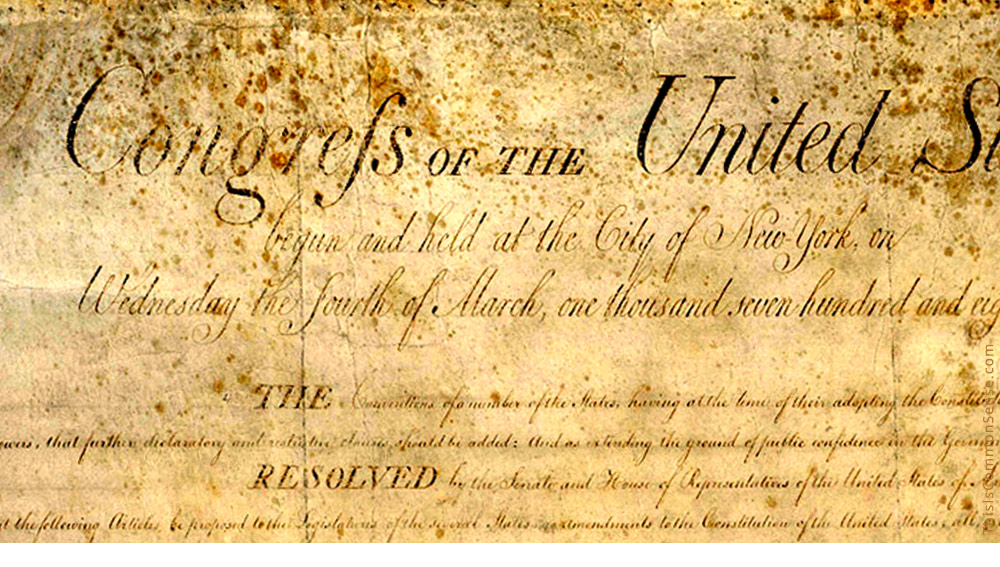
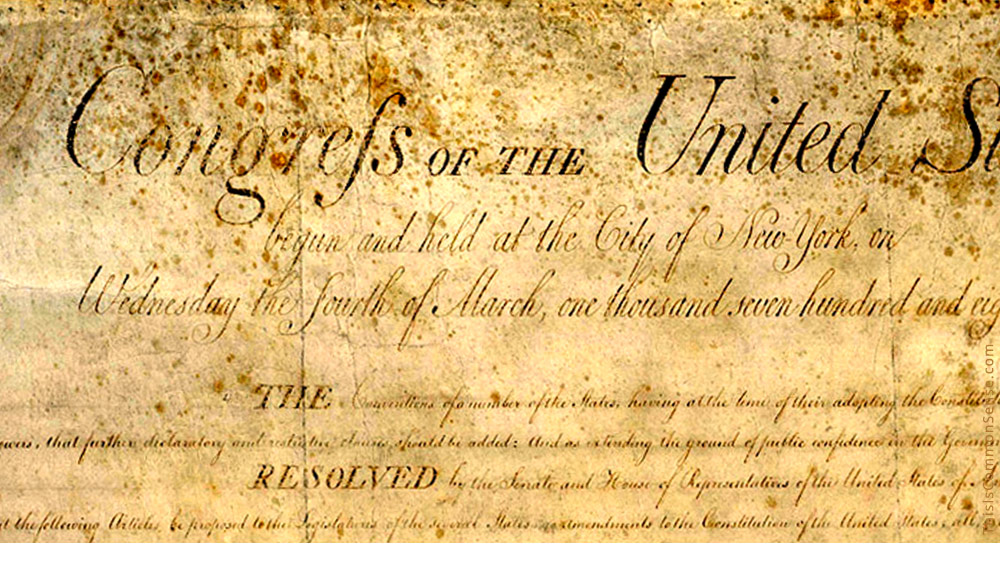
We were taught in school that the first ten amendments to the Constitution make up the Bill of Rights. True enough.

But not completely true — as I pointed out at Townhall.

In 1789, Congress passed and sent to the states twelve constitutional amendments, called “articles.” Our current First Amendment was billed as Article the Third.

The first two of the original batch did not pass at that time: Article the First and Article the Second. That latter article, after more than two centuries of wandering around legislatures, was finally ratified by the necessary three-fourths of the states as the 27th Amendment to the Constitution. In 1992.*

As for the rejected Article the First, last Tuesday, Eugene M. LaVergne filed a motion, pro se, before a federal three-judge panel convened in the D.C. Circuit to hear his challenge to “the validity and Constitutionality of the 2010 Apportionment of the U.S. House of Representatives.” He and four other rabble-rousing New Jersey citizens are challenging the courts to acknowledge a surprising truth: the original Article the First was actually ratified.

On June 21, 1792, Kentucky’s legislature voted to ratify, making it the twelfth of fifteen states at that time to do so.

It’s a complicated story. One of the elements is a clerical error.

But rectifying this old mistake would have huge repercussions.

How huge? Currently the lower house of Congress has a mere 435 members. Were this amendment acknowledged, that number would soar to over 6,150 members.

And that would be a good thing.**

This is Common Sense. I’m Paul Jacob.


* Sadly, its sensible prohibition — “No law, varying the compensation for the services of the Senators and Representatives, shall take effect, until an election of representatives shall have intervened” — was immediately rendered toothless by the automatic cost of living salary adjustments congressmen had already provided themselves.

** Skeptical? Well, click here for a preview of more detailed arguments to come.

PDF for printing


Categories
crime and punishment general freedom moral hazard nannyism national politics & policies privacy responsibility too much government U.S. Constitution

Too Healthy to Play

Cannabis oil can prevent the seizures of at least some victims of epilepsy. But the hope this medicine provides is too often undercut by fear.

I discussed, a few days ago, the case of 15-year-old David Brill, whose life is in danger because officials forcibly removed him from the care of his parents. His mom and dad had (illegally) let him smoke pot — which stopped his seizures. Now they’re fighting to recover custody of David and save his life.

Somewhat different is the plight of an aspiring football player at Auburn University.

Early in 2017, the would-be safety in question, C.J. Harris, began taking cannabis oil to stop epileptic seizures. He has suffered no seizures in all the months since. And he’s in no legal trouble.

But Auburn University’s football team has rescinded its offer to join the team. Exactly why he won’t be allowed to play is unclear. One would guess it is because of the National Collegiate Athletic Association’s ban on cannabis oil, even if prescribed. But the team’s medical personnel says they’re only concerned about his health given his history and the roughness of football.

Does Auburn apply the same standard to all players who have recovered from major physical setbacks? Or, rather, does the team typically let players return to play as soon as they’re ready and able?

Whatever is keeping him off the field, the factors that should decide the question are being shunted aside.

One, is C.J. Harris healthy enough and skilled enough to play for Auburn?

Two, is C.J. Harris willing to accept the risks involved?

This is Common Sense. I’m Paul Jacob.



PDF for printing


Categories
crime and punishment free trade & free markets general freedom ideological culture media and media people moral hazard national politics & policies privacy property rights responsibility U.S. Constitution

Wouldn’t Freedom Be … Easier?

To bake or not to bake, that is the question.

Actually, the question was may a state discriminate against Christians in regulating “public accommodations”? The Supreme Court has decided, in a supermajority 7-2 ruling, that the Colorado Civil Rights Commission wrongly prosecuted a Christian baker who would not make a special wedding cake for a gay couple — while the Commission shrugged when it came to bakers who wouldn’t bake Bible verse cakes.

The ruling came down along the lines I suspected in December: Equal protection. This narrow ruling focused “on what the court described as anti-religious bias on the Colorado Civil Rights Commission when it ruled against baker Jack Phillips,” Fox News informs us.

In his majority opinion, Justice Anthony Kennedy censured the “Commission’s hostility” to Phillips. And Kennedy recognized the root problem, the “difficult questions as to the proper reconciliation of at least two principles”:

  1. “the authority of a State and its governmental entities to protect the rights and dignity of gay persons”;
  2. “fundamental freedoms under the First Amendment, as applied to the States through the Fourteenth Amendment.”

Ah, discrimination. Has picking at this, like a scab, really increased comity? It sure would be easier were we to stick to freedom of association.

Wouldn’t that dredge up less animus?

States should not engage in invidious discrimination. Sure. Vital.

But businesses? Must they serve anyone and everyone? Even when it requires the baker or florist to create something custom — or the pianist to perform? Especially when customers can easily go to a competitor?

Besides, in Colorado, anti-discrimination laws were used by government to persecute Christians.

This is Common Sense. I’m Paul Jacob.



PDF for printing


Categories
Accountability crime and punishment folly moral hazard nannyism national politics & policies Popular responsibility too much government U.S. Constitution

Where the Beef Is

In South Florida, two McDonald’s customers are suing the fast food behemoth for charging them for cheese they say they do not want.

“According to a class-action lawsuit filed in Fort Lauderdale federal court on May 8,” informs the Miami Herald, “Cynthia Kissner, of Broward County, and Leonard Werner, of Miami-Dade, say they have had to pay for cheese they don’t want on their Quarter Pounder sandwiches.”

Before you upchuck every last greasy, chemical-infused/extra-beef morsel of this story, let’s look at the facts:

The Quarter Pounder went national in 1973.

The fast-food franchise used to charge extra for the cheese.

But “at some point” the junk food purveyor stopped “separately displaying these products for purchase on menus.” These days, only the Quarter Pounder with Cheese and the Double Quarter Pounder with Cheese are listed.

McDonald’s joints in Florida, at least, provide no discount for removing the cheese.

Rip-off, say these two customers. How big? A $5 million injury!

That’s what they are suing for.

It’s mad. The lawsuit, that is. You are not entitled to set the pricing and menu policies of stores you do not own.

In a celebrated analysis of loyalty in markets, an economist revealed that consumers have a continuum of options, including “voice” and “exit.”

“Voice” is what you express when you argue your case in a family or a democracy — and fast food provisioners. Decent people will, if disgruntled, choose “exit,” driving down the street to a Wendy’s.

McDonald’s could rightly charge extra for withholding the cheese.

That it doesn’t do so? Chalk it up to savvy.

This is Common Sense. I’m Paul Jacob.


PDF for printing


Categories
Accountability crime and punishment folly general freedom ideological culture media and media people moral hazard nannyism privacy property rights responsibility tax policy too much government U.S. Constitution

Brave New Paternalism

Michael Bloomberg is rich. He’s also in politics — a public health crusader.

And, for years, he “has personally funded and promoted all sorts of regressive taxes and regulations in an attempt to push people around,” the folks at Americans for Tax Reform tell us. “He uses the coercive power of the government to force people to live their lives as he sees fit.”

Onstage at a globalist event, One-on-One with Christine Lagarde — who is managing director of the International Monetary Fund — Bloomberg blurts out his approach to government policy regarding what he calls “those people.”

“If you raise taxes on full sugary drinks,” he says, “they will drink less and there’s just no question that full sugar drinks are one of the major contributors to obesity and obesity is one of the major contributors to heart disease and cancer and a variety of other things.”

Against the charge often made that such taxes fall heaviest upon the poor, he is forthright. Regressive? “That’s the good thing about them because the problem is in people that don’t have a lot of money.”

Notice that he is not talking about a public service campaign to help people learn how to drink (and eat) better. And he is not talking about removing all the government policies that have encouraged bad eating and drinking habits (as well as lethargy) — the government programs to encourage the overuse of high fructose corn syrup; the welfare state’s poverty trap that stifles life at the lower incomes; the subsidized consumption of food and drink — he wants to add another government program.

He can only see betterment by increased governmental bullying.

This is Common Sense. I’m Paul Jacob.


PDF for printing

Michael Bloomberg, tax, policy, nanny state, vice, social engineering, statist, technocrat

Photo by Center for American Progress

Categories
Accountability folly general freedom ideological culture moral hazard responsibility U.S. Constitution

China Marks Marx Anniversary

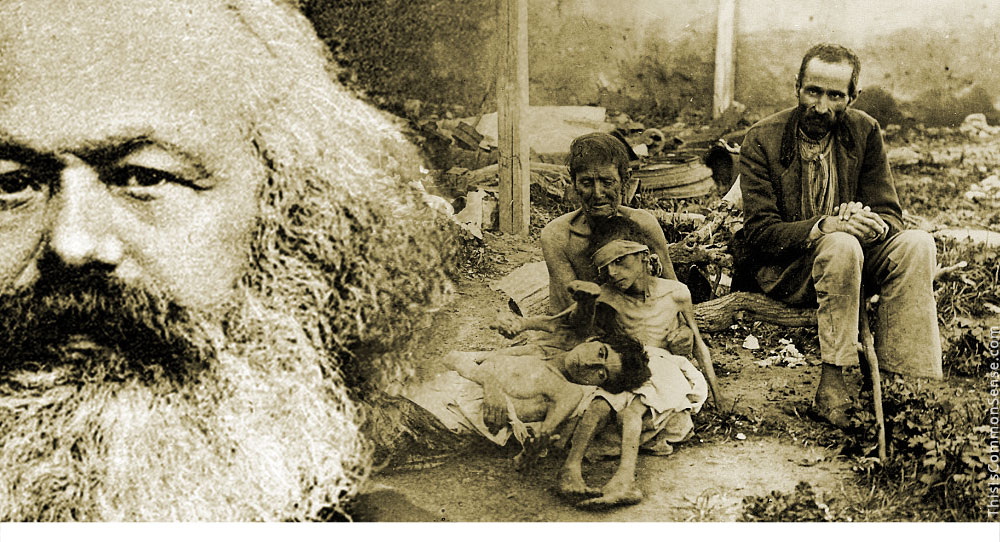
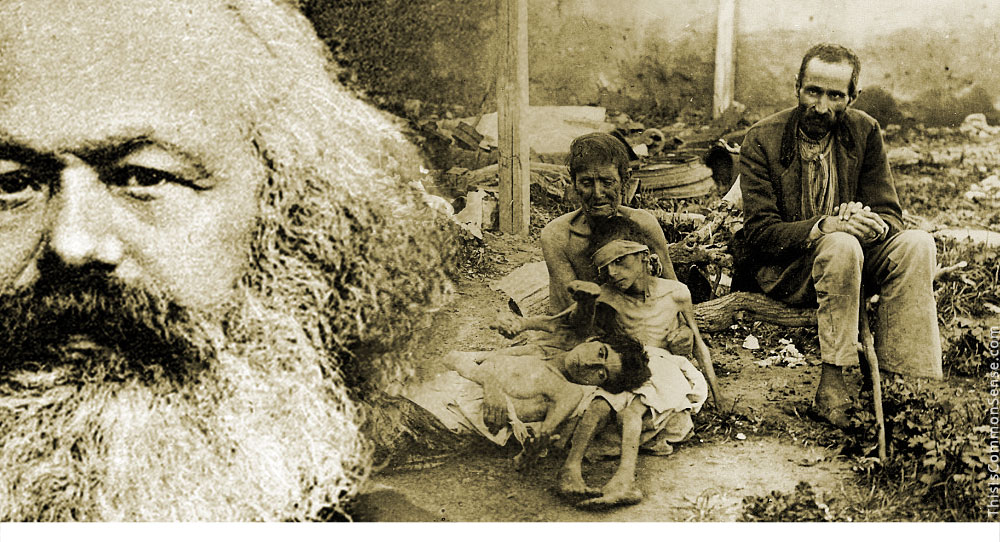
The Chinese government has sought to honor the birth of Karl Marx (1818-1883) by giving a giant bronze statue of the social philosopher and pseudo-economist to the German city of Trier, his birthplace.

Agreeing that Trier and Marx should be thus honored, local officials shamefully accepted the donation.

Marx was a bad guy. His willfully destructive anti-capitalist theorizing and polemics have been enlisted to enslave and murder many millions of people in the Soviet Union, China, Cambodia, Cuba and elsewhere. The story is told in works like Modern Times and The Black Book of Communism. One effective critique of Marxian ideas may be found in the second volume of Murray Rothbard’s History of Economic Thought.

We often hear that Communist implementation of Marxian theory poorly translates “real” communism/socialism/collectivism. No government unswervingly enacts all the ideas and prescriptions of a single intellectual founding father. But there is much in Marx’s volumes that openly demands the razing of the division of labor, profit-seeking, and other requirements of civilization.

In one article, Marx scribbled that “there is only one way in which the murderous death agonies of the old society and the bloody birth throes of the new society can be shortened, simplified and concentrated, and that way is revolutionary terror.” There’s plenty more where this came from.

When a major nation-state gives a town a statue, it’s hard to say no. But one needn’t accept it at face value. Install it on a base that lists the separate bouts of Marx-inspired mass murder. Or use it as a target in paintball tournaments.

Or just place it in the local cemetery. Where deadly ideologies should go.   

This is Common Sense. I’m Paul Jacob.

 

PDF for printing