Categories
Common Sense First Amendment rights tax policy too much government

Feinstein No Einstein

Government’s job is to protect our lives and liberties. But how best to accomplish this? Should books be banned? Websites blocked?

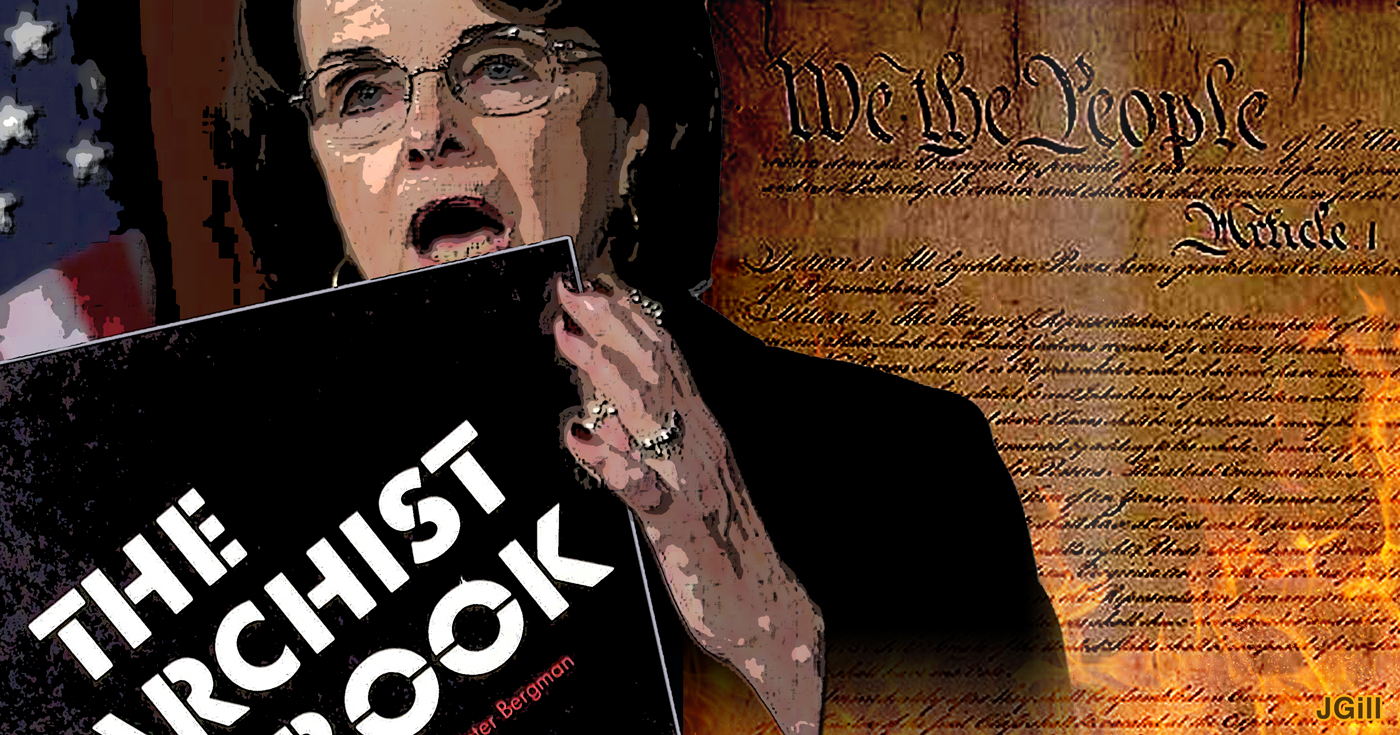
Diane Feinstein thinks so.

Sen. Feinstein (D-California) wants to ban The Anarchist Cookbook from the Internet. The book, which came out in 1971 with lots of radical ideas, including notoriously unreliable instructions for making bombs, is now a website. Perhaps the quality of  the “cookbook” has helped us survive against the anarchist threat these last five decades.

Today, the threat is not anarchist but Islamist terrorism. So of course Sen. Feinstein also wants the Al Qaida magazine Inspire “off the Internet.”

Government censorship, anyone? Free speech, Senator?

Now, I don’t approve of the bombing and murdering of innocents for any cause. So I am not at one with deadly anarchists or deadly jihadists. Count me as among their enemies.

But, at the risk of being called a “liberal,” I don’t think we should defend ourselves against anarchists or jihadists or other terrorists just any old way. For both moral and strategic reasons, we ought not be killing innocents by drone strike, along with those simply declared guilty, without any lawful process at all.

Likewise, we ought not abridge our own cherished principles and the rule of law.

Including the First Amendment.

After all, that’s what government is supposed to be protecting in the first place.

The fact that Feinstein seems so comfortable with simply “banning” books and magazines and websites suggests an illiberal, unAmerican attitude. An attitude that threatens to do more damage to the homeland than any “cookbook” or pro-terrorist magazine or website ever will.

This is Common Sense. I’m Paul Jacob.

Printable PDF

Anarchy and Chaos


Categories
general freedom national politics & policies tax policy

The Taker’s Gift

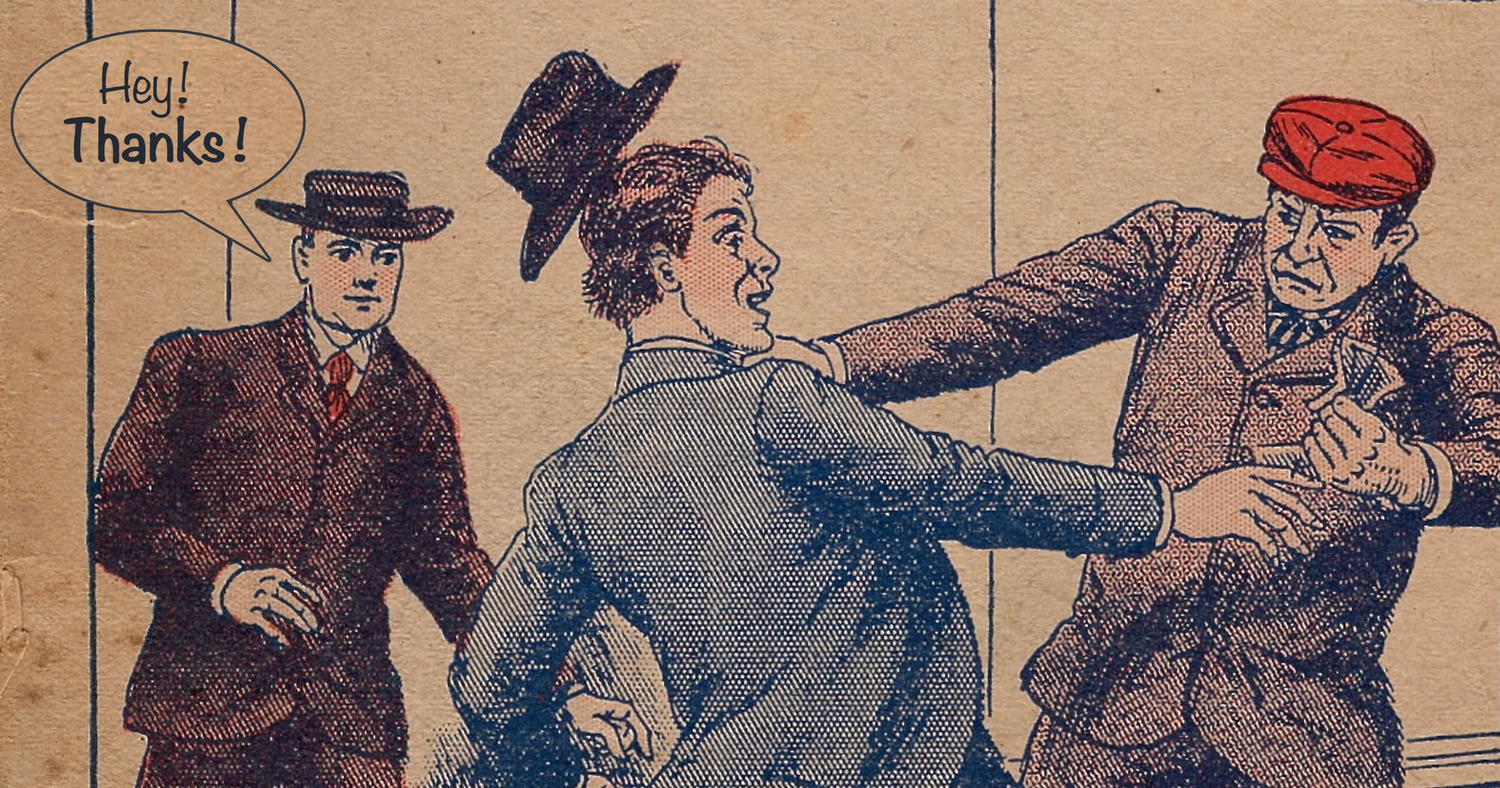
Say a mugger robs Ed instead of you. Has the mugger given you a present of your stuff by not taking it? Is his non-taking a “giveaway”?

No. If you possess something you have honestly earned, it is yours by right, not as a special gift from each person who abstains from relieving you of it.

Why is this not just as true when the prospective stuff-taker is a government?

Whatever case may be made for taxing you to fund a governmental goal, the state is not “giving” you whatever part of your wealth it lets you keep.

Yet this is the claim that partisans of big government repeatedly make. They apparently aim to undermine any hint of willingness to let us keep more of what belongs to us.

We see it again in the context of President Obama’s recent attacks on the plan of some Republicans to do away with estate taxes, the notorious “death taxes.” This tax relief would allegedly be a “giveaway” to those who have worked most successfully to earn something worth leaving to people they care about. It would also allegedly “deprive” non-recipients of some government handout no longer fundable because of the tax cut.

Being taxed less is always about keeping more of your own money and being able to spend it as you wish, including on heirs.

That’s a feature of tax cuts — not a bug.

This is Common Sense. I’m Paul Jacob.

Printable PDF

mugger300


Categories
free trade & free markets general freedom Ninth Amendment rights tax policy

Taxation Rules

It turns out the United States is a tax haven.

Haven? Heavens! I live here. I don’t feel that low-tax feeling when April 15 rolls around.

But the Cato Institute’s Dan Mitchell, an expert on all things tax-policy — a dirty job, but somebody’s gotta do it — says “The U.S. Is a Tax Haven . . . and That’s a Very Good Thing.”

He is a huge fan of international tax competition. He likes it when governments at least marginally decrease the tax burden on prospective producers and investors, so as to lure production and investment from other tax jurisdictions. In his opinion, “we need some way to restrain the greed of the political class.”

Fans of big government disagree. Tax competition hinders their master plans to control and plunder the rest of us.

Mitchell knows that we mere U.S. citizens tend to lug a big tax load. But the United States is in fact “a tax haven. Not for Americans, of course, but . . . we have some good rules for foreigners.” In addition to their ability to exploit the especially robust corporate privacy rules of a state like Delaware, foreign investors can avoid taxes on interest and capital gains on their stateside investments.

Now, Mitchell says, let’s apply those “same good policies to Americans.”

Hear hear! Havens I can access are even more appealing than those I can’t.

This is Common Sense. I’m Paul Jacob.

Printable PDF

Overburdened Pack Mule


Categories
initiative, referendum, and recall tax policy

Two-Thirds to Raise Taxes

You can’t keep a good Eyman down.

“Who says politicians don’t listen?” asked Tim Eyman in a recent email to his Washington State supporters.

“OK, you got me: we normally do. 😉  But not today.”

Pleased as punch, Eyman announced the resurrection of the two-thirds requirement for legislators to raise taxes. Three times voters have passed initiatives promoted by Mr. Eyman mandating a 2/3 legislative vote or a vote of the people before taxes can rise — in 2007, 2010 and again in 2012, the last two times by a whopping 64 percent vote.

But in 2013, the state supreme court ruled voters could not so limit their state legislature, short of a constitutional amendment. And — you guessed it — the Evergreen State lacks a statewide initiative process for voters to amend the constitution . . . without the permission of their legislators.

Eyman was blocked; the voters thwarted. Legislators could go back to raising taxes as usual.

Not so fast!

Enter State Sen. Mike Baumgartner (R-Spokane), who helped motivate a narrow GOP majority to pass a new Senate rule, 26-23, that no new tax may pass the chamber without garnering a 2/3 vote.

Democrats are livid. “Going around the voters is not only disingenuous,” bemoaned Washington State Democrats Chairman Jaxon Ravens, “it is wrong.”

Going around the voters? Really? It must have slipped his mind that “the voters” had previously voted (and been thwarted) three times.

“[H]as the Senate already nullified any attempt by Gov. Jay Inslee to create a carbon emissions charge or a capital gains tax — solely by rearranging its own internal rules?” asked John Strang at Crosscut.com.

Yes is the answer from those pesky voters.

And from their representatives who listen.

This is Common Sense. I’m Paul Jacob.
Categories
tax policy

Instead of a Tax Hike

The new Congress is in session and already there’s a push for a tax hike. Republican Senator Inhofe of Oklahoma says, “nothing is off the table.”

Of course the Democrats are chomping at the bit to raise . . . the gas tax. With gas prices having plunged so low, they see a green flag. But then, high prices at the pump are something they like. You know, to “save the planet.”

And across the aisle in the Senate, anyway, it’s not just Inhofe who’s sending up smoke signals to indicate a willingness to “bargain”; Senators Hatch (R-Utah) and Thune (R-SD) seem onboard. (Thankfully, House Republicans appear less enthused.)

To aid the cause, Inhofe calls the gas tax a “user fee.” Euphemistically. He has the tiniest of points: the modern “deal” has been to tax fuel and then use that revenue to pay for new roads and upkeep.

But recent congresses have been spendthrift, misusing the revenues on idiotic projects (hiking trails, bike paths, museums) and not so much on repair. In that context, the call for higher taxes almost looks responsible.

There’s a problem, though. Several.

You cannot go on rewarding government when government fails. They waste money? Why, give them more! Sheer folly.

Further, lower gas prices have meant an effective increase in incomes for regular people. Taxing that away, after so many bad years, is just cruel — to both the middle class and the poor.

Only a politician could call that “responsible”!

I have a modest alternative proposal: Devolve all federal roadways to the states; abolish all federal taxes on fuel. Let the separate states figure best how to fix “our crumbling infrastructure.”

Congress, after all, has failed. Miserably.

This is Common Sense. I’m Paul Jacob.
Categories
initiative, referendum, and recall tax policy

Automatic Tax Hike Nixed

The contest? Uneven, in a sense. My side was outspent more than 17 to one.

But, in another sense, the odds were closer, maybe even on my side.

Well, our side.

That is, Liberty Initiative Fund, my 501(c)(4) outfit, was the largest contributor to a referendum campaign in Massachusetts.

In 2013, the legislature had passed a bill to turn a fuel tax of 24 cents per gallon into a more permanent rate structure, increasing the tax every year as the Consumer Price Index rose.

Citizens of “Taxachusetts” objected to the idea of automating tax hikes. Perhaps thinking about their wallets, they were hardly amused by their state government piling further taxes on whenever prices, including fuel prices, rose. It’s one thing to have to pay more when supplies get tight or demand bids up prices, making gasoline and diesel more expensive. But why pay extra to the government?

Automatically. Without a legislative vote on the record.

So citizens petitioned to have the law referred to a general vote. The measure became Question 1 on last week’s ballot.

It won with a 53 percent majority. The automatic tax hike was nixed.

So, who outspent us? Who wanted the permanent, automatic tax hike? The extra tax revenues, I wrote before the election, “are slated to go toward road construction and maintenance in the Bay State. And — surprise, surprise — the biggest opponents of Question 1 are construction companies doing business with the state.”

But, despite special interests dumping tons of money, citizens won.

The money spent by Liberty Initiative Fund was leveraged effectively. Because, on issues like this, siding with the people is no long shot.

This is Common Sense. I’m Paul Jacob.

Categories
judiciary national politics & policies tax policy

IRS Re-Unleashed

Outrageous. That’s the best word for the recent court decision letting the Internal Revenue Service off the hook for ideologically targeting organizations that apply for tax-exempt status.

True the Vote, which combats voter fraud, sued the Internal Revenue Service because of the tax agency’s deliberate obstruction of applications from Tea Party and conservative organizations like True the Vote. The long delay in approval was costly in part because many prospective contributors to TTV had been awaiting the granting of 501(c)(3) status before going ahead with their donations. True the Vote’s president, Catherine Engelbrecht, was also harassed by other government agencies after submitting the application to IRS.

Nevertheless, Judge Reggie Walton has cavalierly dismissed the suit, asserting that the eventual granting of the tax-exempt status means that the IRS had taken adequate “remedial steps to address the alleged behavior.”

Following the same exalted principle of jurisprudence, Walton would presumably dismiss charges against a mugger so long as at some point the arrested criminal had tossed the wallet back to his victim.

The dismissal, no matter how outrageous, is not in the tiniest bit surprising.

IRS personnel often behave as if they may assault our rights (e.g., to our bank accounts) with impunity, so long as they occasionally defer to our protests by announcing temporary or cosmetic reforms. Others in government cooperate in letting the agency run riot. Perhaps because they agree that the IRS (maybe themselves, too) should enjoy virtually unlimited power over us.

Or perhaps simply because they, like the rest of us, are scared of the IRS.

This is Common Sense. I’m Paul Jacob.

Categories
tax policy

Death But No Taxes

Is the Internal Revenue Service inevitable?

I’ve often discussed the IRS’s ideologically motivated harassment of taxpayers as fostered by Lois “I Took the Fifth” Lerner (e.g., here and here and here and here). But typical nonpartisan forms of IRS harassment are also deplorable.

Consider the so-called “practice” audit, to which blogger Philip Hamburger was once subjected.

In any field, employees may presumably be sicced on a person primarily for training purposes. If you’re a new Spanish Inquisition employee, maybe you’re given somebody to flay and strangle not because he’s particularly heretical but just so you can hone the torture techniques. Seems wrong; but, you know, people have to be trained.

Same thing at IRS. Taxpayers sometimes get audited just so the new guy can fine-tune making taxpayers sweat over each deduction.

It’s why Hamburger got audited. When an IRS supervisor admitted that there was no problem with his small charitable deduction, that the point was only to enable an (absent) agent to practice auditing, our humble taxpayer almost blew up. Fortunately, his accountant intervened to ask, simply, whether the matter was now therefore closed. Yes, it was.

Year in, year out, the IRS causes millions of us to waste time and energy and to suffer angst thanks to the agency’s sundry demands. Solution: shut it down. No law of nature ordains that our income be federally taxed, and until 1913 it mostly wasn’t.

What prevents such urgently needed reform is only politics, not physics.

This is Common Sense. I’m Paul Jacob.

Categories
crime and punishment tax policy

Overkill America

The death of Eric Garner, a 43-year-old Staten Islander, by police chokehold, not only sparked in me the usual combination of sadness, anger and frustration — there was an additional element: would this do it?

Would the nation’s shock, incredulity, indignation amount to anything?

Lots of questions. But one thing not being focused on in the standard reports was noted by Scott Shackford of Reason. It’s not merely a question of why the bust went so violent. Why, he asks, a bust at all? “We should be concerned that the reason why the police swarmed Garner in the first place is getting lost. He allegedly possessed ‘untaxed cigarettes.’ That is it.”

A tax matter.

The police are arresting people — and going into overkill mode in the process — on tax matters.

Couldn’t this such issues be handled by mere citation, followed by a court summons? With an arrest the last resort?

Why go all violent when violence is not really in order?

But maybe it’s not just about the taxes. Or “contraband.” Maybe this is also about “drugs.” (Yes, tobacco’s a drug.) We’ve long had a “War on Drugs” in this country. It has not gone well. As I suggested last week (as well as yesterday, on Townhall), the effects have not only been wide and deep, but inevitable.

War is like that. Expect the “unintended consequences.”

Scott Shackford suggests that New York lower the city’s high sin taxes on cigarettes.

But maybe the whole mindset of the modern state needs changing. Big things, like murder, slavery, etc., those are worth fighting about. Let’s not go to war over the little things.

This is Common Sense. I’m Paul Jacob.

Categories
tax policy too much government

Value the Vote

What happens when politicians create a special new election date in order to place a tax increase before voters . . . when least expected?

Did I mention that, as the Seattle Times reported, Proposition 1 “enjoyed massive support among politicians, labor unions, environmentalists, social-equity groups and business coalitions”?

Or that the YES campaign outspent the NO side by $654,922 to a mere $7,700, a nearly 100 to 1 margin?

The answer: On Tuesday, voters in one of the most liberal counties in America said NO. A solid 55 percent rejected the ballot measure.

Proposition 1 would have hiked King County’s 9.5-cent sales tax by 0.1 percent and imposed a $60 annual car-tab fee. The idea was to provide more funding for mass transit and local roads, with 60 percent of that revenue going toward the area’s mass transit system.

Transit officials argued that without the additional dough they’d have to make deep service cuts.

“The voters are not rejecting Metro; they are rejecting this particular means of funding Metro,” explained County Executive Dow Constantine. “We know the people of King County love and value their transit service.”

Love? Perhaps. Ridership is reportedly at a near-record high, about 400,000 a day.

Value? Not so much.

This very “progressive” electorate expressed, with utmost clarity, their unwillingness to pay higher taxes for transit. Further, there’s an unmistakable signal in the refusal of King County Metro officials to consider raising the price of their beloved service to become sustainable.

Isn’t it only fair to ask those riding the bus to pay the fare?

This is Common Sense. I’m Paul Jacob.