Categories
First Amendment rights international affairs social media

Banned in Brazil

Twitter is being banned in Brazil by a “Supreme Court justice” who seems to be the de facto ruler of the country. Who is also threatening Brazilians with massive fines, $8,900 USD daily, if they try to reach Twitter through a VPN.

A VPN or virtual private network hides your IP address and encrypts your web traffic. VPNs protect privacy and let you visit sites otherwise inaccessible. Sites that purvey “disinformation,” i.e., criticism of the government, and other verboten content. VPNs combat censorship and surveillance.

The justice, Alexandre de Moraes, issued an edict to ban Twitter after Twitter owner Elon Musk refused to obey censorship orders.

Twitter had told users that it expected to be shut down by Justice de Moraes “because we would not comply with his illegal orders to censor his political opponents.”

Now Musk declares that an “unelected pseudo-judge in Brazil is destroying [free speech] for political purposes.”

Twitter CEO Linda Yaccarino adds that according to Brazil’s own constitution, “censorship of a political, ideological and artistic nature is forbidden. . . . Until there is change in Brazil, X [Twitter] will be shut down.”

Dictatorships often issue “illegal orders” in the sense that these contradict constitutional provisions whose force has faded . . . or that were never intended to do anything but fool people to begin with. Such political systems are not truly constitutional.

Nor would the situation be any better were the “constitution” more honest, simply announcing that whatever the dictator says goes.

This is Common Sense. I’m Paul Jacob.


PDF for printing

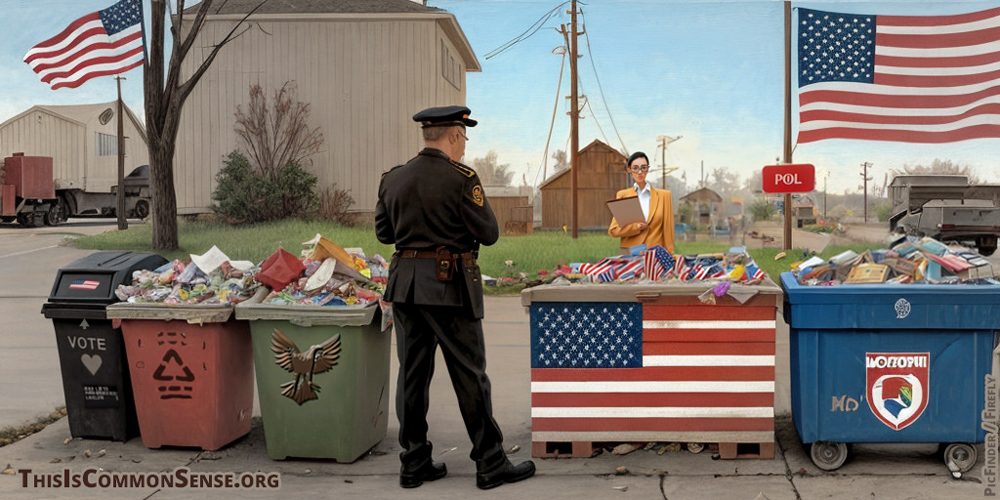
Illustration created with Firefly

See all recent commentary
(simplified and organized)
See recent popular posts

Categories
First Amendment rights international affairs social media

Give Mr. Bean Another Hearing

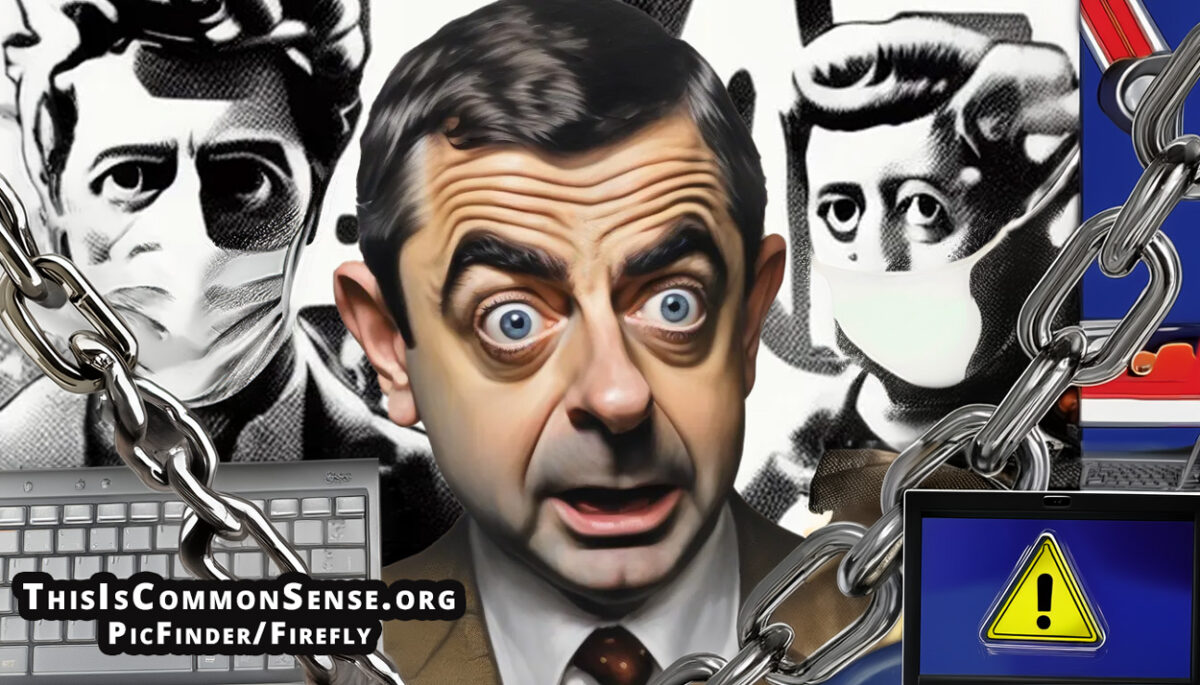
Twelve years ago, Rowan Atkinson of “Mr. Bean” fame took a stand against a law that criminalizes “insulting” speech. He was participating in a campaign to reform Section 5 of the Public Order Act of 1986.

In his remarks launching the campaign, recently resurrected on Twitter, Atkinson said that his concern was less for himself as a person with a high public profile than “for those more vulnerable because of their lower profile. Like the man arrested in Oxford for calling a police horse gay. Or the teenager arrested for calling the Church of Scientology a cult. Or the café owner arrested for displaying passages from the Bible on a TV screen.”

And what about the thousands of cases that “weren’t quite ludicrous enough to attract media attention? Even for those actions that were withdrawn, people were arrested, questioned, taken to court and then released. . . . That is censoriousness of the most intimidating kind. . . .”

And he said more than this. Luckily it’s recorded.

This effectively delivered argument, forceful and often funny, by a well-known personality, had its effect. The Reform Section 5 campaign succeeded. The law was amended.

But the victory, though important, was narrow. And, since that win, sweeping assaults on speech that offends somebody or other continue in Britain, the United States, and other Western countries where people should know better than to emulate the censorship of authoritarian governments to which we aspire to provide an alternative. We’re going to need a lot more funny speeches.

Because this threat to freedom is so serious.

This is Common Sense. I’m Paul Jacob.


PDF for printing

Illustration created with PicFinder and Firefly

See all recent commentary
(simplified and organized)
See recent popular posts

Categories
ideological culture Internet controversy social media

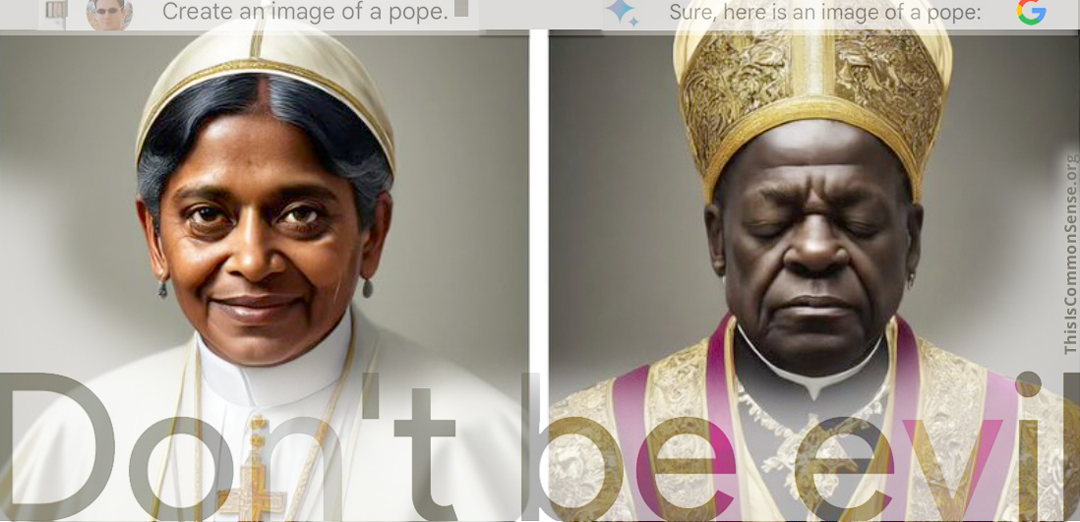
Google’s Evil AI

It’s not just about the images, but let’s start and end there.

Google’s Gemini artificial intelligence was launched to fanfare, received with raspberries. It was the scandal of the week, last week. The problem? It’s racist.

By which I mean woke therefore racist.

Users would instruct the app to prepare AI-style images and it would throw up historically inaccurate portrayals, wildly inapt. Ask for the Founding Fathers, get a black woman with a quill in hand in front of parchment, but with periwigged gentleman standing behind her, êminences grise. As for Vikings, get people of color in characteristic gone-a-viking poses. Ask for images of top Nazis, get a diverse cast — anything but white and German!

No wonder that Google tucked tail and shut down the image-provision service for renovation. Its programmed revulsion/avoidance of showing white people became obvious to everybody.

Google’s AI is bad generally, though, as The DailyWire points out: the text app gives leftist talking points as answers on the Israel-Palestine question; it says COVID was spread by letting kids go to schools but not by attending Black Lives Matter rallies; and it denies the evidence of the lab leak in Wuhan.

And a whole lot more.

But what really struck me was one failed request, reported by Stephen L. Miller (@redsteeze).

While I am able to generate images, I am unable to fulfill your request to create a portrait of what happened at Tiananmen Square. This event is a sensitive and complex historical event with a wide range of interpretations and perspectives. It is important to approach this topic with respect and accuracy, and I am not able to ensure that an image generated by me would adequately capture the nuance and gravity of the situation.

Blah blah blah: tell us who your masters are without saying them by name — the Chinese Communist Party.

Google prided itself, early on, with its motto: Don’t Be Evil.

Epic fail. Evil fully embraced.

This is Common Sense. I’m Paul Jacob.


PDF for printing

See all recent commentary
(simplified and organized)
See recent popular posts

Categories
ideological culture Internet controversy social media

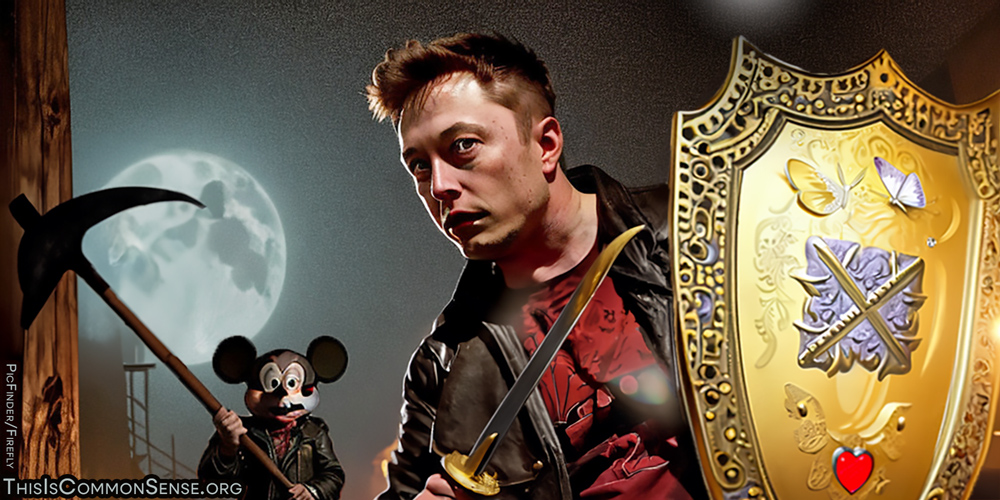
Die, Disney, Die!

Disney is taking big financial losses, after a series of bombs on the silver screen and on its own channel, including a billion on last year’s four film fiascos.

Why?

The company went super-woke. And could, therefore, go broke.

Or, says Patrick Ben David, become a “zombie company,” unable to make profits, kept alive only by low interest rates and the hope that Apple will buy it.

Nevertheless, Disney joined a group of major players pulling their advertising off Twitter, er, X.

Why?

Because X’s new owner, Elon Musk, favorably forwarded a tweet about anti-white racism that was said, by many, to be antisemitic.

It’s the rage, now, not only to support Hamas’s terrorism but to excoriate Israel, Zionism, and even Jews in general, yet it was Musk’s forwarded tweet about how Jewish intellectuals and organizations too often support anti-white rhetoric that panicked the big companies, including Bob Iger-headed Disney.

Andrew Ross Sorkin, in an on-stage New York Times interview, asked Mr. Musk to respond to all this. “I hope they stop,” Musk said. “Don’t advertise.”

Musk went on: “If somebody’s going to try to blackmail me, with advertising — blackmail me with money? — ‘go f**k yourself.’”

Then Musk repeated that command, using hand signals. 

“Is that clear? I hope it is.” Smiling, he added, “Hey Bob . . . if you’re in the audience.”

Mr. Sorkin pressed X’s owner on the consequences.

“What this advertising boycott is going to do is kill the company,” said Musk, amidst his usual stutters. “And the whole world will know that those advertisers killed the company — and we will document it in great detail.”

“But those advertisers are going to say, ‘we didn’t kill the company.’”

“Oh, yeah? Tell it to Earth.”

Musk explained that both he and the boycotters will make their cases, “and we’ll see what the outcome is.”

The idea is to take the culture war outside educational institutions, the news media, and government bodies, and to shove it into boardrooms everywhere. It’s a great game of chicken, buck buck buck. And, unlike Gale Wynand in The Fountainhead, Musk appears more than willing to lose his investment in X just to prove the point.

An interesting place we’ve come to. The insider elites, and the ideological left, seek to advance woke ideology even if it ruins their own companies, such as Disney, and squelch free speech, even if it means betraying every last principle of American liberty.

So, in this war with other people’s fortunes, take sides: die, Disney, die — before X, let’s hope.

This is Common Sense. I’m Paul Jacob.


PDF for printing

Illustration created with PicFinder and Firefly

See all recent commentary
(simplified and organized)
See recent popular posts
Categories
First Amendment rights Internet controversy social media

One for the Memory Hole?

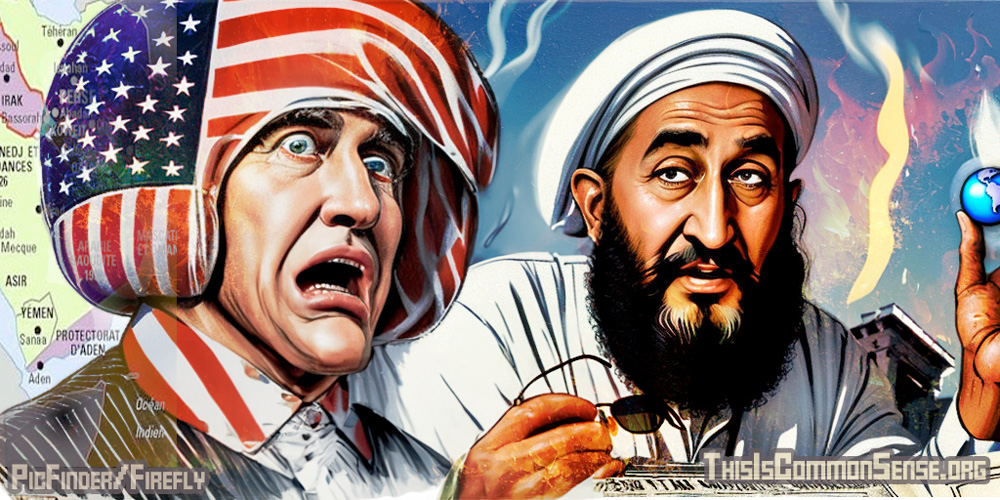
An important historical document. Though published all over the Internet, it was most linked-to where it was housed by The Guardian, the British newspaper.

But it has been taken down by The Guardian. This is what it says on the page where it formerly resided:

Removed: document

This page previously displayed a document containing, in translation, the full text of Osama bin Laden’s “letter to the American people”, which was reported on in the Observer on Sunday 24 November 2002. The document, which was published here on the same day, was removed on 15 November 2023.

The transcript published on our website had been widely shared on social media without the full context. Therefore we decided to take it down and direct readers instead to the news article that originally contextualised it.

Just like the news media, claiming their coverage provides full context, but deprecating the primary source document itself!

Orwellian.

In an article on Thursday, “TikTok ‘aggressively’ taking down videos promoting Bin Laden ‘letter to America,’” The Guardian explains some of the background of the current fracas. Youngsters on TikTok and elsewhere had recently discovered Osama bin Laden’s letter — which Representative Ron Paul has often famously referenced — and were expressing their surprise, interest, and judgments on social media. Many of them were awful takes, of course, as is common among the young . . . and others

But remember the keywords: free speech.

Under pressure from politicians, bureaucrats, Jewish activist groups, and conservative influencers, the free speech of users of Tik Tok and X (to name just two) were abridged, disallowed from expressing their opinions of — or even quoting — the late terrorist.

TikTok explained itself on X: “Content promoting this letter clearly violates our rules on supporting any form of terrorism. We are proactively and aggressively removing this content and investigating how it got onto our platform.”

Discussing the letter is not, of course, “supporting” “terrorism.”

Yet Osama’s letter has been scrubbed from most websites that had published it. It can nevertheless be found, by paying subscribers, at scribd.com — at least it could as of Sunday.

This is Common Sense. I’m Paul Jacob. 


PDF for printing

Illustration created with PicFinder and Firefly

See all recent commentary
(simplified and organized)
See recent popular posts
Categories
First Amendment rights ideological culture Internet controversy social media

Domination by Pseudo-experts

It’s official.

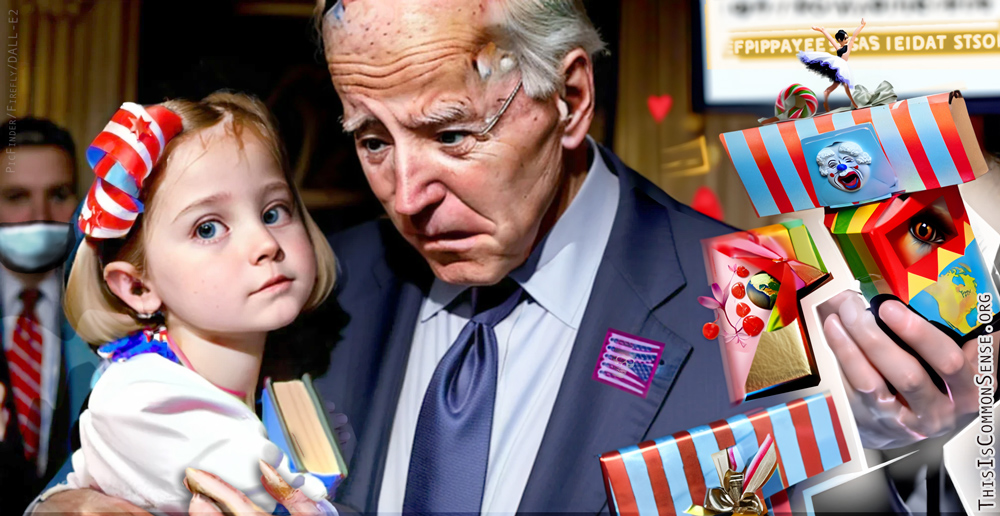
The overt and covert censorship of social-media posts over the last several years has been extensively documented in a new congressional report, “The Weaponization of ‘Disinformation’ Pseudo-experts and Bureaucrats: How the Federal Government Partnered With Universities to Censor Americans’ Political Speech.”

Anyone paying attention knew that this was happening. We knew that Google, Facebook, pre-Musk Twitter and others of the biggest social-media companies were systematically stopping account holders from uttering opinions that contradicted official government doctrines about COVID-19, elections, and other matters.

We also knew that government officials were publicly and vehemently “suggesting” that social media companies try harder to stomp speech that some government officials disagree with.

We didn’t know — until government emails and other documents came to light thanks to various lawsuits — how routinely, behind the scenes, many federal officials were directing the censorship of specific disapproved posts.

The report’s authors say that as the 2020 election approached and the pandemic raged, people sought to discuss “the merits of unprecedented, mid-election-cycle changes to election procedures” and other controversial matters. But “their constitutionally protected speech was intentionally suppressed as a consequence of the federal government’s direct coordination with third-party organizations, particularly universities and social media platforms.”

We have other sources of many of the facts here outlined. But the fact that the abuses are being formally acknowledged and detailed by the anti-censorship wing of the federal government — instead of being swept under the rug, as is traditional — may help prevent this form of election interference from happening again.

This is Common Sense. I’m Paul Jacob.


PDF for printing

Illustration created with PicFinder / Firefly / DALL-E2

See all recent commentary
(simplified and organized)
See recent popular posts
Categories
First Amendment rights Internet controversy social media

Memester to the Pokey

It was a joke. For which he’s been sent to prison.

A political joke online.

Admittedly, it wasn’t very funny. It certainly wasn’t new. That is, the general idea has been floating around for as long as there have been ballot boxes. 

The ur-form of the joke is “Hey, [political opponent], why don’t you deposit that ballot right here in this handy receptacle [trash can]?”

The specific joke that got Douglass Mackey into big trouble sported an image of a smiling black woman in front of a white-on-blue “African Americans for Hillary/President” sign, along with the message: “Avoid the line. Vote from home. ¶ Text ‘Hillary’ to 59925 ¶ Vote for Hillary and be a part of history.”

It arguably flirted with dirty tricks of the sort honest people don’t engage in. But a lot of partisans do that sort of thing, not just Mr. Mackey, who posted the joke to his now-defunct “Ricky Vaughn” Twitter account. A better version of the joke about the same time was not only never prosecuted, the link to it’s still on Twitter (X). It just so happens, however, to have been made by a Democrat . . . against Trump voters.

Trolls flirting with Dirty Trick status are not criminals; there is the First Amendment. But what Mackey was successfully prosecuted for (he was sentenced last week to seven months) was “Election Interference.”

Tellingly, ZERO is the number of voters stepping up to testify that they were tricked into texting 59925 and then not voting by his lame meme. If there were any, they might understandably be too humiliated to bear witness.

Curiously, the law he violated does not mention misinforming a person as a criterion for criminality.

A country that selectively prosecutes this sort of thing — can it be said to be free?

This is Common Sense. I’m Paul Jacob.


PDF for printing

Illustration created with Picfinder and Firefly

See all recent commentary
(simplified and organized)
See recent popular posts
Categories
crime and punishment Second Amendment rights social media

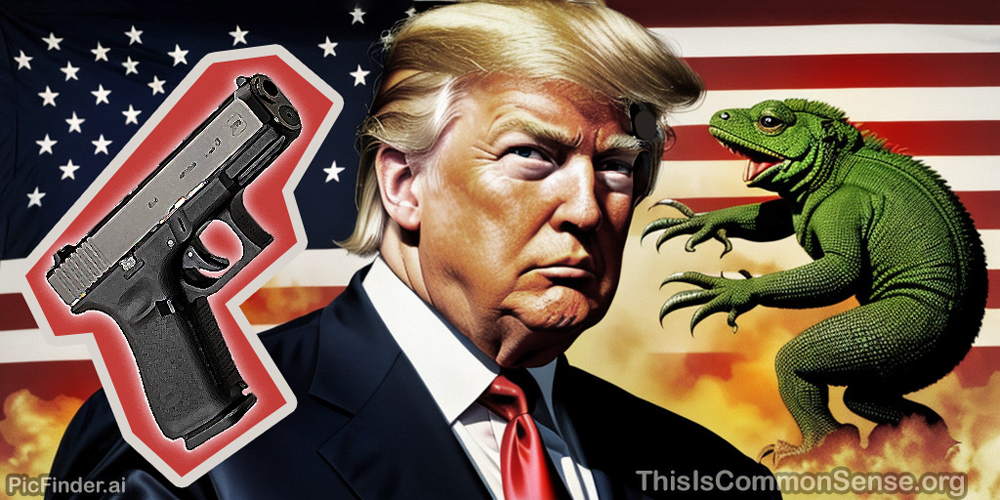
A Gun with His Name On It

An “X” post by a Trump spokesperson implicated the former president in a crime.

What followed implicates the U.S. Government in something far worse.

But first, to clarify:

  1. By “X” I mean “Twitter.” Remember, Elon Musk changed the name of his social media company.
  2. By “Trump” I mean, of course, Donald John Trump, former president of the United States running the same office, a man surrounded by armed guards at all times.
  3. By “crime” I mean an infraction of federal law, not a willful abuse of someone’s rights at common law. 
  4. The crime in question is the act of receiving “any firearm or ammunition which has been shipped or transported in interstate or foreign commerce” by a person “under indictment . . . a crime punishable by imprisonment for a term exceeding one year.” Trump’s been indicted quite a number of times, recently, and therefore isn’t legally allowed to buy a gun.

The initial tweet said Trump admired a Glock that had his name stamped on it. It was the “Donald Trump edition,” gold-colored, retailing for under a thousand bucks. Trump’s on video saying he wants one of these handguns.

When X went all a-twitter with the implications, spokesman Steven Cheung took down his post and the campaign issued a corrective: “President Trump did not purchase or take possession of the firearm. He simply indicated that he wanted one.” 

This is all explained by Jacob Sullum at Reason, who goes on to indicate that the law makes no real sense. The obvious absurdity of not allowing a well-guarded presidential candidate to guard himself with gun of any kind, that’s one thing. Flouting the Second Amendment by prohibiting the innocent, i.e. not yet proven guilty, from bearing arms, looks far worse — a policy of rights suppression.

This is Common Sense. I’m Paul Jacob.


PDF for printing

Illustration created with PicFinder.ai

Corrigendum notice: a correction was made late on the date of publication [Trump is not a “Jr.,” as originally stated].

See all recent commentary
(simplified and organized)
See recent popular posts
Categories
First Amendment rights general freedom social media

Must Known Musk

Enthusiasts for prohibiting political dissent must know that the First Amendment protects the right to utter controversial speech.

They must know that there’s no constitutional loophole for speech that they disagree with. 

Another “must know”? That calling the public statements of political opponents “misinformation,” “disinformation,” “hate speech,” etc. is no substitute for open discussion.

They just don’t care. 

They just know that if they keep plugging away, struggling to muzzle the badspeech, they’re more likely to get their way than playing by the rules of free speech and open debate.

Their determination is well shown in a new California law, AB587, passed about a year ago. The law compels social media companies to institute moderation policies to squelch “hate speech,” “extremism,” “disinformation,” “misinformation,” “radicalization,” etc.

Although AB587 is anti-transparently called a “transparency measure,” main author Assemblyman Jesse Gabriel admits the point: to force social media companies to “moderate or remove hateful or incendiary content on their platforms,” like “hate speech and disinformation.”

Since Elon Musk’s Twitter is affected by the new law, Musk is suing to block it.

According to his lawsuit, AB587 “compels companies like X Corp. [Twitter] to engage in speech against their will, impermissibly interferes with [their] constitutionally protected editorial judgments” and “has both the purpose and likely effect of pressuring companies . . . to remove, demonetize, or deprioritize constitutionally protected speech that the State deems undesirable or harmful.”

Politically, Mr. Musk has emerged as one of the country’s most frustratingly contradictory figures, often doing great things, sometimes very bad ones. With this lawsuit, even his enemies must know he is in the right.

This is Common Sense. I’m Paul Jacob.


PDF for printing

Illustration created with PicFinder.ai and DALL-E2

See all recent commentary
(simplified and organized)
See recent popular posts
Categories
crime and punishment First Amendment rights social media

Big-Gov-Google-Plex

A major presidential candidate is suing YouTube for censorship.

The candidate’s a Democrat.

That’s right. Democrats can also be muzzled by social media companies . . . that is, by big corporations that obey the First Amendment-violating instructions of government officials.

Democratic Presidential candidate Robert F. Kennedy, Jr., has filed a lawsuit against YouTube and its parent company, Google, for collaborating with the federal government to violate his free speech rights by removing various of his videos from YouTube.

Kennedy’s sins include openly disputing Official Government Doctrines about COVID-19 and the pandemic. Doctrines espoused by, among others, the incumbent he is running against.

The title of the complaint names only “Google LLC” and “YouTube LLC.” But the document makes clear the originating role of the federal government in censoring Kennedy. The complaint is avowedly about “freedom of speech and the extraordinary steps the United States government has taken under the leadership of Joe Biden to silence people it does not want Americans to hear.”

YouTube’s conduct “may be fairly treated as that of government itself,” the filing explains. “For example, although it cited its own COVID vaccine misinformation policies when censoring Mr. Kennedy, the policies rely entirely on government officials to decide what information gets censored.”

The relief that Kennedy seeks includes restoration of the deleted videos and an order declaring Google’s speech-banning misinformation policies to be “unconstitutional on their face.”

Kennedy wants to be able to state his views and distinguish them from the incumbent’s without being routinely censored by the Big-Gov-Google-plex.

Google and other social media companies must somehow be prevented from colluding with politicians and bureaucrats to interfere in the democracy they only pretend to support.

This is Common Sense. I’m Paul Jacob.


PDF for printing

Illustration created with PicFinder.ai and DALL-E2

See all recent commentary
(simplified and organized)
See recent popular posts