Categories
general freedom nannyism property rights responsibility too much government

Why the Tiny Domicile

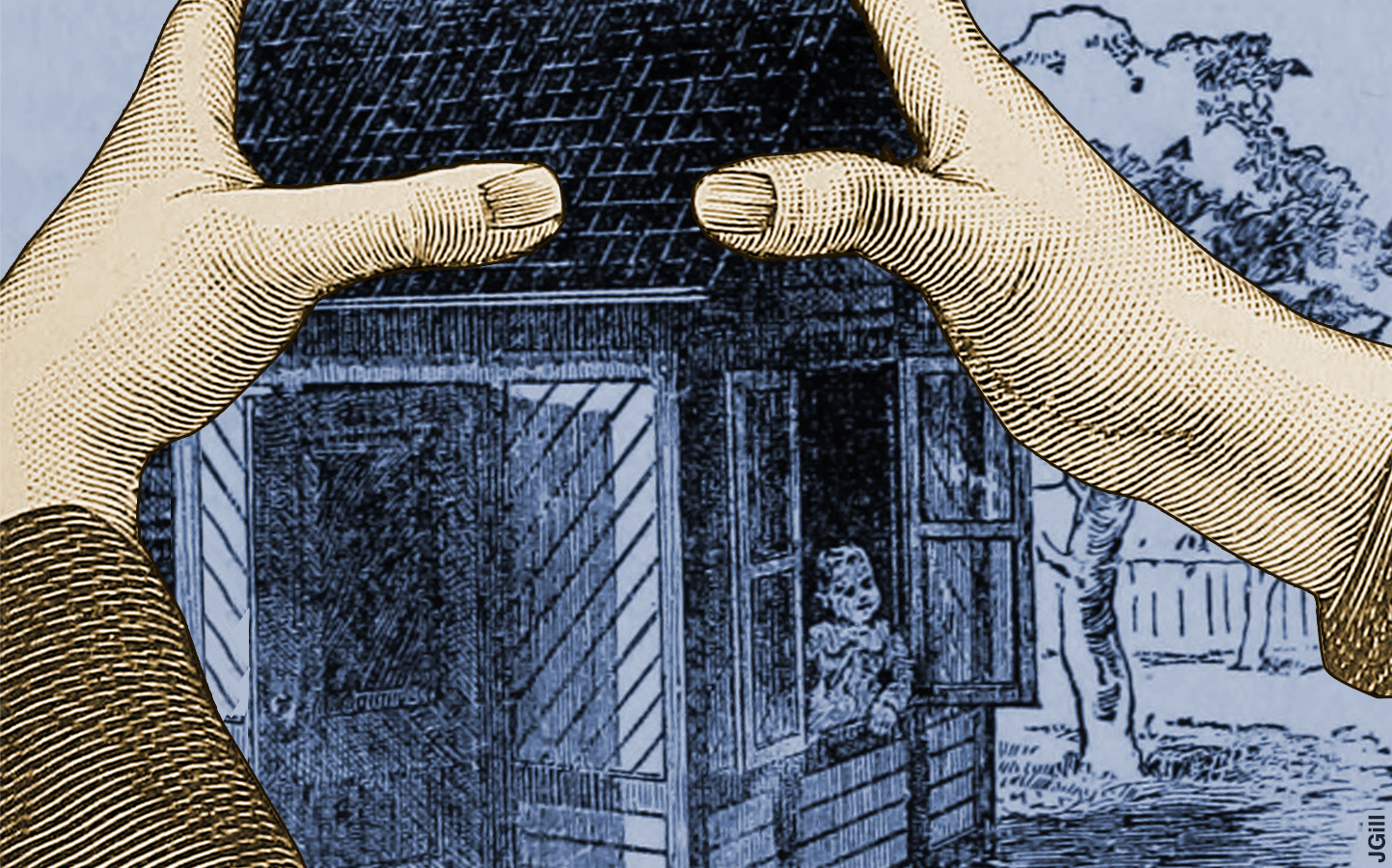
[mks_dropcap style=”letter” size=”60″ bg_color=”#ffffff” txt_color=”#000000″]T[/mks_dropcap]he “tiny house” movement has gained momentum. More and more people — especially young people and childless people — see the virtue of very small houses. They are cheaper, can be made energy-efficient, have an almost necessarily smaller “environmental footprint,” and are mobile.

And I can see the attraction. For one thing, a tiny house would be easier to clean than what I have. For another? Snug. Many of the efforts are very cleverly designed and built. And certainly for young singles, they make a great deal of sense.

But, wouldn’t you know it, there is a problem here. Government.

Urban housing authorities, zoning boards, and the like, have not exactly been accommodating to this new development.

Which is, in its way, typical, and typically frustrating. After all, many of the reasons folks are looking to tiny houses result from government regulation in the first place. City, metro and county governments have been so poorly accommodating to diversity in housing demands that costs have risen horribly.

This is all explained over at Reason, which draws the bureaucratic environment of the nation’s capital in relation to tiny homes: “they’re illegal, in violation of several codes in Washington D.C.’s Zoning Ordinance. Among the many requirements in the 34 chapters and 600 pages of code are mandates defining minimum lot size, room sizes, alleyway widths, and ‘accessory dwelling units’ that prevent tiny houses from being anything more than a part-time residence.”

This leaves Reason’s featured tiny home owner in yet another bad-government-induced limbo: “allowed to build the home of his dreams — he just can’t live there.”

We need tiny government. Or at least tiny-accommodating government. Really… both.

This is Common Sense. I’m Paul Jacob.

Categories
responsibility

Learning from Defeat

Coach Michael Anderson and the girls on his team did too well.

At least according to officials at Arroyo Valley High School in San Bernardino, who suspended him for “running up” the 161-2 score.

Here we go again.

Anderson is, alas, apologetic. But there’s nothing morally wrong with winning — or with losing, either — an honest basketball game. No matter what the margin.

And it’s vicious to teach either adults or kids that they should shoot for less than their best. Should kids also be telling their bosses, twenty years down the line, that they’re deliberately doing third-rate work this month so that less able co-workers (or competitors) won’t feel so bad?

Bloomington Coach Dale Chung says people should not feel sorry for his team, but for the Arroyo team, which “isn’t learning the game the right way.”

No, coach. To accept responsibility for a bad loss without casting blame, then to work to improve, takes grit, persistence and grace. It’s something we all must learn to do in life. It’s the real magic of sport. And easy wins don’t teach us that. Hard losses do. Why are you communicating the opposite?

If you’re doing very badly at an important task — figure out how to do better. Don’t assume that you should be accorded a fraudulent “better” regardless of actual effort and achievement; don’t chastise winners and call them “unethical” for doing their very best; don’t teach your charges that winners should hobble themselves out of “fairness.”

And if you’re a winner? Don’t apologize.

This is Common Sense. I’m Paul Jacob.

Categories
individual achievement moral hazard responsibility too much government

Finding a Mission

Iraq War vet Daniel Gade is a lieutenant colonel, professor of public policy, and triathlon competitor with a message for fellow veterans: disability pay may be doing you more harm than good.

Having lost a leg in combat himself, he submits that he is a messenger somewhat harder to dismiss than some others would be.

Professor Gade criticizes how the government puts vets with relatively mild problems in the same category as those with true disabilities, and gives them incentives to stay out of the job market.

An example is the Individual Unemployability program, which treats veterans rated as at least 60 percent disabled as if they are 100 percent disabled as well as 100 percent long-term unemployable. Demonstrating that level of disability and unemployability to the satisfaction of the government means a bump in monthly benefits from $1,200 to $3,100.

“It’s a trap,” Gade insists.

He is working with private donors on a pilot program for vets. His idea is to give grants to develop employment skills rather than to maintain unemployment. Participants must forego any attempt to increase their disability pay by seeking a higher disability rating.

According to one soldier who gave the professor’s pitch a hearing, the government’s system to help vets “is just ‘Give me the money, who cares about anything else.’”

Gade’s proposal, on the other hand, “says go out and work, be productive, feel good about yourself. There is where we do well. If we don’t have a mission, we don’t do well.”

Accept the mission.

This is Common Sense. I’m Paul Jacob.

Categories
education and schooling national politics & policies responsibility

Sack Lunch

On the face of it, the idea that the federal government should be involved in school lunches is . . . weird.

And yet Congress and a long line of presidents have pushed the notion of federally funded and controlled lunches; recently the First Lady, Michelle Obama, made a big deal about revamping the federal school lunch program. But as Baylen Linnekin explains, “Whatever past successes [the national school lunch] program may point to, by any objective measure, the USDA’s school lunch program has since earned a failing grade.”

Instead of going through another alleged upgrade, maybe the best idea would be to, as Linnekin puts it, “Separate School Lunch and State.”

And this isn’t an oddball, contrarian proposal. As Linnekin relates, “More than 1,400 school districts have opted out of the USDA School Lunch Program since 2010.”

Linnekin tells the tale of Meghan Hellrood, a high school student in Wisconsin who leveraged Facebook to hold a one-day protest boycott of her school’s lunch. “It’s not actually giving us healthy foods,” she said.

Maybe Hellrood’s protest strategy should become the norm. Brown bag it, America. Declare your independence!

Parents can make a sack lunch. Older kids can pack their own. And as Adam Carolla, king of the podcasters, has so often opined, even the poor can afford to make their kids a bean sandwich. We can do this.

Reform of public schools might best begin with lunchtime. Locally. With parents regaining some control and responsibility.

This is Common Sense. I’m Paul Jacob.

Categories
national politics & policies responsibility

Book-Cooking with Extra Salsa

Lately, governments have sought to seem more fiscally responsible by re-confabulating how they calculate a measure of economy-wide economic strength called Gross Domestic Product. (The principle involved is ancient. It’s been denominated “fudging.”)

One of the crassest number-jugglers is the Italian government.

Italy wants to comply with a European Union demand that it limit debt to 2.6% of GDP. If the country’s GDP is statistically fattened by using looser rules for calculating it, then debt as percentage of GDP becomes magically “lower” — as a statistical percentage. Italian politicians can lurch to waste more money while still fetching EU handouts.

A year ago, the American fedgov was guilty of similar fudging when it statistically padded our GDP by $500 billion.

Statistical aggregates like GDP entail much guesswork and many dubious assumptions to begin with. For one thing, why is government spending — including that huge portion that dampens or destroys economic production — included in a calculation supposedly measuring economic value?  (A better indicator of general economic strength, Gross Output, hasn’t quite caught on yet. And I don’t expect those highest up in government to push it.)

The purpose of the number-tweaking by Italy, the U.S. and other governments is hardly to improve or amend or salvage whatever is conceivably salvageable in the original number-crunching. The purpose is to disguise bad policies.

But jiggering with how the impact of awful policies is guesstimated in order to better to hide their consequences won’t erase the awfulness of those policies. And curtailing or ending awful policies can be done entirely without peering into statistic-stoked crystal balls.

This is Common Sense. I’m Paul Jacob.

Categories
ideological culture individual achievement media and media people national politics & policies responsibility

Mercy as a Calling

The cause of immigration reform hit a huge speed bump in recent weeks, with the arrival at the border of thousands upon thousands of children from war-torn Central America.

War-torn? Yes. Gangs — micro-governments in the olden style — fed by drug money have turned the Latin American states to our south into war zones, alas not too dissimilar to the gang warfare that beset some of our great American cities.

Only worse.

No wonder the people in those countries are scared, and desperate. “Coyotes” are taking advantage of U.S. politicians’ inability to secure the border, or even cook up a coherent immigration policy, and charge large amounts of money to transport children to “safety” in the U.S.

Where they are gathered and detained.

In the midst of all the partisan bickering — a legitimate clash of ideologies, really — stands one hero: Glenn Beck. While President Obama avoids the border crisis as if avoidance solves problems, radio/TV/Internet sensation Beck is taking his trucks and buses and volunteers directly to the area Obama avoids, the detention centers and surrounding cities and churches.

He’s taking food, clothing, and comforts for the children.

Last night on The O’Reilly Factor he explained  that governments are instituted to provide justice. He laments the lack of justice on  immigration coming from Washington. But the business of the people — of caring Americans — is not primarily justice.

It’s mercy, Beck says. He’s raised millions, and he’s personally taking aid to where it’s needed.

Heroic. And very neighborly.

This is Common Sense. I’m Paul Jacob.

Categories
responsibility

Bong Hits, Car Misses

Two social developments are about to collide — for our good?

First up, the relaxing of the Drug War approach, at least against marijuana use.

The Drug War didn’t work. Increased drug use, even in prisons, suggests there was something fundamentally wrong with the strategy.

With medical marijuana legalized in 19 states, and near-complete decriminalization in Washington and Colorado, we will see what happens when the black market is cut out of the social picture. Will people become less responsible? More? Will there be little change?

The worst thing about drug use is incitement to violence; the second worst thing is decreasing personal responsibility, perhaps especially relating to automobile usage. Marijuana’s violence-promotion seems completely a factor of the black market. But, like alcohol mis-use, marijuana imbibing can impair motor functions, and lead to traffic accidents, even fatal ones. That’s quite bad.

How to control this?

Well, Washington State’s decriminalization law, I-502, had built in a THC indicator for inebriation: the “five nanogram rule.” Alas, evidence suggests it’s, well, the wrong number. Too extreme, too picky, too low, as Jacob Sullum reports at Reason.

Obviously, how to incentivize good driving and responsible drug use, and dis-incentivize reckless driving and drug abuse, will continue to be a problem.

Still, a second social development may provide a long-term alleviation of the problem: driverless cars. The successes of the Google self-driving prototypes, and the legal preparation for this, may soon provide a real and safe alternative to inebriates driving around helter skelter.

Progress comes in unexpected ways.

This is Common Sense. I’m Paul Jacob.

Categories
First Amendment rights responsibility

Reset the Net?

I don’t know on which version the current Internet is said to be. Internet 4.0? Web 3.1? HTML something-or-other? (You may notice: I’m not a tech guy.)

But it’s changing. Streaming video and the fast development of cloud computing are revolutionizing the way we think about the “common space” beyond our computers.

Oh, and then there are all the “post-PC” devices — smart phones and tablets and the like — metamorphosing with Ovidian avidity.

Nevertheless, there’s one big element that outshines them all: government surveillance. 

Shhh. This is just between me and you, but … this is not just between you and me. The NSA and other branches of our government insist on listening in.

In the past year, since Edward Snowden’s NSA leaks began hitting the news stream, we’ve learned more and more about how intrusive our government spies not only want to be, but can be; not only can be, but are.

So, to celebrate the first anniversary of the beginning of the Snowden Era, folks at the Electronic Frontier Foundation, in co-operation with good netizens everywhere, have proclaimed today, June 5, “Reset the Net” Day.

A day of protest? More a day of preparation. What can you do to make your Internet presence a bit more secure?

Well, according to the EFF activists, and according to Snowden himself, there are many things you can do. Encryption is one of them.

My advice? Don’t ask me about it. Consult the experts. Let’s think more carefully about life under the eyes of our overlords.

This is Common Sense. I’m Paul Jacob.

Categories
individual achievement responsibility

Declining Self-Pity

Mike Rowe is used to seeing people suffer almost insufferable things on a daily basis.

But as blogger Justen Charters puts it, “eight years hosting Dirty Jobs couldn’t prepare” Rowe for his encounter with Staff Sergeant Travis Mills. The veteran of the war in Afghanistan got half his body torn off by an improvised explosive device; he is a quadruple amputee.

On his Facebook page, Rowe tells what it was like to meet Travis at a convention. “He wanted to tell me how much he and his buddies appreciated that show while on active duty. He wanted to know what it was like to work in so many ‘difficult and dangerous situations.’ . . . I’ve seen a lot of things over the years, and I’ve gotten good at pretending there’s nothing unusual when there clearly is. But I was completely unprepared for this.”

When he expressed sympathy, Travis shrugged it off. “No big deal. It’s been two years now. I’m good. Tell me something though — are you gonna do anymore Dirty Jobs?” The show has been cancelled, but Rowe managed to report that he is working on a sequel.

“Hey, that’s great! I got new legs and you got a new show! Tell me all about it!”

There are real victims in this world, and there are people who assume the mantle of victimhood when they have little to complain about. I’d say Travis Mills has a reason to complain. But he doesn’t.

This is Common Sense. I’m Paul Jacob.

Categories
responsibility too much government

The Ten Trillion Dollar Decade

It’s Tax Day tomorrow. Waiting till the last moment to file because you’ll have to write a check?

It hurts, but you must be financially better off than the federal government, which itself owes $17.5 trillion, all because Congress and the President refuse to balance budgets.

In the last ten years, according to a convenient Department of Treasury website, the federal government’s debt has not merely doubled, it has ballooned … by more than $10 trillion.

During the Reagan Administration, we were aghast at the idea of a “mere” one trillion dollar debt. I remember “No Trillion Dollar Debt” signs.

Waving signs didn’t help.

But something’s gotta give. As J. D. Tuccille writes, “you have to think that it’s going to occur to people that the United States government seems neither willing nor able to stop borrowing, and to start paying the sum down, even a little bit.”

Debts must be repaid, with interest. That goes for the last decade’s additional ten trillion tonnage of “bricks” now hanging over our heads.

Writing your check to the government isn’t made any more pleasant by pondering how paltry your payment is compared to what’s needed to make a dent in the debt. Moreover, even amid constant talk about “cuts,” federal government spending continues to increase. Thus, getting out of debt is not about writing checks to government. It’s about government writing fewer and smaller checks.

This is Common Sense. I’m Paul Jacob.