Categories
crime and punishment general freedom moral hazard national politics & policies Regulating Protest responsibility The Draft too much government U.S. Constitution

For Genderless Freedom

When President Obama announced last week that he wants my daughter to register for the draft — as a symbol of the nation’s commitment to gender equality and a “ritual of adulthood” — believe me, I noticed.

Sure, the symbolism rings hollow, I wrote at Townhall. The president is on his way out and Congress just agreed on a defense authorization bill blocking any Christmas-time sign-up of women by the festive folks at Selective Service.

Still, President O’s symbolism is all wrong.

Free societies don’t require the involuntary service of men and/or women for their defense, much less celebrate conscription as a secular rite. Our All-Volunteer Force is the most effective military in the world. Its leaders neither need nor desire to swell its ranks with draftees — even if, heaven forbid, a major war bubbles forth from all the foreign conflicts and interventions in which we’re currently engaged.

As for the “it’s just registration” argument, and promises by politicians that they don’t support a draft. Well, it’s registration for the draft. Per politicians’ promises, I rest my case.

Yet, this comment at Townhall called me back into service: “Has this author been against draft registration for the last 30+ years or is it just because his little princess might have to register? If men have to do it, so should women.”

With slight edits, I replied: “I oppose the draft on principle . . .  As Daniel Webster pointed out, government has no constitutional authorization to conscript citizens. The draft further violates the 13th Amendment. Conscription has been the hallmark of dictators and totalitarian regimes, not America. We’ve had a draft rarely in our history.

“In 1980, I refused to register for the draft when Jimmy Carter brought it back. Candidate Ronald Reagan said, ‘The draft or draft registration destroys the very values that our society is committed to defending,’ and pledged to end registration as president. But Reagan reversed himself and prosecuted 13 of us who had spoken out against the policy and refused to register. I served six months in a Federal Correctional Institution (without being corrected) — the longest of anyone post-Vietnam.

“Here are the reasons I resisted at the time (1985) and a more recent reflection (2010).

“My daughter will make her own decision, and I’ll be supportive. But it is a terrible policy that will diminish our military defense, while also violating . . . ‘the very values our society is committed to defending.’

This is Common Sense. I’m Paul Jacob.


* Today, Tuesday, Dec. 6, 2016, marks the 32rd anniversary of my arrest by the FBI for violating the Military Selective Service Act by refusing to sign a draft registration form.


Additional Information

Common Sense: Needless List

Townhall: Draft the Congress and Leave My Kid Alone (2003)

Townhall: Americans Gung-Ho to Draft Congress (2004)


Printable PDF

draft, register, registration, woman, Paul Jacob, resistance,


Categories
Accountability folly ideological culture media and media people moral hazard national politics & policies privacy property rights responsibility too much government

A Hailstorm of Orthodoxy

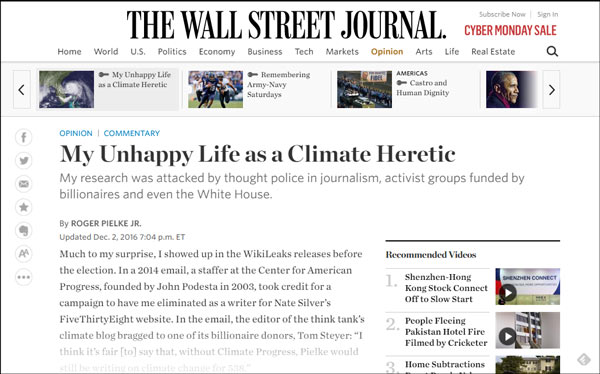
Don’t worry, scientist Roger Pielke, Jr., informs us. He is doing fine — he has tenure.

It is too bad, though, that he no longer works in climate science.

He was drummed out of that endeavor by journalists, big-monied foundations, and the White House.

Climate Scientist

Are you skeptical? Well, drill down into the Podesta emails on WikiLeaks. There you can read infamous billionaire Tom Steyer gloating, “I think it’s fair [to] say that, without Climate Progress, Pielke would still be writing on climate change for 538,” a popular website. Pielke has not been published there at all since 2014.

Pielke had made the mistake of publishing the results of his research. He claims not to be heretical on the main points of the current orthodoxy. But Pielke ticked off all the wrong people with his demonstration that the evidence did not back up the climate change movement’s much-repeated charge that the weather has gotten more traumatic as the planet has gotten warmer.

Pielke relates all this in a fascinating Wall Street Journal commentary, “My Unhappy Life as a Climate Heretic.” Pielke is actually somewhat philosophical about the political and foundational forces arrayed against him — expressing more dismay at his betrayal by journalists and academics.

“You should come with a warning label,” jested one journalist who had merely quoted him. “Quoting Roger Pielke will bring a hailstorm down on your work from the London Guardian, Mother Jones, and Media Matters.”

This “hailstorm” is more widespread and damaging than the results of global warming itself. It effectively distorts both scientific research and the news.

Thus, a political orthodoxy rides herd over public opinion. Over us. By squelching good journalism and honest science.

This is Common Sense. I’m Paul Jacob.


Printable PDF

global warming, climate change, skeptic, Pielke, science, illustration


Categories
Accountability free trade & free markets insider corruption national politics & policies responsibility

United States of Corruption

When Hillary Clinton assured her insider sponsors (as we learned through WikiLeaks) that there would be a crucial difference between what she tells the people and what her actual policies would be, she was not merely admitting to a private and a public face.

The President is legally, and by honor, bound to serve the American people, not Goldman-Sachs. What she was confessing to was more than the mere appearance of a conflict of interests.

She boasted a plan of betrayal.

In that light, President-elect Donald Trump’s international business deals seem . . . what? His first diplomatic meeting — with Japanese Prime Minister Shinzo Abe — included his daughter and partner-in-business Ivanka.

It seems to at least wander into conflict-of-interest territory, if not stake claim and hoist up a flag proclaiming Trumpistan America!

So I was very pleased, yesterday, when the President-elect vowed to step out from the running of his global business and branding empire.

Earlier, he had brushed off conflict-of-interest concerns, saying he could run his empire and . . . ours.

Apparently, his new White House appointees have convinced him that this business dealing while President was a huge problem. “I feel it is visually important,” he explained Wednesday morning, “as president, to in no way have a conflict of interest with my various businesses.”

Thanks, Steve Bannon?

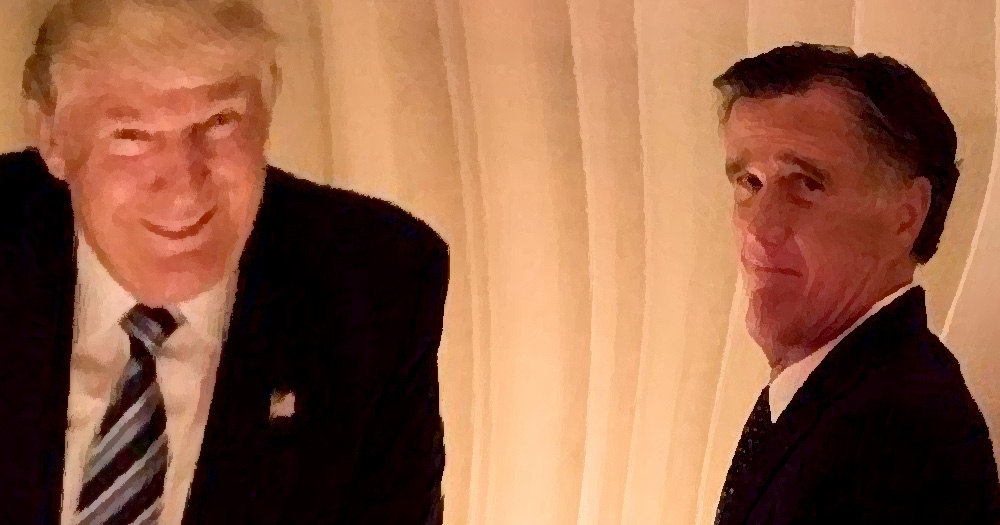
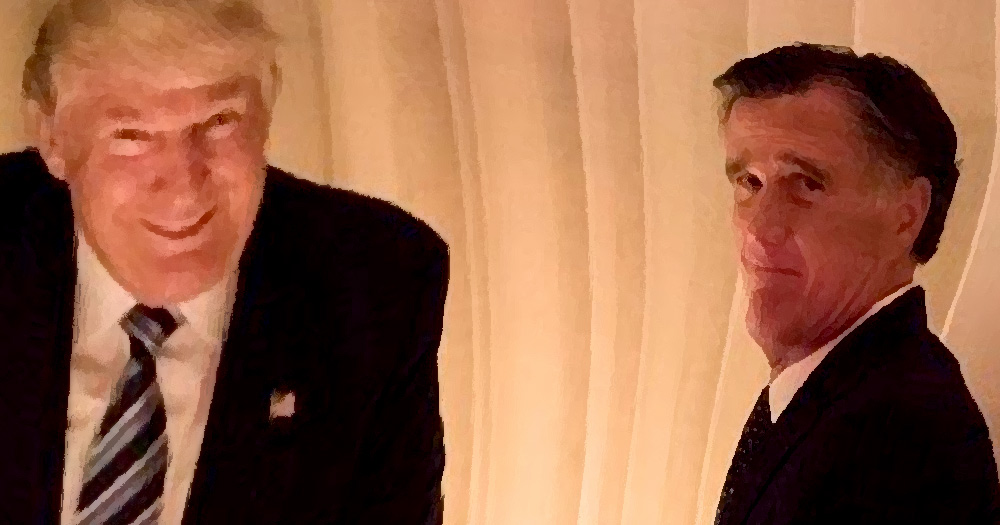
Or, maybe, Mitt Romney, with whom he dined* the night before?

I hope Mr. Trump follows through with this, as well as distance himself from business partner Ivanka as unofficial policy advisor.

Americans did not reject Corrupt Hillary only to wind up with a Corrupt Trump set.

This is Common Sense. I’m Paul Jacob.


Printable PDF

Romney, Trump, crow, corruption, dinner, illustration


Categories
ideological culture media and media people moral hazard nannyism national politics & policies porkbarrel politics responsibility too much government U.S. Constitution

Diversity, Identity, and the Liberal Implosion

“To paraphrase Bernie Sanders, America is sick and tired of hearing about liberals’ damn bathrooms.”

Finally. Some sense from the New York Times.

Mark Lilla, in “The End of Identity Liberalism,” delivers a valuable lesson about political correctness — without once mentioning the term “political correctness.”

Now this is a lesson we can get behind.

The problem is “diversity.” The center-left became so obsessed with it that it helped sink the last election for Hillary Clinton, Democrats at large, and the coherence and legacy of President Barack Obama.

“However interesting it may be to read, say, about the fate of transgender people in Egypt,” Lilla wrote in the Friday think piece, “it contributes nothing to educating Americans about the powerful political and religious currents that will determine Egypt’s future, and indirectly, our own.”

Fixating on diversity of gender identity and racial make-up in business and government has scuttled the rights-oriented approach of the older liberalism.

Alas, Lilla is not talking about the liberalism of J.S. Mill or Lord Acton. He is talking about FDR.

But compared to today’s “identity liberalism,” FDR’s burdensome promises look like sheer genius. And Lilla understands at least one thing about diversity: “National politics in healthy periods is not about ‘difference,’ it is about commonality. And it will be dominated by whoever best captures Americans’ imaginations about our shared destiny.”

He does not bring up the real liberal message: that the way to find commonality is to avoid making government all things to all people. It is to limit its scope, instead, so the president of the United States isn’t every school’s bathroom monitor.

Perhaps an essay on The End to Hubristic Liberalism is required?

Another day. And probably another paper.

This is Common Sense. I’m Paul Jacob.


Printable PDF

identity, diversity, politics, individualism, rights, individual, illustration, crowd


Original (cc) photo by James Cridland on Flickr

Categories
Accountability general freedom ideological culture media and media people nannyism Regulating Protest responsibility too much government

Tyranny’s Days Are Numbered

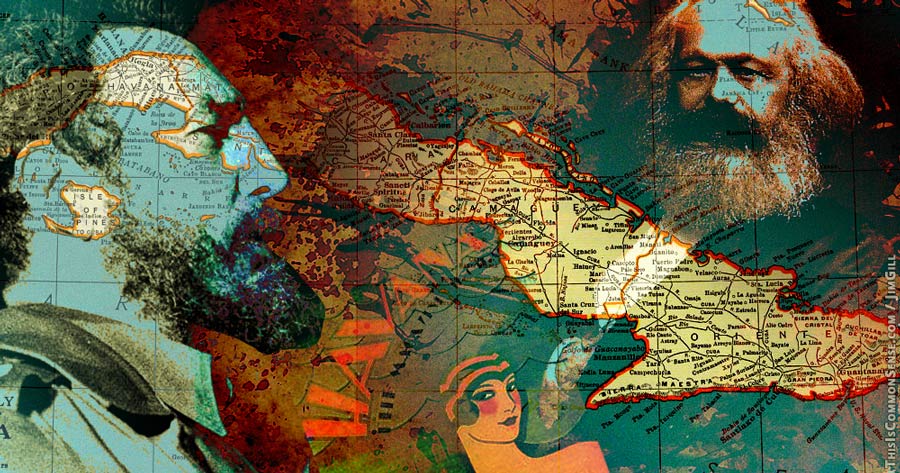
Fidel Castro, the Cuban dictator for half a century, died Friday night.

“Although Castro was beloved by a legion of followers,” The Washington Post acknowledged, “detractors saw him as a repressive leader who turned Cuba into a de facto gulag.”

Many on the American left — especially in Hollywood — have been surprisingly enamored of Castro, and the supposed “accomplishments” of better education and healthcare delivery in his socialist paradise.

I guess we must all weigh whatever policy advances were made against Mr. Castro’s faults.

As the New York Times detailed: “Foreign-born priests were exiled, and local clergy were harassed so much that many closed their churches. . . . a sinister system of local Committees for the Defense of the Revolution that set neighbors to informing on neighbors. Thousands of dissidents and homosexuals were rounded up and sentenced to either prison or forced labor. . . . jailing anyone who dared to call for free elections. . . . imprisoning or harassing Cuban reporters and editors.”

Fidel Castro’s death reminds me of Irving Berlin’s jazz tune about Adolf Hitler, When That Man is Dead and Gone:

What a day to wake up on

What a way to greet the dawn

Some fine day the news’ll flash

Satan with a small mustache

Is asleep beneath the lawn

When that man is dead and gone

Saturday morning, that news finally flashed for Cuban Americans in south Florida. Followed by jubilation. Horns honking. Smiles, cheers and songs. Jigs were danced.

Fidel Alejandro Castro Ruz — that dictator, the person who imprisoned and murdered many seeking freedom — is dead and gone.

For now, sadly, his brand of tyranny continues through brother, Raúl Castro. But its days, too, are numbered.

This is Common Sense. I’m Paul Jacob.


Printable PDF

Castro, death, Cuba, Communism, freedom, illustration


Categories
ideological culture individual achievement nannyism responsibility too much government

Don’t Dress for Excess

Undoubtedly, men have it easy in several ways that women do not. Take something only seemingly trivial: clothing.

When men need to dress to impress, the answer is simple: a suit. There is not really a lot of variety here, and little is required of a man in his choice of suit.

Women, on the other hand, do not have a business and formal occasion uniform to rely upon.

Instead, they have fashion.

Which is a whirl of constant change and a world of enervating expense.

I wouldn’t put up with it. But then, I’m a man. The modern dress suit was developed to meet men’s needs for functionality as well as excellence. And our need to not think hard on a matter of mere garment.

So it is with no small pleasure to read, in the Telegraph, of a professional woman who forswears fashion to wear just one design of clothing. “‘I can tell you the cashier in the store look[ed] pretty confused when I asked if she had 15 extra sets of the whole outfit,’ she jokes, ‘but all in all, choosing the uniform was a pretty pain-free process.’”

And the style choice seemed obvious: “I’ve always felt that black and white is a cool and classy look,” so that’s what she went with.

She made herself culturally equal with men. Took for herself a formerly all-male advantage. And she did not depend upon a man for that advance, he-for-she style.

And did not look to government.

This is the way forward.

This is Common Sense. I’m Paul Jacob.


Printable PDF

fashion, government, suits, illustration


Categories
Accountability crime and punishment folly nannyism national politics & policies responsibility too much government

Virtually Useless

Here is something I don’t quite understand about us moderns — we, oh-so-sophisticated citizens of the world; we who say that government is instituted to help us . . . but often we expect almost no real help when it comes to even the basics.

Take this very “virtual” venue: the Internet; “the Web.”

This wasn’t a thing in the first decade of my adult life. I never expected to spend so much time “on” something that did not, then, exist in any meaningful way.

Well, computers opened up brave new worlds for us, but, did you notice? Bad guys were right there from the beginning, making “viruses” and “spyware” and “malware” of all kinds. Destroying billions of dollars of data and equipment, robbing us of the most important thing of all: time.

And what did the United States government do?

Nothing, or next to it.

Belatedly, and haphazardly, it scraped together a digital defense for its own infrastructure, and began to cook up ways to surveil us all.

But did it offer to help? What programs did it provide the public, or the states, to assist us with bad guys trying to steal our savings, credit, and virtual identities?

I haven’t seen anything. And our local governments have stood around useless, too.

Yet I haven’t heard anyone complain.

Our security has been up to us. Long ago, John McAfee invented the first anti-virus software, and an industry grew up from his kernel — and that industry is where we turn to for help.

Government has mostly just stood by — in the sole area of the computer industry that it could plausibly have warrant to “interfere.”

This is Common Sense. I’m Paul Jacob.


Ask the next question.

Questions Answered:

Does government fulfill its main function consistently?

Who do Americans turn to for effective security?

The Next Question:

If government doesn’t even bother doing its main job, why give it more jobs?


Printable PDF

web, crime, virus, government, illustration


Categories
Accountability ballot access general freedom incumbents initiative, referendum, and recall national politics & policies political challengers responsibility too much government U.S. Constitution

Votes Without Poison

Strange election. So . . . round up the usual suspects!

Immediately after Hillary dried her tears and conceded, out came the Tweets, then the analyses: the “third parties” are to blame!

Over the weekend, I focused* on one such election post-mortem. The basic idea is not altogether wrong: minor party efforts together may have cost the Democrat her Electoral College advantage this time around, just as Nader’s Green Party run spoiled Al Gore’s bid in 2000 and several past congressional races have been spoiled for the GOP by Libertarians.

Is there a problem here? Yes. But do not blame the minor party voters. It’s the way we count their votes that is “problematic.” The current ballot-and-count system turn voters most loyal to particular policy ideas into enemies of those very same ideas.

When we minor party voters turn away from a major party — usually because said party tends to corrupt or betray our ideas, or make only small steps toward our goals — our votes aren’t so much wasted as made poisonous.

Because the candidate least preferred may prevail.

But there’s a way out: On election day, voters in Maine showed how to cut through the Gordian Knot. Voting in approval for Question 5, Maine now establishes “ranked choice voting.”

Under this system, you don’t “waste” your vote when expressing a preference for a minor party candidate. You rank your choices and, if your first choice proves unpopular, your second choice (or maybe your third) gets counted. So you don’t “poison” your cause.

Republicans and Democrats have more than enough reason, now, to adopt ranked choice voting across the country.

This is Common Sense. I’m Paul Jacob.


* See yesterday’s links page to my weekend Townhall column for the basic references. But there were many, many articles on the Minor Party Effect, including a skeptical one by Sasha Volokh’s.


Ask the next question.

Questions Answered:

What is the effect of minor parties on major party outcomes?

What causes those effects, voter intent or something else?

Is there a way to prevent this, short of further sewing up the ballot access system to minor parties?

The Next Question:

What might our elections look like if people spent more time discussing issues and ideas … and less about class, culture wars, and sex crimes?


Printable PDF

ranked choice, vote, voting, democracy, clown, illustration


Categories
Accountability general freedom ideological culture moral hazard national politics & policies political challengers responsibility too much government U.S. Constitution

The Wisdom of the Founders

“At a certain point, you have to let go for the democracy to work,” President Barack Obama told HBO’s Bill Maher last week, praising “the wisdom of the founders.”

“There has to be fresh legs,” he continued. “There have to be new people. And you have to have the humility to recognize that you’re a citizen and you go back to being a citizen after this office is over.”

Maher failed to ask Mr. Obama how this “fresh” viewpoint squared with his support for Mrs. Clinton. Nevertheless, let’s applaud the president’s endorsement of term limits.

Speaking of the founders, and limits on power, and this being Election Day, I’m reminded of a commentary in Forbes, back on Election Day four years ago, written by Ed Crane, the man who built the Cato Institute into one of the nation’s preeminent think tanks. Bemoaning the “interminable presidential race,” Crane wished for “a nation in which it really didn’t matter who was elected President, senator or congressman.”

“Don’t get me wrong, because I’m not saying it doesn’t,” explained Crane, “only that it shouldn’t.” He added, “I believe the Founders had a similar view.”

His point is simple: Getting to vote for your next president and senator and congressman is swell, but it’s important to have a Constitution that restrains those elected, so they “don’t have a heck of a lot of power over you or your neighbors.”

“We are a republic of limited governmental ­powers,” or should be, argued Crane. “Such a nation allows for sleep on election night.”

Instead of gnashing of teeth.

This is Common Sense. I’m Paul Jacob.


Printable PDF

Constitution, voting, democracy, Ed Crane, fear


Categories
Accountability ballot access incumbents moral hazard national politics & policies political challengers responsibility

Vote Early & Often?

Voted yet? The Pew Research Center thinks about 50 million Americans have, representing 38.5 percent of the voter turnout forecast.

I’m for making it as easy as possible for people to cast a ballot. Who isn’t? Well, I mean who among normal people isn’t? I’m not counting politicians and their hacks.

But even I am opposed to extended “early voting.”

Here’s why:

First, the longer the voting period goes, the greater the cost — as more paid advertisements, phone calls and mailings are needed to keep reaching voters over many weeks. No problem here with more money in politics — money is essential, and my candidates and ballot issues could certainly always use more promotion. But let’s not artificially advantage big money by running the meter.

Several states now allow more than six weeks of voting prior to so-called Election Day. Even a three-week voting period is far more expensive than building toward a single day — or, say, a weekend through Tuesday voting period (four days).

Second, we ought to vote together, close to the same time, all of us privy to the latest public knowledge. This year’s drip of near daily “October”* surprises, thanks to WikiLeaks and the FBI, shows the potential problem should a major scandal or incident impact the race after so many folks have already voted.

Third, early voting tends to advantage incumbents. Challengers often don’t catch up to the better known and organized incumbent until the final days of the race.

As for voting often, as in more than once, that’s a crime. Plus, with these candidates, once is more than enough.

This is Common Sense. I’m Paul Jacob.


*Well into November, some of these surprises, eh? I mean, it is as if they saved the blood rituals for last.


Printable PDF

vote, early, often, democracy, early voting, illustration, joke, meme