Categories
Accountability crime and punishment government transparency insider corruption media and media people moral hazard national politics & policies responsibility

Stranger Counsels

The office of special counsel, like that of the special prosecutor in days (and administrations) of yore, is a strange one. Not mentioned in the Constitution, it is institutionally slippery. An executive branch position designed to investigate the executive branch — there is no way it cannot be . . . “problematic.”

Just in time for Halloween, Special Counsel Robert Mueller, tasked with looking into the Russian connections of the Trump administration — particularly electoral mischief* — landed his first fish this week, Paul Manafort and Rick Gates. The two have been charged with, and pled innocent to, twelve criminal counts related to their activities in Ukraine before their association with Trump. There are tax dodging charges, too, including something called “conspiracy to commit money laundering.”

And while the whole bizarre Russia story has now launched into a feeding frenzy, it appears that it just became . . . mundane. “Legal experts said the court filings indicate Mueller is running a serious, deliberative, and far-sighted inquiry,” says The Atlantic.

Meanwhile, the weird relations between the Clintons and Russia loom on the horizon, rather like that smoky monster from the Upside Down on Stranger Things 2.

But hey, none of this is shocking. Troll through the modern state and you will find corruption. You can land all sorts of fish.

Including suckers.

Could we be those suckers?

Since this sort of thing can always be found — and the Manafort skullduggery seems somewhat tangential to Russian electoral influence, despite the man having served a stint as Trump’s campaign manager — is this just a way to get us to look the other direction from anything really meaningful?

This is Common Sense. I’m Paul Jacob.

*And let’s not pretend this is new. Foreign influence was an issue in the campaign of 1800.


PDF for printing

Categories
Accountability Common Sense incumbents initiative, referendum, and recall local leaders moral hazard national politics & policies responsibility term limits

Agreeable America

Americans actually agree on a lot of things; it’s a pity that today’s media and political debates play up the discord.

Or so argues A. Barton Hinkle at The Richmond Times-Dispatch. Sure, he admits, “[a] lot of people seem willing to tear your head off over the smallest thing.” But “on some topics, the public is of one mind, or as close to that as you can get.”

Hinkle notes that “Nine out of 10 Americans think a background check should be required for every firearm purchase.”  A few percentage points fewer wish to keep “Dreamers” in the country; a mere one point fewer disapprove of civil asset forfeiture. Medical marijuana is approved of by 83 percent of Americans.

Not on Hinkle’s list? American agreement on term limits. A year ago, a Rasmussen Poll found support for limiting congressional terms at 74 percent of likely voters, with only 13 percent opposed and 13 percent undecided. This overwhelming public support has been consistent for many decades.

But consistently ignored by Congress. Not so surprisingly.

Can Americans put their united oomph behind their overwhelming agreement? U.S. Term Limits thinks so.

The group isn’t depending on cajoling the Congress, either. They’re mobilizing concerned citizens to convince 34 state legislatures to call a Term Limits Convention.* The convention’s purpose is to propose a constitutional amendment for congressional term limits, which then still requires 38 states to ratify it.

Rather than brewing up a civil war over tweets and “microaggressions,” join the Term Limits Team.

Let’s agree to agree. And make our representatives agree, too.

This is Common Sense. I’m Paul Jacob.

* As Article V of the U.S. Constitution states, “The Congress . . . on the application of the legislatures of two thirds of the several states, shall call a convention for proposing amendments, which, in either case, shall be valid to all intents and purposes, as part of this Constitution, when ratified by the legislatures of three fourths of the several states . . .


PDF for printing


Categories
Accountability incumbents insider corruption local leaders moral hazard national politics & policies responsibility term limits

Our Experience with Experience

It seems exceedingly plausible that the longer one serves as a legislator, the better legislator one would become.

Yet voters back home have noticed something: the longer in office, the less representative their so-called representative tends to become.

No wonder that in those states where Americans have been permitted to vote on congressional terms limits, that vote has been a resounding, “Let’s limit ’em!”

In a Washington Post op-ed, Greg Weiner, associate professor of political science at Assumption College, praised Senators Jeff Flake (R-Ariz.) and Bob Corker (R-Tenn.) as “voices for congressional power” and “defenders of congressional prerogative.” He worries their departure weakens Congress as an institution, further eroding a critical check on the president and the executive branch.

“The problem pertains far less to opposition to this president,” Weiner points out, “than to the long-range erosion of congressional resistance to the presidency as an institution.”

This caught my attention because we desperately need Congress to function as a co-equal branch of government and because opponents of state legislative limits* often assert a similar argument: term-limited legislatures are less able to check the power of the governor and executive branch agencies.

“Congress has been in decline for generations,” Weiner acknowledges. What else has been happening over this time? Politicians have been loitering in Congress longer and longer, term after term after term. 

Hmmm. The correlation is between a weakened Congress and more experience, not less.

Let’s further note that Flake is only in his first Senate term and Corker his second.

After nearly four decades in office, is, say, doddering Sen. Thad Cochran (R-Miss.), providing better oversight?

This is Common Sense. I’m Paul Jacob.


* The 15 states that have them — Arizona, Arkansas, California, Colorado, Florida, Louisiana, Maine, Michigan, Missouri, Montana, Nebraska, Nevada, Ohio, Oklahoma, South Dakota — contain 37 percent of us.


PDF for printing


Categories
Accountability Common Sense folly general freedom media and media people moral hazard nannyism national politics & policies responsibility term limits too much government

It’s the Stupid Spending

These United States are approaching a crisis. Mounting debt seems increasingly unpayable. Sovereign default and financial chaos are “in the offing” — drifting from the (future) horizon to the (present) shore.

The costs of our debt load have been accommodated as astute economists predicted, with the weakest recovery in American history.

Seven years ago I wrote:

According to increasing numbers of Americans, it’s the level of spending by government that must decrease. We must balance budgets. Soon.

One could play sloganeer and say “It’s the spending, stupid”; or, twist that, to say “It’s the stupid spending.” But however you formulate the problem, what the new Republican House must do is find a way to cut spending.

They haven’t. Is there any reason, even with super-duper businessman Donald Trump riding herd, that they will make net cuts?

We can expect gross spending to increase and the debt to balloon even bigger.

Why?

Well, we are trapped.

Even the politicians themselves feel trapped.

You see, once the government begins a program, a constituency comes to depend upon it, and resists being “betrayed.” And the media supplies a steady stream of sob stories about the brutality of “austerity.” Politicians fear the passion of voters reacting to a specific hyped human need more than the general desire for less spending. So politicians increase the stupid spending.

Well, if the politicians are trapped, release them. Free them.

How? Term limits.

Congressional term limits would un-trap not just the pols — it’d free the voters, too. Let’s end the pretense that sending the same politicians to Washington term after term can produce local prosperity. Oh, the power of incumbency may lavish benefits on career congressmen, but it doesn’t pay off for the rest if us.

This is Common Sense. I’m Paul Jacob.


* It was President Harry Truman who said that term limits would “help to cure senility and seniority — both terrible legislative diseases.”


PDF for printing


Illustration: Gustave Doré, Avaricious and Prodigal”


Categories
Accountability local leaders media and media people moral hazard national politics & policies political challengers responsibility term limits

Sic Transit Gloria Flake

Yesterday, a major American politician gave up.

Sort of.

Senator Jeff Flake, the junior member of the upper chamber from the State of Arizona, took to the Senate floor to announce that his “service in the Senate will conclude at the end of my term in early January, 2019.”

Actually, most of the speech was an appeal to President Trump.

Or a lambasting.

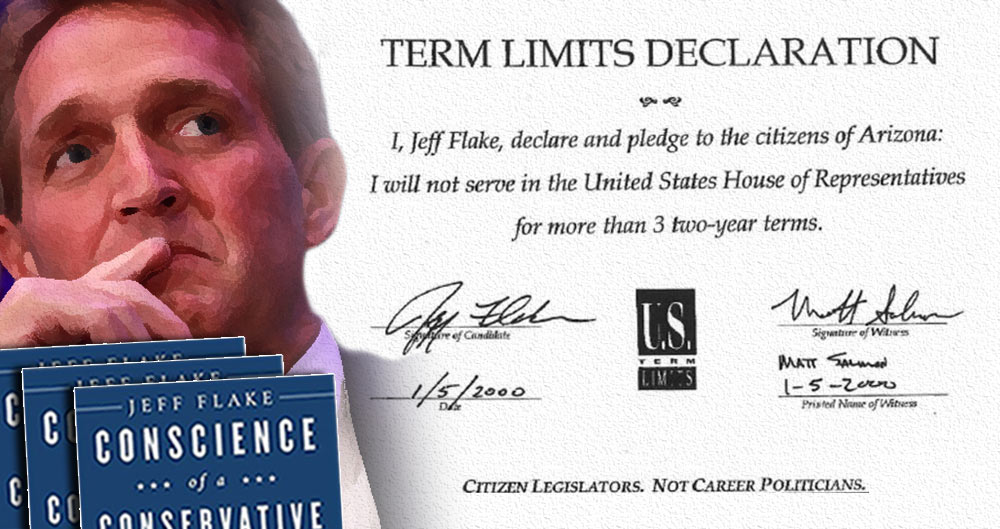
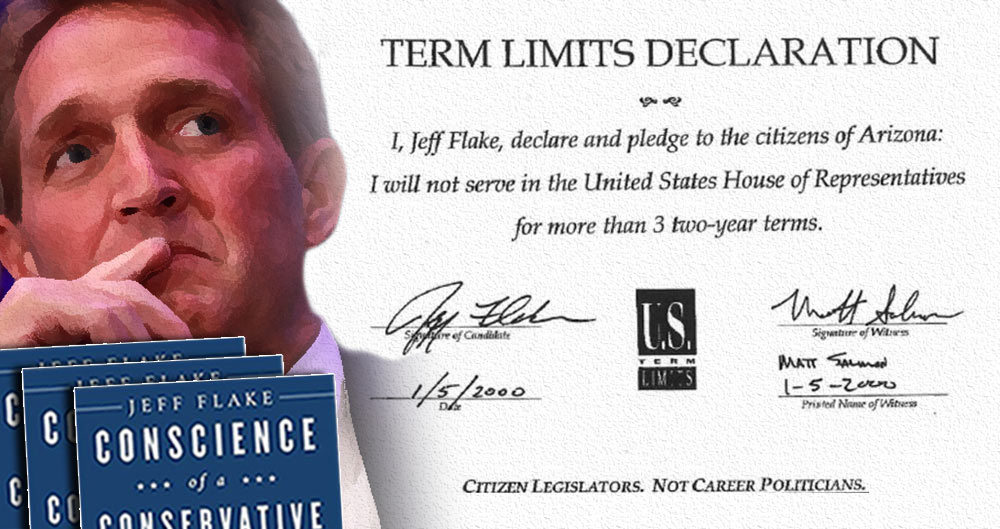
In either case, he was echoing his recent book, Conscience of a Conservative: A Rejection of Destructive Politics and a Return to Principle, which columnist David Brooks has described as a “thoughtful defense of traditional conservatism and a thorough assault on the way Donald Trump is betraying it.”

In the Age of Trump, anti-Trumpian manifestos are . . . controversial in GOP ranks. And his opposition has cost him. All bets were against him winning re-election.

“I believe that there are limits to what government can and should do,” Flake wrote in a letter to supporters, going on to say “that there are some problems that government cannot solve, and that human initiative is best when left unfettered, free from government interference or coercion.”

Solid principles. Principles I share. But how principled was Flake? He began his career promising to limit his own terms, in accordance with . . . conservative principles. And yet the man from Snowflake, Arizona, broke that promise in 2006, holding on to his House seat for three more terms.

For his remaining 14 months in the Senate, Flake can return to the principle he reminded himself of in yesterday’s speech: “Sustained incumbency is certainly not the point of seeking office.”

There’s life after Congress. And Jeff Flake can do good things in the real world.

This is Common Sense. I’m Paul Jacob.


PDF for printing


Categories
Accountability government transparency insider corruption local leaders moral hazard national politics & policies political challengers responsibility

Omission of Character

One downside to jumping to the wrong conclusion is that the failure to even look for the correct, accurate conclusion inevitably follows. 

This sleepy odd-year campaign for governor of Virginia has recently been riled by charges of racism. Democratic Party gubernatorial nominee Frank Northam made the “mistake” of “omitting the party’s candidate for Lt. Governor, Justin Fairfax, from a small printing of literature for union members about the Democrats’ statewide slate. 

Northam is white and Fairfax is black. 

“[A] slap in the face to Justin and to black voters,” is what Quentin James, who runs a PAC working to elect black candidates, called the removal of Fairfax from the literature. He added that it “reeks of subtle racism” and “sends a signal across the state, that we, as black voters, are expendable.”

Noting that black voters make up 20 percent of the state’s electorate, Think Progress dubbed Fairfax’s deletion: “mindboggling.”  

Was this a “dis” and did it really have anything to do with Fairfax being black?

Well, Fairfax labeled it a “mistake,” but his exclusion from the flyer was certainly not inadvertent. It was by clear-eyed design.

The Laborers’ International Union of North America (LiUNA), a $600,000 donor to the coordinated state Democratic campaign, requested that Fairfax be removed from literature their members will distribute. The union is at odds with Fairfax over his opposition to two state pipeline projects the union favors.

So, Northam didn’t throw Fairfax under the bus because Fairfax is black. No sirree. Northam threw Fairfax under the bus to placate a powerful, well-heeled special interest group.

Northam isn’t a racist. He’s just a self-interested, disloyal politician.

This is Common Sense. I’m Paul Jacob.


PDF for printing


Categories
Accountability media and media people moral hazard national politics & policies responsibility

Asleep at the Constitution

Are we at war in Niger, too? Do our “representatives” in Congress know?

The answer to the first question is, obviously, yes. The answer to the second is, admittedly, no

Yesterday, Meet the Press host Chuck Todd asked hawkish Sen. Lindsey Graham (R-S.C.) what the four U.S. soldiers ambushed and killed weeks ago were doing in Niger. “I can say this to the families,” Sen. Graham offered, “they were there to defend America,” before conceding that, “[W]e don’t know exactly where we’re at in the world militarily and what we’re doing.”

Oh.

Graham acknowledged he had been unaware U.S. military forces were even in the African country. And still hasn’t “been briefed.” Later in the program, Senate Majority Leader Chuck Schumer (D-N.Y.) also confessed his profound ignorance . . . before reading in the newspaper about the deaths of four soldiers there.

Still, Sen. Graham expressed great hope that Sen. John McCain (R-Ariz.) could “create a new system” to ensure that “if somebody gets killed there, that we won’t find out about it in the paper.”

Huh?

Doesn’t Congress’s job description include something about debating and deciding on policies, providing funding, and checking executive power?

Not, surely, cuddling in ignorance and burping up pablum.

Cradled in their long-term careers, our congressional delegates neither debate, deliberate, nor oversee much of anything.

In any case, we can be sure that Congress’s role in our constitutional system is not to scoop reporters to war news.

This is Common Sense. I’m Paul Jacob.


PDF for printing


Categories
Accountability folly ideological culture insider corruption media and media people moral hazard national politics & policies responsibility too much government

Choice Corruption

What is corruption? said no jesting Pilate ever.

But please, stay for an answer.

A week ago, Jimmie Moore pleaded guilty to filing a false campaign finance report in order to conceal a $90,000 payment to drop out of a congressional race. Moore is a former Philadelphia judge (heavens). The nearly one-hundred-grand came from the incumbent he was challenging: Congressman Bob Brady (D-Pa.).

Moore, who implicated Rep. Brady in the scheme, now faces as many as five years in prison. Brady, for his part, has yet to be charged.

A pro-life politician’s 15-year tenure in Congress has ended. Tim Murphy (R-Pa.) has resigned following revelations that he had urged the woman with whom he was having an extramarital affair to have an abortion. Additional bad behavior — “a culture of abuse and a culture of corruption” in his congressional office — was detailed in an in-depth Politico exposé.

But for the biggest scandal story, go Hollywood. Movie mogul Harvey Weinstein has been ousted from The Weinstein Company upon allegations that he had committed criminal sexual assaults for decades. As a huge donor to the Democratic Party, questions abound. Which Democrats had knowledge of Weinstein’s behavior and yet remained silent?

That ‘look the other way’ rot has already spread to a media/entertainment institution: Saturday Night Live. Last Saturday night, observers were surprised that SNL did not feature even one joke at liberal Weinstein’s expense.

“It’s a New York thing,” quipped Producer Lorne Michaels when questioned about the omission.*

I’m not big on launching boycotts at every turn. But how could anyone who values evenhandedness turn on SNL next Saturday — or the following — as if nothing had happened?

Who needs these jesters covering for corruption?

This is Common Sense. I’m Paul Jacob. 


* Audience members at a rehearsal said there had been a Weinstein joke, which garnered a big laugh, but it was apparently pulled from the live broadcast.


PDF for printing


Categories
Accountability Common Sense general freedom media and media people national politics & policies Regulating Protest responsibility

Time for Action

More protests during the national anthem; more opposition to those protests by the Trump administration; more recriminations about the administration’s opposition to the protests. Ah, modern times.

Let’s review:

  1. NFL players have a constitutional right to take a knee during the national anthem.
  2. NFL owners do have or could have (depending on who you believe) a contractual right to require players to stand for the national anthem or face action.
  3. Presidents have a right to suggest that owners fire NFL players who take a knee during the anthem, though I’d really prefer they not use the term SOB — though again they have a right to say it.  
  4. Vice-Presidents have a right to leave an NFL game if NFL players take a knee during the anthem or, believe it or not, for any reason they feel like. And under our free system, they can even go further, and plan their reaction ahead of time depending on what action players take.*
  5. NFL fans have a right to continue to be fans or not.

I love football, but haven’t followed the NFL for decades.

I love rights even more. And I think we certainly ought to be talking about and, more importantly, working on criminal justice reform. Let’s not lose sight of that in the controversy over the NFL protests.

Perhaps, the time for protest is ending. The time for action is now.

This is Common Sense. I’m Paul Jacob.


* Did Vice-President Mike Pence leave the Colts-49ers game as a PR stunt? Well, every move the president or the VP make is a public relations stunt. If that’s the primary attack on the VEEP’s actions, he has turned the corner and is in the clear.


PDF for printing


Categories
Accountability folly ideological culture national politics & policies responsibility

Politics as Painfully Usual

The crazed nature of our leaders’ willingness to spend beyond revenue, and accumulate debt, is not limited to one party. Both Democrats and Republicans are responsible for their outrageously perverse fiscal policies.

Their irresponsibility hides in plain view, and can be seen in most of the major policy discussions of our time. Take two:

  1. the Democrats’ idea of putting every American on Medicare and
  2. the Republicans’ current tax reduction bill.

Though the Republicans often pretend to be all about something called “fiscal conservatism,” their murky tax plan is not fiscally sound. Not yet, anyway — after all, it is “evolving.”

And I expect it to get worse, not better.

“The current plan proposes about $5.8 trillion in tax reduction offset by about $3.6 trillion in base-broadening offsets, meaning that it would result in a $2.2 trillion deficit increase over the next decade,” Peter Suderman summarizes over at Reason.

They have a number of cuts in the works, but also plan to spend more on defense and the like. The debt would go up.

But if the Republicans are hypocritical and irresponsible, the Democrats add sheer insanity to their irresponsibility.

“Medicare for All” is pushed by Senator Bernie Sanders, who serves Vermont, where a similar universal system was enacted, only to be repealed after it proved unaffordable even with huge tax increases. All single-payer/socialized medicine proposals would require whopping tax increases to work, and the increases in spending would inevitably yield greater deficits.

Besides, Medicare is heading for financial Armageddon. Adding more burdens to a system that they cannot (or simply will not) now make solvent?

Only a politician could consider such a “solution.”

This is Common Sense. I’m Paul Jacob.


PDF for printing


Art by John Goodridge on Flickr