Categories
folly general freedom government transparency national politics & policies too much government

Safety, Savings and Symbolism

How can the U. S. save $2.5 billion a year, reduce the federal workforce by 4,000 hires, and engage in a symbolic act of undoubted patriotism, all at the same time?

Get rid of the Department of Homeland Security.

Matt A. Mayer, a former DHS employee who claims to have “written more on DHS than just about anyone,” writes in Reason that dismantling DHS would increase co-ordination and decrease inefficiencies.

Since DHS was put in place, in 2003, to increase governmental co-ordination in the face of terrorist threats, Mayer’s charge that it serves the opposite cause should . . . give us pause.

Establishing the DHS didn’t get rid of turf wars. Why would it? It increased the turf rather than merely reroute chains of communication and command. All other agencies still exist. Extra turf exacerbates co-ordination difficulty.

And then there’s what state and local law enforcement faces: “the multi-headed hydra.” The federal operation remains fragmented, which “only ensures that key items will fall through the cracks between these departments, whose personnel spend far too much time fighting each other for primacy than they should. Our enemies couldnt ask for a more fertile environment within which to attack us.

I added the italics, for emphasis.

Ever since Jimmy Carter ran for the presidency on consolidating bureaucratic departments in the nation’s capital, but delivered, instead, new departments, the “logic” of adding new bureaucracies onto old has proven to be the “easy answer” for insiders. But a transparent failure, for everyone else.

So, start over. Get rid of the inefficient monster.

And take heart: republics don’t have “homelands”; empires do. Let’s stop playing the wrong game.

This is Common Sense. I’m Paul Jacob.

Printable PDF

NSA Hydra


Categories
education and schooling national politics & policies

The Bloomberg Limit

Afraid that scandal-alluring Hillary Clinton may prove too flawed a presidential candidate, some Democrats are talking to billionaire and former three-term New York City Mayor Michael Bloomberg about a 2016 presidential run.

Mrs. Clinton’s “slide is accelerating,” writes New York Post columnist Michael Goodwin. “A damaging new poll goes to the Achilles’ heel of her candidacy: People simply don’t trust her.”

Goodwin gushes, instead, at the “intriguing” possibility of Mr. Bloomberg.

“Wall Street wants Michael Bloomberg to run for president,” reports Business Insider, “but the billionaire isn’t budging.”

And for good reason. He can’t win.

It’s not just me saying so; it’s Michael Bloomberg himself. Last year, he told CBS Face the Nation that he’d consider running . . . “If I thought I could win.”

His honor should know, having spent more of his own money chasing public office than any person in American history.

Why did incumbent Mayor Bloomberg have to spend so much dough? He double-crossed voters on term limits. Bloomberg promised to oppose city council attempts to weaken the limits, but flipped to grab a third mayoral term for himself.

Voter anger “over his maneuver to undo the city’s term limits law,” reported The Times, became . . . well, a big problem. “To eke out a narrow re-election victory over the city’s understated comptroller, Mayor Michael R. Bloomberg spent $102 million of his own money, or about $183 per vote,” explained the New York Times in 2009, “. . . making his bid for a third term the most expensive campaign in municipal history.”

A similar price tag in a presidential race stands at roughly $23 billion. That’s a lot for anyone.

This is Common Sense. I’m Paul Jacob.


Printable PDF

Bloomberg Votes


Categories
ballot access general freedom national politics & policies

The Duopoly Rules

As Americans brace themselves for another presidential campaign, USA Today’s editors hazard that the “configuration” of the Commission on Presidential Debates (CPD) “certainly creates an appearance of a political duopoly designed to limit independent voices.”

In 1987, after the League of Women Voters displeased the two major parties, the duopoly’s respective chairmen cooked up the CPD. Both men indicated that including non-R-or-D candidates was not part of the plan.

Thirteen years later, to keep the CPD’s tax-exempt status, the CPD established a “non-partisan” rule to “fix” an opportunity for minor parties: candidates must garner 15 percent support in the polls for inclusion in the debates.

Fast forward to today, and we witness a new group pushing the CPD to drop that requirement. Change the Rule wants one third-party nominee to be included, provided that candidate is on enough state ballots to mathematically have a chance to win the presidency.

“A third person in the general-election debates would make it harder for the major-party candidates to stick to talking points and platitudes,” agrees USA Today. But the newspaper worries about “unintended consequences,” that rather than the “centrist” they want in the debates, a new system might produce someone “on the far left or far right.”

Dear Editors, the election process ought not be designed to produce a certain pre-arranged ideological outcome.

Establishing a fair system entails not limiting voter choice ahead of time. Voters should get to hear from every candidate on enough ballots to be elected president.

This is Common Sense. I’m Paul Jacob.


Printable PDF

Duopoly


Categories
folly general freedom national politics & policies too much government

Political Theatrics

Our suspicions have been proved: the Transportation Security Administration (TSA) doesn’t secure much of anything; it is mere “security theater.”

After revelations that TSA screeners failed to find weapons and other deadly contraband in 96 percent of tests, David A. Graham, writing for The Atlantic, asked “what kind of theater this is. . . . A period drama, satirizing the 2000s? Vaudeville farce?”

Easy answer: the genre is “statism.”

Statism is the worship of government, or the reliance upon government to do many more than a few tasks. It is very old.

The ancient states arose from conquest, developing as a way to milk the masses for the benefit of the few. That’s what states traditionally do: use force to move wealth from one group to another.

Along the way, the states did do some good. Amidst all their horrors.

But mostly rulers just leveraged myth and bluster to cover crimes.

In more recent times, in this great country, the idea arose that the state should be limited to a few necessary jobs, tightly controlled by the people so that government might actually defend rights, not abridge them.

But this revolutionary democratic-republican ideology did not alter the basic nature of reality, turning the sow’s purse of the conquerors’ art into the gold of the Public Interest.

Without our vigilance, government always reverts back to its roots.

The TSA is simply the latest myth-and-bluster-backed scam aiding the ludicrous notion that government is all-powerful . . . while providing only faux security. Get rid of it; let its people go. Then watch airlines come up with more effective, less intrusive, more passenger-friendly security systems.

Want theater? Try “vigilance theater.”

This is Common Sense. I’m Paul Jacob.

Printable PDF

TSA


Categories
nannyism national politics & policies

For and Against?

Bad ideas take a person only so far.

Proponents of a widely destructive policy may be loath to relinquish it altogether when destructive consequences loom. Yet they may also loathe to see it applied consistently — because of the pain it’ll cause their particular gang.

Harm to others inflicted by lousy ideas? Fine!

Harm to yourself? Not fine!

Hence the semi-reversal by Los Angeles union officials of their demand for a minimum wage of $15 an hour, recently approved by LA’s city council. Union leaders have been among the most ardent proponents of the new minimum, which until now they’ve insisted must be imposed equally, no exemptions for special hardship.

But now union reps like Rusty Hicks want exemptions for unionized companies so that unions are free to negotiate an agreement that, as Hicks puts it, “allows each party to prioritize what is important to them.” Wow! Sounds like he might favor free markets, in which parties to a trade participate, voluntarily, only when priorities are aligned and each expects to gain.

Many motives for Hicks’s contradictory stance are plausible. One is that the requested exception would encourage companies to unionize to escape burdensome new costs. Accept one burden to escape a worse one.

Instead of letting unions cripple all workplaces but their own, let’s “allow each party to prioritize what is important to them” across the board, by letting employers and employees negotiate without any political interference whatever.

This is Common Sense. I’m Paul Jacob.

Printable PDF

Labor Union Logic


Categories
general freedom government transparency national politics & policies privacy too much government

Rand to the Rescue

Nothing gets done in Washington?

Tell that to Kentucky Senator and presidential hopeful Rand Paul. Last night, he single-handily “repealed” Section 215 of the Patriot Act, ending the federal government’s mass collection of our phone records.

At least, for the next few days.

On the floor of the Senate, Paul blocked the USA Freedom Act, a “compromise” bill passed by the House. It would’ve required private telecoms to keep the data, allowing the government to query that data with a warrant.

“I’m supportive of the part that ends the bulk collection by the government,” said Paul. “My concern is that we might be exchanging bulk collection by the government [with] bulk collection by the phone companies.”

In a Time magazine op-ed, he argued, “We should not be debating modifying an illegal program. We should simply end this illegal program.”

Also last week, the Tea Party Patriots joined the ACLU in agreeing with Paul’s position: the USA Freedom Act doesn’t go far enough . . . to protect our civil rights.

Others warn we aren’t safe without maximum snooping and info-scooping by government:

  • CIA Director John Brennan called the metadata program “integral to making sure that we’re able to stop terrorists in their tracks.”
  • Attorney General Loretta Lynch said the expiration amounted to “a serious lapse.”
  • James Clapper, director of National Intelligence — most famous now for lying to Congress about the existence of the metadata program — declared we “would lose entirely an important capability that helps us identify potential U.S.-based associates of foreign terrorists.”

Yet, there’s not a single case where this bulk phone data helped capture a terrorist or stop an attack.

Sen. Paul believes “we can still catch terrorists using the Constitution.”


Printable PDF

Rand Paul vs. the Surveillance State


Categories
folly free trade & free markets general freedom national politics & policies

Raise Your Hand, Dry and Secure

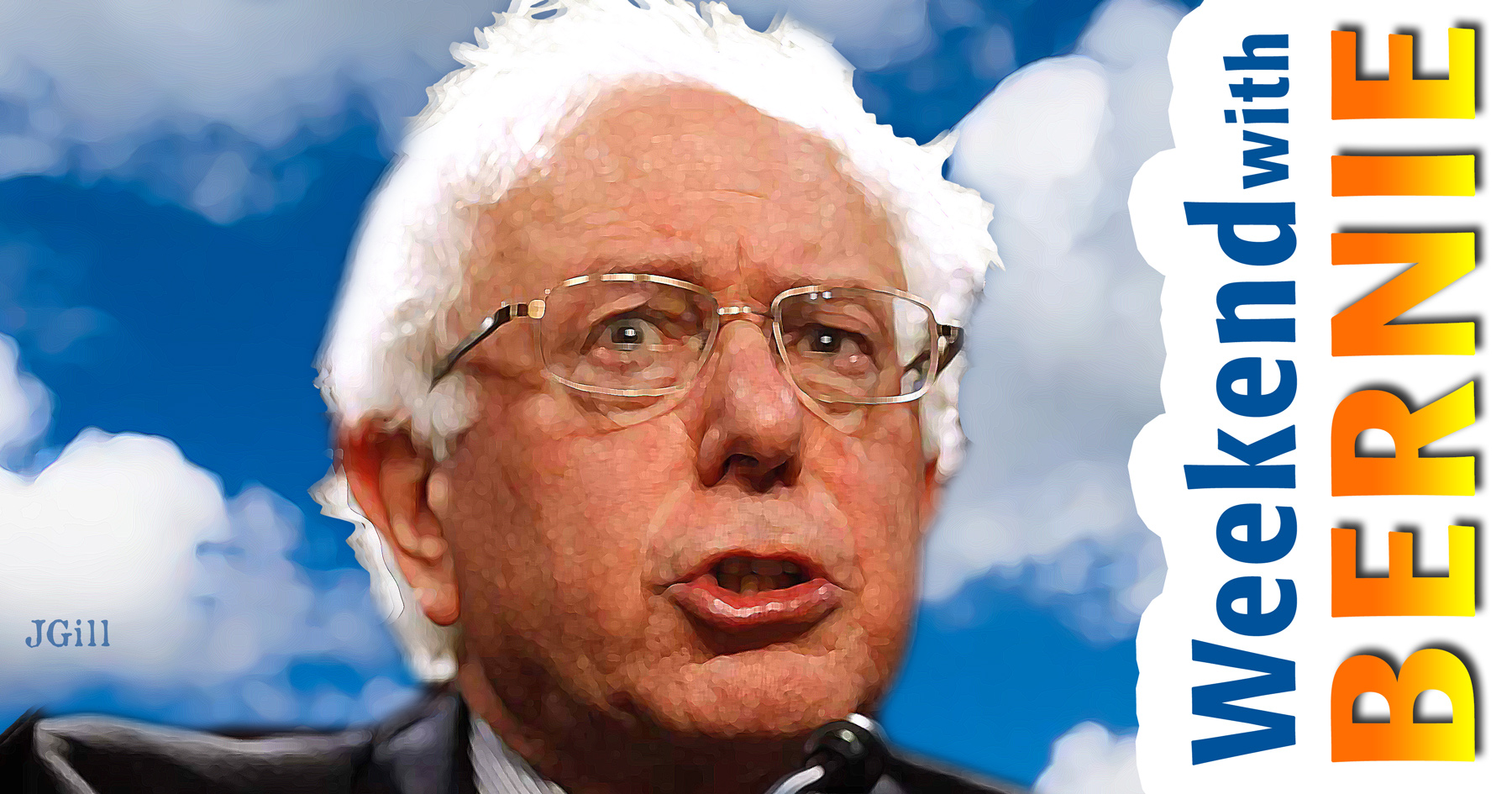
Presidential candidate Bernie Sanders made a splash last week with an off-the-cuff comment. “You don’t necessarily need a choice of 23 underarm spray deodorants or of 18 different pairs of sneakers when children are hungry in this country.”

The candidate whose initials are “B. S.” doesn’t call himself a Socialist for nothing.

The Democratic-caucusing “Independent” Senator from Vermont was expressing a tired old sentiment. See his error? (Raise your hand if you know.)

To make any connection between “feeding the hungry” and cutting back on competitive products one would have to believe there is a fixed stock of wealth, and that we waste it on different brands and whole varieties of antiperspirants and sports shoes.

But there is no such fixed supply.

Supplies are concocted to meet consumer values, wants, and getting rid of competitive products means that some values are not being met . . . and that some folks are not being employed at the rates they could be with more diversity of commodities.

The best way to “feed the hungry” is for the hungry to feed themselves, by being productive — if children, then being fed by productive parents. And to do that, folks need to find their market niche. Which might very well entail another deodorant or shoe.

There is a realm where one person gains at the expense of someone else: redistributive government. If Sen. Sanders wants government to give more money to feed hungry people, he should consider cutting back on some other government expenditure.

Why didn’t B. S. suggest that? Perhaps more than feeding the hungry, he’s interested in feeding government, and his own pride in his own b.s. ideology.

This is Common Sense. I’m Paul Jacob.


Printable PDF

B.S.


Categories
national politics & policies term limits

Unlimited Gall

Some claims don’t persuade. For example, the claim that starting a conversation is an effort to end conversation. Or that one “bullies” officeholders by telling constituents what officeholders are up to.

But so contends a Columbus Dispatch editorial (“Don’t let pledges close discussions”) chastising U.S. Term Limits, my old stomping ground, for spotlighting pols plotting to pulverize term limits.

U.S. Term Limits advised constituents of Ohio State Representatives Bob Cupp and Nathan Manning that neither will pledge to forbear from weakening Ohio’s state legislative term limits — and that both men serve on a commission scheming to weaken the limits.

The organization’s mailing is “out of line in two ways,” the paper opines.

First, lawmakers mustn’t “surrender their autonomy to bullying interest groups” but must consider issues “with open minds.” Should these open minds be closed to any reminders of the legitimate interests of constituents? The Dispatch editors write as if they’d never head of politics and political debate before; anyway, as if it should desist forthwith.

Second, the pledge itself is “misplaced,” because Ohio voters must approve any referendum Ohio lawmakers send to ballot; lawmakers can’t act unilaterally. True. But why take even one bad step on a bad road?

How can the Dispatch’s theme be that USTL seeks to “close” discussions of term limits? U.S. Term Limits would be delighted if all Ohioans engaged in loud and long discussions of term limits, as well as of what Ohio lawmakers hope to do to their constitutionally limited terms in office.

This is Common Sense. I’m Paul Jacob.


Printable PDF

open minds


Categories
folly general freedom national politics & policies

Memorial Day Questions

What do we owe to those who fight and give, as President Lincoln spoke at Gettysburg, “their last full measure of devotion”?

More, surely, than appreciative applause for the troops on airplanes and at professional sporting events . . . with their high-priced, taxpayer-paid military promotions.

First, vets are entitled to contracted-for medical care, as I addressed in greater detail at Townhall.com yesterday — not a Veterans Administration that systematically denies them needed diagnoses and treatments.

Second, wiser strategic decisions going forward. Vets deserve, and we all need, more (not fewer) questions of presidential candidates, such as the hypothetical inquiry of former Florida Gov. Jeb Bush on Iraq, and the hypothetical Libya question Sen. Rand Paul suggests should be posed to Mrs. Clinton.

Bring on the if-you-knew-then questions!

But wait, what about a non-hypothetical: Are we today at war against the Islamic State?

We really should know . . . I mean, on Memorial Day and all.

President Barack Obama claims he has the constitutional power to engage militarily against the Islamic State under Congress’s 2001 Authorization for Use of Military Force (AUMF). A number of legal scholars vehemently disagree. Which may be why, back in February, Obama asked for a new, anti-ISIS AUMF. Congressional Republicans balked, complaining the president’s proposed AUMF isn’t strong enough.

Of course, nothing prevents congressional Republicans from passing a stronger version.

Or better yet, demand that President Obama keep American boys and girls out of harm’s way in the always-messy Middle East.

The murderous leaders of the Islamic State may wish to be at war with us, but we don’t have to humor them. Let Turkey, Saudi Arabia, Jordan, Iraq and Iran defend themselves and their territories from this gang of cutthroats.

This is Common Sense. I’m Paul Jacob.


Printable PDF

Veterans and the political class


Categories
ballot access initiative, referendum, and recall national politics & policies

Anti-Democratic Republicans?

The Republican Party of Ohio paid lawyers $300,000 to keep a competitor off the ballot.

Typical two-party corruption. We can blame the party, yes — but also blame the system.

A “two-party system” is, mathematicians tell us, the logical result of simple plurality/winner-takes-all elections. That is, when the first candidate “past the post” wins enough votes to best any other, that candidate wins.

When you count votes like this, two parties emerge to dominate.

But to really rule the roost, those parties are incentivized to pile on . . . to make it hard for “minor-party” challengers. Ballot access becomes a nasty business.

Last year Charlie Earl ran for the governorship of Ohio as a Libertarian Party candidate. But he was blocked from the ballot. And when the Ohio LP “filed a federal lawsuit to try to force Earl’s name on the ballot,” Ohio Republican Party Chair Matt Borges testified that his party had nothing to do with the legal maneuvers involved.

As Borges put it at the time, “Anyone who’s looking for the conspiracy behind it — it’s just not there.”

Now, it turns out, the conspiracy was there. His party paid the bills.

Whether Borges was lying or not — maybe he was clueless about these shenanigans — the deed got done.

More important than whether Borges himself can be held culpable for the ballot-access conspiracy, it’s the system that encourages such anti-democratic nonsense that needs changing. First-past-the-post elections must go. There are alternatives, as my friends at FairVote.org champion.

As Ohio GOP leaders stand shame-faced with the evidence of evildoing, it’s time to press such reforms.

This is Common Sense. I’m Paul Jacob.


Printable PDF

2 Party Lockout