Categories
Internet controversy social media

All a-Twitter

On Friday, Elon Musk bowed out of his attempt to take over Twitter.

And Twitter stock plummeted over 10 percent in trading on Monday.

Citing the woke corporate social media company’s non-disclosure of information that he had been requesting for many, many weeks, Mr.Musk withdrew his offer.

The big issue, here, is the possibility that Twitter is over-valued because the company has allowed “bots” to proliferate. That is, accounts run by computers and AIs and scammers who create accounts and then just crank out content that have no value for advertising — which is how the company makes most of its money.

“Twitter claims that only 5 percent of its monetizable daily active user (mDAU) base consists of bots,” explains Nicholas Dolinger at The Epoch Times, “but Musk has argued that the number is much higher, and that Twitter, in misrepresenting the total number of bots, has misled him in such a way as to void the agreement.”

The best part of the story may be the “meme” Musk shared about it, “implying that Twitter would face embarrassment at having to disclose information about the prevalence of bots on the platform in court.”

Twitter user @ZanderfromNOLA offers an image that shows that bot problem: multiple accounts for healthcare professionals all saying the exact same thing, word for word, pushing the COVID vaxxes. It could be a propaganda campaign from Big Pharma. Or it could be the CIA. Or China. Or even Russia! Who knows? But the wealth of duplicate and obviously suspect content on the platform suggests that Musk’s initial offering of $44 billion was way too generous.

The humiliation that Twitter has suffered may be well-deserved.

But will humiliation nudge along any decent reforms?

This is Common Sense. I’m Paul Jacob.


PDF for printing

See all recent commentary
(simplified and organized)
See recent popular posts

Categories
First Amendment rights international affairs Internet controversy

The Coffee Connection

We have another indication now that the Internet of Things can be a mixed blessing. Perhaps not every gadget in our homes should be linked to the Worldwide Everything?

The great thing about a coffee maker with a Wi-Fi or Bluetooth connection is that you can set things up with a few taps on your smartphone. Brewing times, strength, temperature, etc., can all be arranged without ever having to trudge from bedroom to kitchen.

The horrible thing, though — in addition to the slim possibility that a hacker will take your coffee machine hostage — is that a Wi-Fi-capable coffee maker made in China may be spying on you on behalf of the Chinazi government.

This is the conclusion of Christopher Balding, a researcher who finds evidence that coffee machines manufactured by Kalerm in Jiangsu, China, collect a diverse array of data.

About their users. 

Stuff like the users’ names and general locations as well as usage patterns.

Balding doesn’t know for sure that the company simply turns over such data to the government. But Chinese companies must cooperate with any government demands, and Balding notes that China often gathers as much data as possible and figures out what to do with it later.

The data-scavenging of the Chinese government is not exactly unique. Think Ed Snowden and the program he revealed, for example. But “the breadth and depth of their data-collection efforts” are in a class by themselves, Balding says.

It seems that my lack of a connected coffee machine, coupled with my chronic dependence on Starbucks, is proving very wise indeed.

This is Common Sense. I’m Paul Jacob.


PDF for printing

See all recent commentary
(simplified and organized)
See recent popular posts

Categories
Internet controversy social media

FYI re Musk

“Tesla is building a hardcore litigation department where we directly initiate & execute lawsuits,” Elon Musk says in a recent tweet. “The team will report directly to me. Please send 3 to 5 bullet points describing evidence of exceptional ability.”

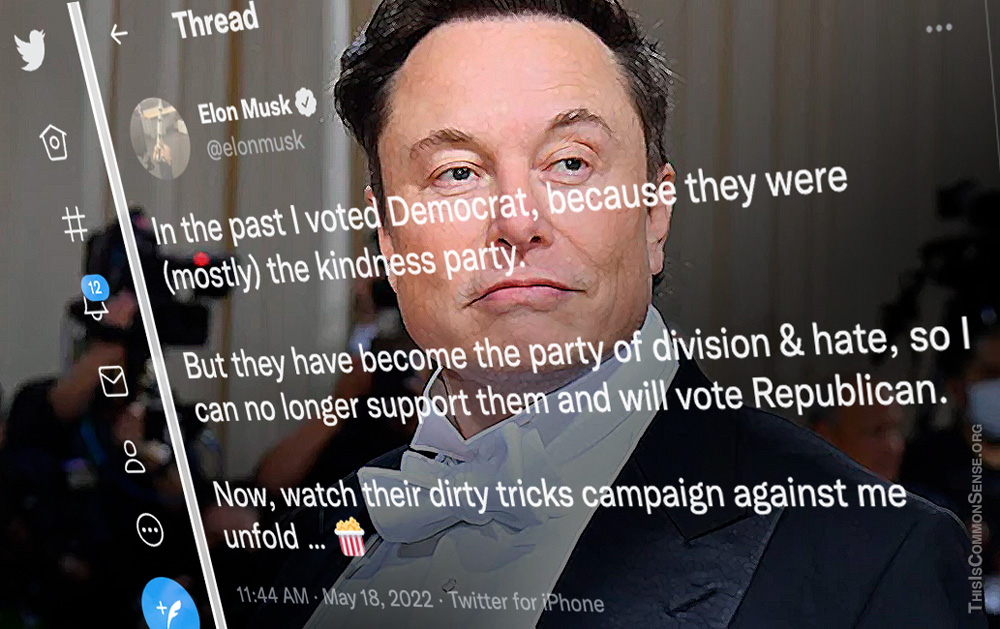
Now a major target of the commies and Democrats, Musk has good reason to seek expert legal assistance. Indeed, he prophesied his peril in an infamous tweet, and he prophesied correctly — leading to the de rigueur sex scandal . . . and another funny tweet.

But it’s not all seedy, partisan sturm und drang:

  • Musk knows how to make stuff, like electric cars and spaceships. Of course, other hugely successful entrepreneurs happen to be very bad politically, not the sort whose legal team you’d want to join if you’re a good guy. But . . .
  • Soon after Ukraine publicly asked Musk for Starlink satellites to help maintain communications in the wake of Russia’s invasion, Musk sent thousands to the country.
  • Musk has made a deal (not yet completed) to buy Twitter, avowedly motivated by the goal of liberating tweet speech. (The FCC recently contradicted reporting that it has pondered trying to block the purchase.)
  • He opposes subsidies for electric vehicles and favors more gas and oil production, which have been under assault by the Biden administration.
  • He can no longer abide the Democrats, the party of “division and hate.”

Musk’s record isn’t perfect. But chances are that the help he’s seeking will be used in a good cause. 

Just FYI — in case you’d like to boil down your resume to pursue this opportunity. 

This is Common Sense. I’m Paul Jacob.


PDF for printing

See all recent commentary
(simplified and organized)
See recent popular posts
Categories
First Amendment rights general freedom ideological culture Internet controversy

Two Thumbs Up for Netflix

Although a new “Artistic Expression” section in Netflix’s culture memo could be improved, I’m giving it two thumbs up instead of the customary one and a half accorded to promising but imperfect credos.

In these censorious times, why not applaud any sincere testament upholding freedom of speech?

Even if called “diversity,” in Netflix-speak.

According to the revised memo, the company supports “a diversity of stories, even if we find some titles counter to our own personal values. . . . If you’d find it hard to support our content breadth, Netflix may not be the best place for you.”

This is probably not about Netflix’s willingness to rent The Wizard of Oz no matter who objects to the spectacle of weepy tin men or broom-riding green-faced women in pointy hats.

Recently, Netflix has been roiled by employee protests against videos they find annoying, especially Dave Chapelle’s comedy special “The Closer.” Chapelle, who appears to lean more left than right, turns out not to be the type to run his riffs by a lefty censorship board.

Now let’s see how Netflix follows up on its delicate suggestion that working for Netflix “may not be the best place” for employees demanding censorship. Will Netflix show the door to all sullen saboteurs of speech-diversity?

Also, will it more fundamentally diversify its own original content?

In any case, good for Netflix for resisting the mob, for now. Until further notice, it’s two full thumbs up.

This is Common Sense. I’m Paul Jacob.


PDF for printing

See all recent commentary
(simplified and organized)
See recent popular posts

Categories
First Amendment rights Internet controversy social media

Musk’s Twitter’s Must-Do’s

Twitter is selling itself to billionaire Elon Musk “for an estimated $44 billion.”

Since deals sometimes fall through at the last second, the sale may yet be thwarted. For example, the government could try to foul things up — objecting, perhaps, to the possibility that if Mr. Musk takes over, obnoxious repression of speech would be dealt a grievous blow.

So, fingers crossed. But say Musk now has Twitter. What next?

Well, Elon Musk should stick to his stated free-speech absolutism. He should unfetter speech on Twitter. He is already being pressured to keep banning “misinformation,” i.e., disagreement with people who certainly don’t want their own alleged misinformation to be censored, only their opponents’.

Others want “hurtful” speech — impassioned polemics and invectives by their adversaries — to be squelched.

Musk has said that Twitter should “just be very cautious” about imposing any bans and suspensions. This is vague. Does it not imply the wrong kind of wiggle room for dealing with controversy? Musk must make no attempt to fine-tune Twitter’s speech to appease the censor faction, for this tribe cannot be satisfied until all with whom they disagree are silenced.

Twitter requires massive, sweeping, immediate changes, including restoring the banned or suspended accounts of all users kicked off for “misinformation” and the like.

Ban terrorists and others calling for — or facilitating — criminal actions. That’s it.

Current Twitter employees who try to sabotage the more free-wheeling policies should be unceremoniously shown the door.

This is Common Sense. I’m Paul Jacob.


PDF for printing

See all recent commentary
(simplified and organized)
See recent popular posts

Categories
Internet controversy media and media people social media

TikTok Dox War

Merriam-Webster says that to “dox” is “to publicly identify or publish private information about (someone) especially as a form of punishment or revenge.”

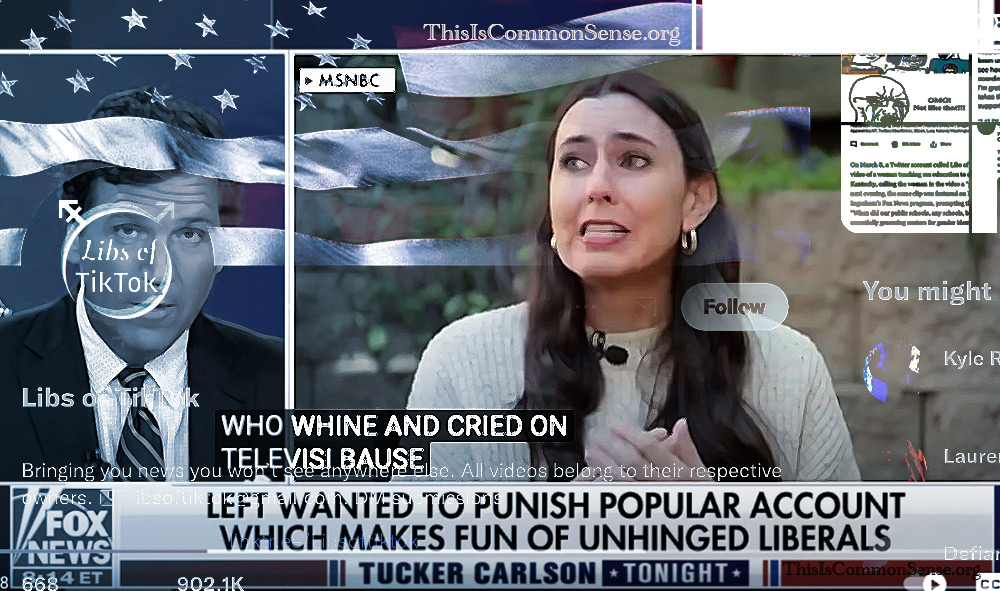
Here is a sentence to illustrate the usage: The person behind the popular Twitter account “Libs of TikTok” — featuring video clips of left-wingers talking about their crazy agendas, thereby confirming the crazy left-wing agendas that mainstream media often pretend don’t exist — has been doxxed by the Washington Post.

Well, the doxxer, Taylor Lorenz — the notorious and teary-eyed reporter on the social media beat — did not act alone. At least one Post editor must have okayed her action.

Not so long ago, Lorenz claimed to oppose online “harassment” (criticism), lamenting that she was a victim of it in consequence of her brave work as a left-wing smear artist. But then, in a smear-laden Post column, she revealed the identity of the hitherto anonymous publisher of Libs of Tik Tok, even including a link to private information about her day job.

The link has since been deleted.

For now, Libs of Tik Tok, bane of progressives for heretically showcasing their very own words, is still on Twitter. (Although the publisher suspects that it’s “a matter of time before I get suspended.”)

The other good news is that even if the LoTT creator loses her nine-to-five job as a result of being Post-doxxed, she’s now got another remunerative position. Babylon Bee CEO Seth Dillon says he’s made a deal with her “that will turn her heroic, high-risk work into a career.”

This is Common Sense. I’m Paul Jacob.


PDF for printing

See all recent commentary
(simplified and organized)
See recent popular posts
Categories
First Amendment rights Internet controversy social media

Will Elon Liberate Tweeting?

Persons who skip social media or who spend their time on Twitter and Facebook discussing lunch or the weather may not realize how anti-speech such big-tech forums have become.

If you disagree about what’s better for breakfast, eggs or oatmeal, no problem.

But despite their putative pretense of providing open forums, the dominant social-media companies routinely ban discussion of touchy subjects like Hunter Biden laptops, pandemics, and and the politics of race and gender. As the satire site Babylon Bee discovered, even calling a man a man, apparently quite a controversial observation, can get you in hot water with Twitter censors.

We have ways of combatting the censorship. One is using alternative platforms that do regard open discussion as a value. Another is becoming a major stockholder and disrupting the anti-speech agenda from within.

Is this what Elon Musk is up to? Bee CEO Seth Dillon says that after Twitter suspended Babylon Bee for calling a man a man, Musk called him about the suspension and said that “he might need to buy Twitter.” 

Presumably in order to put a stop to such censorious shenanigans.

Now Elon Musk, who has 80.6 million followers on Twitter, has bought the company. Or rather, he has acquired a big stake in it, a 9.2 percent stake. This apparently makes him Twitter’s largest stockholder. Maybe we can dare to hope that he will eventually become the majority stockholder.

Good first step, Mr. Musk. 

Next? Get Twitter to remove the gags.

This is Common Sense. I’m Paul Jacob.


PDF for printing

See all recent commentary
(simplified and organized)
See recent popular posts

Categories
Internet controversy social media

We Hear a Rumble

Build it and they will come. 

What’s the “it”?

Rumble.

And who’s the “they”? 

The superstars censored by YouTube.

Not just superstars and the censored, of course. Plenty of producers and viewers are migrating to Rumble simply because they’re sick of seeing discussion squelched on dogma-guarding platforms like Google’s YouTube.

But it sure is a boost for Rumble and the cause of open discussion on the interwebs when Dan Bongino, who had about 900,000 subscribers on YouTube when it booted him, has two million subscribers and counting on Rumble.

House Republican Leader Kevin McCarthy joined Rumble late last year and in just a few months has acquired over 53,000 subscribers. Not Bongino level, but not bad.

Among others joining Rumble recently are Bitcoin Magazine, the financial news channel Benzinga, and Reason magazine.

Fast-growing Rumble boasts of an “independent infrastructure designed to be immune to cancel culture” and a mission “to restore the Internet to its roots by making it free and open once again.”

That’s the opposite attitude and ambition of the big-tech hall monitors, constantly thumping their chests about how efficiently they’re censoring “misinformation.” (Good thing these people aren’t in charge of water-cooler chit-chat.)

The growing success of Rumble and other alternatives shows we’re not forever stuck with Google, Twitter, Facebook, et al. even if we’re stuck with their censorship.

This is Common Sense. I’m —

Oops. Almost forgot to mention that This Week in Common Sense is on Rumble too. Drop by, sign up, and chat with us in the comments. We’ll even let you disagree.

— Paul Jacob.


See all recent commentary
(simplified and organized)
See recent popular posts
Categories
Internet controversy media and media people

This Is Just Huge

“Why isn’t this in the newspapers?” 

That’s what Dr. John Campbell asked on his YouTube channel yesterday, reviewing several studies of ivermectin as an agent in the fight against COVID-19 — but directly regarding the results of research out of Brazil. It was an impressive large-number study, in which the researchers invited the whole population of Itajaí to participate, with 159,561 included in the analysis: 113,845 regular users of ivermectin and 45,716 non-users. 

“Seventy percent reduction in mortality in this study” of those who took a very “tiny dosage of ivermectin every fortnight, acting as a prophylaxis” over those did not. “I mean, this is just huge!”

Dr. Campbell, who has been a voice of calm science during the pandemic, goes on to say that “It’s almost as if information has been deliberately suppressed throughout the pandemic, to be quite honest.” With a wry look, he went on to say “No one’s saying that’s true, of course, but it’s almost like that.” 

Droll.

But non-ironically, he insists the evidence is “powerful, present, and overwhelming.” 

“Seventy percent,” he marvels, “how do you argue with a number like that? It’s a very, very high number.”

And the decrease in hospitalization was 67 percent.

All in all, the study found less infection, fewer hospitalizations, and an astoundingly lower death rate in the ivermectin group.

Earlier in the video, the doctor considered another study, comparing the cheap anti-parasitic to the far more expensive remdesivir, a Fauci-pushed Gilead Sciences anti-viral, with similar results.

It’s “almost as if” the expert class that spurned ivermectin doesn’t care if people die.

No one’s saying that, but. . . .

This is Common Sense. I’m Paul Jacob.


The studies:

Kerr L, Cadegiani F A, Baldi F, et al. (January 15, 2022) “Ivermectin Prophylaxis Used for COVID-19: A Citywide, Prospective, Observational Study of 223,128 Subjects Using Propensity Score Matching.” Cureus 14(1): e21272. doi:10.7759/cureus.21272.

I. Efimenko, S. Nackeeran, S. Jabori, J.A. Gonzalez Zamora, S. Danker, D.Singh, “Treatment with Ivermectin Is Associated with Decreased Mortality in COVID-19 Patients: Analysis of a National Federated Database.” International Journal of Infectious Diseases 116 (2022) S1–S130.

PDF for printing

Categories
international affairs Internet controversy social media

Starlink to Ukraine

Twitter’s policy of spasmodically censoring tweets and banning accounts, often without pausing to ponder what they are doing, has had at least one baleful effect in Ukraine. 

Last Wednesday, Twitter said it had “erred when it deleted about a dozen accounts that were posting information about Russian troop movements.” Obviously, the Russian invaders already know about their own troop movements. Losing this info could only hurt the people in Ukraine trying to defend themselves or run for their lives.

Innocent error? Anyway, Twitter said, in effect, “Our bad” and that it was now “proactively reinstating” affected accounts.

On the plus side, though, Ukraine official Mykhailo Federov was able to use Twitter to ask Elon Musk for help when the Russian assault knocked out the Internet in parts of the country.

“@elonmusk, while you try to colonize Mars,” Federov tweeted, “Russia try to occupy Ukraine! While your rockets successfully land from space — Russian rockets attack Ukrainian civil people! We ask you to provide Ukraine with Starlink stations. . . .”

That’s one way to get around the secretary barrier. And it worked.

“Starlink service is now active in Ukraine. More terminals en route,” was Musk’s tweet-response last Saturday.

Starlink satellites provides Internet access from space. No cables or optic fiber needed. Nothing for saboteurs to snip.

Good thinking, Mr. Federov. Thank you for the unreliably available platform, Twitter. Thank you, Elon Musk, for answering Ukraine’s cry for help and doing so as swiftly as possible.

This is Common Sense. I’m Paul Jacob.


PDF for printing

See all recent commentary
(simplified and organized)
See recent popular posts