Categories
Accountability initiative, referendum, and recall local leaders responsibility

The Maine Thing

Ranked Choice Voting (RCV) allows voters to rank electoral candidates and not “waste” their vote in cases where their most favored candidate is* unlikely to win. RCV also requires a majority for election, not merely a plurality of the vote.

Last November, Mainers passed Question 5 to begin using this voting system for statewide races, state legislative races and congressional contests. Voters in Portland, the state’s largest city, already use ranked choice voting for several city offices.

Nonetheless, Gov. Paul LePage, who has won twice for governor without ever capturing a majority, opposes RCV, as do many state legislators, also elected under a different first-past-the-post plurality system.

Because Maine’s state constitution specifically mentions plurality winners for statewide officials and state legislators (in the General Election), legislative leaders asked the Maine Supreme Court for an advisory opinion on the constitutionality of the ballot measure. Earlier this week, the court ruled that Question 5 was not constitutional when applied to those specific offices and elections.

However, the constitutionality of RCV was not challenged regarding congressional elections or primary elections for the state legislature.

Now some legislators are proposing a constitutional amendment to enact the RCV that voters supported. Others are urging that the entire law be repealed — even the parts not ruled unconstitutional. They claim the new system is too confusing if not used for every office.

But Portland city voters use RCV for some offices and not others, without confusion.

Legislators should follow the court’s decision, sure, but also respect the vote of the people for every part of the measure not addressed by the court.

This is Common Sense. I’m Paul Jacob.


* Ranked Choice Voting also prevents wasted votes in cases where a voter merely expects or fears (even inaccurately) that his or her favorite candidate does not have enough support to get elected.


Printable PDF


Original cc Photo by Tim Evanson on Flickr


Categories
general freedom ideological culture initiative, referendum, and recall local leaders national politics & policies political challengers

Not a Joke

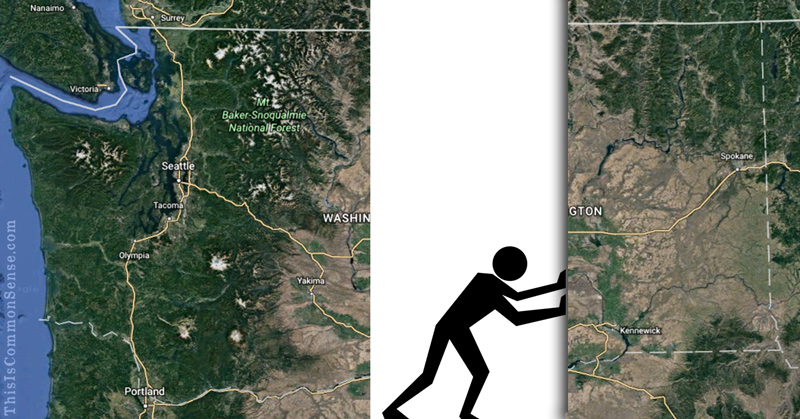
Yesterday, the chief sponsor of a Washington State legislative bill withdrew it. He said it was “a joke.” His co-sponsor wasn’t laughing, however . . . even proclaimed an intent to introduce the bill again next year.

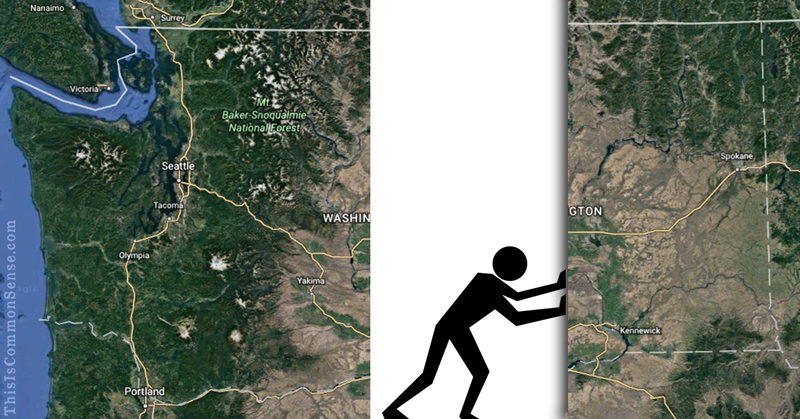
The legislation’s purpose? Split the state into two.

The eastern, drier half of the State is much less populated, and the wet, western half gets its way almost all the time. The bill’s sponsor mentioned his intent: to call attention to the persistent lack of effective representation.

It was not a funny* joke. What he meant, surely, was “a stunt.”

This is just one of many ongoing secessionist movements in the United States. Most represent the eternal struggle between more self-reliant, community-centered and less statist country folk and the more atomized, fearful statists of the cities. But also present is the problem of representation. There is not enough of it. Many people do not have a voice. Hence the desire for exit.

“Voice” vs. “exit” are two crucial aspects of constitutional politics, particularly relating to different kinds of “freedom.”

Many states could use splitting, California, especially.

But exit is not the only option. Representation itself could increase in sheer numbers; California, anyway, has (astoundingly!) too few politicians, er, representatives . . . per residents.

Another key constitutional change would be to set the bar higher to passing new legislation, especially regarding adding tax burdens.

But not for the people. We are best represented by our own votes, which means initiative and referendum rights extended to all states. Citizens of Washington State (still intact) lack the ability to change their constitution by initiative — an important process for future state shape shifts.

This is Common Sense. I’m Paul Jacob.


* Originally, the new state’s name was to be Liberty, much better than the states of Tyranny, Servitude and Denial. Now I read that the proposed name is Lincoln, awkwardly tied to our union’s most determined anti-secessionist. That is a bit funny.


Printable PDF


Categories
Accountability free trade & free markets initiative, referendum, and recall insider corruption moral hazard national politics & policies porkbarrel politics too much government

A Wall of Separation

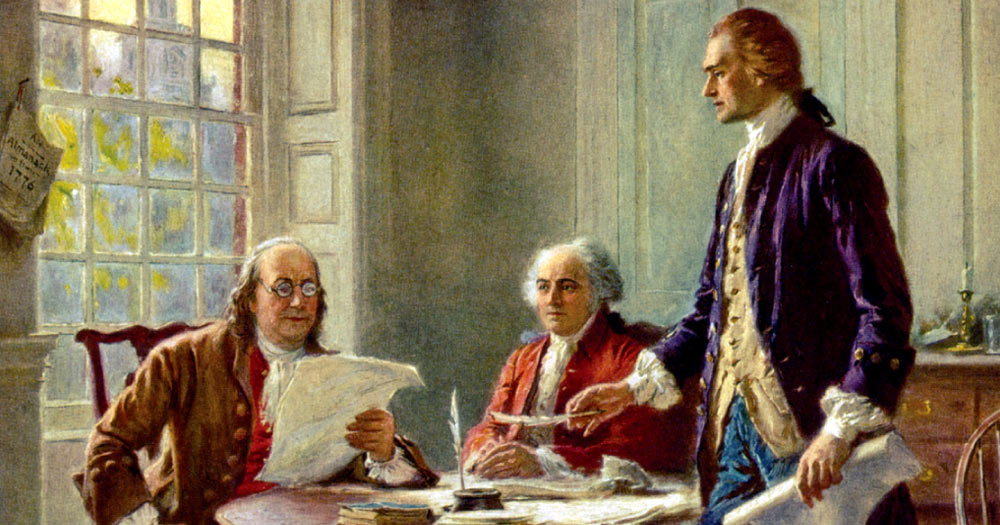
Whatever you think of Thomas Jefferson’s letter to the Danbury Baptists, wherein he celebrated the First Amendment for “building a wall of separation between Church & State,” let’s agree that it would have been nice had he penned another letter — to the Waterbury Methodists or someone — urging a wall of separation between Sports and State.

Last week, actor Tom Hanks became another brick in my hoped-for wall. “It’s a billion-dollar industry,” Hanks said of the National Football League.

[T]hey have billion-dollar TV contracts. All the owners are billionaires. And yet when they want to build a stadium they’re going to use for 10 weeks out of the year, they expect the city taxpayers to buy the building.

Hanks is livid. The recent “deal” that lured his beloved Oakland Raiders to Las Vegas included $750 million in public funds to build a $1.9 billion stadium. The Raiders are planning to stay in Oakland for the 2017 and 2018 seasons, while that new stadium is built. “When the Raiders leave,” the beloved star declared, “I am going on an NFL moratorium for two years.”

Unfortunately, Hanks appears more angry that his team is leaving (eventually), than with the principle that taxpayers ought not be ripped off.

Subsidizing businesses is cronyism, not capitalism. It’s even more outrageous when the poor must pay for the rich.

But how to stop it? In every city where citizens can propose ballot initiatives, let’s petition and pass measures requiring a public vote before any such subsidy.

It may not be the great wall I’d prefer, but it’s a high hurdle providing taxpayers some important protection.

This is Common Sense. I’m Paul Jacob.


Printable PDF


Categories
Accountability government transparency initiative, referendum, and recall local leaders moral hazard term limits too much government

Regnat Tyrannis

Arkansas’s motto is Regnat Populus “The People Rule.” Unfortunately, the people’s so-called representatives are demanding that this motto be made more fitting: Regnat Tyrannis.

I jest. The Natural State’s legislators aren’t nearly so honest. Just devious.

A few years back, the fine people of Arkansas (where I grew up) had arguably the nation’s most accessible-to-the-people petition process. With it, they enacted issues that legislators despise: term limits, for instance.

But in 2013, legislators passed several bills upping the difficulty and cost of the citizen initiative process.

They’re back.

Yesterday, Senate Bill 698 was passed and now goes to the governor.

Today, the Senate votes on House Joint Resolution 1003, a constitutional amendment for the 2018 ballot. It increases the petition requirement and raises the vote threshold to 60 percent to pass an initiative amendment.*

SB 698 is straightforwardly sinister. When groups gather the voter signatures to place a measure on the ballot, the Secretary of State is required to publish the wording in the legal notice section of newspapers throughout the state. Despite low readership. This bill would make the petitioners pay.

According to a report in the Arkansas Democrat-Gazette, the state spent nearly $2 million publishing the language of these measures in 2016. The old requirement should be repealed, but the new one would be disastrous: Only citizens with deep, deep pockets could pursue ballot initiatives.

A veto is needed from Governor Asa Hutchinson — call him at (501) 682-2345.

As for HJR 1003, Arkansans can find their state senator here. Call early.

My adopted state’s motto is also Latin: Sic Semper Tyrannis.** The good people of Arkansas are welcome to it, until theirs is once again operative.

This is Common Sense. I’m Paul Jacob.


* At least, voters can defeat this measure at the ballot box.

** The precise English translation of Virginia’s motto is “Thus always with tyrants.” The common translation is “Death to all tyrants.”


Printable PDF


Categories
Accountability crime and punishment free trade & free markets general freedom initiative, referendum, and recall moral hazard nannyism national politics & policies property rights

Good and Bad News

On the issue of “civil asset forfeiture” — police seizing property from folks merely on suspicion, without a criminal conviction — there is good news.

In Idaho, House Bill 202a just passed both legislative chambers overwhelmingly. “Among other changes, HB 202a would no longer allow civil forfeiture of the vehicle of a person who merely possessed a controlled substance,” explained a Spokesman Review report, “without using the vehicle in connection with trafficking offenses or obtaining it with drug-trafficking proceeds. . . .” It also puts off the table “property that’s merely in proximity to illegal drugs” and the mere possession of cash.*

Legislation is moving forward in Arizona, too. House Bill 2477 passed to the Senate Judiciary Committee last week — which unanimously cleared it despite what the Arizona Republic calledstrong opposition from . . . primarily people representing law-enforcement and prosecutors’ groups that benefit from the funds.”

The bill heightens the standard of proof required for making seizures stick from “preponderance of the evidence” to “clear and convincing evidence.” HB 2477 also increases reporting requirements, and creates a process police must follow to spend seized funds.

Unfortunately, there is also bad news.

Even with the new Idaho law and the enaction of the Arizona legislation, police in both states will continue to take people’s stuff without a criminal conviction. The level of abuse would be diminished, but not ended.

Citizens in both states can and should use the ballot initiative process to end this injustice. In total.

We must restore the bedrock principle of innocent-until-proven-guilty.

This is Common Sense. I’m Paul Jacob.


* Other provisions include a court determination on “whether a property seizure is proportionate to the crime alleged,” absolving “innocent owners from having to pay the state’s costs associated with an attempted seizure,” and some required record-keeping.


Printable PDF


Categories
Accountability initiative, referendum, and recall moral hazard nannyism responsibility

Whose Constitution Is It, Anyway?

Last November’s biggest mistake? Colorado voters passing Amendment 71. It makes the Rocky Mountain State’s constitution exceedingly more difficult for voters to amend through the initiative petition process.

And more like it may be in the offing. Legislation is moving in Florida to require a 66.7 percent vote to amend the state constitution. Already, a 60 percent vote is required, but legislators remain fearful voters can muster that.

The Ohio Modernization Commission, a legislatively created mix of legislators and insiders, is recommending a new constitutional amendment to — you guessed it — make it tougher for voters to pass amendments. Future voter-initiated amendments must pass twice, by a 55 percent supermajority.

There are also efforts to weaken citizen initiatives in Arizona and Maine.*

The big money behind Colorado’s Amendment 71 told whopper after whopper to win. They pretended to love and revere the constitution. Finally, they put former Denver Broncos Super Bowl champion quarterback John Elway on television — spot after spot — telling voters the amendment “protects our constitution.”

But . . . from whom?

You see, politicians and special interests don’t have to amend the state constitution to spend money on themselves or their cronies. From their perch in the state capitol, they can do that with a simple statute.

But you and I need the ability to pass constitutional amendments. Why? Only through the constitution can we limit the power of those same politicians — the power of government. Legislators can overrule a mere statutory ballot initiative (and often do).

That’s what this battle is all about. Politicians mean to limit our power to limit theirs.

This is Common Sense. I’m Paul Jacob.


* Thankfully, South Dakota legislators defeated several bills aimed at making it tougher to place initiatives on the ballot.


Printable PDF


Categories
general freedom ideological culture initiative, referendum, and recall national politics & policies responsibility too much government

Adios, California?

Californians account for more than one of every ten Americans.

For now.

Three years ago, an initiative sought to split the mega-state up. Had that measure succeeded, the U.S. Congress would have decided whether to permit the Golden State to become six separate states — with ten more U.S. Senators.

Now, a group called “Yes California” is petitioning for a 2018 ballot measure on leaving these United States altogether: Secession. “California could do more good as an independent country than it is able to do as just a U.S. state,” says its website.

Supporters argued in a recent Washington Post feature that California “subsidizes other states at a loss.” Indeed, it’s one of 14 states that get less money back from the federal government than paid in taxes.

And there’s Trump. Opposition to the president is palpable. California provided Hillary Clinton with a 4.3 million popular vote margin over Republican Donald Trump, 1.5 million more than her national margin.

“It’s understandable why the election of an evil white supremacist swindler as president,” wrote Zócalo Public Square’s Joe Mathews in the Fresno Bee, “has given the idea of California independence such currency.” Nonetheless, he opposes #CalExit as divisive and “not very Californian.”

Nationally, for partisan reasons, Republicans may cheer it, while Democrats shudder.

Me? I’m for self-determination.

But, remember: Northern Californians have been agitating to secede from the state since 1941. Those desires are picking up steam — especially with trepidation over whether the Oroville dam will hold. Folks feel unrepresented in the state capitol.*

And they are. Already 21 of the 23 northernmost counties have made declarations to form the State of Jefferson.

Let Californians decide . . . county by county.

This is Common Sense. I’m Paul Jacob.


* Note that Trump won by a landslide in the counties that would comprise Jefferson, our would-be 51st state.


Printable PDF


Categories
Accountability initiative, referendum, and recall local leaders

The Unfairness of Losing

Maine’s citizen initiative process is unfair, claims State Rep. Paula Sutton.

“[R]ural Mainers are left out of the equation,” Sutton tells readers of Knox County’s Village Soup, “and Portland dictates public policy for the rest of the state.”

Hmmm? Every Mainer eligible to vote currently has the equal right to decide ballot measures.

Her grievance appears to be that there are more urban voters than rural.

Last November, voters passed four of five issues, all opposed by Rep. Sutton. Still, losing at the ballot box is hardly prima facie evidence of “unfairness.”

“Unless we do something to fix the citizens’ referendum process here in Maine,” she nonetheless contends, “the state will continue to be an easy target.”

For what, exactly? Voting on issues people favor?

Mainers are “ripe to be taken advantage of by wealthy out-of-state special interests,” she complains, explaining that billionaire Michael Bloomberg “spent millions of dollars in his failed attempt to squash Mainers’ Second Amendment rights with Question 3.”

Yes, you read that right. Question 3 failed. Voters weren’t exploited.

Sutton has introduced legislation “to ensure rural Mainers are no longer being run over by wealthy liberal special interest groups.” Her bill requires petitions to qualify in each of the state’s two congressional districts instead of qualifying statewide. That makes it more difficult, but hardly changes the need to circulate petitions in urban areas.

Not forests and empty fields.

Rep. Sutton seems to understand her proposal won’t effectively thwart citizen initiatives, pledging to support further restrictions. That’s easier for politicians than permitting democracy and persuading people.

This is Common Sense. I’m Paul Jacob.


Printable PDF


Categories
Accountability government transparency initiative, referendum, and recall local leaders moral hazard

Rules for Rulers?

Politicians in Tampa, Florida, have forced citizens there to vote for term limits, and then vote to keep those term limits again and again — against attempts to repeal or weaken the limits. So I keep my eye out for news from the city.

Earlier this month, Mike Deeson, an investigative reporter with WTSP 10 News, Tampa Bay’s CBS affiliate, exposed Mayor Bob Buckhorn’s open violation of the city charter’s requirement that all department heads must be city residents. Buckhorn hired Sonja Little, now the city’s highest paid employee, to serve as his Chief Financial officer, and admits on camera that he promised her she would not have to move into the city.

“The question is,” the mayor explained, “do you want talent or do you really make the residency — she’s only about a mile away from the city border — the issue?” Buckhorn answers his own question, “I would rather have talent” . . . than follow the law.

In even slipperier fashion, Mayor Buckhorn has attempted to get around the clear, unequivocal wording in the charter by claiming Ms. Little has served as the “interim” Chief Financial officer for the last five years!

Reporter Deeson asks the operative question: “[I]f you’re going to ignore the residency requirement, what other parts of the charter should you just ignore?”

Deeson worries about provisions requiring competitive bidding, guarding against conflicts of interest and mandating term limits, which is “particularly problematic for a mayor who is in his second term and has to leave office when it’s over.”

On social media, Tampa residents are unloading on the mayor with numerous variants of: “This is truly what’s wrong with government.”

This is Common Sense. I’m Paul Jacob.


Printable PDF

Tampa, initiative, corruption, Mayor, Mike Deeson, Mayor Bob Buckhorn


Categories
Accountability crime and punishment initiative, referendum, and recall moral hazard national politics & policies

Stealing Now Unpopular

Civil asset forfeiture is stealing. So, why is it still happening?

Police seize boats, cars, houses and cash that they allege were used in the commission of a crime or were proceeds from the crime. Sometimes they simply take cash found on a motorist in a normal traffic stop, claiming it’s “drug money.”

Tragically, only 13 percent of forfeiture is criminal, i.e. involving a conviction. The rest is civil, wherein the person hasn’t been convicted of anything. Often not even charged.

When officials confiscate property without due process of law, it’s theft. The legal rationale government uses to snatch our stuff via civil forfeiture is a sick joke. Our property can be deemed “guilty” without enjoying our presumption of innocence. Instead, we have to go to court to prove our stuff is innocent.

Often officials negotiate a large cut, because hiring an attorney to get one’s money back might well cost more than the money itself.

The good news? People are becoming aware of civil asset forfeiture and overwhelmingly oppose it. A Cato Institute/YouGov poll found 84 percent of Americans against taking property without a criminal conviction.

While New Mexico and Nebraska have outlawed civil forfeiture, and some other states have sought to at least minimize its abuse, there is still significant pushback from police and prosecutors, who like getting all that dough. And who often have the ears of decision-makers.

The time has come to short-circuit the watered-down half-measure. Twenty-four states and a majority of cities enjoy the initiative process.

Let’s do it ourselves.

This is Common Sense. I’m Paul Jacob.


Printable PDF

Civil Asset Forfeiture, crime, drugs, marijuana, stealing, theft, police abuse