Categories
general freedom media and media people

The Four Froms

Liberty was a straightforward concept.

Once. 

Then The New York Times got ahold of it back in April with a featured editorial: “The America We Need.” 

“Our society was especially vulnerable to this pandemic,” the paper alleges, “because so many Americans lack the essential liberty to protect their own lives and the lives of their families.”

The fight against the Wuhan virus has been deficient due to a deficit of . . . “essential liberty”? 

This isn’t the Merriam-Webster definition of “liberty,” i.e. the “quality or state of being free” or “freedom from physical restraint.” Dump that retro “narrow and negative definition,” advises the editorial; it represents an “impoverished view of freedom” that “has perpetuated the nation’s defining racial inequalities and kept the poor trapped in poverty.”

Freedom of speech, religion, the press, etc., are all negative. Trade them in for a “broad and muscular conception of liberty: that government should provide all Americans with the freedom that comes from a stable and prosperous life.”

Prosperity for all! For free! Come on down!

Noting the “extraordinary nature of the crisis,” the editorial calls for “permanent changes in the social contract” to take the nation “beyond the threadbare nature of the American safety net.”

Free stuff from the government, housing, healthcare — all very positive ideas of liberty. 

But what about these positives’ negatives?

“A government big enough to give you everything you want,” former President Gerald Ford once explained to Congress, “is a government big enough to take from you everything you have.”

The cost of “positive freedom” is our freedom from dependence, from interference, from coercive control, from . . . oppression.

Positively negative, if you ask me.

This is Common Sense. I’m Paul Jacob.


PDF for printing

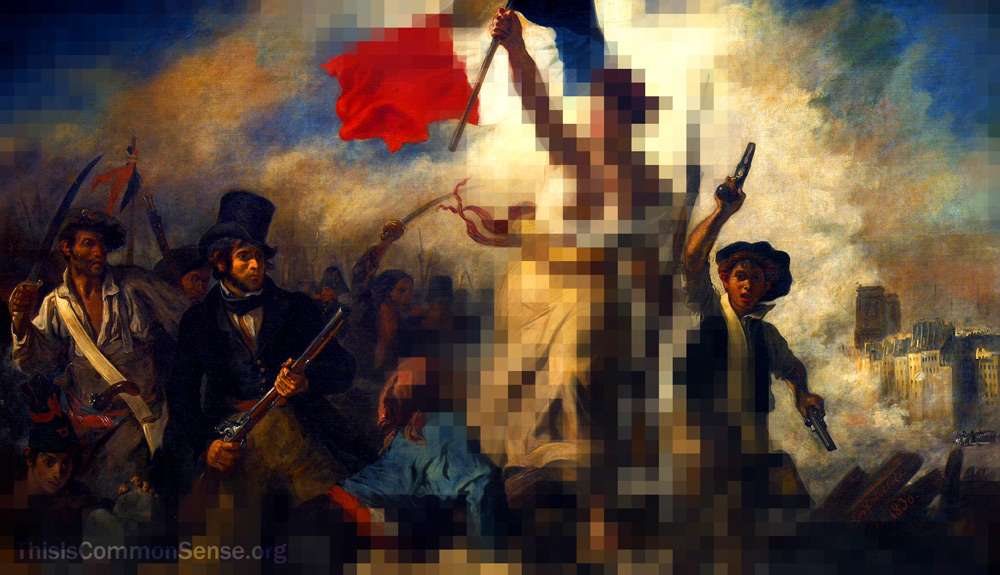
Illustration adapted from Liberty Leading the People (La liberté guidant le people) by Eugène Delacroix (1830)

See all recent commentary
(simplified and organized)
See recent popular posts

Categories
general freedom international affairs

iQuisling

Sometimes you should not try a balancing act.

Last weekend, Hong Kong citizens voted in opposition primaries — conducted in defiance of China’s new “national security” law that deprives Hong Kong of the last vestiges of democracy and individual freedom that the region had been allowed to retain after Great Britain handed it over to China in 1997. 

General elections will be held in September.

The primary organizers developed a voting platform called PopVote with apps for iOS and Android. 

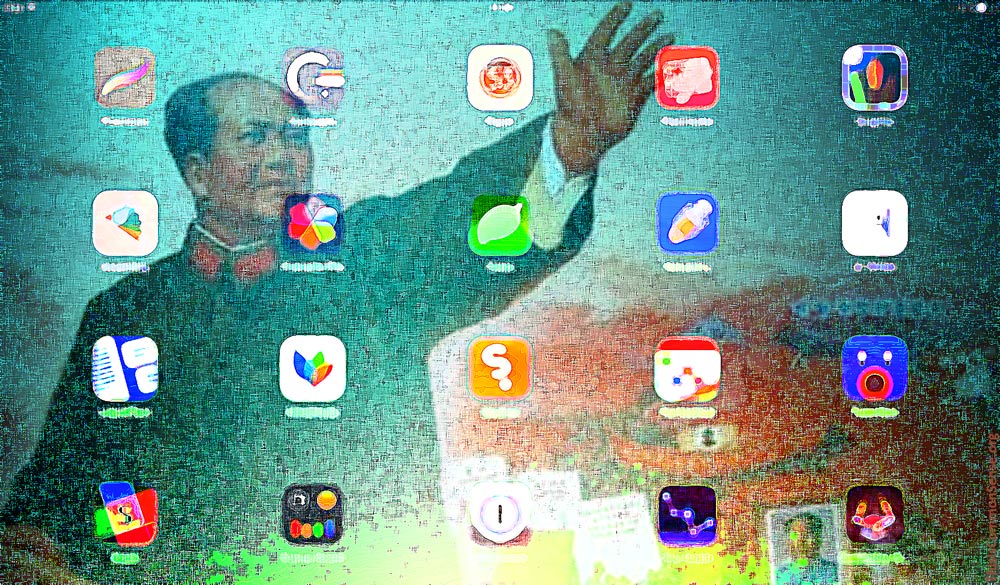
Although China condemns the elections as illegal, Google has accepted the app for Android. But Apple first voiced technical objections to the code; then, after programmers made requested changes, the company stopped responding to them at all.

“We think it is being censored by Apple,” says Edwin Chu, one of the developers. 

It wouldn’t be the first time Apple has rejected apps in obedience to the Chinese government.

The Quartz website says that the firm “has long had to walk a tightrope between its commitment to user rights and placating China” because of the large market for (and production of) iStuff in that country.

Apple’s conduct may be unfavorably compared to that of companies like the one responsible for the secure messaging app Telegram. When China banned the app in 2015, founder Pavel Durov saw no point trying to get the ban reversed. He said: “It’s pretty obvious that the Chinese government’s desire for total control over its population is incompatible with our values.”

Not so incompatible with Apple’s values, apparently.

This is Common Sense. I’m Paul Jacob.


PDF for printing

See all recent commentary
(simplified and organized)
See recent popular posts
Categories
Common Sense general freedom

I pledge allegiance to my refrigerator warranty . . .

. . . and to the refrigerator for which it stands, one cooling unit, under electric power, indivisible from the side by side freezer, with cold drinks and frozen TV dinners for all.

Silly to pledge allegiance to a refrigerator or its warranty? Perhaps no more so than to pledge allegiance to our nation’s flag or our beloved Republic, for which that flag stands.

Wait a second: Doesn’t our Republic deserve our allegiance?

Well, what is meant by “allegiance”? The first dictionary definition reads: “the obligation of a feudal vassal to his liege lord.” 

The word “allegiance” does indeed derive from feudal times. Even further variations of the definition — “the fidelity owed by a subject or citizen to a sovereign or government” or “the obligation of an alien to the government under which the alien resides” — are tied to a relationship whereby “We, the People” are inferior to our nation-state.

But not in America. We are not “subjects” nor “aliens.” We are the sovereigns.

That wonderful frost-free icebox is ours; it works for us. This Republic is also ours and it was designed to work for us. In clear and deliberate language. In fact, language not dissimilar from an appliance warranty — though written more accessibly for the common person.

We are the government. So, do we really need to pledge our allegiance to ourselves?

As Judge Andrew Napolitano asked on his Freedom Watch show several years ago — before Fox mysteriously cancelled the show — “Does the government work for us or do we work for the government? Are true patriots guided by symbolism such as flag waving and pledges or by their commitment to personal freedoms?”

Perhaps it doesn’t matter. Most folks reciting the Pledge surely do not view themselves as feudal serfs.

Still, words matter. And actions and rituals matter as well. Tomorrow we celebrate Independence Day — not simply as a method to get out of work, but as a way to remind ourselves and our children that this country was conceived in liberty, in the hope we can continue to expand on and live in freedom. (That’s why I say “Independence Day” rather than the “Fourth of July,” since what happened is much more important than the date it happened.)

The Founders who signed the Declaration of Independence — pledging their lives, fortunes and sacred honor — didn’t see fit to establish a pledge for citizens to recite. Their pledge was to each other and to the country.

The Pledge of Allegiance, on the other hand, was written by an admitted socialist, Francis Bellamy, in 1892. In addition to the Pledge, Mr. Bellamy also came up with a salute for school children and others to make toward the flag. To prove that truth is stranger than fiction, what came to be known as the Bellamy Salute was very similar to the salute adopted by Mussolini and the Italian fascists . . . as well as the Nazis, for use in tandem with their exclamation of “Heil Hitler!”

In 1942, after U.S. entry into World War II, Congress amended the Flag Code to advise folks to place their hand over their heart, instead of giving the Nazi — er, Bellamy Salute.

Don’t go off the deep-end here: I’m not suggesting that reciting the Pledge of Allegiance makes one a Nazi, or even a far milder brand of socialist. When Americans recite the Pledge, they do so for love of country and to affirm the freedoms our Republic is designed to protect and defend.

What I am declaring is that we Americans must understand our history, our government, and our exceptional place in the world well enough to stop defining patriotism as the repetition of someone else’s words about an alien concept of allegiance. Instead, let’s celebrate the words that are quintessentially ours: the Declaration of Independence, the Constitution and the Bill of Rights.

As we celebrate our Independence Day, our break from the monarchy of the Old World, we ought to appreciate that this break threw out any allegiance to rulers as if they wielded divine power over us and substituted for that corrupt rule a constitutional republic, where the citizens had protection against government encroachment on their freedoms, written down in black and white and fully enforceable.

The Constitution is a warranty of sorts. And the more we think of government in practical terms, like a refrigerator or an agreement for services, rather than some mystical force that tells us what to do, the better for actually maintaining our freedom and keeping our Republic.

As Tom Paine wrote: “It is the duty of the patriot to protect his country from his government.”

We cannot protect our freedom by repeatedly declaring allegiance to the Republic, much less its three-color stand-in. 

Instead, saving our Republic requires citizens to stand up and demand that our government adhere to the contract.

This is Common Sense. I’m Paul Jacob.


PDF for printing

See all recent commentary
(simplified and organized)
See recent popular posts
Categories
general freedom international affairs

Last Bit of Freedom

Yesterday, on the 23rd anniversary of Britain’s 1997 handover of Hong Kong to China, the Chinese Communist Party (CCP) imposed a draconian national security measure on the previously semi-autonomous territory.

“The law effectively ends the long-cherished freedom of speech that Hong Kong residents have had,” reported The Washington Post, “putting them under the same threat of life imprisonment if they criticize Beijing’s government, as other Chinese nationals face.”  

Supersizing police powers to “intercept communications and covertly surveil people” are also part of the CCP clampdown.

“In the past,” a pro-Beijing council member explained, “Hong Kong has been too free.”

In keeping with that sentiment, protests planned for yesterday were banned. 

“They still came out,” however, noted a reporter with UK’s Sky News, “even though the cost of protest had been raised significantly on the first full day of the new law.” 

“We are on street,” tweeted Joshua Wong, the young pro-democracy activist, “against national security law. We shall never surrender. Now is not the time to give up.”

“China is Hong Kong, Hong Kong is China, as of today, the first of July. It’s a sad day, but that’s what it is,” offered a woman protester. “I’ll still take to the streets. I’ll still say what I think. Because it is my right as a human being.”

More than 300 protesters were arrested yesterday. 

Wong called on the “international community” to “continue to speak up for Hong Kong” and help protect its “last bit of freedom.”

This is Common Sense. I’m Paul Jacob.


PDF for printing

See all recent commentary
(simplified and organized)
See recent popular posts

Categories
general freedom media and media people U.S. Constitution

The Rates that Matter

Millions more Americans have been infected with SARS-CoV-2 than are considered “confirmed cases,”* at rates ranging from 6/1 (Connecticut, early May) to 24/1 (Missouri, late April), making the fatality rate of COVID-19 much lower than feared.

Unfortunately, we cannot trust our news sources to be forthright about this.

The “death count” had been the pandemic’s repeated headline for months, Dr. Ron Paul noted yesterday, “all of a sudden early in June the mainstream media did a George Orwell and lectured us that it is all about ‘cases’ and has always been all about ‘cases.’ Death, and especially infection fatality rate, were irrelevant.”

There’s a reason for this re-focus. Since peaking in April, deaths, you see, “had decreased by 90 percent and were continuing to crash. That was not terrifying enough so the media pretended this good news did not exist.”

And the case number increases do look ominous, despite being almost innocuous: “This is not rocket science: the more people you test the more ‘cases’ you discover.”

And that is not the only change of spin regarding the pandemic, as Jeffrey Tucker dramatized on Twitter:

“Flatten the curve!”
“What does that do?”
“Pushes infections to the future”
3 months later
“There are new infections!”
“What should we do?”
“Flatten the curve!”

At Mr. Tucker’s stomping grounds, the American Institute for Economic Research, Gregory van Kipnis wrote last month that the “most frightening aspect of the coronavirus-19 (COVID-19) epidemic in the US is that it brought about exaggeratedly heightened fear of death.”

We have something to fear from the virus and its attack upon the respiratory system, but we have more to fear from fear itself.

That staple of propagandistic media.

This is Common Sense. I’m Paul Jacob.


*  A confirmed case is of a patient who has seen a doctor for symptoms of the disease and has tested positive with the diagnosis seconded and logged by scientists associated with a national health agency.

PDF for printing

See all recent commentary
(simplified and organized)
See recent popular posts

Categories
general freedom ideological culture

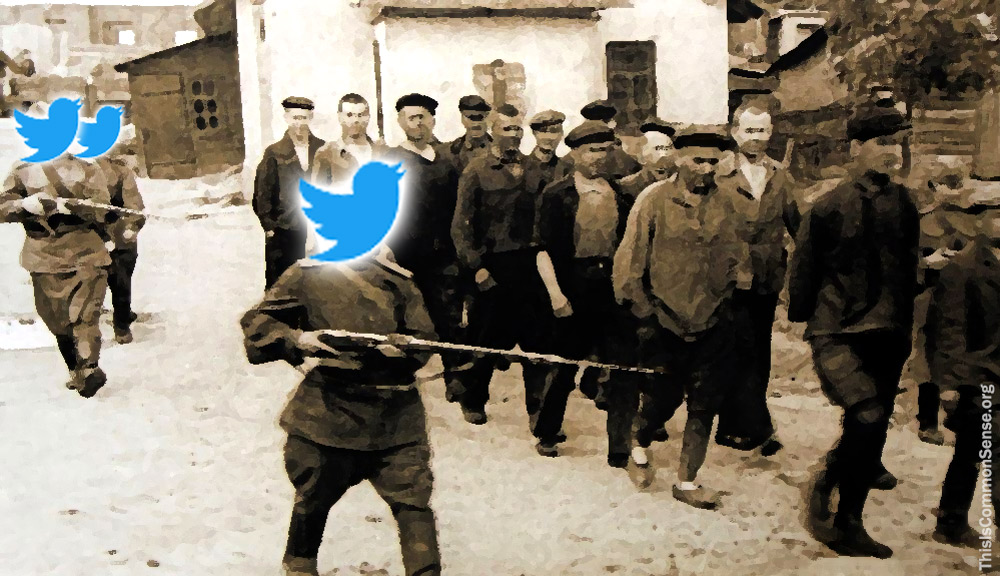
Twitter Gulag?

An old Soviet-phrase — “ne chital, no osuzhdayu” (“didn’t read, but disapprove”) — seems as apt now as ever. Why? Because Americans today have revived the “Soviet mentality,” according to Izabella Tabarovsky, writing at Tablet. 

Ms. Tabarovsky, a researcher with the Kennan Institute at the Wilson Center, explains that “[c]ollective demonizations of prominent cultural figures were an integral part of the Soviet culture of denunciation that pervaded every workplace and apartment building.”

Jobs lost, careers ruined, people socially disgraced — for “social media gaffes or old teenage behavior” — this is not just a Soviet mania, for Twitter mobs are on the rampage against those they deem “to be deplorable and unforgivable.” 

The difference between current mobbing and Soviet experience, though, is stark: the government does not seem to be in charge, and there are no real gulags to be sent to — as of yet.

Today’s mobbing behavior, on and off Twitter, appears spontaneous and “systemic,” not organizational — more Crucible-like than 1984-ish. 

Nevertheless, this is dangerous stuff. “The practice of collective condemnation feels like an assertion of a culture that ultimately tramples on the individual and creates an oppressive society,” Tabarovsky concludes, insisting that “the failure of institutions and individuals to stand up to mob rule is no longer an option we can afford.”

She’s right. Twitter-mobbing may be ugly, but it is more than that: it is obviously backed by force — witness the current riots; look at the policy agendas of the “politically correct” — and, unless stopped culturally it will have to be stopped in the realm of (ugh) politics and government.

This is Common Sense. I’m Paul Jacob.


PDF for printing

See all recent commentary
(simplified and organized)
See recent popular posts
Categories
general freedom

Happy Juneteenth!

Slavery has been called America’s “original sin.”

Folks do not generally like to dwell on their sins. That is why we all think forgiveness is so swell.

But the first and most important step in redemption? To stop committing the wickedness, in this case to immediately emancipate those held in bondage. That “struggle,” as the escaped slave and abolitionist Frederick Douglass would so eloquently refer to it, was anything but quick.   

Emancipation came only after Union forces won the Civil War, America’s bloodiest conflict by far.  

But it did come. Slavery was abolished.

And this wonderful news reached Galveston, Texas, on June 19, 1865 — a date that has lived on as the holiday “Juneteenth.” (Some call it “Emancipation Day” or “Freedom Day.”) And enslaved people were freed.

“This year, Juneteenth, a holiday that celebrates the arrival of the news of emancipation from slavery,” Veronica Chambers writes in the New York Times, “seems to be a bigger deal across the nation.”

By executive order, New York Gov. Andrew Cuomo has declared today a paid holiday for state employees. Virginia Gov. Ralph Northam, of blackface infamy, gave all state executive branch employees the day off and promised to push through legislation next year naming Juneteenth a state holiday to be “acknowledged and celebrated by all of us.”

U.S. Rep. Sheila Jackson Lee says she will introduce a bill to make Juneteenth a national holiday. 

I like it. Is there anything more worthy of commemoration than freeing people from slavery? It cannot hurt to remind people there was once slavery in America, or that we fought and died to bring that awful institution to an end.

This is Common Sense. I’m Paul Jacob.


PDF for printing

See all recent commentary
(simplified and organized)
See recent popular posts
Categories
crime and punishment general freedom too much government

Unfriending the Police?

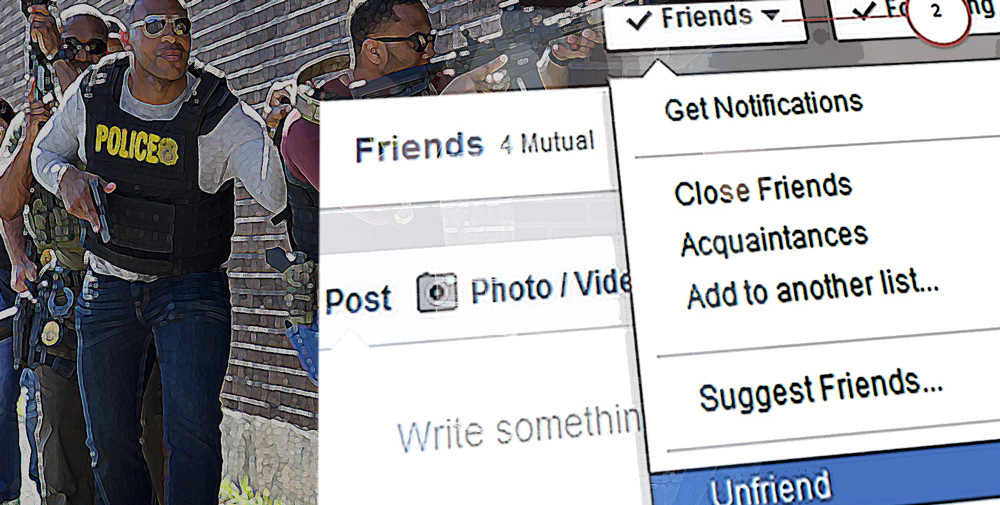
Defund the police?

First, take a moment to celebrate those on the American Left who have finally — miraculously — stumbled onto something they actually want the government to spend less money on. 

Second, consider policing expert and Washington Post columnist Radley Balko’s amply backed-up contention that “the evidence of racial bias in our criminal justice system” is “overwhelming.” 

Nonetheless, Mr. Balko notes that “lots of white people are wrongly accused, arrested and convicted” and “treated unfairly, beaten and unjustifiably shot and killed by police officers. White people too are harmed by policies such as mandatory minimums, asset forfeiture, and abuse of police, prosecutorial and judicial power.”

Even if police violence is “more of a problem for African Americans,” posits David Bernstein at Reason, “it’s not solely a problem for African Americans. Eliminating racism, in short, would still leave the U.S. with far more deaths from police shootings than seems reasonable.”

This is not an argument to ignore racism, but in favor of making effective changes in policy and law.

Maybe the solution to our police violence problems is not defunding departments, in a vast unfriending campaign, but to let up on some of their burdens, require them to do less. De-task.

For starters? Defund the War on Drugs! 

Drug prohibition has been a criminal justice disaster — filling our jails with victimless criminals whose problem is drug addiction. In a myriad of ways, the drug war has spawned greater police corruption and introduced more intrusive and dangerous policing.

Let’s have a frank conversation about . . . making practical changes to our criminal justice system.

This is Common Sense. I’m Paul Jacob.


PDF for printing

See all recent commentary
(simplified and organized)
See recent popular posts
Categories
general freedom U.S. Constitution

Thoughts in Slo-Mo

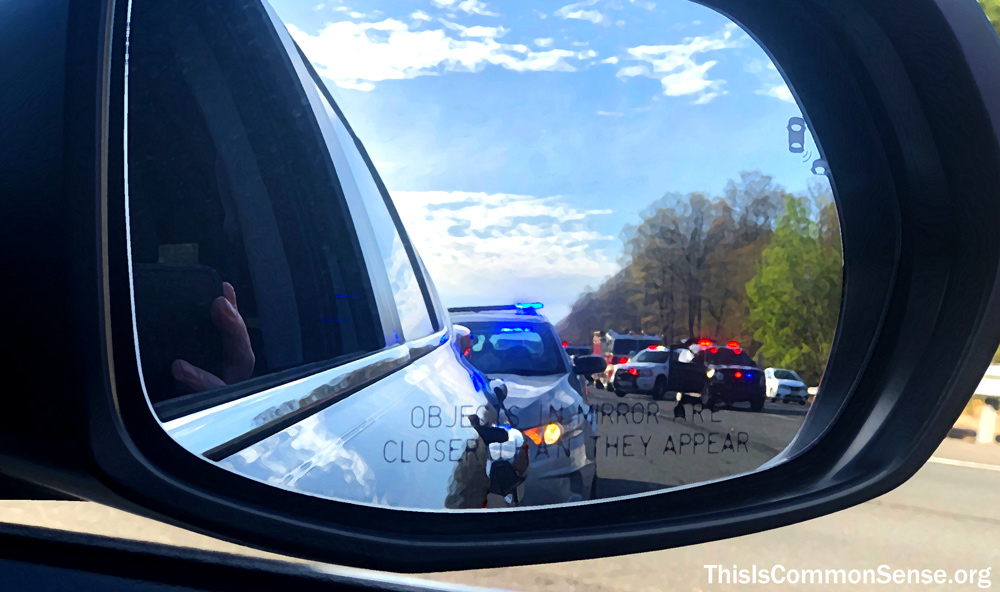
“Oh my God,” my wife gasped after that eerie instant of calm when things stopped. She told me to call 911 just as I was pressing “9.”

We had been navigating the less-than-usually-clogged interstates up the East Coast when suddenly dirt and debris swept across the asphalt. As we quickly stopped, a small vehicle flipped back onto Interstate-84, rolling over twice, throwing its occupant — a 21-year-old woman — out of the car and onto the road some 30 feet in front of us.

As another man and I got to her, we saw she was breathing. Thankfully, a nurse came forward from the traffic, which would be stopped for hours. Within minutes, emergency personnel were on the scene.

The woman was airlifted to a hospital; she later died. 

Those slow-motion seconds of the accident stay with me, along with the surrealism of the aftermath, standing on a stopped superhighway — helpless — feeling amazingly connected to someone’s precious life. 

And death.

Back on the road, after giving a statement to police, my wife wondered aloud if, what with the current pandemic, the young woman’s parents would even be able to get into the hospital to see her.

Throughout this coronavirus crisis we have heard stories of people dying all alone because of policies designed to “keep us safe” — by keeping relatives and even spouses out. 

We like safety, but if either my wife or I lies dying in a hospital, regardless of the COVID-19 risk, each of us would wish to be with the other.

It’s “till death do us part,” not “till quarantine do us part.”

This is Common Sense. I’m Paul Jacob.


PDF for printing

See all recent commentary
(simplified and organized)
See recent popular posts
Categories
First Amendment rights general freedom international affairs

Too Many Tiananmens

Chinese students suddenly occupied Beijing’s Tiananmen Square for seven beautiful weeks in the Spring of 1989. 

Millions more from all walks of life joined them.

Protesting tyranny, they demanded democracy and freedom of speech.

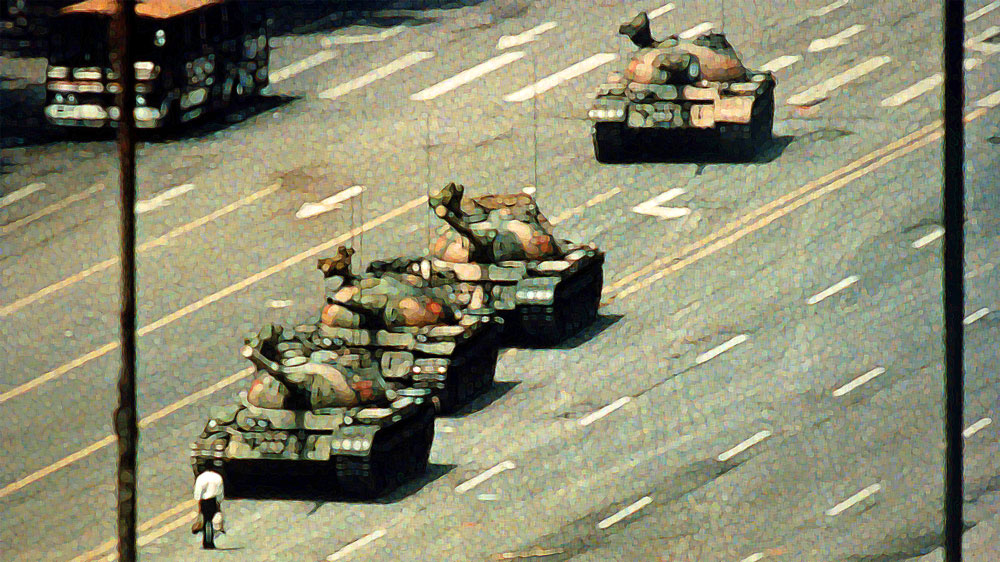
Then, 31 years ago to this very day, the Chinese government sent in tanks and soldiers, opening fire on citizens outside the square, killing thousands. The Chinese Communist Party (CCP) followed up the massacre with arrests and lengthy prison terms for those committing the unspeakable crime of speaking out for freedom.

Fast-forward three decades and the ChiNazis in Beijing are currently engaged in snuffing out the civil liberties and democratic aspirations of the people in Hong Kong.*

In mainland China, the CCP has always squelched any mention of the Tiananmen Square massacre, but every year Hongkongers have held a vigil. Not this year. It has been banned.

The world should have learned two obvious lessons: (1) the Chinese people want freedom and democracy, and (2) the ‘Butchers of Beijing’ will brutalize to prevent it.

Far more powerful than in 1989, CCP tyrants now wield a much more effective police state against Chinese citizens. 

Now is the time to honor the Tiananmen demonstrators, but clearing Lafayette Park of protesters so President Trump can walk to a church seems . . . disquieting.

Not a memorial. 

And suggesting he might invoke the Insurrection Act of 1807 to engage the military in domestic policing? Trump’s defense secretary rightly opposes. 

Comparisons to Tiananmen Square have not unreasonably been drawn. 

The difference? Americans can revolt . . . peacefully, which our government cannot put down. 

For the sake of the free world and all those — including 1.4 billion Chinese — in the unfree world, now is no time to abandon peaceful protest and political action for insurrection, riot, and military suppression.

This is Common Sense. I’m Paul Jacob.


 * This is brazen violation of the 1997 turnover agreement made with Britain, of course.

Additional Reading:

What It Means

What Tiananmen Inspired

Tiananmen & Term Limits

All the Tyranny in China

I Am Hong Kong

PDF for printing

See all recent commentary
(simplified and organized)
See recent popular posts