Categories
free trade & free markets judiciary

Musk’s Bête Noire

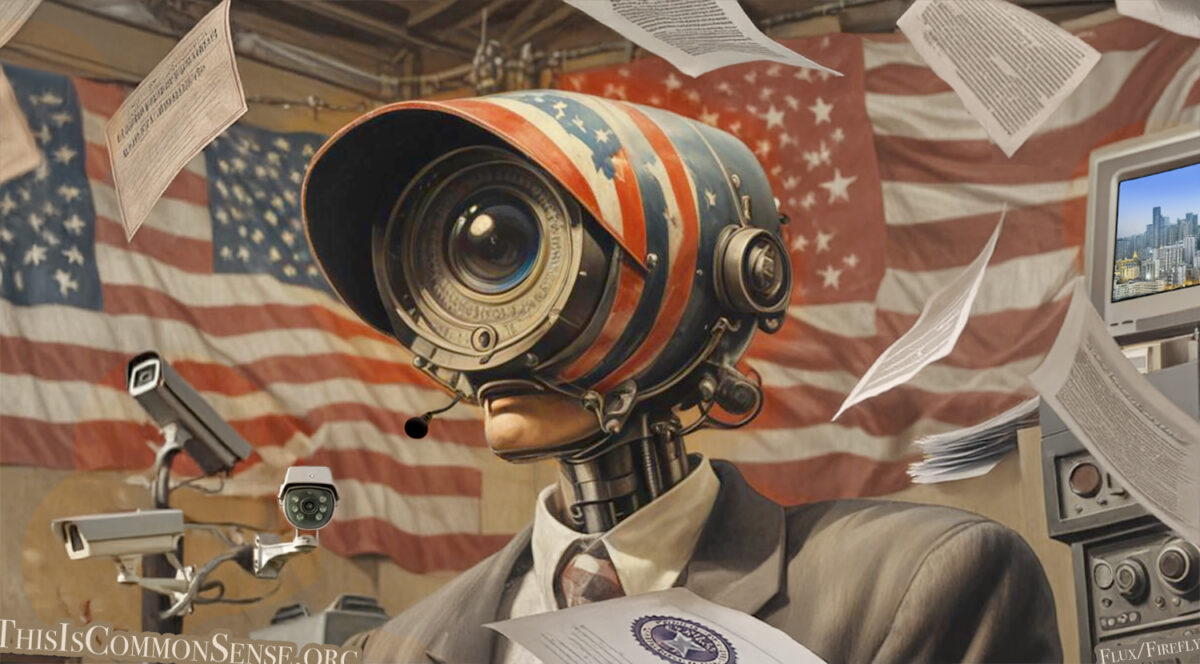
Should a judge decide how much Elon Musk can be paid?

Well, when the job that Musk is doing is not a government job and a company’s internal process of determining the compensation is voluntary and aboveboard . . . no.

But according to a Delaware judge, Chancellor Kathaleen McCormic, who last January rescinded Tesla’s compensation package then worth $56 billion, now worth more than $100 billion, Musk is not entitled to this compensation. And she has just affirmed her ruling.

Musk says that “shareholders should control company votes, not judges.”

Tesla says: “The ruling is wrong, and we’re going to appeal.”

The appeal could take a year or more.

There’s nothing in the U.S. Constitution authorizing judges to run private companies or decide how much their most valuable personnel may be paid. The judge has no constitutional warrant. And no moral warrant. 

Not her business.

Ignoring the enormous success of Tesla, McCormic is simply deciding that Musk’s pay is way too much with respect to some arbitrary personal criterion that is irrelevant to the decisions that companies must make to attract and keep their greatest entrepreneurial talents, the ones who do the most to make it all go.

Still, maybe we should give the judge a break — I mean, just a tad?

Remember, it was Chancellor McCormic who forced Musk to go through with his Twitter purchase — which turned out to be the most consequentially favorable free-speech/-free-press event of our time. 

Sure, then too she was grinding a personal or ideological animus against the magnate.

But credit where credit’s due!

This is Common Sense. I’m Paul Jacob.


PDF for printing

Illustration created with …

See all recent commentary
(simplified and organized)
See recent popular posts
Categories
free trade & free markets regulation tax policy

Destroying Dane Farming

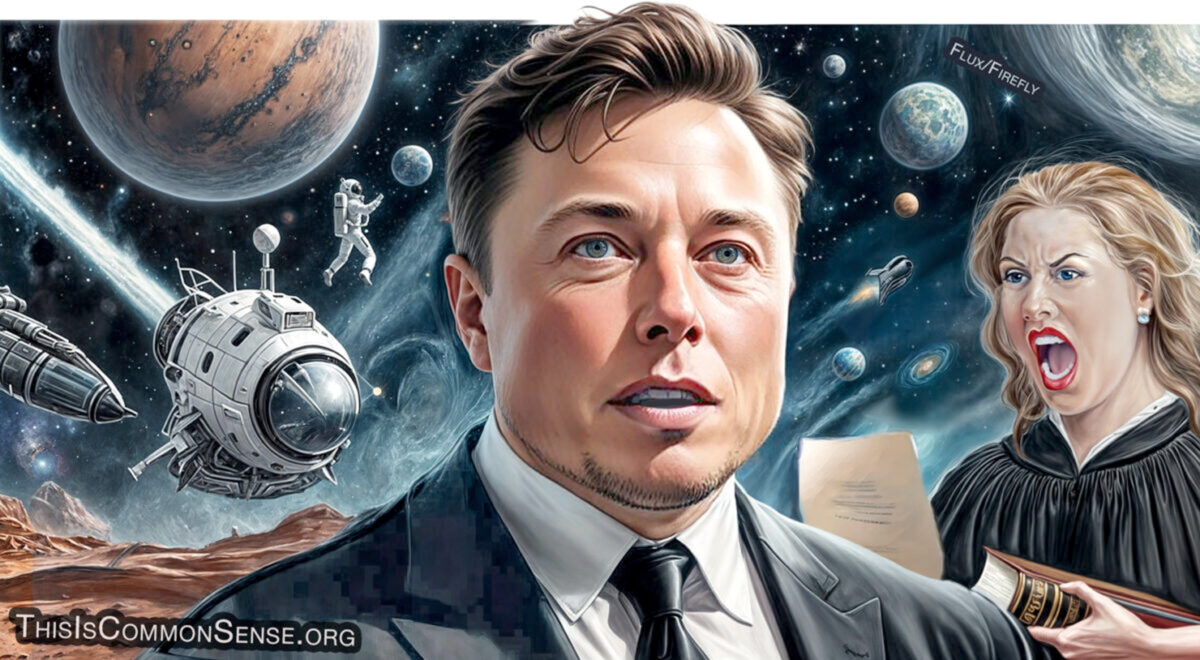
In February, Denmark’s farmers were worried “that plans to levy a carbon emission tax on farming” in the name of global weather control “would force them to reduce production and close farms.”

In the same month, farmers across Europe protested against assaults on their livelihood.

Meanwhile, a report by a government commission concluded that the carbon tax could cause Denmark’s agricultural production to decline by as much as a fifth. The central planners made clear that this was a price they were willing to pay in order to indulge their ideological-meteorological fantasy.

And also, not incidentally, in order to collect more tax dollars.

But the concern and the estimates of the severity of the blow on farmers — to be penalized for providing food, a requirement of survival — availed naught.

The carbon emissions tax is being enacted and will take effect in 2030. The levy will initially be something like $96 per cow, rising to $241 per cow in 2035.

Insane. But cows produce methane “through their burps and manure,” CNN reports. So what can tyrants do but tax farmers into oblivion?

The fantasists may claim success no matter what global climate turns out to be in years to come. Or they may claim that their measures haven’t yet fixed the global climate only because the rest of the world’s countries haven’t yet followed suit and appropriately penalized their farmers for farming.

Only when civilization is fully destroyed will we be able “save” it.

This is Common Sense. I’m Paul Jacob.


PDF for printing

Illustration created with Midjourney and Firefly

See all recent commentary
(simplified and organized)
See recent popular posts
Categories
free trade & free markets too much government

An Ember of Hope?

Will the world escape the punishing “green energy” mandates?

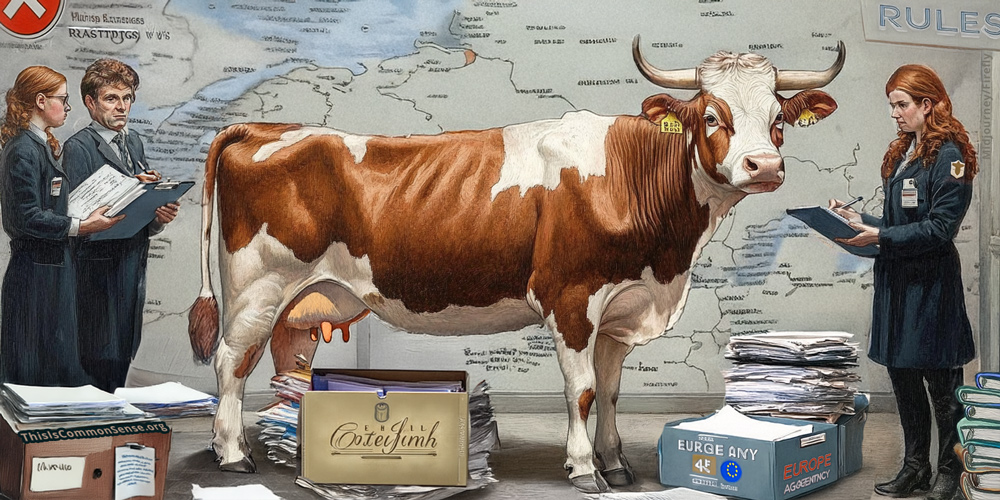
The government of Italy is making known its unhappiness with a looming ban on sales of gas-powered vehicles, supposed to happen by 2035. The mandate has been imposed by the European Union, of which Italy is a member.

The transition is to be attended by formal review of how things are progressing toward the goal of eliminating gas cars. One is scheduled for 2026. Italy wants it to happen sooner.

Italy’s industry minister, Adolfo Urso, has indicated that his government will soon formally request this early review. Everyone understands that this is not because the current government of Italy is in a hurry to stamp its imprimatur on the EU’s plans.

Urso says: “We believe it’s absolutely necessary to modify the direction of EU industrial policy. The automotive sector is the one where a change from the Green Deal is most required.”

Prime Minister Giorgia Meloni has called the decision to outlaw gas-powered vehicles “self-destructive.”

Meanwhile, demand for electric cars has slumped in Europe and the U.S. as the inconveniences and risks become better known. These include the cars’ still very high cost, their tendency to freeze up in very cold weather, the greater frequency with which their tires must be changed, the difficulties of recharging, the difficulties of putting out the fires when the cars catch fire.

May Italy show the way out of the debacle and let’s hope the rest of the EU follows.

This is Common Sense. I’m Paul Jacob.


PDF for printing

Illustration created with Midjourney and Firefly

See all recent commentary
(simplified and organized)
See recent popular posts
Categories
free trade & free markets international affairs tax policy

Trump’s Tariff Question

If Donald Trump fails to re-take the White House in November (and then for real in early 2025), his legacy may quickly devolve into a matter for historians, not live politics. After people calm down and the culture war stuff recedes (once again, if allowed by events), what will be left to argue over are a half-dozen major issues, which include war, mass migration . . . and tariffs.

Tariffs have long been Mr. Trump’s major hobby horse; he gets excited about 100 percent levies. The whole business about the “bloodbath” quote was his insistence that American auto industry will be destroyed if Trump himself doesn’t get the chance to erect ultra-high tariffs against automobiles from Mexico.

Trump looks at tariffs on foreign goods as harming foreign nations and helping us, the Americans.

But it is worth noting that economists from Adam Smith and David Ricardo onward have regarded tariffs as chiefly harming consumers within the country that erects them. 

At Reason you can read Veronique de Rugy make the classic free-trade case, anew, in “No, Trump-Style Tariffs Do Not Grow the Economy.” If Frédéric Bastiat didn’t convince you, maybe de Rugy will.

But something’s missing. Surrounding Trump’s talk against free trade in general and China in particular there was always another element that neither Bastiat nor de Rugy emphasize: free-trading with China helps Chinese and Americans, sure; gotcha — but it also helps the Chinese state, and its ruling Communist Party. 

“Trump is an avowed restrictionist on both immigration and trade,” de Rugy writes. But both unchecked immigration and free trade present problems not economic so much as political. It’s about real bloodbaths, actual warfare, not metaphorical ones.

Even if Trump misdiagnosed the domestic economy, he saw problems with China perhaps more clearly than anyone else.

This is Common Sense. I’m Paul Jacob.


PDF for printing

Illustration created with PicFinder and Firefly

See all recent commentary
(simplified and organized)
See recent popular posts
Categories
free trade & free markets general freedom international affairs

Bombers Off the Coast

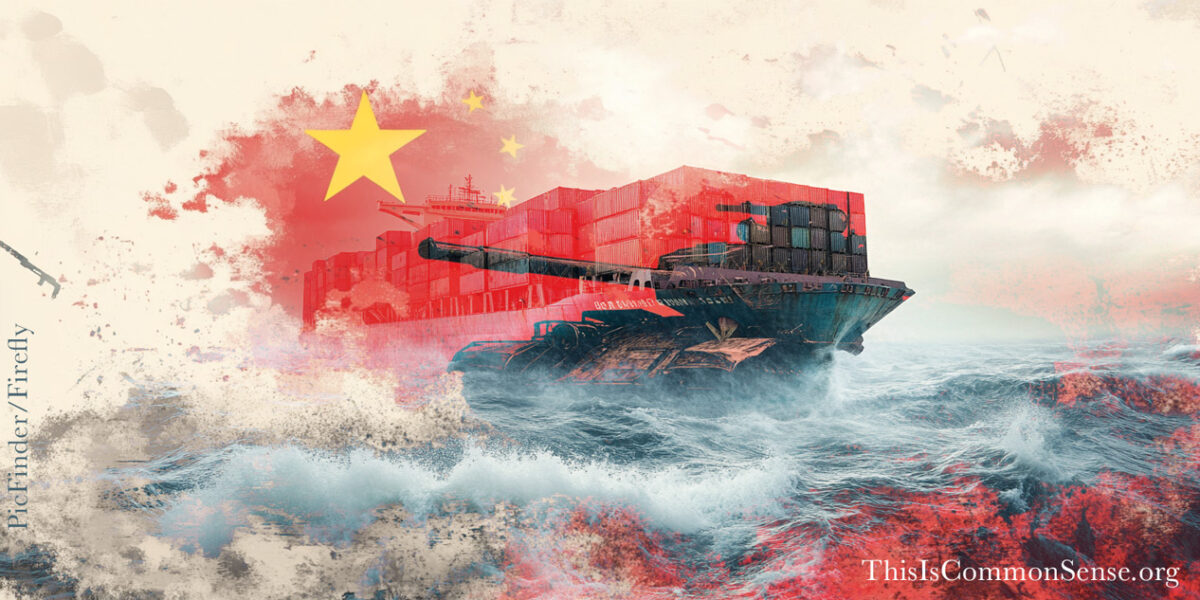
No wonder Taiwan is going ahead, despite a typhoon battering the island, with its annual war games

China threatens. And threatens. And threatens

As discussed yesterday, it is unclear just how committed a Trump 47 administration would be to protecting Taiwan. 

President Joe Biden, on the other hand, has repeatedly pledged to engage U.S. military forces in defense against China. But since he is physically and cognitively unable to run for the presidency, are we safe letting Joe hang out at the White House for the next six months performing the “lesser” job of being America’s commander-in-chief?

That position might suddenly take on a less sleepy character.

Just prior to Biden’s Oval Office address, NORAD disclosed that it had “scrambled fighter jets to intercept two Russian Tu-95 ‘Bear’ bombers and two Chinese H-6 bombers off the coast of Alaska.”

Lately, the Philippines has gotten most of the CCP’s bullying, enforcing their ridiculous claim to 90 percent of the South China Sea. The U.S. has an unambiguous treaty obligation to the Philippines. 

On the other hand, the U.S. position toward Taiwan, right there 80 miles off the Chinese coast, is friendly . . . but the U.S. doesn’t officially recognize Taiwan as a country and our policy toward its defense remains one of “strategic ambiguity.” 

Still, unless the U.S. plans to leave Asia, and maybe even then, we will have to stand up to China. Best to draw that line, to mount that defense at Taiwan.

Why? 

  • Because of the island’s worldwide dominance in producing vital computer chips, a New York Times headline declared, “Pound for Pound, Taiwan Is the Most Important Place in the World.” Kept free, that is.
  • But it’s more than that: without a free Taiwan uniting Japan and the Philippines in the “first island chain,” China can divide those two countries — both of which the U.S. is treaty-bound to defend — and conquer.
  • Taiwan is freedom and democracy’s success story of the last half-century, successfully throwing off four decades of martial law authoritarianism to become, arguably, Asia’s freest and most democratic nation. 

Making it in my interest and yours to disallow the snuffing out of freedom on the other side of the globe. 

We need a president who knows the world is a dangerous place, understands how critical Taiwan is, and levels with the American people about the challenges ahead.

This is Common Sense. I’m Paul Jacob.


PDF for printing

See all recent commentary
(simplified and organized)
See recent popular posts

Categories
crime and punishment free trade & free markets general freedom

Rogue City Government?

Is it a coup?

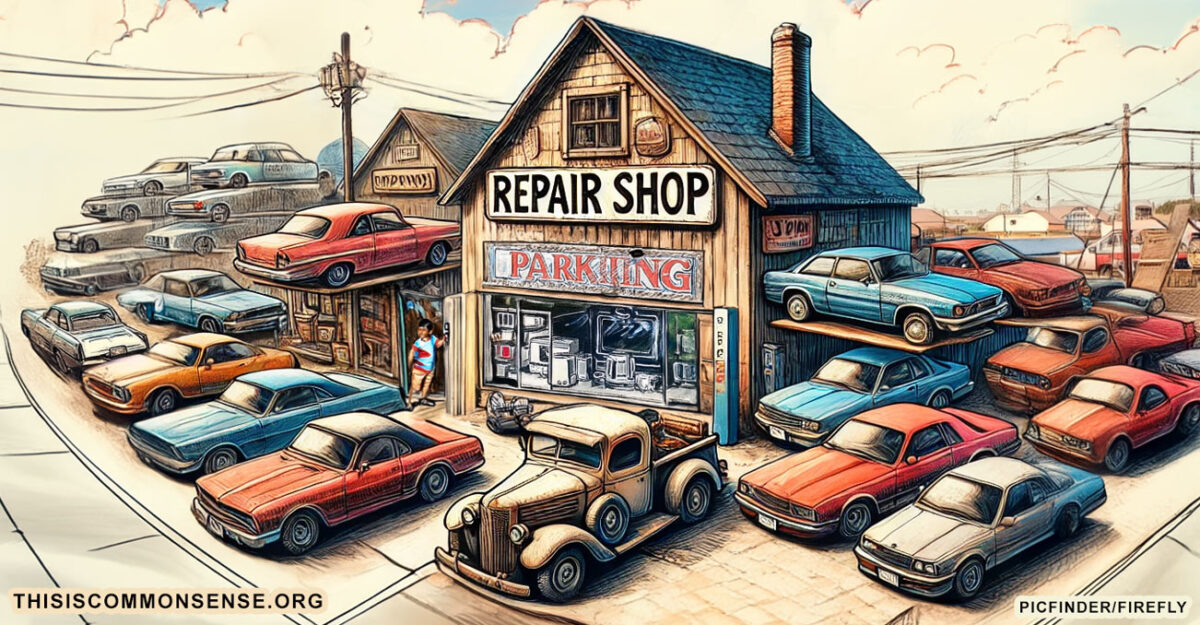
Two years ago, Azael Sepulveda, a mechanic, sued the city of Pasadena. The city had demanded that he provide 28 parking spots before he could open a shop to fix things. The property his shop is on can accommodate only a few parking spaces.

With the help of Institute for Justice, which fights for people’s right to earn an honest living all over the country, Sepulveda reached a settlement with the city. He would be allowed to open.

Hurray. Big hassle, but now he could go on with his life.

Except that for two years the city has still blocked him from opening up.

So IJ had to sue again. And get this. Members of the Pasadena City Council recently said that for the past year they have been kept in the dark about developments in the case. This, “even though the city’s attorney claims to be acting on ‘instruction from city council.’”

That attorney, Bill Helfand, has been arguing that the city should be immune from litigation to enforce the city’s own settlement.

So . . . is it a coup? Is Helfand running local government himself, unauthorized, randomly ignoring settlements and whatnot?

Could some weirdly pervasive and persistent miscommunication be the problem? It just seems unlikely that mislaid telephone messages are why Sepulveda is still being stonewalled.

Whatever the problem is, Pasadena, fix it. “Stop with the games,” as IJ says. And let Azael Sepulveda get started fixing other things.

This is Common Sense. I’m Paul Jacob.


PDF for printing

Illustration created with PicFinder and Firefly

See all recent commentary
(simplified and organized)
See recent popular posts
Categories
crime and punishment free trade & free markets regulation

Natural vs. Regulated

“I don’t need metabolically unhealthy politicians and obese bureaucrats watching out for my health,” The Telegraph quotes an anonymous source. 

The subject? “How milk became the new culture war dividing America,” published on June 22. It’s a “natural” vs. “technological” debate.

“For more than 130 years, Americans have been instructed that drinking milk that comes directly from a cow’s udder can be dangerous,” Tony Diver’s article begins, but how it ends is telling: “‘With respect to the question of food being natural — arsenic is natural,’ Prof Schaffner said.” And so, too, he says, is cyanide. 

“Sharks are natural. Those things can all kill you. So just because something is natural does not mean that it’s safe.’”

That sounds like something I’d say. 

But is it something to say about raw milk?

Consider the historical context. Raw milk and its products have been produced for human consumption for millennia. Of course there are dangers, and pasteurization has done wonders to curb bacteriological infections and death. Still, a lot of people wonder what we’ve lost in the pasteurization process. Nutrition and immune system health, for example. So for decades — perhaps as long as there have been regulations to make pasteurization mandatory — there’s been a “pro-natural” backlash.

On the Nature side, we note that our populations aren’t as healthy as you’d expect from the benevolent tyranny of politicians, regulators, and, uh, “obese bureaucrats.”

So, last week, “the latest bill to repeal an outright ban on raw milk hit the governor’s desk in Louisiana, after similar efforts in West Virginia, Iowa, Georgia and North Dakota.”

If signed into law, Louisianans will be able to purchase raw milk in stores — “albeit with a warning, in capital letters, that it is ‘not for human consumption.’

“Everyone, including the legislators, knows that instruction will be ignored.”

There’s something sickness-inducing about that.

This is Common Sense. I’m Paul Jacob.


PDF for printing

Illustration created with ChatGPT4o and Firefly

See all recent commentary
(simplified and organized)
See recent popular posts

Categories
free trade & free markets general freedom regulation

Leave Us Alone to Do Our Work

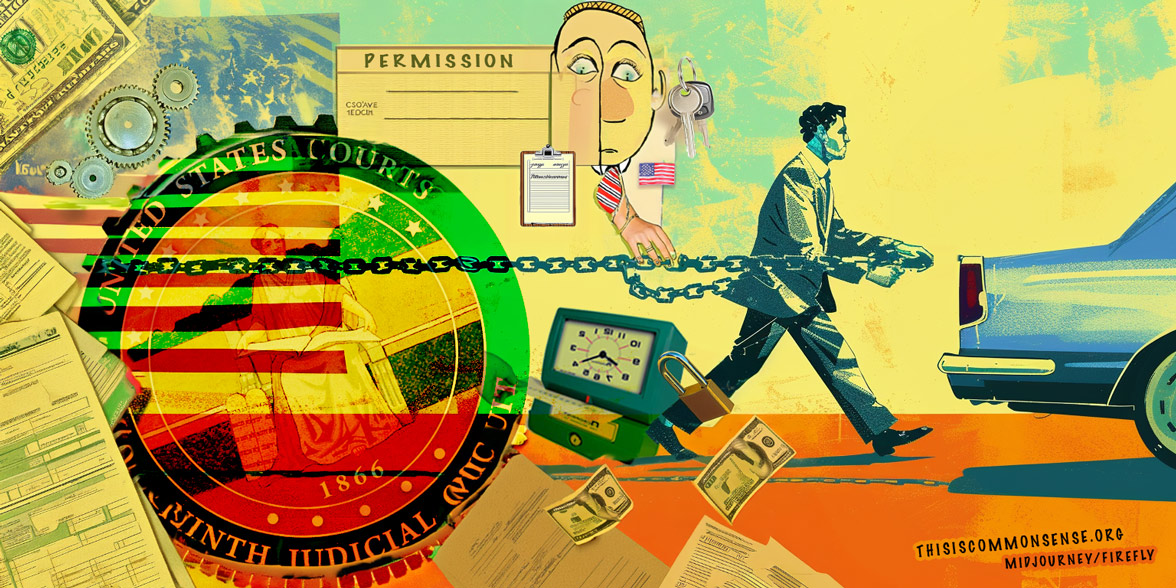
Drearily, an appeals court has dismissed Uber’s challenge to California’s anti-gig-work law.

According to the 9th Circuit, the ride-sharing company couldn’t show that the California anti-freelancer law AB5, which took effect in 2020, unfairly targeted Uber while allowing other types of contract work to continue unhindered.

In fact, the many exceptions to AB5 — determined by abundance or lack of political pull of various groups — mean that Uber is hardly alone in suffering from uneven application of the law.

But suppose AB5 had in fact been evenly imposed on everybody. Suppose every single gig worker in California, without exception, had been forced to become a regular employee of all of his clients — with all the additional costs for employers that this entails — or else lose all work altogether.

This would be worse, not better. 

Inconsistent tyranny is bad for the victims. Absolutely consistent and uniform tyranny is bad for the victims — which would be greater in number.

Maybe the 9th’s misjudgment won’t stand. If the case makes its way to the U.S. Supreme Court, maybe the high court will unambiguously affirm our right to contract with each other in order to make a living and get stuff done.

Meanwhile, the fate of Uber also hinges on another court case, one determining the fate of Proposition 22, a 2020 California initiative affirming Uber’s right to contract with drivers.* A labor union says Prop 22 is unconstitutional. The state supreme court is deciding whether this is so. 

It is not so.

This is Common Sense. I’m Paul Jacob.


* Citizens in Charge, a pro-initiative and referendum group, for whom I serve as president, filed an amicus or friend of the court brief with the California Supreme Court in this case.

PDF for printing

Illustration created with Midjourney and Firefly

See all recent commentary
(simplified and organized)
See recent popular posts
Categories
free trade & free markets general freedom too much government

Doctoring Malady

There is a doctor shortage. Economists who study such issues project that the shortfall will continue to grow.

That is, the pool of available professionals for advanced and general practice medicine is shrinking relative to demand.

A report last year at Definitive Healthcare provides a list of reasons:

  1. Shifts in physician and patient populations
  2. Most healthcare workers prefer not to work in rural hospitals 
  3. Medical school and residency programs are limited 
  4. Healthcare workers are burnt out 

What wasn’t mentioned? The COVID response debacle. When an elephant makes a deposit on the waiting room floor, don’t ignore it.

But, instead, the list of causes and cures was predictable: “too many administrative tasks” (need more assistants, or at least AI?); “poor work-life balance” (but that’s always been the case); “insufficient salary” (you could see that one coming a mile away, right?).

A study published in March, “The Complexities of Physician Supply and Demand: Projections From 2021 to 2036,” prepared for the Association of American Medical Colleges, dips its timid toes in that topic, but says little of significance. 

And as I scrolled through a report on the study, I thought: this is none of my business. Just as it’s none of my business to fret much about the supply and demand for toilet tissue or garbage trucks. This is all supposed to be taken care of by “the market.” 

Trouble is, we do not have a free market in medical care. We have an over-regulated, vastly subsidized healthcare system.

The key to the future supply of doctors is getting the government out of doctors’ business. Hesitating to turn that key, or saying that government “must do more,” merely makes the malady worse.

This is Common Sense. I’m Paul Jacob.


PDF for printing

Illustration created with PicFinder and Firefly

See all recent commentary
(simplified and organized)
See recent popular posts

Categories
free trade & free markets ideological culture political economy too much government

Sweden’s Electric Sense

Common sense in Sweden! Energy in Sweden!

Under the policy of Sweden’s current government, the Swedish people are to be allowed to illuminate and heat their homes and do all the other things they use electricity for. The Swedish parliament has formally relinquished the government’s former target of somehow reaching “net-zero” renewable energy by 2045.

Such unreliable means of generating power as erratic wind and erratic sunshine just don’t cut it, says Finance Minister Elisabeth Svantesson.

“We need more electricity production, we need clean electricity, and we need a stable energy system. In substantial industrialized economies . . . only a gas-to-nuclear pathway is viable to remain industrialized and competitive.”

The new energy policy is an about-face for Sweden, which decided in the ’80s to nuke nuclear power and pursue 100 percent “renewable” energy.

Sweden is now following the lead of Finland. After Finland’s latest nuclear power plant went on line in April, reports Peta Credlin, “wholesale power prices dropped 75%, almost overnight. The Olkiluoto 3 plant is . . . delivering 15 percent of the country’s power needs. Nuclear now provides around half of the country’s total electricity generation.”

Nuclear power has gotten a bad rap in many countries, including the United States. But if societies and governments are rightly or wrongly determined to retreat from reliance on fossil fuels while also not pulling the plug on industrial civilization, a steady supply of electricity has to be obtained somehow or other.

Nuclear power is one major way to do the job.

This is Common Sense. I’m Paul Jacob.


PDF for printing

Illustration created with ChatGPT 4o

See all recent commentary
(simplified and organized)
See recent popular posts