Categories
First Amendment rights international affairs

The Censors’ Conceit

Is it okay to stop people from talking to prevent them from saying things that are possibly incorrect?

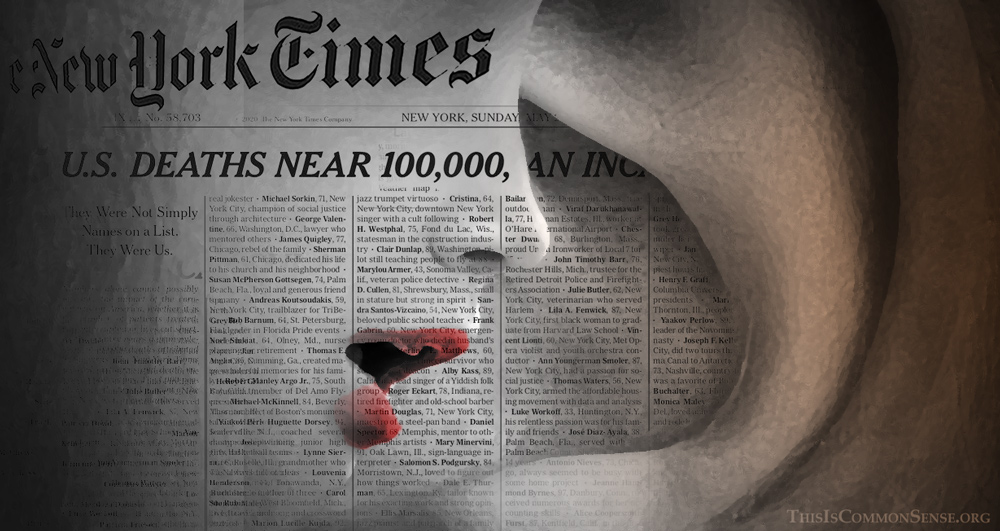
A New York Times article about Chinese censorship of discussion of COVID-19 seems to imply that the Chinese government would have been justified in choking off discussion to “debunk damaging falsehoods.”

A mass of government documents recently obtained by hackers “indicate that Chinese officials tried to steer the narrative not only to prevent panic and debunk damaging falsehoods domestically. They also wanted to make the virus look less severe — and the authorities more capable. . . .”

The government’s efforts included hiring hundreds of thousands of people to publish party-line posts on social media as well as detaining people “who formed groups to archive deleted posts” about the death of Dr. Li Wenliang, who had warned about COVID-19.

The Chinese government has also issued endless instructions to providers of nominally private social-media platforms to control what people say about the pandemic.

Thank the Gray Lady for the report confirming the known details about Chinese censorship. But how do you draw a line between censorship “only” to “debunk falsehoods” and censorship to spread official lies and suppress the very appearance of truth? You can’t.

Discussion itself helps us determine what is true and what is false.

The notion that the government (or any society-wide institution obeying the government) can neatly and unilaterally shape discussion to prevent only “bad” discussion — without inflicting massive damage on “good” discussion — is itself false.

This is Common Sense. I’m Paul Jacob.


PDF for printing

See all recent commentary
(simplified and organized)
See recent popular posts
Categories
education and schooling First Amendment rights

Signs of the Times

Texas A&M University’s Student Code of Conduct office is harassing a student for posting pro-Biden signs on campus last November.

Don’t believe it? 

Well, ya got me. The signs were pro-Trump, not pro-Biden.

I committed this small and fleeting deception to make a point. The fact that posting of signs, announcements, etc., on a university campus, including the Texas A&M campus, is nothing unusual. The kids these days (along with those of the last umpteen centuries) have always engaged in political debate on campus, trying to promulgate their views.

Doing so doesn’t typically cause big problems with officials of U.S. universities. Unless — and, alas, increasingly — the message being promulgated contradicts approved establishmentarian political themes.

According to a CampusReform.org report, Dion Okeke, president of Students for Trump, received a letter from the school’s Student Conduct Office saying he’d better meet with the Student Conduct office about posting the signs. Otherwise, he could face charges of improper student conduct, and his registration could be placed on “administrative hold.”

Universities doubtless have rules about sign placement. Okeke’s sign-posting sounds like a minor infraction at worst.

If it even was an infraction at all.

Are the veiled and not-so-veiled threats in the letter signed by Jessica Welsch, assistant coordinator of the Student Conduct Office, a proportionate response to any alleged sin by Dion Okeke? No.

Meanwhile, a Texas A&M student who perpetrated a hoax about alleged racism last summer is not in any trouble with the school.

This is Common Sense. I’m Paul Jacob.


PDF for printing

See all recent commentary
(simplified and organized)
See recent popular posts
Categories
First Amendment rights ideological culture

Cry No More

And the children sing: “you can’t always get what you want.”

It’s a Rolling Stone song, and its album version does actually feature a children’s chorus (over adult singers).

I mention it not because I’ve just listened to the non-choral version put up in April by the famous rock group, a special pandemic recording. Though I just did. And perhaps it’s on my mind because the song was used by Donald Trump on his way to the White House, and at the present moment it sure doesn’t look like he’s going to get a second term.

“No, you can’t always get what you want want./ But if you try sometime, you just might find/ You get what you need.”

A silver lining for Trump voters?

No. It just came to mind when I learned that employees at Penguin broke down in tears when they learned that the huge publishing company was going to publish Jordan Peterson’s follow-up to his 2018 best-seller, 12 Rules for Life.

There was weeping, and it wasn’t for joy.

You see, the young people in the company said that Peterson is “an icon of hate speech and transphobia.” Oh, and he’s also “an icon of white supremacy,” and the lamenter admitted that “regardless of the content of his book, I’m not proud to work for a company that publishes him.”

It is really hard to sympathize. A major publishing company in an open society must be expected to publish a wide variety of material. So, buck up, as Peterson likes to say. Unless you own the place, you can’t always publish what you want.

More importantly, note that word: icon. That’s an image that stands for something by looking like that something.

How does Peterson look like a white supremacist or transphobe? 

By imputation. By ignoring his arguments. And by treating his fans as wholly other and as a unified mass.

Who can be hated and denied ever getting what they want. 

But such desired censorship is certainly not what we need.

This is Common Sense. I’m Paul Jacob.


PDF for printing

See all recent commentary
(simplified and organized)
See recent popular posts
Categories
First Amendment rights ideological culture

Buzz-Sawing the Conservative Treehouse

“They’re really showing their hand now, aren’t they?” 

That is how one blogger puts it. And the “They” are the leftward tech giants that provide platforms on which all of us can (in theory) have our say.

“They” — Google, Twitter, Facebook, WordPress — have provided these platforms in a country where freedom of speech is protected, if imperfectly, by the First Amendment and allied ideas, institutions, habits, and sensibilities.

But the First Amendment cannot, by itself, protect speakers of speech from having the rug yanked out from under them by these service providers. With increasing frequency and brazenness, the tech giants are de-platforming speakers they disagree with despite past assurances of being open to all comers (not using speech to do anything illegal).

In this case, “they” means WordPress, which has notified a popular political blog, The Conservative Treehouse, that its days are numbered. Because “your site’s content and our terms” are incompatible, “you need to find a new hosting provider and must migrate the site by Wednesday, December 2.”

It took many years and, apparently, the (apparent) election of Joe Biden for WordPress to discover this “incompatibility.”

Says the Treehouse: “After ten years of brutally honest discussion, opinion, deep research and crowdsourcing work” by the site, WordPress can cite no violation of any term of service “because CTH has never violated one.”

So, what’s the upshot? At a minimum, if you’re using a big-tech platform but aren’t toeing the big-tech ideological line, seek alternatives. Pronto.

This is Common Sense. I’m Paul Jacob.


PDF for printing

See all recent commentary
(simplified and organized)
See recent popular posts
Categories
First Amendment rights ideological culture

The Latest Fake Mystery

We Americans want to have our say, speak our piece — we do not wish to be gagged. No mystery to that. No puzzle. No strange, arcane, unexpected turn of our temper.

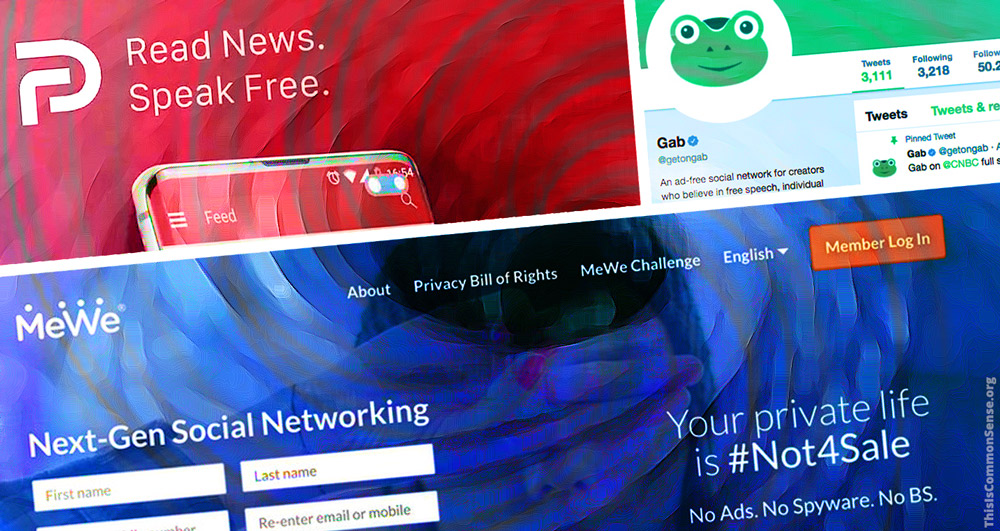
But that’s how it must seem to Nathan Bomey, author of “Parler, MeWe, Gab gain momentum as conservative social media alternatives in post-Trump age,” gracing the pages of USA Today.

“America’s crisis of political segregation — we increasingly don’t live alongside, associate with or even marry people who think differently from us — is increasingly leading conservatives to congregate together on social media outlets designed specifically for people who think like them.”

This is a passage of surpassing dumbness.

To pick one fundamental ideological divide at random: capitalist twitterers have never had any problem with posting tweets “alongside” socialist twitterers. The problem is the growing censorship of tweets that officials and employees at tech giants like Twitter, Facebook, and Google happened to dislike or disagree with for any reason.

This censorship was revved up during the recent election.

Bomey does mention claims of censorship by the persons being censored, but treats these as the ravings of “the extremist crowd.” He adds: “Experts on political polarization say [the rise of alternative social media] is a natural outgrowth of our divided culture. . . .”

Again: a major reason the alternatives to Twitter etc. are gaining such traction is the censorship. People are leaving the Big-Tech-sponsored discourse because they are being censored. 

You don’t kick people out of the room and then scratch your head in wonderment, asking, “Gee willikers, why are you guys going away?”

This is Common Sense. I’m Paul Jacob.


N.B. I have Minds and Gab accounts, but do not use them. Should I start again? I just set up a MeWe account. What alternative social media apps do you use?

PDF for printing

See all recent commentary
(simplified and organized)
See recent popular posts
Categories
First Amendment rights Second Amendment rights

Students Fight Back

Everywhere, assaults on freedom and free speech are going full blast. Violent True Believers are on the march as others, even if less overtly barbaric, provide cover, an excuse.

For example, the State University of New York at Binghamton has cooperated with left-wing thugs to suppress conservatives.

The mob stole or destroyed posters and the table students were using to promote an appearance by Arthur Laffer, the noted supply-side economist. The same mob also disrupted the lecture itself. A lawsuit brought by the victimized students accuses officials of failing “to take action to defend College Republicans’ constitutional rights” and supporting the “physically abusive actions of the College Progressives.”

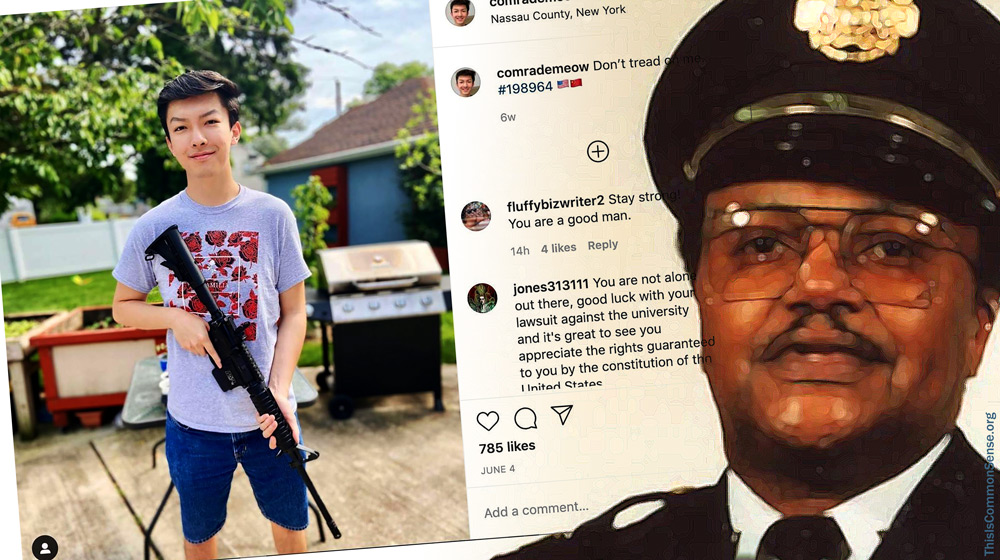
Another student under attack is Austin Tong. Recently, the Foundation for Individual Rights in Education (FIRE) has been going to bat for Tong, a Fordham University student suspended for social media posts.

One is a picture of Tong holding (not pointing) a legally owned rifle, intended to draw attention to the Tiananmen Square massacre. The other shows black police captain David Dorn, who was murdered by looters. Its caption chastises members of the Black Lives Matter movement for apparent indifference to Dorn’s fate.

Before suspending him for “bias” and “threats,” university personnel showed up at Tong’s house to interrogate him about the posts.

Tong is unapologetic, and FIRE says that Fordham has “acted more like the Chinese government than an American university, placing severe sanctions on a student solely because of off-campus political speech.”

Far from isolated cases, unfortunately.

This is Common Sense. I’m Paul Jacob.


PDF for printing

See all recent commentary
(simplified and organized)
See recent popular posts
Categories
First Amendment rights

Protest Hits the Pavement

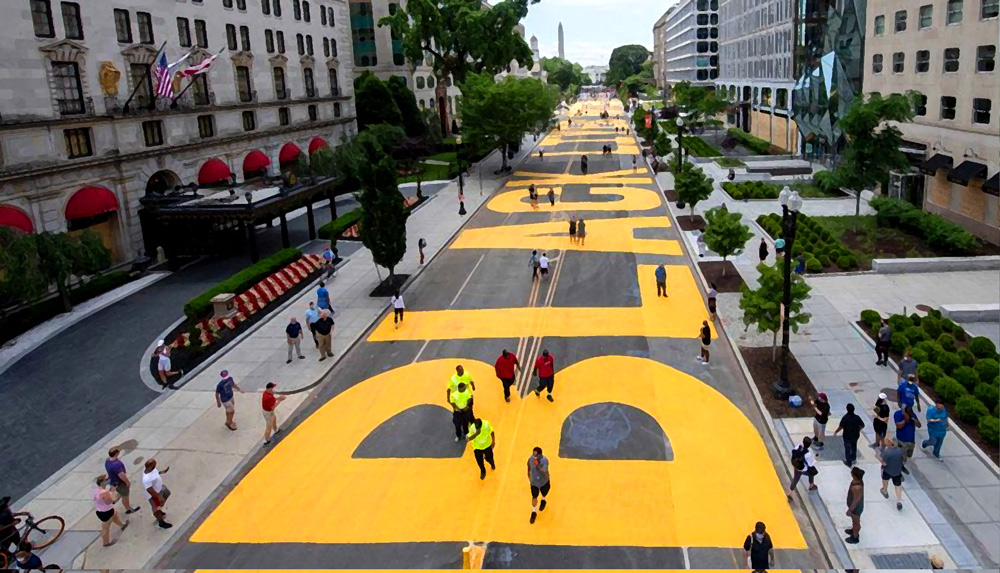
Social justice activists and Washington D.C. city officials have collaborated to paint the slogan “Black Lives Matter” on 16th Street near the White House. 

The city has also allowed the words “Defund the Police” to be painted on the street.

Does this mean that the roadways of our nation’s capital city are now a public forum accessible to anyone who files the proper forms?

So far, doesn’t look like it. 

So Judicial Watch (JW) is suing for the right to paint its own motto, “Because No One is Above the Law,” on a DC street. JW went to court because its applications to perform a similar paint job have fallen on deaf ears.

It contends that its First Amendment right of freedom of speech is being violated.

“We have been patient,” Judicial Watch says. “We also have been flexible. We have stated our willingness to paint our motto at a different location if street closure is necessary and the city is unwilling to close our chosen location. All we ask is that we be afforded the same opportunity to paint our message on a DC street that has been afforded the painters on 16th Street.”

I can’t wait until all this gets cleared up. I suppose it’ll be one or two paint jobs per applicant. 

ThisisCommonSense.org” has a nice ring to it, eh? 

Something about “unalienable rights [to] Life, Liberty, and the pursuit of Happiness” would also be a great message, assuming it’s still legal to quote the Founders whose legacy we celebrated over the weekend.

This is Common Sense. I’m Paul Jacob.


PDF for printing

See all recent commentary
(simplified and organized)
See recent popular posts
Categories
First Amendment rights national politics & policies too much government

A Modest Extrapolation

The big news from yesterday’s Supreme Court decisions (in June, they typically come in chunks) regards discrimination law, in which the court decided, 6-3, with Neil Gorsuch writing the majority opinion, that discrimination “against an employee for being gay or transgender violates the Civil Rights Act of 1964.” As covered at Reason it makes for fascinating reading.

Still, there are many problems here. The whole employment discrimination issue assumes that people have a right to be judged suitable for employment based only on strict consideration of job performance.

This is intrusive into private decision-making, and opens up hiring and firing to huge legal costs.

But a bigger issue lurks here.

It is now commonplace for employees to be fired under public pressure for merely having political opinions that have little or nothing to do with their jobs.

Anti-discrimination civil rights law was designed to curb this sort of thing — public pressure for reasons of antipathy and social mania — but only on a limited number of criteria, racism and sexism against protected groups being the areas carved out.

Since we have a First Amendment right to speak, mightn’t that right be applied via discrimination law to prohibit mob deplatforming or resulting loss of employment?

Sure, 1964’s Civil Rights Act limited the scope of its intervention into employment contracts and the “public accommodations” realm of commerce to the above-mentioned isms, on grounds of a long history of bigotry and invidious private discrimination. But right now, that sort of discrimination is primarily an ideological matter, not racial or sexual. 

Extending the scope of the First Amendment via an anti-discrimination rationale would seem a natural.

At least for those who favor consistent government intervention over freedom. 

This is Common Sense. I’m Paul Jacob.


PDF for printing

See all recent commentary
(simplified and organized)
See recent popular posts
Categories
First Amendment rights general freedom international affairs

Too Many Tiananmens

Chinese students suddenly occupied Beijing’s Tiananmen Square for seven beautiful weeks in the Spring of 1989. 

Millions more from all walks of life joined them.

Protesting tyranny, they demanded democracy and freedom of speech.

Then, 31 years ago to this very day, the Chinese government sent in tanks and soldiers, opening fire on citizens outside the square, killing thousands. The Chinese Communist Party (CCP) followed up the massacre with arrests and lengthy prison terms for those committing the unspeakable crime of speaking out for freedom.

Fast-forward three decades and the ChiNazis in Beijing are currently engaged in snuffing out the civil liberties and democratic aspirations of the people in Hong Kong.*

In mainland China, the CCP has always squelched any mention of the Tiananmen Square massacre, but every year Hongkongers have held a vigil. Not this year. It has been banned.

The world should have learned two obvious lessons: (1) the Chinese people want freedom and democracy, and (2) the ‘Butchers of Beijing’ will brutalize to prevent it.

Far more powerful than in 1989, CCP tyrants now wield a much more effective police state against Chinese citizens. 

Now is the time to honor the Tiananmen demonstrators, but clearing Lafayette Park of protesters so President Trump can walk to a church seems . . . disquieting.

Not a memorial. 

And suggesting he might invoke the Insurrection Act of 1807 to engage the military in domestic policing? Trump’s defense secretary rightly opposes. 

Comparisons to Tiananmen Square have not unreasonably been drawn

The difference? Americans can revolt . . . peacefully, which our government cannot put down. 

For the sake of the free world and all those — including 1.4 billion Chinese — in the unfree world, now is no time to abandon peaceful protest and political action for insurrection, riot, and military suppression.

This is Common Sense. I’m Paul Jacob.


 * This is brazen violation of the 1997 turnover agreement made with Britain, of course.

Additional Reading:

What It Means

What Tiananmen Inspired

Tiananmen & Term Limits

All the Tyranny in China

I Am Hong Kong

PDF for printing

See all recent commentary
(simplified and organized)
See recent popular posts
Categories
First Amendment rights media and media people

Who’s Banned What?

Has dissent about pandemic policy been outlawed? 

I mean, “for the duration”?

Well, no. 

The Internet displays every possible view of policy and epidemiology, expressed with every possible degree of temperateness or intemperateness.

Yet we are indeed seeing signs of indifference to freedom of speech even when that speech cannot entail breathing a coronavirus on anybody.

According to CNN, Facebook told the network: “Anti-quarantine protests being organized through Facebook in California, New Jersey, and Nebraska are being removed from the platform on the instruction of governments in those three states because it violates stay-at-home orders.”

Online posts “violate stay-at-home orders”? 

Who knew? 

Obviously, a protest that violates social-distancing rules (if it does) is not the same thing as a communication about the protest.

Apparently, Facebook is a willing functionary of whichever state governments will instruct it to carry out their censorship. Tyler O’Neil opines that “it is disconcerting that Facebook would work with local governments to remove pages organizing protests against them.” 

Yes, indeed.

But such reports have been disputed. Facebook may be acting on its own. For example, a spokeswoman for New Jersey Governor Phil Murphy says that his office “did not ask Facebook to remove pages or posts for events promoting lifting the provisions of the Governor’s stay-at-home order.” Nebraska also denies making such a request. 

Which version of the story is true? 

Which is worse? 

Both are creepy.

I just hope that this muzzling-speech-just-to-help thing doesn’t start spreading like a virus.

This is Common Sense. I’m Paul Jacob


PDF for printing

Facebook, censorship, protests, corona virus, Covid, pandemic, epidemic,

See all recent commentary
(simplified and organized)
See recent popular posts