
Categories
crime and punishment education and schooling

Justice (Almost) Done

It ain’t over until the money’s in the bank. But one wrong, long fought, may soon be righted. Justice done.

Years ago, Gibson’s Bakery won a judgment of $38 million against Oberlin College because of the Ohio school’s role in harassing the bakery and defaming it as “racist” after a 2016 shoplifting incident.  

The shopkeeper of the family-donuts, racist, college bakery, Allyn Gibson, caught students trying to steal wine. They attacked him. They were black.

For whatever reasons, students on campus chugged into uproar mode, accusing the bakery of racism as if it prefers to be robbed only by persons of pallor. 

The shoplifters eventually pled guilty and acknowledged that the bakery is not racist.

The students’ irrationality was bad enough. Then Dean of Students Meredith Raimondo chimed in, working with protesters to defame the bakery. The school canceled its contract with Gibson’s and would claim in legal filings that the bakery’s “archaic chase-and-detain policy regarding suspected shoplifters was the catalyst for the protests.”

In 2017, the bakery sued Oberlin and won.

Oberlin has been appealing. Now it has lost in the Ohio Supreme Court, which refused to hear the appeal.

Only the U.S. Supreme Court can save Oberlin now. But according to the Legal Insurrection blog, the chances that it will even consider the case are slim.

Is $38 million the right award? Perhaps Oberlin should pay Gibson’s $50 million. Or a cool billion. 

But Oberlin deserves to be punished just as Gibson’s deserves to be compensated. 

May this finally happen.

This is Common Sense. I’m Paul Jacob.


PDF for printing

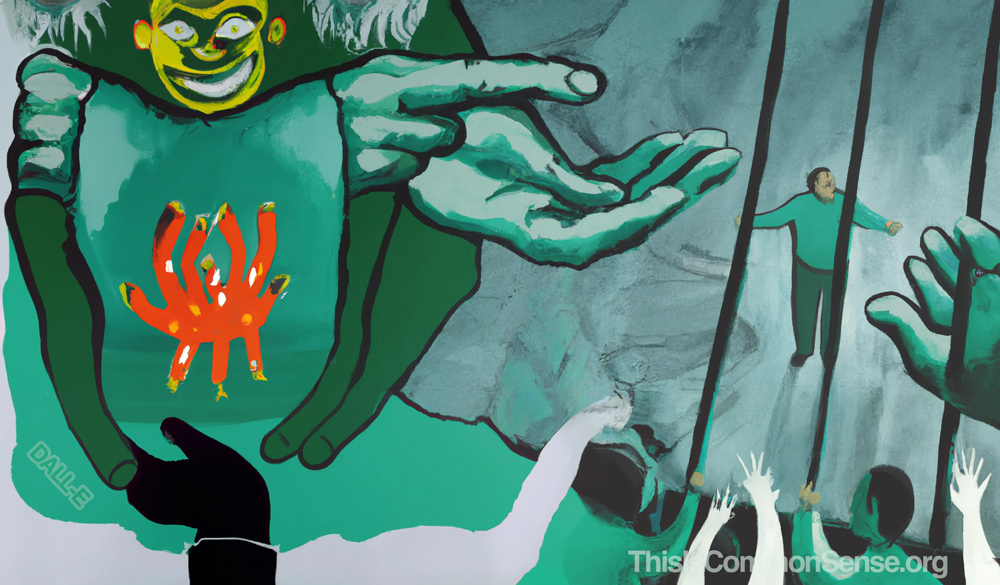
Illustration created with DALL-E

See all recent commentary
(simplified and organized)
See recent popular posts

Categories
education and schooling ideological culture

Power Theory

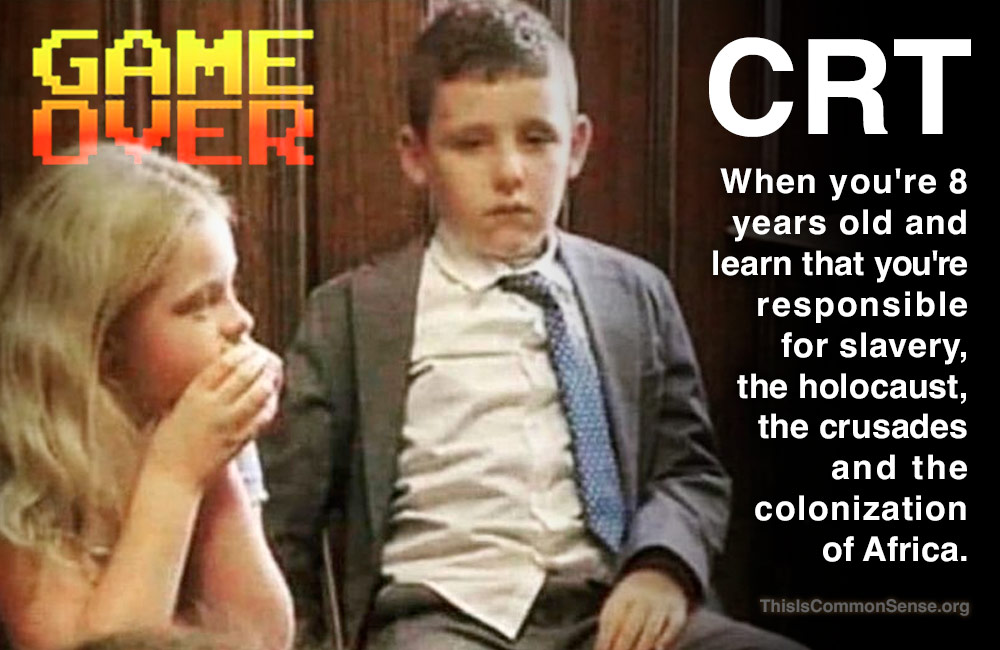
What if CRT were precisely about what its advocates say it is?

“Far-right white people are in a moral panic over Critical Race Theory,” Pennsylvania educators are being taught, “because they fear losing political power.”

Beth Brelje, at The Epoch Times, explains that this is the lesson of a “a webinar presented by Justice Leaders Collaborative, a Michigan-based social justice training organization.” Ms. Brelje quotes Shayla Reese Griffin, the webinar leader, who states that these “far-right white people” are “really just using Critical Race Theory as a kind of an umbrella term for any kind of cultural things that the far-right isn’t interested in.”

This is, of course, disingenuous. Critical Race Theory is not merely an umbrella term. It is a theory of power that tracks oppression (which is a specific variety of power) along rigid class lines, the classes being defined by race.

And it is a movement of the “far left.” 

Which is why CRT’s defenders and obfuscationists identify their opponents as “far right.”

Heaven forbid were moderates and centrists also to object!

It’s a bluffing tactic, this extremist-identification, aiming to make moderates, centrists, and just normal, non-political people ashamed to criticize CRT.

It’s manipulative.

CRT’s way off, since power, broadly defined, is everywhere and omnipresent and omnidirectional — everybody has some power, nobody has all power. Critical race theorists aim to ply victimhood status as leverage against innocents who do not want to harm anyone; too often they pretend that everybody on one side of a racial divide is a victim and everybody on the other side is an oppressor. It’s a repackaging of a too-familiar “guilt trip,” as we used to say in the Sixties.

As for parents in most school districts, they’ve discovered they have little power to lose. But by confronting the people they vote onto school boards, they gain more.

Democracy proves itself as one method of holding the powerful to account.

This is Common Sense. I’m Paul Jacob.


PDF for printing

See all recent commentary
(simplified and organized)
See recent popular posts
Categories
education and schooling First Amendment rights

A Lesson for the Board

Shawn McBreairty has the right to speak at public school board meetings in Maine.

That may not sound like the most controversial of contentions, but many school boards and even the Justice Department have been treating parents as criminals for publicly objecting when schools 

  1. teach kids to feel racially guilty, 
  2. unlearn the biologically obvious about sex, and in general 
  3. engage in radical indoctrination at the expense of education.

The parents’ sin in such cases is that of nettling board members and others who want a free hand to inflict such policies.

Mr. McBreairty has gotten in hot water with more than one school board in Maine. The recent court ruling that he has the right to speak at board meetings was occasioned by the actions of the RSU 22 school district, which barred McBreairty from its own board meetings.

When he tried to attend one in June, the board used local police to stop him.

The judge in the case, Nancy Torreson, has no sympathy for the board’s antics, characterizing its rationale for trying to muzzle McBreairty as “evolving, ad hoc, and unsupported.”

Judge Torreson concludes that McBreairty’s expression of “school-related concerns at the podium during the public comment period of School Board meetings constitutes speech that is protected under the First Amendment.” Her ruling grants the motion for an order temporarily restraining the school board from stopping McBreairty from attending and speaking at its meetings.

Even if board members disagree with him.

McBreairty and the school board are in America, after all.

This is Common Sense. I’m Paul Jacob.


PDF for printing

Photo credit

See all recent commentary
(simplified and organized)
See recent popular posts

Categories
education and schooling First Amendment rights general freedom

Squelched in Quebec

It’s a Université Laval thing; a Quebec thing: a Canada thing.

These are no places to be if you want to debate questions about pandemics and vaccines now “settled” by government-mandated consensus. Professors Patrick Provost and Nicolas Derome, who both teach at Laval, recently got the message in spades.

Provost, professor of microbiology and immunology, has been suspended for two months without pay for doubting the wisdom of giving COVID-19 vaccines to children. Kids face only a very low risk of serious consequences from the disease and a nonzero risk of being hurt by vaccination.

A newspaper that quoted his thoughts on the data and on free speech has cravenly deleted the offending article, stressing that “we can’t subscribe to” Provost’s views.

Laval also suspended Derome, professor of molecular biology, for expressing doubts about the value of vaccinating kids.

Canada’s authoritarians enjoy no monopoly on smothering academic and other speech. Many governments strive to more diligently repress their citizens. But Canadian officials fancy themselves pioneers in this area, and perhaps they are.

The hazards of squelching discourse about life-and-death matters should be obvious. It’s in our interest that scientists and everybody be able to freely investigate and discuss facts and interpretations without worrying whether an unauthorized assertion will cost the speaker two months of salary.

Or worse.

But some care nothing about logic and evidence — or, apparently, how useful these are to both individuals and to society at large.

It’s not an attitude consistent with . . . Common Sense.

I’m Paul Jacob.


PDF for printing

See all recent commentary
(simplified and organized)
See recent popular posts

Categories
education and schooling government transparency

Parents Kept in the Dark

When does it become irresponsible to send children to a public school? 

Has the line been crossed in Fairfax County, Virginia?

Their school board now prohibits teachers from telling parents when children “change gender” or pretend to change gender. Such decisions may be evidenced by a student’s changing his name or by identifying as a member of the opposite sex or as “nonbinary” on a school’s learning portal.

The district is not inviting teachers to exercise discretion about whether to inform parents. One can imagine cases in which a teacher knows parents to be physically abusive and likely to come down on a kid like a ton of bricks if alerted to such an event.

Rather, the policy stipulates that parents needn’t ever be told about such matters. To the extent teachers obey, parents won’t know unless informed by the children themselves.

If you live in Fairfax County, you could protest.

And you could do other things, such as

  • attend school board meetings to object, as parents attended a Fairfax board meeting to object to the policy of suspending fourth-graders for using the “wrong” pronouns for classmates;
  • join the shadow board that parents have formed to criticize the doings of the Fairfax County board;
  • vote against a school board member or try to recall members — unless a judge decides that your recall petition fails to show “probable cause for removal.”

Or you could just get your kids the heck out of the public schools.

This is Common Sense. I’m Paul Jacob.


PDF for printing

See all recent commentary
(simplified and organized)
See recent popular posts
Categories
Accountability education and schooling initiative, referendum, and recall

After Recall, Revival

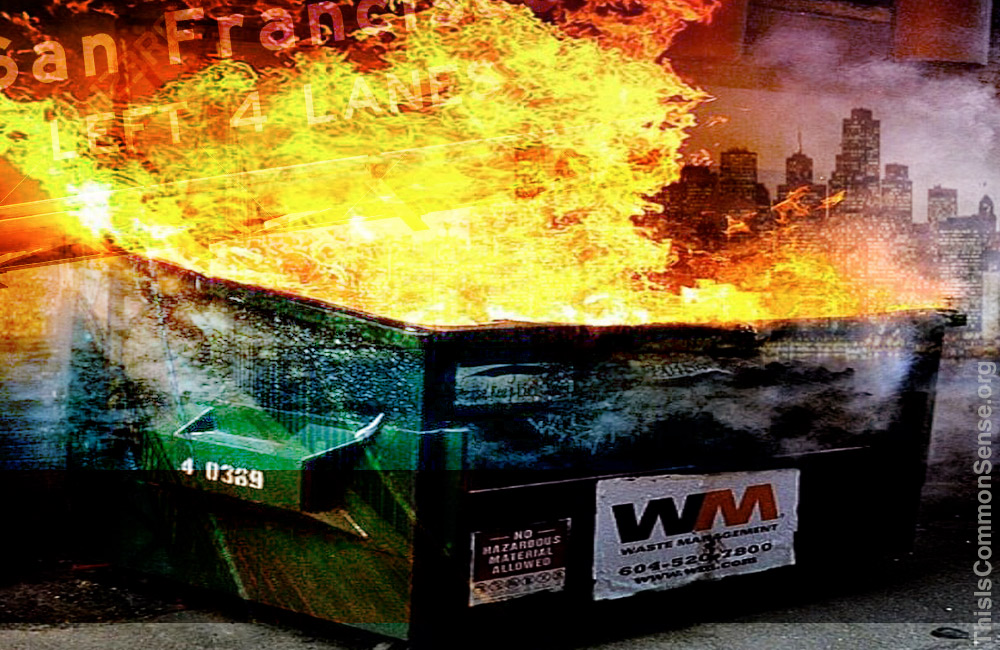
Is San Francisco waking up from its dystopian nightmare?

The egalitarians who have pushed the great city into absurdity have suffered another setback.

The earlier victory for sanity was won in a landslide election this February when parents recalled three members of the local school board for doing things like renaming 44 schools to conform to a left-wing agenda, keeping San Francisco schools closed because of outsized fears of the pandemic, and using a lottery system to undermine the magnet school Lowell High.

The lottery ended Lowell’s merit-based admissions, preventing the most qualified students from getting in unless they happened to get a lucky number. A step was thus taken toward reducing all students in the district to the same low academic level. Obviously, kids too behind or lazy to be even good students let alone top students would not suddenly become stellar academicians merely by winning a lottery.

The three board members ousted in February were the only ones then eligible to be recalled. Now the reconstituted board has voted 4-3 against extending the lottery system. The vote restores merit-based admissions.

A victory, but way too narrow. One flipped vote and the district would be back to hobbling the best and brightest.

The three anti-education board members who voted against the best possible future for the best students are Kevine Boggess, Mark Sanchez, and Matt Alexander.

They should be recalled or at least defeated in their next election. Since district parents are on the alert and active, there’s a good chance that this will happen.

This is Common Sense. I’m Paul Jacob.


PDF for printing

See all recent commentary
(simplified and organized)
See recent popular posts

Categories
education and schooling First Amendment rights general freedom ideological culture

Target: Government Schools

Former Attorney General William Barr gave a rather stark appraisal of the current politico-cultural moment, last Saturday.

Speaking at a Christian conference in Chicago, Bill Barr said that our “whole civilization” is “under sustained attack by increasingly secular forces.”

Certainly, the western tradition in which we live is “Judeo-Christian,” yet the explicitly religious aspect of our civilization is openly mocked and undermined by major progressive institutions. But is the civilization itself under attack?

Well, if you lean left you might say No. 

To others, the “woke” mob that dominatesso many major organizations in America is foursquare against freedom of speech and religion, and by demanding ideological conformity on a number of issues like sexual identity and racial “equity,” seems determined to re-make society from the ground up, and have that work done under mob violence threat as well as corporate compliance and state command.

But especially interesting is what Barr said was the foundation for today’s secular revolutionaries: the public schools. 

“The variety of American beliefs now makes a monopoly on education untenable,” Barr argued, as quoted by The Federalist. “You can’t finesse it anymore. You can’t pretend what’s being taught in schools is compatible with traditional religion, nor can you pretend schools are neutral any more.”

This radical a critique of government schooling is something I used to hear only from libertarians. Barr’s advocacy of school choice is not as cautious as Republicans would advance decades ago. His is an attack on government-run schools as such: the constitutional and existential crisis in American education requires,Barr said, a direct attack upon the government monopoly over the provision of education.

The culture war just ramped up a notch.

This is Common Sense. I’m Paul Jacob. 


PDF for printing

See all recent commentary
(simplified and organized)
See recent popular posts
Categories
education and schooling judiciary

The Choice in School Choice

The U.S. Supreme Court has ruled that state programs which help parents pay for private schooling may not discriminate against parents who want to send their kids to a religious school.

The court relied on its 2020 ruling that state programs subsidizing private schooling “cannot disqualify some private schools solely because they are religious.”

The present case pertains to a Maine program. The court determined that “Maine’s ‘nonsectarian’ requirement for otherwise generally available tuition assistance payments violates the Free Exercise Clause.”

It adds that a state government’s interest in not establishing a religion “does not justify enactments that exclude some members of the community from an otherwise generally available public benefit because of their religious exercise.”

Maine’s tuition program is for families who live in regions without any secondary public school. Qualifying families can use the subsidy to pay for either public or private schooling in another part of the state. Before 1981, Maine had no problem with students going to religious schools under the program. In that year, the rule changed.

So-called sectarian schools are, of course, often the major and sometimes the only private secondary-school alternative to public schools in an area. According to the Council for American Private Education, 78 percent of all students who attend private schools in the U.S. attend schools that are religiously affiliated.

Proponents of keeping kids trapped in public schools are in an uproar over the court’s decision.

But it only stands to reason that school choice programs must permit choice.

This is Common Sense. I’m Paul Jacob.


PDF for printing

See all recent commentary
(simplified and organized)
See recent popular posts
Categories
education and schooling ideological culture

Some Scandal

Why do public schools and libraries expose their charges to drag queens and cross-dressers but not to strip-club “artistes”?

Both are overtly sexual and “kinky” and contra traditional family values. But “drag” is where men (and now boys) dress up in parodic feminine clothing. Milton Berle did it as comedy while the “Drag Queen Story Hours” held these days in schools and libraries around the country play for something else.

In late May, in Iowa, “Ankeny’s Gay Straight Alliance (GSA) club hosted a drag event as part of the club’s end-of-the-year meeting,” explains KCCI Des Moines. “The event was not for the whole school.”

Thankfully

“Drag event at Ankeny High School,” ran the headline, “draws criticism from some parents” — why the “some”? Normally, wouldn’t it read “draws criticism from parents”? Could the editor have used it, here, to weaponize this as a divisive issue rather than a public scandal?

Before you can say “Sodom and Gomorrah,” the real problem with allowing drag shows in schools reveals itself: this is not unlike a religious issue, except the religion is irr-. 

A tent revival meeting in a public school should be scandalous, too, if with a different “some.” While prayer groups and LGBTQ+ clubs are both fine on public school campuses, as part of normal student activities allowed outside the curriculum, a mass baptism would not be fine, and neither are . . . drag shows.

Behind all this I catch a whiff of something worse than the push to normalize (rather than merely legalize) “sex work”: anti-natalism. Not having babies. All of this fits the population reduction ideology that has been pushed since the Sixties.

A tax-funded movement against the basic task of humanity. 

That’s the most scandalous.

The opposite of Common Sense. I’m Paul Jacob.


PDF for printing

See all recent commentary
(simplified and organized)
See recent popular posts
Categories
education and schooling judiciary

School Choice Rescued

Though not yet a complete victory for school choice, a recent decision by the Tennessee Supreme Court constitutes a big win for the Tennessee Education Savings Account Pilot Program.

The court rejected a major claim in a lawsuit filed by Nashville County and Shelby County to challenge the constitutionality of the program, which awards scholarships up to $7,300 to qualifying students so they can escape failing public schools.

The lawsuit contends that the program flouts a rule prohibiting the state legislature from passing local laws that are “applicable to a particular county . . . either in its governmental or its proprietary capacity.”

Judging that school districts aren’t counties and that the ESA program does not impair the ability of counties to govern themselves, Tennessee’s highest court threw out a determination to the contrary by lower courts and sent the case back down for review of other claims in the lawsuit.

The Institute for Justice and the Beacon Center of Tennessee, which have been working together on the case, are optimistic about the final outcome.

According to IJ attorney Arif Panju, the ruling means that “thousands of Tennessee parents and children trapped in failing school districts can look forward to seeking a better education this fall at a school of their choice.”

In its description of the program, the Tennessee government mentions the lawsuit and expresses the hope that the state will “succeed on appeal” and begin enrolling students in 2022.

This is Common Sense. I’m Paul Jacob.


PDF for printing

See all recent commentary
(simplified and organized)
See recent popular posts