Categories
ballot access general freedom initiative, referendum, and recall media and media people Regulating Protest

Three Bad Propositions

Two propositions on this November’s California ballot, Propositions 8 and 11, have found an opponent.

“Both would have voters decide very narrow union-management conflicts in two relatively small medical service sectors,” explains Dan Walters, long the dean of California columnists. Unions are sponsoring Prop 8, which “purports to limit profits in clinics that provide dialysis treatments to sufferers of kidney failure.” Ambulance companies are behind Prop 11, which would “require ambulance crews to remain on call during meal and rest breaks.”

Walters thinks it “foolish to expect November’s nine-plus million voters to make even semi-informed decisions about their provisions, much less understand how dialysis clinics and ambulance services operate, or should operate.”

Well, yes, but this criticism applies to government universally. Legislators don’t understand how every business or industry functions, or should function, either. Even when politicians pretend to comprehend, by what right do they micromanage other people’s businesses and labor contracts?

Freedom, not government regulation, should be the default position.

But Walters’ fix runs against this logic. He thinks that upping the required percentage of signatures for ballot placement “by half . . . might discourage the misuse of the system for issues that cannot be fairly and rationally decided by voters.”

Don’t bet on it.

As Walters himself admits, making it tougher and more expensive to petition a measure onto the ballot won’t block the well-heeled: “any interest group with a few million bucks and an axe to grind can qualify a ballot measure, regardless of their merits.”

But it would disenfranchise grassroots groups.

Defeat bad measures; don’t destroy the democratic process.

This is Common Sense. I’m Paul Jacob.


PDF for printing


Categories
ballot access incumbents initiative, referendum, and recall term limits

Intentionally Confounding Incumbents

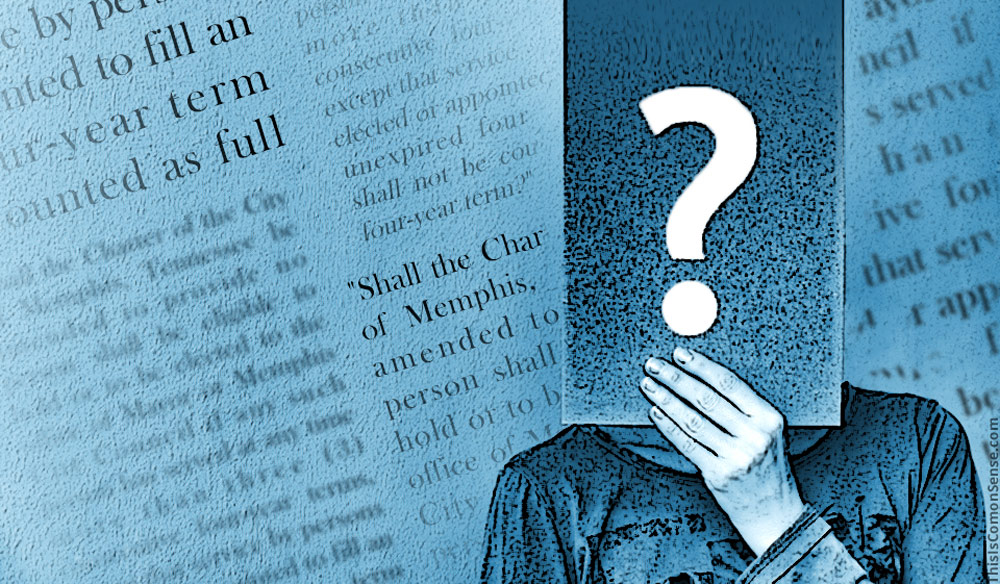
The three issues on the ballot in Memphis this November are “not complicated,” writes Commercial Appeal columnist David Waters, “unless you read the actual ballot questions.”

Which is all most voters will see.

All three directly affect the self-interest of members of the Memphis City Council, which placed them on the ballot and determined the language voters will attempt to decipher. 

Waters called that ballot wording “incomprehensible” and “intentionally confounding.” His newspaper colleague, Ryan Poe, accused the council of “trying to stack the deck.”

The first measure would weaken the council’s term limits, passed in 2011 with a 78 percent vote and just about to kick in. The ballot language, Mr. Poe explains, “reads like voters are being asked to place limits on council members . . . rather than extend them.” By an extra term.

The second issue would repeal Instant Runoff Voting (IRV), which was brought forth by citizen petition and enacted via a 71 percent yes vote. The confusing ballot wording brings up a 1991 federal court decision without providing voters any context or explanation.

Though IRV has not yet been used, council incumbents fear it.* This becomes especially clear when you discover that the third ballot question is actually a sneakier, second attempt to repeal IRV.

“Instant runoffs, and run-off elections in general, tend to make it easier for challengers to unseat incumbents in multi-candidate district races,” argues Waters. He adds, “Incumbents generally become stronger the longer they are in office.”

To incumbent politicians, reform is a dirty word. 

This is Common Sense. I’m Paul Jacob.


* Back in February, the council was caught paying a lobbyist to convince state legislators to restrict their city’s ability to implement Instant Runoff Voting. 

PDF for printing


Categories
ballot access national politics & policies

Party Line, Nudge Nudge

I’m all for government transparency. But transparent politicians?

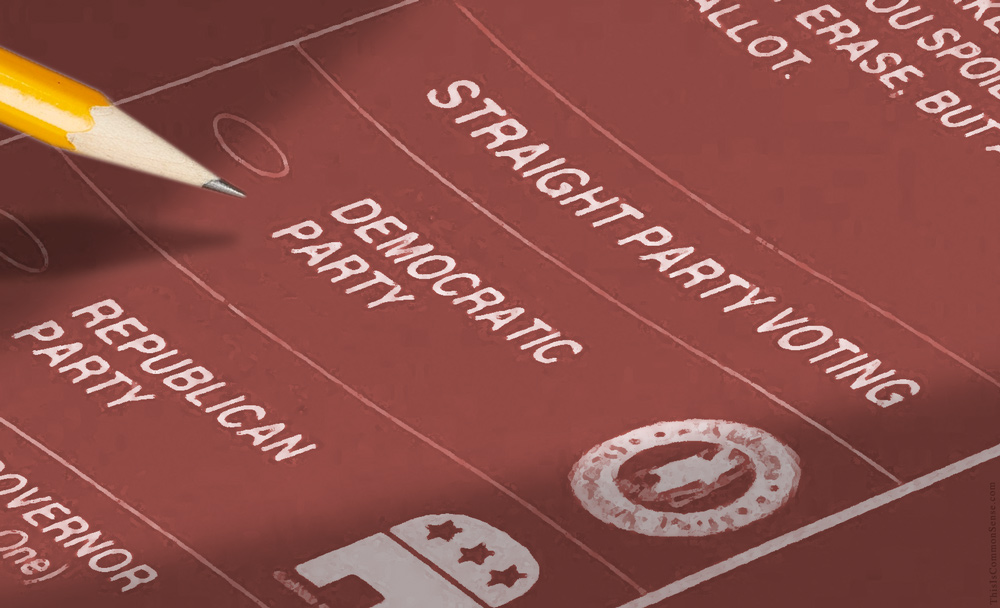
The office of New Mexico’s Secretary of State sent out a press release, yesterday, announcing that Secretary Toulouse Oliver “is formatting the 2018 general election ballot to once again include the option for ‘straight party’ voting.”

“The more options people have,” Oliver is quoted for explanation, “the easier it is for more eligible voters to participate — and participation is the key to our democratic process.”

This sounds all very nice and good. More options!

But hers was not a conscientious and noble adoption of a choice-promoting democratic notion. The whole point is to nudge voters to not consider a non-R/non-D alternative — perhaps especially in the state’s contest for the U.S. Senate.

In which former New Mexico Governor Gary Johnson is making a not-longshot run.

As a Libertarian.

Though the Secretary of State’s office pretends to be for democracy, I have trouble buying that Ms. Oliver’s motives are non-partisan. Ditto Gary Johnson.

“Pushing voters toward straight ticket voting is a worn-out staple of major party incumbents,” says the candidate, “and flies in the face of the reality that the great majority of voters are independent-minded and don’t need or appreciate a ballot that provides a short-cut to partisanship.”

It’s a standard way to gain, as one Democratic State Senator put it, “partisan advantage in low-information elections.”*

Matt Welch at Reason quotes ballot access expert Richard Winger to show how old a gimmick it is. It’s been on its way out, actually (only nine states sport the “feature”), probably because . . . it’s just so obvious a ploy. 

Transparent.

This is Common Sense. I’m Paul Jacob.


* The partisanship is also not appreciated by the Republican Party of New Mexico, which is suing the Secretary of State.

PDF for printing


Categories
Accountability ballot access folly general freedom ideological culture initiative, referendum, and recall media and media people national politics & policies political challengers responsibility U.S. Constitution

Should Non-Citizens Vote?

“A lot of people would like to say this is an immigration issue. It’s really not,” offered Gary Emineth, the head of North Dakotans for Citizen Voting and a candidate for state senator.  

“It’s really about preserving the right for U.S. citizens, and in our case, North Dakota residents, to only be the voters in all elections across the state of North Dakota,” added Emineth. “And that’s why we want it in the constitution.”

Turning in more than 35,000 voter signatures on petitions last Friday, Emineth and others placed a constitutional amendment on this November’s ballot that, if passed, would make voting the exclusive right of U.S. citizens in North Dakota.

Elsewhere in the country, Emineth points out, non-citizens are already voting — in Chicago and San Francisco, and in 11 cities across Maryland. Moreover, campaigns are underway across the country to give non-citizens the vote — in California, Connecticut, New York City, Boston and Montpelier, Vermont.

Opponents claim the North Dakota measure is completely unnecessary, as the state doesn’t currently allow non-citizens to cast a ballot, nor has any city yet attempted to allow non-citizens to vote. But Emineth’s goal is to keep it that way.

Moreover, University of North Dakota Law Professor Steven Morrison acknowledged to The Forum in Fargo that “the proposed amendment does clean up what could be a grammatical loophole since the word ‘every’ doesn’t conclusively exclude non-citizens from voting. . . .”

It is a very simple proposition: Do you want voting to be the exclusive right of U.S. citizens? Or should non-citizens be allowed to vote?

Coming to a ballot near and Fargo.*

This is Common Sense. I’m Paul Jacob.


* With some help from Liberty Initiative Fund.


PDF for printing


Categories
ballot access general freedom initiative, referendum, and recall moral hazard nannyism national politics & policies political challengers responsibility term limits

The Yellow and White Lines

If I’ve heard it one million times, I’ve heard it ten: “We already have term limits; they’re called elections.” A statement usually offered as the beginning and end of wisdom regarding the problems term limits are designed to tackle.

Equally “profound” is the collateral claim that “the only term limits we need are an informed electorate.”

Such generalities “prove” too much. Any formal restraint of government could be thus airily dismissed.

  • “The only Bill of Rights we need is an informed electorate.”
  • “The only checks and balances we need are an informed electorate.”
  • “The only prerequisites for running for office we need are an informed electorate.”

If formal rules don’t matter, why write these things down or try to enforce them in light of principle and precedent? Just get your informed electorate and let the informed electorate handle it.

To preserve and strengthen our republic and our liberties, we do need an informed electorate. We also need many other things, including well-known, widely accepted, consultable, objective limits on government power.

One such limit limits terms.

Term limits on legislators, executives and even judges combat political corruption, empower informed voters, and give informed and capable electoral challengers more opportunities to effectively present their ideas.

The fact that a given political or cultural factor is crucial to the commonweal doesn’t mean that no other factors are also crucial.

Don’t tell drivers of cars that all they need are skills and gas.  You also need lines on the road — limits to keep us out of the ditch, and from head-on collisions.

This is Common Sense. I’m Paul Jacob.

PDF for printing


Categories
ballot access education and schooling folly ideological culture media and media people Popular responsibility

Fiddling with the Franchise

In 2013, Tacoma Park, Maryland, became the first place in the U.S. to allow 16-year-olds to vote in local elections.* Now, Washington, D.C., Councilman Charles Allen, “inspired by the high-schoolers who are campaigning for gun control and filled D.C. streets last month in a massive protest that mesmerized the country,” reports the Washington Post, wants to follow suit.

“It’s pretty hard for anyone to watch the events of the last couple of months,” claims Councilman Allen, “and not understand the pure power and maturity of incredibly young voices.”

Well, they do use adult words.

One has to wonder: would the “maturity” of these young adults equally amaze this politician, were they advocating opinions** with which he disagreed?

But wait a second . . . wasn’t one of the demands of the “March for Our Lives” to raise, not lower, the age when a person would be deemed mature enough to legally purchase a scary-looking rifle?

Lowering the voting age seems odd, at best, with society lurching in the other direction — raising the age of adulthood for everything else. Decades ago, the legal age to purchase alcohol was 18 in some places; today it is 21 everywhere. In Virginia, one may still drive at 16, as I could back in the day . . . but now there are limits on other young people riding in the car unless the driver is 18.

More ominously, facilitation by many public schools of the recent student walkouts and marches present the strongest argument against lowering the voting age: So long as government schools act in a partisan manner, indoctrination and intimidation would be rampant.

Who wants a captive audience of would-be voters most?

Unscrupulous ideologues.

This is Common Sense. I’m Paul Jacob.

 

* Greenbelt and Hyattsville, Maryland, as well as Berkeley, California, have since joined Tacoma Park in allowing 16- and 17-year-olds to vote in local elections.

** Term limits, say. Or school vouchers. Or the rights of gestating humans.


PDF for printing


Categories
Accountability ballot access folly general freedom ideological culture media and media people national politics & policies Regulating Protest

The Real Democracy Hack

A whistleblower in a British data company called Cambridge Analytica accuses his company of stealing as many as 50 million Facebook profiles. This is the latest version of the “hacked the election” meme pushed by the establishment after Trump’s 2016 defeat of Hillary Clinton.

Cambridge received data on 270,000 Facebook users, who traded their personal Facebook data and their friends’ profiles to download and use an app. The 50 million figure is an extrapolation supposing the average user had 200 friends.

The outrage over this “hack” — by the whistleblower and by the television news commentators, who seem collectively to suffer from a case of the vapors — appears to be mostly pretense. That is, they pretend voters voted in a way they did not want to vote.

But that simply wasn’t the case. The implication that conspiratorial, behind-the-scenes puppeteers changed votes in some nefarious scam remains far off the mark. All we are really talking about is data miners gaining additional info that they pushed to political propagandists who in turn did what campaign propagandists always do.

Maybe we should be grateful

And saying this data group propelled Trump is like saying that support for term limits propelled the GOP to take over Congress in 1994 — though, in this analogy, the data firm deserves less credit than the term limits issue. 

This is more a “life hack” than a technological intrusion into the political process. “Democracy was hacked” like civilization was hacked by Johannes Gutenberg.

What the fainting couch crowd really regrets? Their inability to control new media.

This is Common Sense. I’m Paul Jacob.


PDF for printing


Categories
ballot access initiative, referendum, and recall local leaders political challengers Regulating Protest too much government

New-Fangled Vote Counting

Call me old-fashioned, but when you go to the pols to cast your vote on a ballot measure, your Yes vote should count for yes and your No vote for no.

And if you choose not to vote, your non-vote should count for neither yes nor no.

That’s just common sense. Right?

Well, meet its antithesis: Proposal 97, now being considered by Florida’s powerful Constitution Revision Commission (CRC).* Proposal 97 would count all those who do not cast a vote for or against a ballot measure as a No vote against it.

To pass a constitutional amendment in the Sunshine State already requires a supermajority vote of at least 60 percent of those who do cast a vote on the measure. Under Proposal 97, counting all those not voting on it as No votes, that percentage would necessarily go even higher. If 10 percent don’t vote, Yes would have to come in at 67 percent to win.

This is minority rule . . . with an extra perverse twist.

The supermajority requirement encourages big money interests to spend heavily against ballot initiatives — even when the issues have clear majority support — because if they can manage to lose by less than 20 points (60–40 percent), they win. Now all opponents need do is poison the water with the nastiest campaigning imaginable, causing more voters to throw up their hands or pinch their noses and avoid the issue . . .

. . . thus, being counted as voting No.

Don’t abstain. Stop Proposal 97. Tell them NO here.

This is Common Sense. I’m Paul Jacob.

 

* How powerful is the CRC? Every 20 years it meets with the awesome authority to refer constitutional amendments directly to the ballot — as many as it wishes and the amendments can be packaged to include several different subjects. No other state has a similar body. Of the 37 commission members, the governor appoints 15, the Senate president and the House speaker each appoint nine, the chief justice of the state supreme court appoints three and the attorney general is an automatic member.


PDF for printing


Categories
Accountability ballot access general freedom government transparency initiative, referendum, and recall local leaders moral hazard

Fear of Voters

You are a state legislator, say. And an issue could be placed on the ballot on which a majority of your state’s citizens might not vote according to your preference. What would you do?

  1. Educate your fellow citizens on the merits of your position; or
  2. Dawdle while calling a lobbyist for advice; or
  3. Change the constitution to make it impossible for such a vote to ever be held?

State Rep. John Enns chose option C — perhaps after exhausting B. Stamping out Oklahoma’s ballot initiative process, freeing Enns and other legislators from this citizen check at the ballot box, is the essence of his House Bill 1603.

The Sooner State already possessed the toughest petition requirements in the country.  Supporters must gain the country’s highest percentage of voter support (15 percent) while limited to the second shortest time period (90 days) to circulate petitions.

On top of this current statewide slog, Enns’ constitutional amendment would require also qualifying in every single county. Oklahoma has 77 counties.

As the Tulsa World editorialized, “he wants to make it impossible.”

What lousy rationale lies behind Enns’ desire to destroy democratic governance?

In response to another legislator’s query about his “fear that some marijuana bill will . . . become a state [ballot] question,” Enns claimed his effort was “not pre-emptive.” But he acknowledged his strong opposition to legalizing recreational marijuana, which he pointed out “had been done through initiative petition” in other states.

Enns is afraid of Oklahoma voters having their say. He should be.*

This is Common Sense. I’m Paul Jacob.


* I mean, of course, that Rep. Enns should fear being booted out of office on his keister. He should not have to fear physical reprisal. The Tulsa World reports that the Oklahoma Highway Patrol is now providing security to Enns, after a death threat was received related to his HB 1603.


PDF for printing


Categories
Accountability ballot access general freedom government transparency initiative, referendum, and recall local leaders national politics & policies political challengers responsibility tax policy term limits too much government

What Unlimited Government Costs Us

“Olympia can’t restrain itself,” Tim Eyman wrote the other day, a judgment on legislative irresponsibility hardly unique to the Evergreen State. Citizens around the country have cause to lament the difficulty of obtaining anything close to a good legislature.

Too often the merely “bad” would constitute a significant improvement.

Which is why legislators need to be put on a short leash. Limits on government must be written into law, where possible into either the U.S. Constitution or state constitutions, so the limits cannot be tampered with by legislators, good or bad.

Washington State initiative guru Tim Eyman, cited above, has made a career of working for just those kinds of limits. In 2007, Eyman and the citizen group Voters Want More Choices petitioned onto the statewide ballot a requirement that any tax increase must receive a two-thirds vote from both legislative chambers.

Voters passed the measure* in 2007, 2011 and 2012.

In an email to supporters this month, Eyman presents data — an “amazing real-world comparison” — to help us understand how effective the limits were . . . while they lasted.

He notes that “with the 2/3 rule in effect from 2008-2012, those 5 legislative sessions cost the taxpayers $6.894 billion” in increased taxes.

And he compares that to the five years (2013-2017) since the state’s highest court struck down the voters’ two-thirds mandate: “WITHOUT the 2/3 rule, those 5 legislative sessions cost the taxpayers $23.679 billion.”

“Without the fiscal discipline imposed by citizen initiatives,” Eyman concludes, “politicians cannot hold back.”

Now we have hard evidence for what unlimited government costs us: more than three times more!

This is Common Sense. I’m Paul Jacob.
 

* Washington State’s ballot initiative process allows voters to pass simple statutes but not constitutional amendments. For two years after passage, legislators must garner a two-thirds vote to override a ballot initiative. After those two years, only a simple majority is required.


PDF for printing