Categories
Accountability ballot access general freedom government transparency initiative, referendum, and recall local leaders national politics & policies political challengers responsibility tax policy term limits too much government

What Unlimited Government Costs Us

“Olympia can’t restrain itself,” Tim Eyman wrote the other day, a judgment on legislative irresponsibility hardly unique to the Evergreen State. Citizens around the country have cause to lament the difficulty of obtaining anything close to a good legislature.

Too often the merely “bad” would constitute a significant improvement.

Which is why legislators need to be put on a short leash. Limits on government must be written into law, where possible into either the U.S. Constitution or state constitutions, so the limits cannot be tampered with by legislators, good or bad.

Washington State initiative guru Tim Eyman, cited above, has made a career of working for just those kinds of limits. In 2007, Eyman and the citizen group Voters Want More Choices petitioned onto the statewide ballot a requirement that any tax increase must receive a two-thirds vote from both legislative chambers.

Voters passed the measure* in 2007, 2011 and 2012.

In an email to supporters this month, Eyman presents data — an “amazing real-world comparison” — to help us understand how effective the limits were . . . while they lasted.

He notes that “with the 2/3 rule in effect from 2008-2012, those 5 legislative sessions cost the taxpayers $6.894 billion” in increased taxes.

And he compares that to the five years (2013-2017) since the state’s highest court struck down the voters’ two-thirds mandate: “WITHOUT the 2/3 rule, those 5 legislative sessions cost the taxpayers $23.679 billion.”

“Without the fiscal discipline imposed by citizen initiatives,” Eyman concludes, “politicians cannot hold back.”

Now we have hard evidence for what unlimited government costs us: more than three times more!

This is Common Sense. I’m Paul Jacob.


* Washington State’s ballot initiative process allows voters to pass simple statutes but not constitutional amendments. For two years after passage, legislators must garner a two-thirds vote to override a ballot initiative. After those two years, only a simple majority is required.


PDF for printing


Categories
Accountability crime and punishment education and schooling folly general freedom moral hazard nannyism national politics & policies too much government

Leave Them Kids Alone

This just in: oblivious little boys still play cops and robbers.

Just as in days of old.

Wait. Hold on. Breathe. Just breathe. This sociological fact doesn’t mean that we’re a nation of incipient international terrorists but for the galumphing grace of grumpy zero-tolerant schoolmasters.

Common sense says you don’t suspend toddlers from school for wiggling their fingers as if wielding a gun, or for sculpting a “gun” out of a slice of Wonder Bread or Freihofer’s. Yet evidence continues to mount that all too many teachers and administrators are immune to considerations of reasonableness when it comes to kids who misbehave. (Or “misbehave.”)

Such enemies of childhood innocence must be hindered. So let’s give two and a half cheers to Ohio lawmaker Peggy Lehner, who proposes to legislate an end in her state to suspending children in the third grade or younger who aren’t threatening anybody. (I’m not sure why kids in grades later than third can’t catch the same break.)

A new, probably imperfect government regulation is not the only way to counter blunderbuss government-school policies. The most fundamental alternative is the free market.

Ideally, no public-school monopoly plagued by mandatory insane rules would exist. Ideally, all K-12 (and university) educational offerings would be provided by an unregulated market economy, making it much easier for families to drop insane schools and patronize sane ones. The pressures of market competition would encourage school officials to become students of common sense.

We are not there yet.

This is Common Sense. I’m Paul Jacob.


PDF for printing


Categories
Accountability general freedom moral hazard national politics & policies responsibility

The Online Manipulation of Democracy

There exist many sneaky ways to get other people to do what you want, voluntarily — effectively blurring the line between legitimate persuasion and fraud.

When large, almost unavoidable private companies apply those techniques to targeted groups of voters, that blur might look something very much like election fraud.

Harvard psychologist Dr. Robert Epstein has been studying hidden online persuasion techniques. Interviewed by Tom Woods last Friday, the doctor explained several sub rosa persuasion techniques, especially the fascinating Search Engine Manipulation Effect (SEME), which he says has been replicated in studies by other researchers. 

SEME, he argues, is a “genuinely new” way to manipulate masses of people — without them realizing it.

And it sports “one of the largest effects ever to be discovered in the behavioral sciences.” Google, it turns out, can influence voter and consumer behavior merely by ordering search results in specific ways. Going into his first study, he suspected he might discover a 2 percent influence on voter behavior. He got 48 percent, instead.

There is more: not only can Google do this, the behemoth does do this — Epstein has documented that Google did it in the last election. 

Supporting, or to the benefit of, Hillary Clinton.

Understandably, Epstein scoffs at the “fake news” panic as something insubstantial in comparison. The potential impact of this online manipulation dwarfs the allegations of Russian influence.

I wonder: Did Mrs. Clinton know that her very special high-tech friends were pressing their very big thumbs onto the scale of democracy?

It seems a very old tech — the Electoral College — effectively counteracted the manipulation.

This time.

This is Common Sense. I’m Paul Jacob.


PDF for printing

Categories
Accountability folly general freedom local leaders media and media people moral hazard national politics & policies responsibility

Another Election “Against”

As I write, Democratic candidate Doug Jones has just taken the stage to declare himself the winner of the Alabama Senate race, the one in which Roy Moore became more infamous than famous, and better known for the worst kind of reasons.

The final counts are not in, and I suppose there could be a turnaround at the last moment, but it doesn’t look like it. It looks like Republicans lost the seat. Hillary Clinton is already crowing that this is a sign of more Democratic victories to come.

Maybe.

Too soon to tell.

Meanwhile, what to make of it all? Jones has declared that “This entire race has been about dignity and respect. This campaign has been about the rule of law.” And I am not certain that is a good description. It seemed to me what the campaign turned into was a referendum on whether voting for a man accused of sexual assault and statutory rape was a good idea.

There were also Republicans thankful that Moore lost. “Decency wins” is what Senator Jeff Flake tweeted; “Suck it, Bannon,” is Meghan McCain’s eloquent taunt. (Steve Bannon had backed Moore.) Reason’s Scott Shackford probably put it best, writing that “Polls have closed in Alabama as voters there decide between controversial former judge Roy Moore and … um … not Roy Moore.”

The modern American political process is now firmly a matter of reiterating this pattern: voting against more than for.

A horrible development? Well, there sure is a lot more to be against in American politics, than for.

This is Common Sense. I’m Paul Jacob.


PDF for printing


Categories
Accountability crime and punishment government transparency moral hazard national politics & policies

New Standards?

This is a country trying to establish, and certainly a U.S. Senate trying to establish new standards for acceptable behavior,” Peggy Noonan told her fellow panelists on Meet the Press yesterday.

She is at least half mistaken.

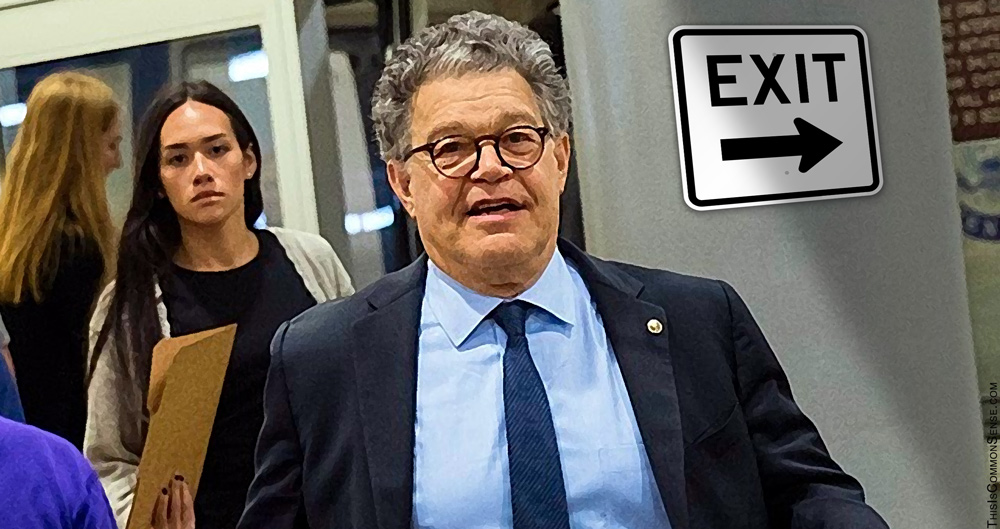
Groping a woman who is stuck posing for a photo with you at the state fair, as Sen. Al Franken (D-Minn.) was accused, has never, ever been publicly viewed as “okay” or “nice work if you can get it.” And believe-it-or-not, Americans are not ambivalent about the propriety of Congressman John Conyers (D-Mich.) taking meetings in his underwear. Nor do folks find it fathomable that members of Congress such as Rep. Blake Farenthold (R-Tex.) paid off their accusers with our tax dollars.

The standard has always been that such behavior is 100-percent wrong. And yet Ms. Noonan is correct to suggest a new official standard for . . . both houses of Congress.*

But in a recent video for Breitbart, actor Jackie Mason mocks the idea of sexual harassment training. “When you’re three years old, you learn how to behave with people. You learn how to control yourself,” Mason rants. “Now Congressmen, who are 67 years old and 98 years old, are being told they have to take training at this age to learn how to behave with women.”

We see that, in media, in Hollywood, in Silicon Valley and among the corporate elite, credible allegations of sexual abuse are met with swift action: firings, dismissals, contracts voided. Out!

Our “representatives” should be ashamed not merely of their loathsome colleagues, but of being “out-democracied” by corporate America.

This is Common Sense. I’m Paul Jacob. 


* The current House system protects powerful politicians and staffers with secrecy and even uses taxpayer money to pay off victims.


PDF for printing


Categories
Accountability folly ideological culture local leaders national politics & policies term limits

The Great Dood Drain of ’17

How can we expect the federal government to continue to function at its usual peak efficiency without the awesome 52 years of experience and institutional knowledge supplied by Michigan Congressman John Conyers?

American government faces a congressional brain drain, Conyers’s resignation in the wake of accusations of sexual harassment not being anything like unique. Yesterday, Senator Al Franken (D-Minn.) announced his impending resignation, as did Rep. Trent Franks (R-Ariz.) — before allegations against him had even hit the news.

Also imperiled? The talents of an unknown number of other eminent gropers and experienced molesters, a treasury of firsthand knowledge of how government really works.

Sure, the nation survived back when George Washington stepped down after two terms as president; when Congress lost Daniel Webster and Henry Clay and John C. Calhoun, the institution carried on. 

But just think of the complexity of modern governance, and the great expertise and finely crafted statesmanship exhibited by someone like Congressman Conyers. Are we being sent up the proverbial Detroit River sans oar?

If only someone could step forward with the same skill-set as the iconic Conyers! Well, in announcing his resignation, and that his “legacy can’t be compromised or diminished in any way by what we’re going through now,” the congressman endorsed his son, John Conyers III, as his replacement.

Qualifications? you dare ask.

Back in 2010, the III tweeted, “My dad’s a f*cking player and reckless as hell! He just got at this doods wife super low-key.” Earlier this year, the young Conyers was arrested (but not prosecuted) on a domestic abuse charge.

Indeed, the “dood” appears more than able to carry on.

This is Common Sense. I’m Paul Jacob.


PDF for printing


Categories
Accountability education and schooling folly local leaders responsibility

Learning to Cheat

Months ago, Ballou High was widely lauded for posting impressive gains in graduation rates — from a abysmal 51 percent two years ago to a much less terrible 64 percent this year — and for the even more remarkable feat of getting every single graduate accepted by a community college or university.

“Pay-dirt!” I sarcastically proclaimed at Townhall.com.

But the real dirt was dug up by WAMU, a National Public Radio affiliate in the nation’s capital. What did Ballou students learn? How to cheat.

Well, that appears to have been the lesson plan, anyway.

In numerous interviews — many given on conditions of anonymity for fear of retribution — teachers charged they were pressured by the administration to give grades that students did not earn, so those students could nonetheless graduate.

“Last year, DCPS put school administrators entirely in control of teacher evaluations. . . .” And those evaluations, which grade teachers and administrators on student performance, can mean as much as $30,000 in bonus pay.

The incentive to cheat is both obvious and sizable.

The mayor and the chancellor of the D.C. Public Schools quickly announced an investigation, but regular observers suspect the usual “white-wash.”

“This is [the] biggest way to keep a community down,” protested one black teacher. “To graduate students who aren’t qualified, send them off to college unprepared, so they return to the community to continue the cycle.”

That tragic cycle is captured in public education’s corrupt cycle: promised reforms followed by false claims of progress . . . followed by the discovery of cheating.

This is Common Sense. I’m Paul Jacob.


PDF for printing


Categories
Accountability folly general freedom government transparency initiative, referendum, and recall local leaders moral hazard national politics & policies term limits

Illinois’s Chicken-and-Fish Supreme Court

A constitution is the law of the land only to the extent that it’s enforced. And in Illinois, the right of citizen initiative — provided for in the state constitution — is not enforced.

The constitution’s wording is explicit: “Amendments . . . may be proposed by a petition signed by a [specified number of electors]. . . . Amendments shall be limited to structural and procedural subjects contained in Article IV.”

Does that Article IV discuss the subject of election procedures, including eligibility requirements, thereby opening the door to a citizen-initiated term limits amendment? Yes, it does. Section 2, subsection (c), for example, specifies citizenship, age, and residency requirements.

Yet the Illinois Supreme Court has repeatedly chucked the results of effective petition drives to get a state legislative term limits question on the ballot.

The justices rely on the venerable Fallacy of Tortured Misreading.

Former Illinois legislator Jim Nowlin recently pointed out that in 1976, the court concluded that the wording about how initiative proposals “‘shall be limited to structural and procedural subjects’. . . meant a proposal must make both kinds of changes.” The lone dissenter on the court “opined to the effect: When I see a restaurant sign that says, ‘We have chicken and fish,’ that doesn’t mean you have to order both chicken and fish!”

The right of citizen initiative is a crucial means of reforming government when those in government won’t reform themselves. The citizens of Illinois have that right. But, for now, they also don’t.

That ain’t Common Sense. I’m Paul Jacob.


PDF for printing


Categories
Accountability free trade & free markets insider corruption moral hazard national politics & policies porkbarrel politics responsibility too much government

Cry Me an Amazon

My idea of a “free market” is not our politicians’. Their idea is to give away free stuff to their new and old business buddies . . . at everyone else’s expense.

That sort of “crony capitalism” has been writ large per Amazon’s search for a location for a second headquarters (HQ2). The world’s biggest retailer — valued higher on the market than all other major retailers combined — announced it would spend $5 billion and bestow 50,000 new jobs on HQ2’s locale. Subsequently, 238 cities, states and provinces in the U.S., Canada, and Mexico offered to take from their current citizenry to give unfairly to Amazon.

Chicago’s proposal would allow Amazon to keep the income taxes their employees pay. Seriously. This “personal income-tax diversion” would add up to over a billion dollars for the company.

New Jersey state government offered a cool $7 billion in subsidies should Amazon choose to locate in Newark.

Seattle Times columnist Danny Westneat described this sorry spectacle of subsidy as not so much a corporate “takeover” as a government “surrender.”

The most egregious example, though, has to be Fresno, California, where the city “promises to funnel 85 percent of all taxes and fees generated by Amazon into a special fund. . . . overseen by a board, half made up of Amazon officers . . . supposed to spend the money on housing, roads and parks in and around Amazon.”

“Rather than the money disappearing into a civic black hole,” explained Larry Westurland, Fresno’s economic development director, “Amazon would have a say on where it would go.”

Selling out the taxpayers? Moolah in the millions. Referring to a normal city budget as a “black hole”? Priceless.

This is Common Sense. I’m Paul Jacob.


PDF for printing


Categories
Accountability general freedom government transparency ideological culture insider corruption moral hazard nannyism national politics & policies responsibility too much government U.S. Constitution

Invulnerable Government

As of this week, there are two heads of the Consumer Financial Protection Bureau.

Two claimants to the throne, so to speak.

The bureau’s previous director, Richard Cordray, resigned last week, and as he left he appointed a deputy director, Leandra English. Ms. English sent out a nice Thanksgiving email, billing herself as “Acting Director.”

Meanwhile, in advance of Cordray’s exit, President Trump appointed Mick Mulvaney to fill the role. Mulvaney showed up at work yesterday and took possession of the director’s office. He ordered a hiring freeze . . . and brought donuts.

It gets juicier. English has filed suit against the president and his appointee, claiming to be, herself, the directorship’s rightful heir. She cites the enabling legislation, which allowed for deputization by the director. And she cites her commitment to the agency’s mission, of which Mulvaney and Trump have none.

Republicans generally regard the agency as having gone rogue.

And the squabble over the directorship sure seems to validate that charge.

The legality? Presumably, the legislation that established the agency — which deliberately insulated the CFPB from oversight by funding it from the Federal Reserve — does not void an established law, the Vacancies Act, which does allows the president to fill vacated posts.

Sen. Elizabeth Warren has taken up English’s side in the dispute, because she believes in the agency’s mission.

Now, I get it: to make government as impregnable as a high mountain fortress is an idea that many folks flirt with, from time to time. But the results are always the same: government secure from democratic checks and constitutional balance.

Come on, Democrats! Give democracy a chance.

This is Common Sense. I’m Paul Jacob.


PDF for printing