Categories
ideological culture too much government

Fields of Schemes

Hopes, wishes and cinematic sentiment are not a business plan.

A baseball stadium in Camden, New Jersey is being shut down three years after the team for which it was built has left town.

At the groundbreaking in 2000, then-Governor Christine Todd Whitman said she’d “heard the message from the movie Field of Dreams: ‘If you build it, they will come.’ Well, soon we will see a field of dreams right here in Camden, and my prediction is ‘they will come.’”

So it’s the movie’s fault?

Officials had hoped that crowds would steadily come to see the Camden Riversharks play ball, boosting the local economy and enabling repayment of the taxpayers’ “investment” of $18 million.

Didn’t work out.

The minor-league team threw in the towel in 2015 after missing several lease payments. The Camden government bought the property. They couldn’t find a successor team, so now the stadium is going. It will cost another million in taxpayer dollars just to tear it down.

Lesson learned? Er, no. Another taxpayer-funded development will replace the stadium.

Of course, private investors can also err when spending their own money. But they’re less likely to throw millions at projects with little prospect of profit. When their investments do fail, companies tend to cut their losses much faster than government officials who are ladling out other people’s money.

Unlike many government planners, private investors of private capital are also not eager to keep repeating their worst blunders.

Meanwhile, perhaps best of all, when private investors misjudge a project, non-investors lose nothing.

This is Common Sense. I’m Paul Jacob.



PDF for printing


» See popular posts from Common Sense with Paul Jacob HERE.

 

Categories
free trade & free markets national politics & policies Popular too much government

Christmas Is Coming

When I was a kid, every December day was like a rocket-launch countdown ’til Christmas.

Republicans in the House of Representatives have fewer days to tick off: the days remaining to do something before Democrats take over. Days left in session? Eight.

We know what Trump wants them to do: pass his negotiated replacement for the North American Free Trade Agreement (NAFTA).

Last week, “Trump held a high-profile signing ceremony with Canadian Prime Minister Justin Trudeau and Mexican President Enrique Peña Nieto at the G-20 summit in Argentina,” Eric Boehm writes at Reason. “The leaders of the three countries put their signatures to the final version of the United States–Mexico–Canada Agreement (USMCA), but the deal must still be ratified by each domestic government.”

And some in the Republican House are uneasy, because they “disagree with the Trump administration on trade issues and correctly see the USMCA as moving North America further from free trade.”

Though Donald Trump has given us some reason to think he might have multilateral free trade in mind as his real goal, the current state of the USMCA does not bolster that.

But it could be worse — the Democrats could scuttle the rewrite, just to spite Trump. This would allow Trump to go “nuclear” and withdraw from NAFTA unilaterally without a replacement.

“This would be disastrous for the American economy,” Senator Pat Toomey (R-Pa.) says, “and would kick off a constitutional battle between the branches over trade power.”

That sounds like a lump of coal for Christmas. But I wonder: can a constitutional battle be all bad if it raises awareness of . . . the Constitution?

This is Common Sense. I’m Paul Jacob.


PDF for printing


» See popular posts from Common Sense with Paul Jacob HERE.

Categories
ideological culture meme national politics & policies Popular too much government

More of the More

Alexandria Ocasio-Cortez’s triumphant entry into Washington, DC, as a United States Representative-Elect, is quickly proving a cautionary tale for Democrats. She’s an enthusiastic socialist. Or “progressive,” to use the preferred euphemism. And thus Democrats see her as a fresh breeze to air out the stodgy, musty chambers of . . .

Nancy Pelosi’s office. 

Ocasio-Cortez showed up in the House office building last week, along with other protestors “flooding,” as Politico put it, the Minority Leader’s work area. 

But what she is proving to be is not a breath of fresh air. And she is not merely “more of the same” in leftist agitation. 

She may be “more of the more.”

Progressives cannot seem to formulate an upper limit to their ideology. Dr. Jordan Peterson, trying to be “precise,” warns that this is the main problem of the left today: a lack of any sense of “going too far.” 

If government growth is always good, then . . . all the way to the socialism of Stalin, Mao and the Castros? The result of “always more” is “most.”

Real socialism is the  trap. “Democratic socialism” is the bait.

Their usual rebuttal? “We just want to be more like Scandinavian countries.” But these countries have less regulation on markets than America does currently. We should believe the “Scandinavian Limit” precisely when progressives earnestly push to repeal some regulations. 

Ideology aside, this may be mainly . . . politics. Ocasio-Cortez proclaimed herself “looking forward” to “working together” with former and likely new Speaker Pelosi, and left the protest before the police began making arrests.

A statesperson in the making.

This is Common Sense. I’m Paul Jacob.


PDF for printing


» See popular posts from Common Sense with Paul Jacob HERE.

Categories
free trade & free markets Popular tax policy too much government

Socialists and Capitalism

New York Mayor Bill de Blasio helped snag Amazon for his city. Yes, the long-awaited destination of Amazon’s HQ2 has been determined. Amazon is not putting all its eggs into the Queens borough, though: there’s another headquarters . . . to be placed near Washington, D.C.

The mayor seems quite proud of the deal.

I’ve not been de Blasio’s biggest fan; too often he sounds like a socialist. But this deal? It’s crony capitalism.

So it is with some satisfaction that I can make common cause with a self-professed socialist, newly-elected Congresswoman Alexandria Ocasio-Cortez. Claiming that her Bronx constituency is “outraged” by the Amazon announcement — I doubt that — she expressed her outrage at the “billion-dollar company” receiving “hundreds of millions of dollars in tax breaks.”

Exactly. No company, big or small, should get special treatment from a government.

Want to attract business? Make generally good business policy. Apply liberally, that is, equally.

Alas, the socialist-elect went on to complain that “our subway is crumbling and our communities need MORE investment, not less.”

Well, Amazon is investing in the community, providing jobs.

Then came the busybodyism, demanding to know, “What’s the quality of jobs + how many are promised? Are these jobs low-wage or high wage? Are there benefits? Can people collectively bargain?”

Uh, wages will be high enough to attract workers from their current employment or out of unemployment. And so on.

Socialists feel a need to meddle.

New Yorkers, anyway, can breathe easier knowing they sent Ocasio-Cortez far away, to D.C. — de Blasio as mayor being bad enough.

This is Common Sense. I’m Paul Jacob.


PDF for printing


» See popular posts from Common Sense with Paul Jacob HERE.

 

Categories
general freedom ideological culture Popular Second Amendment rights too much government

Il Duce Cuomo

A federal judge has ruled that the National Rifle Association has a plausible case against New York Governor Andrew Cuomo; the NRA’s lawsuit, alleging that the organization’s rights have been violated by the governor, is going ahead.

As related by Jacob Sullum in two pieces over at Reason, Cuomo sure looks guilty. 

Indeed, the governor’s own words convict him: “If the @NRA goes bankrupt because of the State of New York, they’ll be in my thoughts and prayers. I’ll see you in court.” 

Precisely.

What has Cuomo done? “I am directing the Department of Financial Services,” he commanded, “to urge insurers and bankers statewide to determine whether any relationship they may have with the NRA or similar organizations sends the wrong message to their clients and their communities.”

Is this just regulatory business as usual, as defenders of Cuomo harrumph? Or is it a real violation of rights?

It can be both. 

This is more than “bully pulpit” power, it is actual, gun-under-the-table power — the kind you give to regulators when you set up regulatory bodies rather than establish general principles under a rule of law.

It is a problem on every level of our society, especially the federal government. But states like New York are obviously not immune.

And it reminds me of Mussolini’s method, of The Leader taking control and bullying businesses and groups to do his bidding. (For the “public safety” and to “end violence” — of course.) The essence of fascism.

It’s good to see Il Duce Cuomo get some legal pushback. 

In this Land of the Allegedly Free.

This is Common Sense. I’m Paul Jacob.


PDF for printing


Categories
general freedom ideological culture Popular too much government

Socialism Is Anti-Democracy

Common sense politics must peer beneath the superficial attractions of “democratic socialism.”

In “Civil Liberties and Socialism Don’t Mix,” Matthew Harwood explains why those who call themselves democratic socialists may “say they believe in civil liberties” nevertheless “will always be hostile to individual freedom.”

In this short Reason piece, Mr. Harwood starts out by showing that socialism cannot merely be “a more generous welfare state along Nordic lines.” For “socialism” to remain distinct socialists must offer a Unique Selling Proposition. You cannot plausibly push a “new” philosophy and stick to pushing the old liberal stand-bys of private property and markets.

Their own pretensions force them back to central planning, to economic planning for all by a few.

Which is not democratic, of course. It goes far further, to anti-majoritarian.

Actual economic planning requires micromanagement. Harwood quotes socialist economist and luminary Robert Heilbroner, who expresses this requirement as “the necessity to intervene deeply, and probably ruthlessly, into the economy in order to establish the socialist order in the first place.”  

But it cannot stop there. Once established, a socialist state must feel a “need to continue a policy of painful intervention” to adjust to “the constricting limits of the environment.”

“Democratic socialism is not freedom,” Harwood concludes. “It is authority paternalistically dressed up in the language of liberation and wielded on behalf of that fuzzy abstraction, ‘the people,’ regardless of what flesh and blood individuals want.”

Sure, democratic socialists may hope that majorities will allow their elites to plan for everybody. 

But once that handoff is made, the power obtained, then the tyranny.

Inescapably.

This is Common Sense. I’m Paul Jacob


PDF for printing


Categories
First Amendment rights too much government

Burning Isn’t the Only Way to Attack Books

The U.S. Copyright Office is enforcing an unjust and destructive law merely because it is there.

Selectively enforcing.

Valancourt Books prints books on demand. It keeps no stocks of books in a warehouse in between orders. Even so, the Copyright Office is demanding to be supplied with physical copies of each of the 400+ books in Valancourt’s catalog.

Failure to comply means crippling fines.

Why the harassment?

Well, once upon a time the Copyright Office required publishers to submit physical copies of books in order to receive copyrights for them. Yet the work of authors is now automatically copyrighted as soon as they create it.

Of course, the government doesn’t demand printed copies of their titles from every small publisher in the country. The Copyright Office just happens to have noticed and targeted Valancourt Books.

The Institute for Justice, which is representing the publisher in court, argues that this requirement unconstitutionally forces people to give up property without compensation, violating the takings clause of the First Amendment.

IJ also argues that the law violates the right of freedom of speech protected by that amendment. “People have a right to speak and to publish without notifying the government that they are doing so or incurring significant expenses,” IJ’s Jeffrey Redfern concludes.

“Because it’s there” may be a good reason to climb a mountain. It is a very poor reason to use an old — and outdated — law to destroy the livelihood of innocent people.

This is Common Sense. I’m Paul Jacob.


PDF for printing


Categories
folly free trade & free markets general freedom ideological culture property rights too much government

Big Government Apologetics

Journalists play different roles.

Too few report. Too many engage in elaborate apologetics for favored causes.

Like big government.

Take this headline: “Venezuela’s Crisis Is Rooted In Oil Prices — and Authoritarianism.”

Guess: reporting, or bending over backwards to save socialism?

The article’s summary of the decline and fall of Venezuela is accurate insofar as it indicates assaults on liberty, including nationalizations and monetary inflation. But neither “oil prices” nor dependence on oil spawned Venezuela’s crisis.

Every industry, city and nation will experience unfavorable markets, now and then. But what’s fundamental is their “antifragility.” And, news to journalists: socialist societies are fragile in ways that freer societies are not.

Suppose Venezuela had had a free market when oil prices dropped so precipitously. People would then have shifted, however grumpily, into enterprises now more profitable than drilling for and distributing oil.

It is no blunder to specialize, to exploit comparative advantages in knowledge, skills or resources, and to engage in local, regional or international trade. It’s fine even if an economy’s production and exports ends up being dominated by just one good. What matters is whether people are free or burdened by government controls. If the latter, how hard does government make it to cope with changing circumstances?

Unhampered market prices supply the information and incentives needed to adapt to all kinds of changes. But if an economy is chronically distorted and calcified by government controls, it becomes much harder to adapt . . . and much harder to survive.

Today’s journalists routinely adapt facts to story, rather than adjust stories to reality. Guys, give up the ideological apologetics. Go back to reporting.

This is Common Sense. I’m Paul Jacob.


PDF for printing


Categories
free trade & free markets national politics & policies too much government

More of the Same?

For those who hated NAFTA, and have supported Donald Trump in his complaints about “the very bad deal” that the North American Free Trade Agreement [allegedly] has been, I ask: what was bad about NAFTA that isn’t in Donald Trump’s new version, the United States-Mexico-Canada Agreement?

Actual question. I am not in the least bit interested in gotchas, here. I am willing to celebrate USMCA when (a) I can make sense of it and (b) it proves not just more of the same.

The thing I liked best about NAFTA was that it had “Free Trade” in the title. I like free trade. Trade is good; freedom is good. It is not generally bad to trade with Mexico and Canada — for Mexicans, Canadians, and Americans. I simply have trouble believing that politicians and their aides (along with overly-friendly lobbyists) know better than market competition what the terms of those zillions of deals should be.

But I freely admit, what I didn’t like about NAFTA was that there was more “free trade” in the title than in the agreement itself.

NAFTA was managed trade. 

As far as I can make out, so is USMCA.

Oddly, I just heard two of the three Daily Wire guys* praising USMCA for setting quotas on how much of what can be produced where.

Quotas and mandates and the like are not free trade.

“Managed trade” is just another way of saying “protectionism.” Savvy politicians don’t even like calling it “managed trade.” They call it “fair trade.” 

Free trade is fair enough. Politicians’ “fair trade” isn’t free enough.

This is Common Sense. I’m Paul Jacob.


* Andrew Klavan and Michael Knowles, recent podcasts: dailywire.com.

PDF for printing


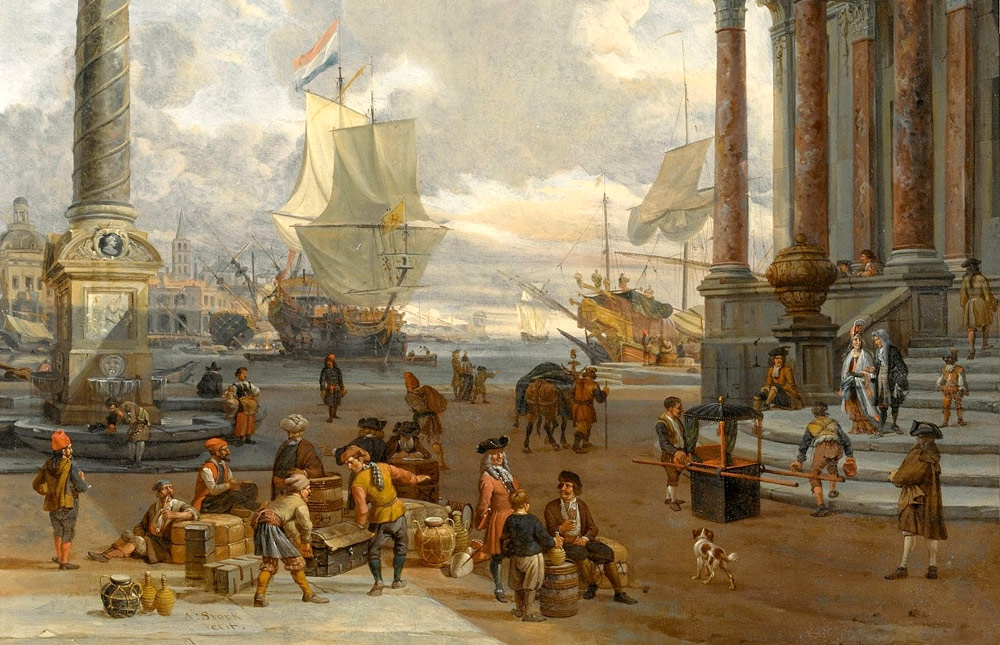
Illustration: Dutch free traders in Harbor Scene by Abraham Storck  (1644–1708)


Categories
First Amendment rights ideological culture too much government

Censorship for Unity

“Social media has given extremists a new tool with which to recruit and radicalise,” writes British Labour MP Lucy Powell in The Guardian. 

And just where are people “being exposed to extremist material”?

On Facebook!

“Instead of small meetings in pubs or obscure websites in the darkest corners of the internet,” she explains, “our favourite social media site is increasingly where hate is cultivated.”

Sharing ideas that she opposes is dangerous because they quickly spread. But her main ire is directed against private “Facebook groups,” an environment she argues “normalises these hateful views” because “critics are removed from the groups.”

Apparently, the problem with Facebook is that it is open — and that it is closed. Facebook is something new and dangerous because everybody uses it. Yet, because it allows closed groups, it is something very much like . . . “small meetings in pubs.”

Ms. Powell has, naturally enough, proposed a bill. “The responsibility to regulate these social media platforms falls on the government,” she asserts. “I believe we can force those who run these echo chambers to stamp out the evil that is currently so prominent.”

Like any politician, she talks up unity, of course. She demands the government prevent social media from “being hijacked by those who instead wish to divide.” 

But remember, she is a member of a political party that opposes other parties. She is trying to suppress divisions that exist. The implication of her agenda is a one-party state, where opposition is suppressed.*

By censorship.

A word she somehow neglects to use.

Online extremism, she writes, “is something we are frighteningly unequipped to deal with.”

I’d say she is frighteningly equipped.

This is Common Sense. I’m Paul Jacob.


* Social media critic Dave Cullen notices that MP Lucy Powell admits that there is a huge personal element here: she is a politician who doesn’t like criticism.

PDF for printing


Illustration by JG