Categories
free trade & free markets too much government

Retreat to Atlanta

“California is the place you oughta be” — or so sang Jerry Scoggins for The Beverly Hillbillies. That may still hold true, if you are an oil millionaire retiring to a pleasant climate.

But if you are trying to make your fortune, the direction is outbound.

Take, for example, the case of Yamaha Motor USA.

The company’s big bike sales — motorcycles 500cc and up — went way down during the last dozen months, 19 percent. And since Yamaha’s operations are in California, hits to revenue like that intersect alarmingly with ongoing hits to the cost of doing business. 

Which explains the decision to move the company to “just outside of Atlanta, Georgia,” as reported by Jensen Beeler in Asphalt & Rubber.

“It should be an obvious statement that California is an expensive place to operate a business,” Beeler explains. “The state isn’t known as being a tax haven for corporations, the property values are high, which means buildings are expensive, and the standard of living for Los Angeles is one of the highest in America, which means that employees have to be paid a premium as well.”

And Beeler’s report does not even mention the state’s regulatory burden.

Problem? Southern California is “where the bulk of the motorcycle industry resides,” and Yamaha will face some difficulty being so distant from its industry’s major talent pool.* But there are a few automotive and motorcycle companies in Georgia, so Yamaha is not alone.

Indeed, if politicians continue to wreak havoc on their business sector, the Golden State bike industry will lose more than just Yamaha.

This is Common Sense. I’m Paul Jacob.


* The company will keep “a small cadre of Yamaha employees” behind in Cypress, California, focusing on testing and racing.

PDF for printing


Illustration by JGill (running silhouette from Max Pixel)

 

Categories
general freedom ideological culture moral hazard nannyism national politics & policies too much government

An Evil Ism

With “democratic socialism” again on the rise, a refresher course in history seems apt: socialism has demonstrated the strong tendency to end up in totalitarian tyranny, poverty, and genocide.

As I mentioned on Monday, Reason’s Nick Gillespie suspects that this response is not very convincing to people tempted by socialism. But really, why not? What about a history of horror could be appealing?

Which is why the question “Do Socialists Mean Well?” as answered by Grant Babcock, might help. Babcock answers in the negative.* “Socialism is not ultimately an end but a means. And as a means, socialism is evil.”

With an evil means, one’s chosen end is irrelevant, because of other results. “If I told you I wanted to end homelessness, you might say I had good intentions,” Babcock explains. But if he confessed to seek that end “by conscripting the homeless into the army . . . [n]ot only should you say I have bad intentions, you shouldn’t give me any moral credit for saying I want to end homelessness.”

True. But Babcock has to engage in his extended argument about means because, for purposes of his essay, anyway, he began with the premise that while fascists are evil because they seek directly to harm some people, socialists do not.

Uh, really? Most socialists make much of taking from “the rich,” however they define the rich — as “the one percent” or “the privileged,” etc.

Call it expropriation; call it theft: that’s a lot of anger and ill will directed to one group of people.

In that way, the appeal of socialism is too much like the appeal of fascism.

This is Common Sense. I’m Paul Jacob.


* Babcock, by the way, denies the label “socialist” to social democrats who call themselves “democratic socialists” — by definition. On this matter, see “Bernie’s Slippery Definition of Democratic Socialism” and “Is Denmark Socialist?” on this site.

PDF for printing


Categories
ideological culture Popular too much government

The Irony Law of Socialism

Under capitalism, said the old socialists, “the rich get richer and the poor get poorer.” Today’s socialists admit this hoary “immiseration thesis” is old hat.

“The socialist argument against capitalism isn’t that it makes us poor,” explains City University of New York Professor Corey Robin in the New York Times. “It’s that it makes us unfree.”

Unfree?

Nick Gillespie at Reason tries to make sense of that breathtaking inversion of the usual anti-socialist argument, which Gillespie characterizes as the invocation of “Stalin, the Great Leap Forward, or even Hugo Chavez.”*

But is there really anything new here? 

“When my well-being depends upon your whim, when the basic needs of life compel submission to the market and subjugation at work, we live not in freedom but in domination,” writes the tax-funded socialist professor. He wants “to establish freedom from rule by the boss, from the need to smile for the sake of a sale,” which is so very not new. It’s reminiscent of Oscar Wilde’s “The Soul of Man Under Socialism,” which imagined rescue “from that sordid necessity of living for others.”

How real-world socialism “frees” us, though, is palpably oppressive: by burdening business and labor and trade with taxes, prohibitions, regulations.

And constant bullying. 

The ironies abound, too. Gillespie notes that “Alexandria Ocasio-Cortez may rail against the gig economy, but just like Bernie and Warren she uses Uber every chance she gets.” Jim Carrey praises “free” medicine in Canada, acknowledging no costs.

The cost of “free stuff” is actual freedom. And the cost of actual freedom is paying for what you get, and not getting what you won’t pay for.

That’s the Irony Law of Socialism.

This is Common Sense. I’m Paul Jacob.


* Gillespie also says it is unpersuasive. Well, unpersuasive to whom? As always, many arguments for the truth are necessary.

PDF for printing


Categories
free trade & free markets general freedom ideological culture too much government

The Ambit of an Ambition

“The geopolitical situation makes this Europe’s hour: the time for European sovereignty has come,” said European Commission President Jean-Claude Juncker this week, staking a big claim for the future in this year’s State of the Union Address.

Juncker wants the EU to be a shiny new “global player,” but shies from the word that comes immediately to mind: “We have to be super,” Juncker clarifies, “but not a superpower.”

The big question is how Juncker’s ramped-up globalism would serve European citizens. Juncker itches to build a “More United, Stronger and More Democratic Union,” but his biggest problem may be that the people seem increasingly iffy on this whole unity thing. 

Brexit is only the most spectacular popular rebellion.

“The Visegrad nations of Hungary, Poland and the Czech Republic,” the Washington Times noted yesterday, have balked at EU migration policies, and “all face EU legal sanctions.” Meanwhile, “Populist governments have been elected in Italy and Austria, where voters are sick and tired of the constant intrusions into their lives by Brussels.” 

And on Wednesday the EU enacted Article 13, an intrusive copyright law that Net activists have dubbed a “meme killer” capable of destroying “the Internet as we know it.”

While Juncker talks about Europe taking “destiny into its own hands,” Europeans seem more interested in taking their government into their own hands.

After all, it is not as if Europeans cannot prosper in a world economy without confederation — much less something much more, a stronger central bureaucratic authority. 

European states could, for instance, adopt free trade. It would make them richer and the world safer.

And they could, in addition, junk Juncker.

This is Common Sense. I’m Paul Jacob. 


PDF for printing


Categories
Accountability general freedom ideological culture national politics & policies Popular too much government

Pulling It Off

Give democratic socialism a chance? 

So says Dr. Cornel West, the “provocative democratic intellectual” who serves as one of eight honorary co-chairs of the Democratic Socialists of America. 

This accomplished Professor of the Practice of Public Philosophy at Harvard University, and Professor Emeritus at Princeton, explained to Fox News host Tucker Carlson that socialism’s “fundamental commitment is to the dignity of ordinary people and to make sure they can lead lives of decency.”

“What happened in Venezuela?” Carlson asked West. “They called that democratic socialism. But they don’t have toilet paper and it’s less equal than ever.”

“But part of the problem is though, brother,” the professor responded, “that any time there [have] been attempts by ordinary people to engage in self-determination, they can get crushed by external nations. Look at U.S. policies toward Venezuela [which have] been very, very ugly — Nicaragua in the same way.”

West offered nary a specific to his charge, but was handy stating his conclusion. “So, we have never had a chance to really pull it off,” the “it” being socialism. 

“So it’s only been a movement so far.”*

How convenient.

West implicitly acknowledges that those ruling Venezuela and Nicaragua are practicing socialism. But he won’t hold them or the -ism responsible for the economic collapse, the hunger, the exodus of millions of very desperate “ordinary” citizens, the arbitrary arrests, use of torture and murder of innocent citizens. 

Dr. West, a follow-up question: Just what specific U.S. policy triggered these socialists to murder and torture their own people?

This is Common Sense. I’m Paul Jacob.


* Dr. West also announced that socialism “is not an ‘ism,’ brother.” I think the professor needs to take a course in ism-ology.

PDF for printing


Photo by Gage Skidmore

Categories
Common Sense free trade & free markets general freedom ideological culture meme porkbarrel politics too much government

Wisdom for Labor Day

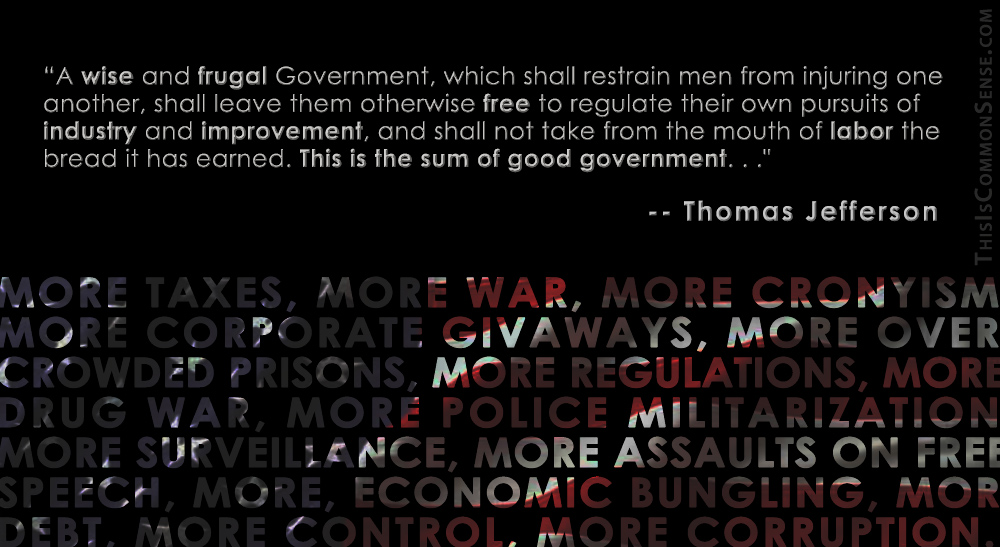
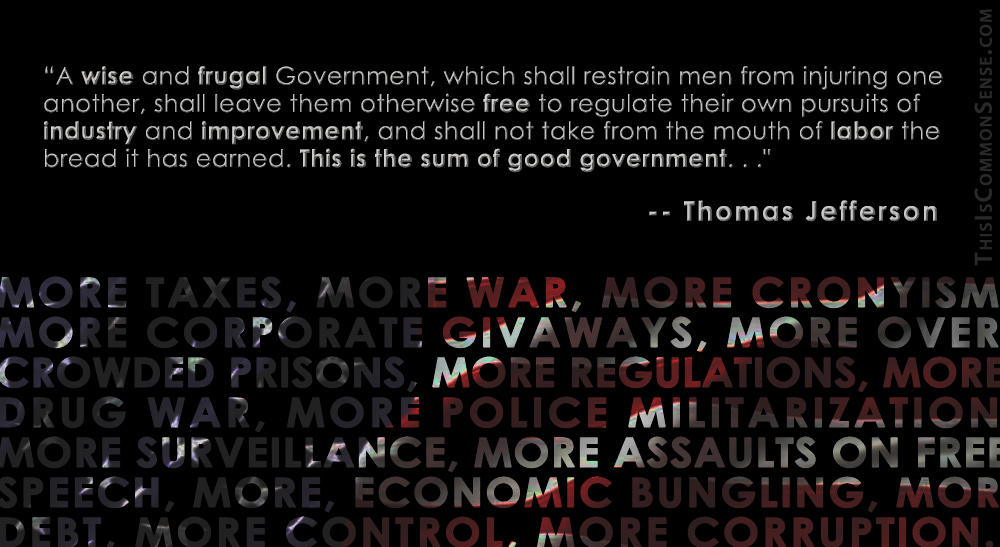
“…a wise and frugal Government, which shall restrain men from injuring one another, shall leave them otherwise free to regulate their own pursuits of industry and improvement, and shall not take from the mouth of labor the bread it has earned. This is the sum of good government…”

–Thomas Jefferson, 1801


Full quote is here


Categories
crime and punishment general freedom ideological culture too much government

Townhall: Free-Range Kids vs. Deranged Adults

There is something peculiarly anti-life as well as anti-liberty about today’s attitudes towards children — as you can read at Townhall.com.

But for more background, please consider:

This column will be available on this site on Tuesday. You can also download a PDF of this column to share easily with your friends and frenemies.

Categories
national politics & policies too much government

When Tax Rates Were High

The truth about the magical 1950s:

Categories
general freedom ideological culture Popular too much government

Who Benefits From Our Fears?

“Think of the children!”

I have daughters. And neighbors, nephews, nieces, cousins, friends with children. And friends who used to be children. But when the command to “think of the children” is screamed out by freaked-out paranoiacs demanding more laws, more punishments, more prison time, more surveillance — and consequently less freedom — I try to think responsibly.

As did one Corey Widen, when she “let her 8-year-old do the most normal, cheerful thing in the world — walk the dog around the block.” Lenore Skenazy tells the tale in Reason. “After the girl returned home, the doorbell rang. It was the police.”

Someone in Widen’s Wilmette, Illinois, community had seen the child and dog walking around “unsupervised” and called 911.

The thing, there was no lack of supervision, here. The child was supervising the dog.

What could be more natural?

The neighbor could have walked outside and smiled at the kid and talked about the dog and, in general, been a good neighbor.

Think of it as a peaceful order of supervision.

Instead: in came the police.

Then, after the police let it go, the Department of Children and Family Services stepped in to “investigate.”

Because nothing says DANGER more than a kid walking a dog.

Skenazy notes that this attitude is commonly justified by crimes against kids. And yet, Ms. Skenazy notes, crime in Wilmette has gone down dramatically over the years. As it has most elsewhere.

The culture has become more paranoid.

Who is served by this?

Authoritarians. Haters of freedom. Demagogues.

Certainly not kids, for kids cloistered from simple responsibilities cannot grow up to take on real responsibilities.

Think of the . . .  future adults.

This is Common Sense. I’m Paul Jacob.


PDF for printing


Categories
Accountability government transparency incumbents initiative, referendum, and recall local leaders nannyism political challengers Regulating Protest term limits too much government

Strange It Is

Strange for the Arlington, Texas, City Council to hold a meeting on a Sunday evening, much less one to “consider suspending the city charter.”

That is how the Fort Worth Star-Telegram reported “the latest twist in the term limit controversy that has engulfed the city with a lawsuit and competing ballot proposals.”

Led by Zack Maxwell, citizens in this Fort Worth adjacent community of 400,000 gathered 11,000 voter signatures to place a term limits charter amendment on the November ballot. It would limit councilmembers to three two-year terms. It also figures in past service, so five of the eight current councilmembers would be blocked from seeking re-election in the coming two years.

With swift legislative prowess, the council responded, passing its own competing “term limits” measure, which incidentally allows them to stay 50 percent longer in office.

But there’s one problem: the council did not follow the law, which requires multiple readings, with one at a regular meeting. 

Actually, there’s a second problem: Mr. Maxwell challenged the council’s unlawful action in court. 

The court blocked the council’s measure. 

That left the council holding an unusual weekend meeting to suspend the rules and re-pass their fumbled alternative to the term limits voters really want. But news travels fast and city hall was “packed.” 

“You’re suspending the rules because your jobs are in jeopardy,” charged one man.

A woman told the council, “You guys should be absolutely embarrassed about this.”

“After hearing from dozens of angry residents,” the paper explained, “[t]he council voted unanimously to not suspend the rules, finally killing its own term limit proposal.”

Politicians doing the right thing . . . having exhausted every other possibility.

This is Common Sense. I’m Paul Jacob. 


PDF for printing


Photo from the Fort Worth Star-Telegram