Botswanans celebrate their independence from Great Britain with an official day on September 30.
Also, September 30 has served as Blasphemy Rights Day since 2009, when it was initiated by the Center for Inquiry.

Botswanans celebrate their independence from Great Britain with an official day on September 30.
Also, September 30 has served as Blasphemy Rights Day since 2009, when it was initiated by the Center for Inquiry.

Raise a long-stemmed glass to the wineries of Minnesota. And to the Institute for Justice, which fought for their rights in court.
Minnesota wine makers may now make wine with whatever grapes they like! They may make wines that were illegal for them to make before.
Early in September, a federal judge struck down a 1980 Minnesota law which prevented Minnesota wineries from crushing grapes into wine unless most of the grapes being used had been grown in Minnesota. Winemakers were thus thwarted from producing popular varietals requiring grapes that can’t be grown in the state. Temporary exemptions from the law were possible but could not be counted on.
Judge Wilhelmina Wright’s ruling may well inspire challenges to similar prohibitions in other states. You know you’re a fifth of the way into the twenty-first century when dramatic modernistic advancements like letting wineries buy whatever grapes they wish have become possible.
You may be thinking: “Huh? I had no idea that wine makers in Minnesota were not allowed to buy grapes from other states. That’s painfully stupid!”
Of course, that is probably not the opinion of the proponents of the law. At least some Minnesota grape growers no doubt believe that persuading lawmakers to block out-of-state grapes was a smart move.
But is it really so very wise to hobble business competitors for the sake of short-term advantages regardless of the long-term costs to the freedom — not to mention the palates — of all?
This is Common Sense. I’m Paul Jacob.
See all recent commentary
(simplified and organized)
See recent popular posts

They’ve crunched the numbers and the shocking truth
The word “shocking” needs quotation marks, of course, for sheer lack of any shock whatsoever.
Also not shocking is who pays.
You see, “80 to 90 percent of the total proposed tax increases in Biden’s plan would fall on the top five percent of earners,” according to the Committee for a Responsible Federal Budget. That is the target taxpayer cohort, anyway. Economists know a hidden truth: the incidence of a tax’s burden shifts. All taxes siphon off production, but — because production is engaged in for consumption’s sake — in the end consumers pay.
In politics, of course, the idea is not to acknowledge this, instead focusing on the targets, tempting voters to get on board with spending and taxing and borrowing just so long as some other (preferably non-voting) people pay.
“While tax burdens would rise by 0.2 to 0.6 percent for most households, they would rise by 2.3 to 5.7 percent for the top 20 percent of earners and by 13.0 to 17.8 percent for those in the top 1 percent in 2021.” The Democrats would have the highest earners in America pay an extra “$300,000 per year” and call that a benefit . . . to those who would pay less.
Meanwhile, the “additional revenue that would be raised through Biden’s tax plan would only pay for a portion of his overall spending agenda.” It would take “$6 trillion
According to the CRFB, because of pandemic panic spending, and before any proposed Biden add-ons, “debt will grow from 79 percent of GDP before the crisis to 101 percent by the end of 2020 and 118 percent of GDP by 2030.”
Have our politicians set out to revise Ben Franklin’s maxim? There is nothing more certain than death and taxes — and debt.
This is Common Sense. I’m Paul Jacob.
See all recent commentary
(simplified and organized)
See recent popular posts
Should Uber and Lyft abandon California?
At issue is the anti-freelancer statute AB 5, passed last year in the Golden State, which outlaws independent contractors in many industries.
Including the wildly successful ride-sharing business.
Horrified, threatened, Uber and Lyft have declared their willingness to suspend operations in California if they are forced to reclassify independent contractors as employees.
You see, wage and salary contracts are heavily regulated already, and switching from independent contractors to employees means drivers would be entitled to expensive benefits.
Which would upset the gig economy business model.
A model Democrats hate. This assault on independent contractors is something that Democratic presidential candidate Joseph Biden wants to impose nationwide.
The Democrat-controlled U.S. House passed such legislation in February.
For now, a court order has given the companies a temporary reprieve from another court’s order mandating compliance.
Maybe the dueling decrees will end well for the ride-sharing companies, allowing them to function. Maybe not. There’s also a citizen initiative in the mix. Proposition 22 on the fall ballot would substantially modify AB5 to make it possible for at least some freelancers to do their jobs in the state of nearly 40 million people.
On the other hand, should California officials succeed in imposing their mandate on the ride-sharing firms, Uber and Lyft should follow through on their threat and leave.
The consequences of such attacks on the market should be made as plain as possible as rapidly as possible so that as many people as possible can make the connection between cause and effect.
This is Common Sense. I’m Paul Jacob.
See all recent commentary
(simplified and organized)
See recent popular posts

That’s the theme of a discussion at reddit.com. “Someone told me it was too late last fall,” the original poster recalls. “I went on to build a moderate canned prep. . . . Someone told me it was too late to prep for the pandemic in February. I went on to gather [personal protective equipment] before the stores emptied.”
Most Redditors nodded. But one suggested that if things go kablooey and some products become scarce on shelves, “buying up those supplies is not being a prepper but being a hoarder.”
“Hoarding” is a word used to disparage somebody else’s foresight and concern for survival. If something you need is in short supply, it is reasonable to stock up, if you can. (Even if it’s toilet paper and comedians chortle.) If the market is allowed to function — so that sellers of highly demanded goods can charge what the market will bear — everyone who can scrape together the necessary extra dollars will be able to obtain those goods.
If a person buys up a supply only to resell it, not to restock his larder, he does us all a favor if the item is about to become desperately needed. He makes no money unless people can pay his price. But if we can afford the price, it is pointless to sputter about the extra expense — an expense we could have avoided had we prepared better for the future earlier on, saving more of the thing ourselves.
The cost of not being prepared can be quite high. Same with the value, hence purchase price, of necessities bought after disaster.
This is Common Sense. I’m Paul Jacob.
See all recent commentary
(simplified and organized)
See recent popular posts
Is California a failed state? It has an electric grid problem. And a vagrancy problem. Both of which stem from the bizarre ideological blind spots of a political class “benefiting” from the state’s high legislator/citizen ratio, which insulates politicians from feedback.
Driving them power mad.
And one form of madness flowers in political greed, hubris and overreach.
“A pack of Democratic lawmakers in California are proposing a wealth tax for the state’s richest citizens, forcing them to pay more essentially just for owning a lot of stuff,” writes Scott Shackford at Reason. “They also, amazingly, want the tax to follow Californians who flee the state in response, attempting to make them continue paying taxes on wealth that’s not even in the state.”
Rob Bonta, Oakland’s Democrat in the Assembly, says the Golden State needs more gold, and he has made a startling observation. Wait for it. “Rich people have money,” Shackford summarizes, and Bonta wants to take it. To expand services.
But surely service expansion is not only not the only option, it is often the worst option.
Take the state’s rolling blackouts. Was that caused by not enough or really bad legislation? President Trump points his finger at the Democratic-controlled Assembly: “In California, Democrats have intentionally implemented rolling blackouts — forcing Americans in the dark. Democrats are unable to keep up with energy demand,” the president tweeted on Tuesday. But the New York Post identifies as a cause not “intentionally implemented” blackouts, but “inadequate transmission and an over-reliance on renewable energy and issues with natural gas plants during high heat.”
Bad policy. Not too few “services.”
And the proposal to tax the richest Californians — or former Californians — to pay for more disastrous programs?
Hubris and greed.
Not Common Sense. I’m Paul Jacob.
See all recent commentary
(simplified and organized)
See recent popular posts

Given everything that has happened over the last several millennia, you can’t be surprised by anything. But still.
I had to check the text of the bill, A06578 in the New York State Assembly, to make sure the stories are accurate. It checks out: some lawmakers really do want to compel aspiring “shampoo assistants” to take 500 hours of training before they suds up your hair. (Apparently, though, you will still be allowed to give yourself a home-shower shampoo, even without training. Maybe future legislation will close this loophole.)
The culpable assemblymen are Carrie Woerner, (518) 455-5404, and John T. McDonald III, (518) 455-4474. A companion bill, S8862, is sponsored by co-conspirator State Senator Jen Metzger, (518) 455-2400.
According to the legislation, certificate holders may shampoo and rinse but not, you know, perform delicate surgical procedures like waxing or placing artificial braids.
One odd thing about the bill is this stipulation: “All shampoo assistant certificates shall expire one year from the date of issuance.” So . . . every year, shampoo assistants must put in another 500 hours?
On the other hand . . . come on, man. Think of the risk.
What if the water is too hot and the shampoo assistant is brand-new and hasn’t had the 500 hours training, so she gets burned and burns the head of the customer, or even heats the water on a stove until it boils and then pours it over her own head and the customer’s head?
How would she know not to do that without any training whatsoever?
This is . . . I’m Paul Jacob.
See all recent commentary
(simplified and organized)
See recent popular posts
Socialists are so “modest”!
But how modest?
Ask Rep. Ilhan Omar, who recently proclaimed to be “fighting to tear down systems of oppression that exist in housing, in education, in health care, in employment, in the air we breathe.”
Gasp?
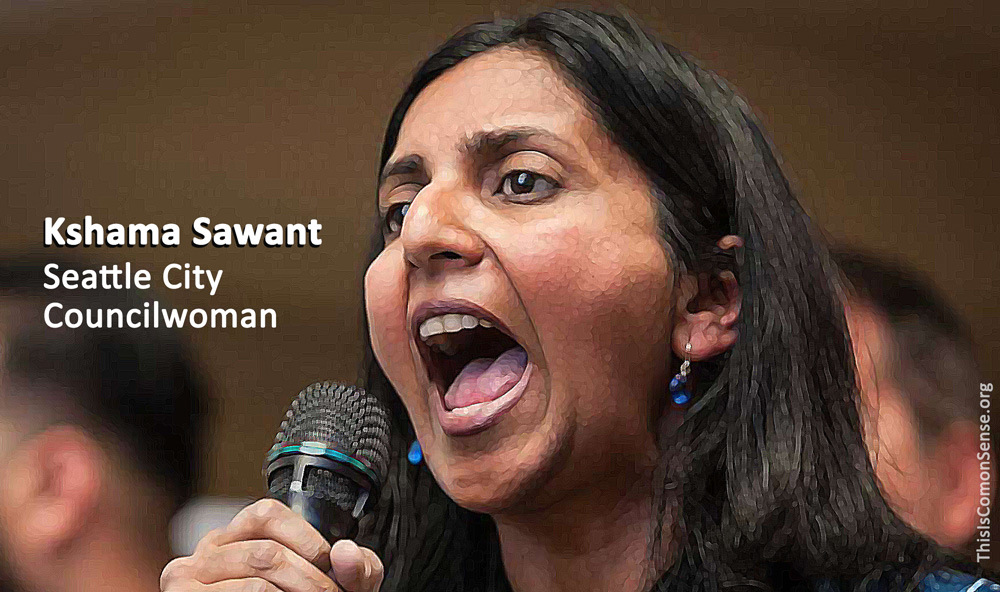
Well, maybe that isn’t so clear. So listen to Seattle City Councilwoman Kshama Sawant.
“I have a message for Jeff Bezos and his class,” Sawant warned. “If you attempt again to overturn the Amazon Tax, working people will go all out in the thousands to beat you. And we will not stop there.”
Does that sound like a threat? Or is it really just a harmless expression of politics-as-usual?
“You see, we are fighting for far more than this tax,” the self-proclaimed socialist elaborated. “We are preparing the ground for a different kind of society, and if you, Jeff Bezos, want to drive that process forward by lashing out against us in our modest demands, then so be it. Because we are coming for you and your rotten system. We are coming to dismantle this deeply oppressive, racist, sexist, violent, utterly bankrupt system of capitalism. This police state. We cannot and will not stop until we overthrow it, and replace it with a world based, instead, on solidarity, genuine democracy, and equality: a socialist world. Thank you.”
And thank you, Ms. Sawant, for making yourself ultra-understandable.
You want to destroy private property and free markets and robust political debate and replace them with . . . well, let’s just say that if you complain about a police state now, wait’ll you get a load of what follows from your “modest” demands.
This is Common Sense. I’m Paul Jacob.
See all recent commentary
(simplified and organized)
See recent popular posts

Modern government finance is like Russian Roulette . . . but with incredibly slow bullets.
We spend money. We create money out of thin air. We borrow it. We promise the Moon. We deliver rocks. With each action, we spin the chamber and pull the trigger. That slowround doesn’t immediately hit, so we do it again.
Calling the perennial deficits and ballooning debt a “predictable crisis,” Nick Gillespie at Reason writes that our federal government’s debt “is already choking down economic growth, but in the future, it could lead to ‘sudden inflation,’ and ‘a loss of confidence in the federal government’s ability or commitment to repay its debts in full.’” And worse: “‘Such a crisis could spread globally’ causing some ‘financial institutions to fail.’ That’s all according to the nonpartisan Congressional Budget Office (CBO), which has been warning Americans about the long-term consequence of the ballooning debt for years.”
This is an old warning. I have been talking about it for years, too. So have you. But once politicians start playing the game, it’s hard for them to stop. They see and we see the benefits, but that slow motion slug has yet to strike the target.
Gillespie makes a better analogy than “slow bullets” (which don’t exist): “Like the coronavirus, the debt problem has the potential to seemingly appear out of the blue and turn our world upside down in a matter of weeks.”
Nassim Nicholas Taleb gained fame talking about “black swans,” major events we cannot predict. But he insists that the financial crisis resulting from government overspending is not a black swan. It’s predictable. We just do not know when.
Here’s a fourth analogy:
In free fall, you don’t feel a thing . . . until you hit the pavement.
This is Common Sense. I’m Paul Jacob.
See all recent commentary
(simplified and organized)
See recent popular posts
I idly wonder who cooks up the initialisms for the big federal legislative packages (“laws”) — you know, like the recent “CARES Act” that distributed $2.3 trillion conjured out of thin air . . . and the faith and credit of a wobbly reputation. CARES stands for “Coronavirus Aid, Relief, and Economic Security,” and I say “idly” because I am not googling this.
If I can resist searching for (as I am instructed to do daily) “any three numbers and ‘new cases,’” I can let others do that initialism research.
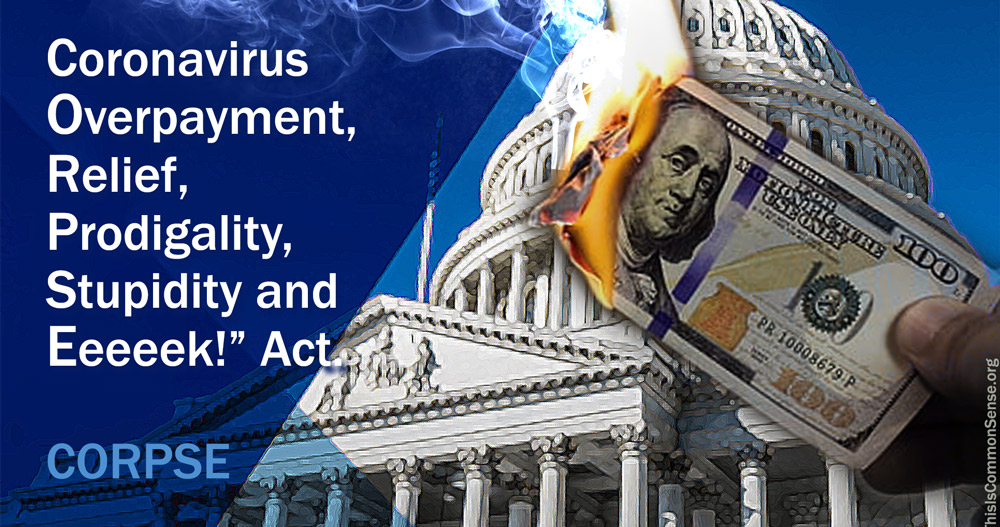
Whoever it is, though, does a pretty good job. Usually. Good P.R. But they missed the boat a bit on CARES. It should have been CORPSE, standing for “Coronavirus Overpayment, Relief, Prodigality, Stupidity and Eeeeek!” Act.
For, you see, $1.4 billion was sent to dead people.
More than a million of them.
At least we can be thankful that the IRS wants that money back.
Well, “wants” is a funny word to use for a bureaucracy. Especially since the IRS has no current plan “to notify ineligible recipients on how to return payments.” According to the General Accounting Office.
You can read about it all at Reason.
I would say it makes for fascinating reading, but it doesn’t really. This is the same-old/same-old. The Department of Kludge and Fubar, you know, which would be a better name for most government bureaus.
The Reason piece call the CARES Act “unprecedented emergency spending,” but I think we could find plenty of precedents.
If we googled.
This is Common Sense. I’m Paul Jacob.
See all recent commentary
(simplified and organized)
See recent popular posts