I have no patriotism, for patriotism, as I see it, is often an arbitrary veneration of real estate above principles.
George Jean Nathan, Testament of a Critic (1931), p. 16.
Categories
George Jean Nathan

I have no patriotism, for patriotism, as I see it, is often an arbitrary veneration of real estate above principles.
George Jean Nathan, Testament of a Critic (1931), p. 16.

On September 17, 1683, Antonie van Leeuwenhoek wrote a letter to the Royal Society describing “animalcules,” later known as protozoa.

That’s what John Kennedy, Louisiana’s wittiest U.S. senator, dubbed Mitch McConnell, yesterday.
Why? From the Wall Street Journal’s write-up, it must be the Kentucky’s senator’s fortitude and resilience that qualify him as hard and stony. The 84-year-old lame duck solon was rolled into the Capitol after a three-month absence, and it appears that everyone was nice to the wheelchair-bound octogenarian.
“Time to get back to work,” he said.
“His words,” explains the Journal, “weren’t clearly enunciated and at times were hard to make out.” Which probably explains why his staff wouldn’t allow reporters to video-record the senator’s short remarks — less evidence to share on social media, audio alone possessing so much less viral cachet.
“McConnell’s absence, which was unusual but not unprecedented, again prompted questions about whether lawmakers with significant health issues should remain in office or step aside,” we are told.
Sure. We talk about age limits, too. But term limits would generally rein such abuses in. The less time in office, the less likely one is to die
Or suffer a stroke. Or experience a debilitating fall, as in the official story regarding McConnell.
Of course, neither term limits nor age limits directly deal with the illness issue. Which may be a good thing. Senator John Fetterman (D.-Penn.) suffered a stroke on the campaign trail, making his election later in 2022 seem . . . imprudent. He has since recovered impressively, going on to become one of the more independent voices in Washington.
Sure, McConnell should step . . . roll . . . aside. Let someone else do the job. But, as it is, he serves as a stark reminder of the gerontocracy.
This is Common Sense. I’m Paul Jacob.
Illustration created with Nano Banana / Grok Imagine
See all recent commentary
(simplified and organized)
See recent popular posts
Great power often corrupts virtue; it invariably renders vice more malignant. Is human nature made worse, a good corrector of human nature? Is vice cured by the strongest temptations? History every where contributes evidence, distinctly replying to these questions. In proportion as the powers of governments increase, both its own character and that of the people becomes worse.
John Taylor of Caroline, An Inquiry into the Principles and Policy of the Government of the United States (Fredericksburg, VA.: Green and Cady, 1814).

On September 16, 1945, the Japanese occupation of Hong Kong came to an end.

In students.
The Illinois Policy Institute’s Chicago Policy Center reports that, “Frederick Douglass Academy, with a capacity of 1,008, had just 27 students in 2025-2026.”
Yet supporters and employees boast online how “loud and proud” they are about the school — while demanding more funding.
We’re not supposed to notice that 981 shortfall in enrolled students.
Last year, according to columnist George F. Will, the school had more paid staff members than students! The year previous, taxpayers had funded “education” there to the tune of $93,000 per pupil!
“But Douglass is not entirely an outlier,” explains Mr. Will. “At more than 50 Chicago schools, the percent of students who achieve math proficiency is 0.”
And the average over all the schools, last year, adds another clue: “43 percent of the city’s teachers were absent 10 or more school days. Students similarly negligent produce the phenomenon called ‘chronic absenteeism.’ A quarter of Chicago high-school students missed more than a month of school, and 100 percent of Douglass’s seniors were chronically absent. Yet the graduation rate remains high, at
Will blames the teachers’ union, which he calls “wicked.”
Corruption festers up and down Chicago’s K-12 hierarchy. There has been a moratorium on closing under-utilized schools, with near-empty schools better serving as union pork than as an efficient way to educate the young.
The Illinois Policy Institute insists that the first step out of this mess is to close failing schools.
We cannot keep passing along those who flunk out. Students and schools, both.
This is Common Sense. I’m Paul Jacob.
Illustration created with Nano Banana
See all recent commentary
(simplified and organized)
See recent popular posts
If Poverty is the Mother of Crimes, want of Sense is the Father.
Jean De La Bruyère, The Characters; or, Manners of the Present Age (Henri Van Laun, translator, 1885), Vol. II, Ch. II.

September 15, 1789, the United States “Department of Foreign Affairs,” established by law in July, was renamed the Department of State and assigned a variety of domestic duties. Thomas Jefferson was the the department’s first secretary.
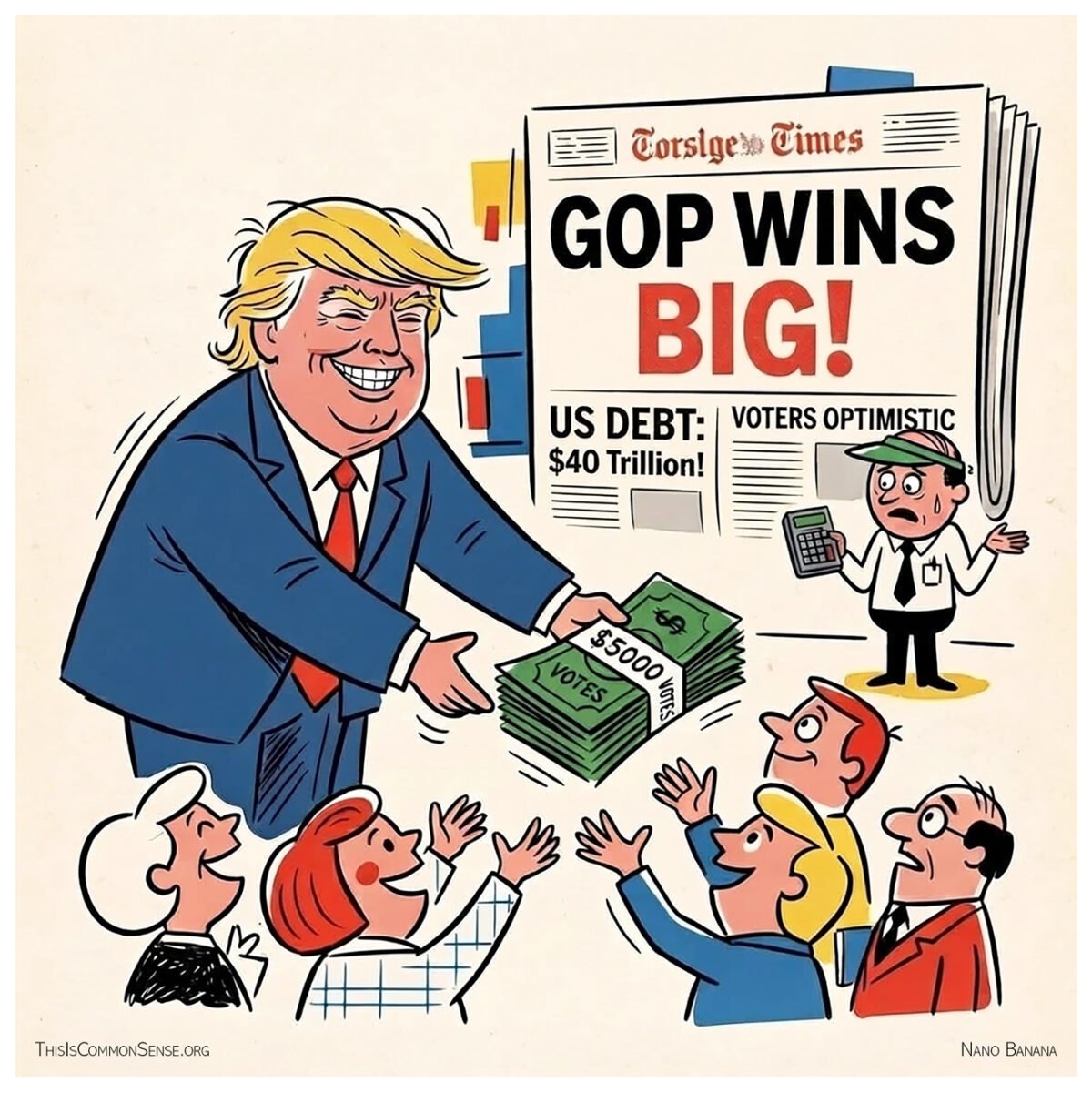
The cost of making good on his pledge, bribe, deal? A cool $1.3 trillion.
I don’t believe Mr. Trump has that much money.
“Because of our tremendous strength and success economically, I will issue a dividend to every adult citizen in the United States of America for $5,000,” intoned the president. “Very much like a successful company will do a cash distribution to its shareholders.”
Dividends are paid out of profits; this operation known as the federal government doesn’t turn a profit. Instead, it’s running past $40 trillion
Can we afford to go trillions further into the red? Or pay more in taxes for this additional trillion-dollar-plus giveaway?
As if trying to outdo the president in folly, Commerce Secretary Howard Lutnick declared “we’re going to deliver” but “not from taxpayer money,” detailing several precarious plans . . . to come up with less than half the needed dough.
On Fox News, Bret Baier brought the vice president into the conversation. J. D. Vance described the current deficit budget in terms of revenue — there is “an extraordinary amount of revenue,” he said — as if the revenue that is not extraordinary enough to cover all current spending is somehow enough to spend $1.3 trillion more without additional debt.
Eric Boehm at Reason says the $5,000 bribe shows that MAGA has run out of ideas.
In an election year when Democrats are featuring wannabe communists, why are Republicans demonstrating a similar lack of sanity?
I think the American voter might be more persuaded by even the smallest dose of common sense. I’m Paul Jacob.
Illustration created with Nano Banana
See all recent commentary
(simplified and organized)
See recent popular posts
Experience has demonstrated over and over again, that a free government cannot subsist in union with extravagance, heavy taxation, exclusive privileges, or with any established process by which a great amount of property is annually transferred to unproductive employments. Such a system is tyranny. How then can it harmonise or live in the same country with liberty? But liberty is always addressed by it, as if she was vain, foolish, and even blind; as if she was only fortune. A free government can only be made lasting by frugality and justice.
John Taylor of Caroline, Tyranny Unmasked (1821), Section III.