Categories
initiative, referendum, and recall

Death Star Destroys Democracy

“I felt a great disturbance in the Force, as if millions of voices suddenly cried out in terror and were suddenly silenced.”

That’s Obi-Wan Kenobi’s line in the original Star Wars movie, sensing that the Empire’s Death Star had obliterated all the inhabitants of the Planet Alderaan. 

It popped into my mind on Friday, after learning of the ruling handed down by the Mississippi Supreme Court that not only strikes down a medical marijuana ballot initiative passed by voters last November but “judicially kills Mississippi’s citizen initiative process,” as Justice James Maxwell wrote in his fiery dissent.

The Magnolia State’s entire initiative process has been destroyed. 

When the direct citizen initiative process was enacted, in 1992, Mississippi sported five congressional representatives. The constitutional provision setting out how to qualify an initiative was worded to allow only “one-fifth” of the required petition signatures to come from any of the state’s five congressional districts (CDs). After the 2000 census, however, the state lost a congressional seat. Now with only four, simple math does not allow a way to get the prescribed balance of signatures.

Talk about a catch-22!

State officials just kept using their old maps with five CDs for ballot initiatives in order to comply with the letter of the law. But the court says that does not suffice. 

Only a constitutional amendment can restore this citizen check on politicians, and after the court’s ruling, only the legislature can place that amendment on the ballot. 

“Legislative leaders have not said clearly why they have not updated the initiative process in the 20 years since Mississippi lost a congressional district,” the Jackson Clarion Ledger reported Friday.

That’s simple: They don’t want citizens to have a check on them. 

Can citizens strike back?

This is Common Sense. I’m Paul Jacob.


Note: Mississippi voters first passed an initiative and referendum process in 1914 and the state supreme court upheld the validity of the process against a legal challenge in 1916. But after a 1922 initiative ruffled establishment feathers, the state supreme court reversed its earlier ruling and struck down the process in total. It was not until 70 years later, that the legislature would act to restore some measure of citizen initiative.

PDF for printing

starry sky /space ship / flag / JGill / 🎨

See all recent commentary
(simplified and organized)
See recent popular posts
Categories
Thought

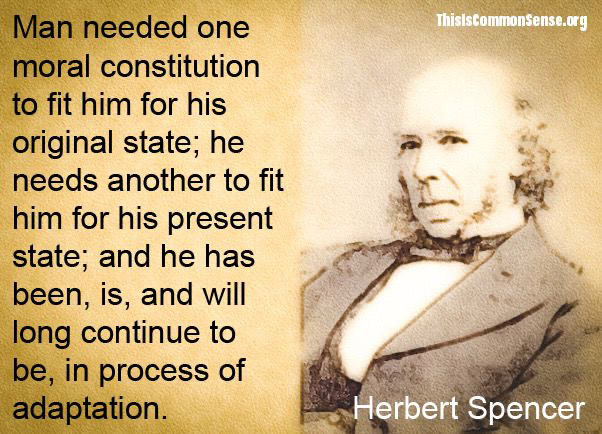
Herbert Spencer

Man needed one moral constitution to fit him for his original state; he needs another to fit him for his present state; and he has been, is, and will long continue to be, in process of adaptation.

Herbert Spencer, Social Statics: or, The Conditions essential to Happiness specified, and the First of them Developed, (London: John Chapman, 1851), Pt. I, Ch. 2 : “The Evanescence of Evil,” from the concluding paragraph.
Categories
Today

Virginia for Independence

On May 15, 1776, the Virginia Convention instructed its Continental Congress delegation to propose a resolution of independence from Great Britain, paving the way for the United States’ Declaration of Independence.

Categories
Today

Oregon Trail

On May 16, 1843, one thousand pioneers from Elm Grove, Missouri, set off for the Pacific Northwest, blazing what became known as the “Oregon Trail.”

Categories
Thought

Jeremy Bentham

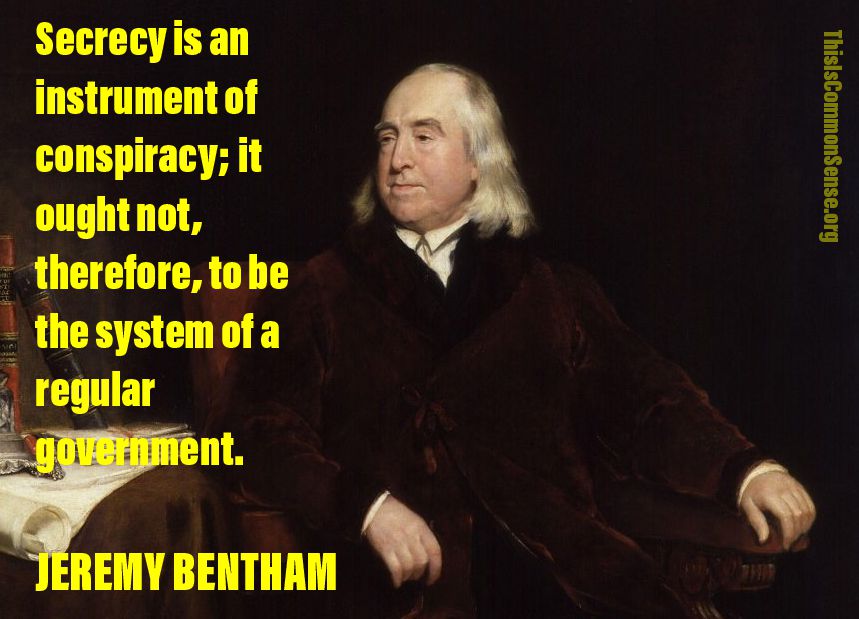
Secrecy is an instrument of conspiracy; it ought not, therefore, to be the system of a regular government.

Jeremy Bentham, “On Publicity,” The Works of Jeremy Bentham volume 2, part 2 (1839).
Categories
Today

Constitution, huzzah?

On May 14, 1787, delegates convened a Constitutional Convention, in Philadelphia, Pennsylvania, to write a new Constitution for the United States. George Washington presided over the convention.

On the same day a century later, jurist and pamphleteer Lysander Spooner — author of an infamous pamphlet titled “No Treason: The Constitution of No Authority” — died.

Categories
education and schooling initiative, referendum, and recall

Organizing an Ouster

Despite everything, public schooling can help kids learn some important things.

But this schooling is also something that kids have to survive. If and when Johnny can’t add, spell, figure out who’s buried in Grant’s tomb, or relate premises to a conclusion — the lessons and educational theories he’s been subjected to often have something to do with it.

Now Johnny is being told, if his skin is white, that he must feel guilty about his skin color and work to find, dwell on, and exterminate super-subtle racism buried deep within his privileged soul. He can’t just be happy and learn.

The rationale for this assault on the individual is called “critical race theory.” And in some school districts, this mislabeled “antiracist” indoctrination is being imposed on students (as it is also being imposed throughout society).*

Parents in Loudoun County, Virginia, are fighting back by forming a PAC with the mission of ejecting purveyors of critical race theory from the school board. The PAC is led by Ian Prior, who says that county parents “cannot wait until 2023 to elect new leaders.”

Board members must be recalled because of the board’s failure to reopen schools, its imposition of “dangerously divisive critical race theory,” and its cooperation with “tactics designed to intimidate students, parents and teachers from exercising their First Amendment rights.”

Good luck, parents. 

And if you can find a way to educate your kids without sending them to public schools, I suggest that you consider that alternative.

This is Common Sense. I’m Paul Jacob.


Take Action

* “On April 19, 2021, the Biden Administration proposed a rule,” alerts Heritage Action, “that would allow the Department of Education to prioritize recipients to receive K-12 grants if they include critical race theory in their curriculum.” The Federal Register is accepting public comments on the proposed rule here until May 19.

PDF for printing

Child / Letters / FreeImmages / Bubbles / JGill 😇/ 🎨

See all recent commentary
(simplified and organized)
See recent popular posts
Categories
Today

Brazilian slavery

On May 13, 1888, Brazil abolished slavery with the passage of the Lei Áurea (“Golden Law”).

Categories
incumbents initiative, referendum, and recall

Christmas in California?

“Gray Davis was never in a position to play Santa Claus,” said Steve Maviglio, press flack for the former California governor who was recalled by voters in 2003.

Maviglio was comparing Davis’ relative misfortune, back then — in not having a pandemic and the resulting economic stimulus — to today’s prospects for current Governor Gavin Newsom, who likewise faces a citizen-initiated recall. Yet, while 18 years ago Davis both cut budgets and raised taxes, Newsom has now discovered an extra $100 billion of spendable funds to let him off that hook. 

California’s whopping budget surplus of $75.7 billion? Just the beginning. Democrats in Congress wanted to help with even more tax dollars, voting to drop-ship Golden State pols another $26 billion as part of the stimulus bill . . . which every Republican opposed, calling it at the time a move to “supply the Governor of California with a special slush fund.”

“Newsom wants to hand out cash before California recall election,” Politico headlined its story on Monday, informing that the embattled governor was quick to “tell Californians he wants to give them cash and pay some of their utility bills and back rent,” and noting specifically: “Checks would arrive in voters’ mailboxes not long before ballots do this fall.”

One key part of Newsom’s $100 billion “California Comeback Plan” is to give $600 “to some two-thirds of state residents in households making up to $75,000, along with $500 to families with dependents.”*

“It’s very significant,” offered former Gov. Davis, arguing “the future looks brighter as evidenced by the checks the public will soon receive.” 

Whose future, precisely? Not Californians, really. Newsom’s.

This is Common Sense. I’m Paul Jacob.


* “Unlike the federal stimulus aid, undocumented immigrants and their families will be eligible to receive a state tax rebate,” The Sacramento Bee explained. “In fact, undocumented immigrants with dependent children will be eligible for $1,000 for family checks, double what other California families will receive, in order to make up for the lack of support at the federal level, according to Finance Director Keely Bosler.” [Emphasis added.] Must they document that they are undocumented?

PDF for printing

Photo by Rob Growler / Photo by Gage Skidmore

See all recent commentary
(simplified and organized)
See recent popular posts

Categories
Thought

Jeremy Bentham

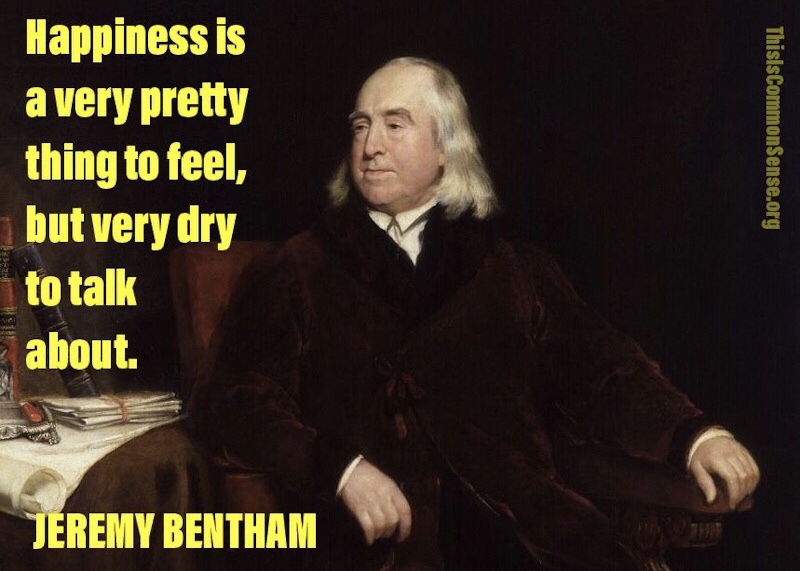
Happiness is a very pretty thing to feel, but very dry to talk about.