Categories
media and media people partisanship

Telling Us Clearly

“While everyone in America gets to cast a ballot on Election Day,” Washington Post columnist Perry Bacon, Jr., explains, “in reality rich people, corporations, foundations, politicians and other elite individuals and organizations have outsize power.” 

Ah, the Washington perspective . . . but don’t worry, Bacon adds, “The media that those people consume is telling them clearly that the current Republican Party is a threat to the nation’s future.”

Notice he does not use the term “informing” or “educating.”  

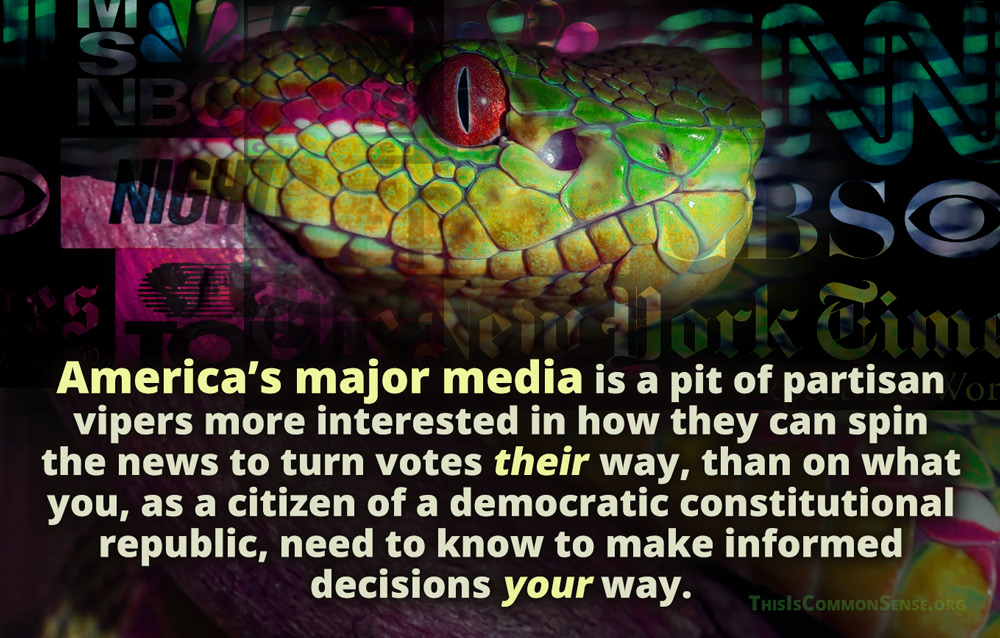
America’s major media is a pit of partisan vipers more interested in how they can spin the news to turn votes their way, than on what you, as a citizen of a democratic constitutional republic, need to know to make informed decisions your way. 

Mr. Bacon remains convinced, however, that the press “still doesn’t go far enough.”

He decries that “GOP radicalization and democracy erosion isn’t being covered extensively or aggressively by a big, important chunk of the media — the morning and nightly news shows of the big broadcast channels (NBC, CBS, ABC) . . .” 

Can’t be serious, can he?

The columnist, like so much of the national press corps, believes in “an emboldened media.”

In fact, he is mightily disappointed that more news coverage “doesn’t implicate the GOP.” Bacon justifies the thumb on the scale because “in most cases,” he asserts, “the GOP’s behavior is far worse than the Democrats’.”

I think we’re supposed to take his word for that . . . or maybe already suspect as much — if well-lectured in the right universities.

Bacon’s column is headlined, “The rise of pro-democracy media.” 

Close in letters, but what he and other “journalists” are calling for is Pro-Democrat Media.

This is Common Sense. I’m Paul Jacob.


PDF for printing

See all recent commentary
(simplified and organized)
See recent popular posts
Categories
Accountability crime and punishment national politics & policies

COVID Cover-Up Criminal

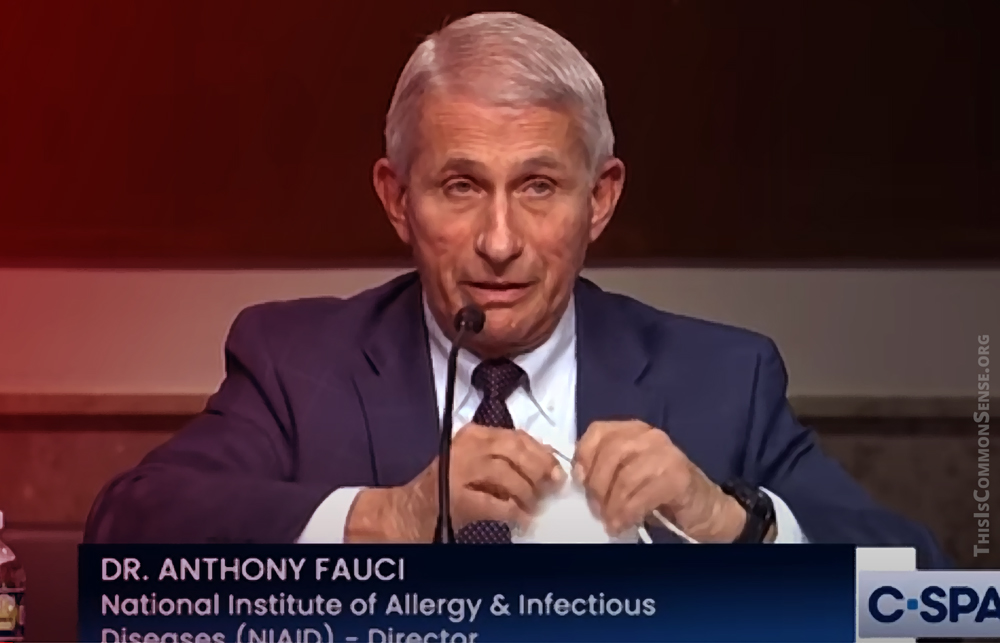
On February 11, 2020, Dr. Anthony Fauci participated in a conference call with about a dozen scientists. The nation’s highest paid government bureaucrat was told that the quickly spreading COVID might have leaked from and even been created in the Wuhan lab, which the National Institute of Allergy and Infectious Diseases (NIAID, which Fauci heads) was funding, in part, through EcoHealth Alliance. 

What did Fauci do?

He worked mightily to discredit the idea.

That is, he engaged in a cover-up.

Last week, Senator Rand Paul asked Fauci about all this. Indeed, he posed a number of very specific questions, and got — for his trouble — generalities and counter-assertions from Fauci. 

The trail of evidence linking Peter Daszak of EcoHealth and Anthony Fauci of NIAID to the gain of function research (along with a Chinese plan to release “novel chimeric spike proteins” into Chinese air with the alleged aim of infecting bats) has been confirmed on the Pentagon end — Senator Paul referenced work by Project Veritas that performed this service. 

There’s really little question that gain-of-function was developed in Wuhan at the instigation of the Daszak-Fauci team. And that it was done despite DARPA’s reluctance, despite U.S. law. 

Let’s hope that Fauci’s cover-up was merely of a dangerous policy that would end in disaster and death, and the ruination of his reputation, not a genocidal conspiracy worthy of taking to The Hague for prosecution as a crime against humanity.

But everyone knows that cover-ups imply criminality. 

This is Common Sense. I’m Paul Jacob.


PDF for printing

See all recent commentary
(simplified and organized)
See recent popular posts
Categories
Accountability First Amendment rights social media

The Expert De-Platformed

Dr. Robert Malone researched mRNA technology in the 1980s at the Salk Institute for Biological Studies. He helped develop mRNA vaccines. He is a founder of Atheric Pharmaceutical. He’s got plenty of credentials. 

So you might think social media companies would respect his voice in the area of his expertise.

But no: for disputing official government assurances about the super-safeness of the vaccines, he’s been banned by Twitter (and copycat LinkedIn).

What precisely did he say that triggered the social media giants?

Well, Dr. Malone argues that for many youngsters the risks (like myocarditis) of being vaccinated outweigh the benefits of being vaccinated against what is a very low-risk infection for most younger people.

“I may be one of the very few that has this depth of understanding of the technology that doesn’t have a direct financial conflict of interest,” says Dr. Malone, who is himself vaccinated. “If I’m not allowed to speak about my concerns, whether they’re right or wrong . . . who is a valid person to participate in the dialogue?”

Nobody, doc. It’s because you’re so credible that you finally had to be stomped by the likes of Twitter. You’re too credible.

At the strongholds of official government doctrine, it’s not about figuring out the truth, encouraging independent judgment of risks and alternatives, or logical persuasion. Argue all you want, as rationally or irrationally as you want — just as long as you hew to the protean prescribed dogma.

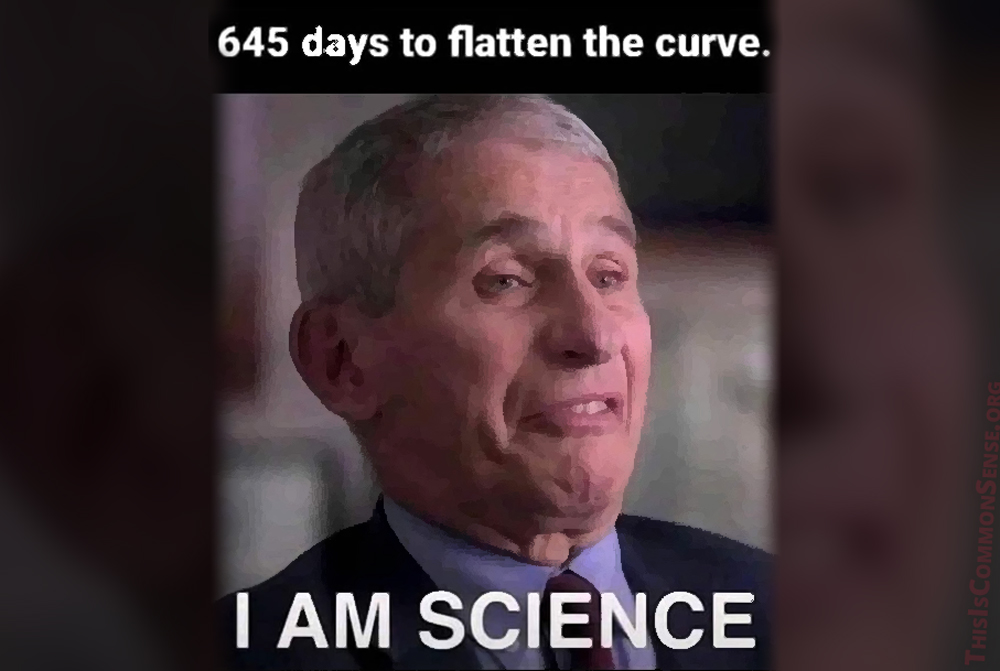
Unsure what the set-in-stone dogma du jour is, precisely, on matters pandemical and vaccinatory? That’s easy. Just look up the very latest utterances of one Anthony Fauci.

This is Common Sense. I’m Paul Jacob.


PDF for printing

See all recent commentary
(simplified and organized)
See recent popular posts
Categories
Today

The First ‘Common Sense’

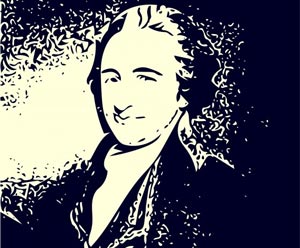
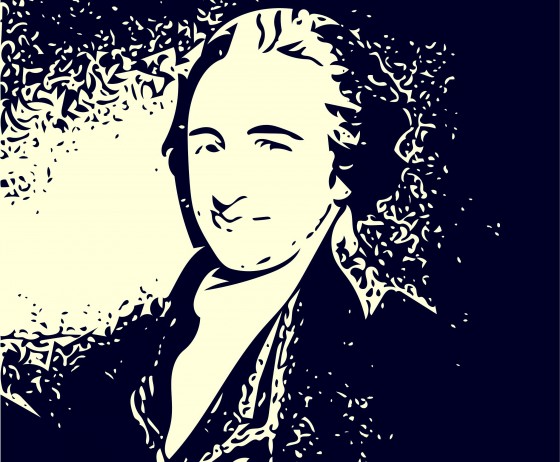
On January 10, 1776, Thomas Paine published Common Sense.

You can read this classic on this site’s library.

Categories
Thought

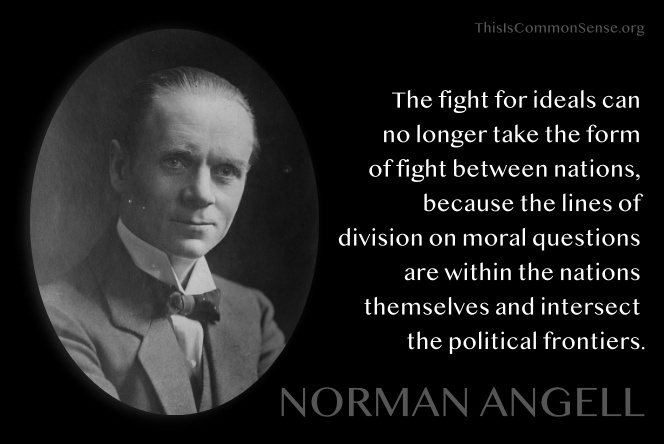
Norman Angell

The fight for ideals can no longer take the form of fight between nations, because the lines of division on moral questions are within the nations themselves and intersect the political frontiers. There is no modern State which is completely Catholic or Protestant, or liberal or autocratic, or aristocratic or democratic, or socialist or individualist; the moral and spiritual struggles of the modern world go on between citizens of the same State in unconscious intellectual cooperation with corresponding groups in other states, not between the public powers of rival States.

Norman Angell, The Great Illusion (1910).
Categories
First Amendment rights general freedom media and media people moral hazard nannyism social media

Tom Paine Sues Facebook

The ghost of Thomas Paine is suing Instagram and Facebook.

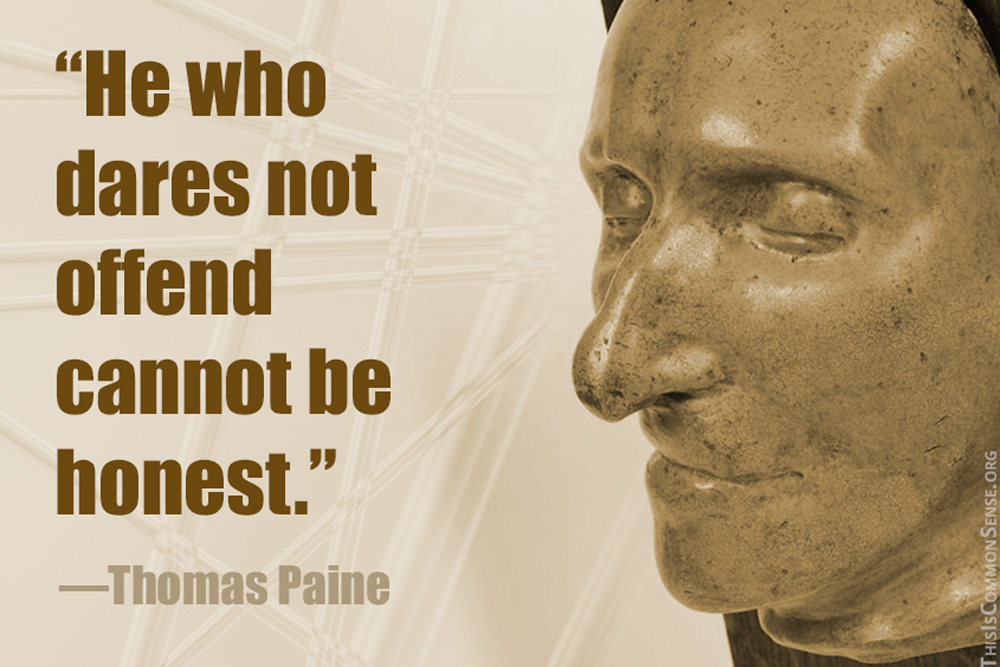
Mr. Paine, the eloquent champion of the American Revolution who penned such zeitgeist-capturing volumes as Common Sense, The American Crisis, and The Rights of Man, is going to court to protest the indignity that these social-media forums recently inflicted upon his spirit by censoring his statement that “He who dares not offend cannot be honest.”

The statement comes from an op-ed Paine published in the April 24, 1776 issue of the Pennsylvania Journal: “Cato’s partizans may call me furious; I regard it not. There are men too, who, have not virtue enough to be angry, and that crime perhaps is Cato’s. He who dares not offend cannot be honest.”

Mr. Paine seems to be saying that persons of craven mettle often eschew the challenge of being standard-bearers of truth, especially when controversial matters are involved. Articulating such views forthrightly tends to offend — somebody.

The particular mentalities of censorious Facebook flunkies and algorithms are new to Mr. Paine, of course. But he is ready to fight.

“Tyranny, like hell, is not easily conquered,” he declares when asked to assess his prospects, “yet we have this consolation with us, that the harder the conflict, the more glorious the triumph. What we obtain too cheap, we esteem too lightly. . . . [I]t would be strange indeed if so celestial an article as FREEDOM should not be highly rated.”

If that be hate speech, Mr. Paine seems to suggest, make the most of it.

This is Common Sense. Happy New Year! I’m Paul Jacob.


PDF for printing

See all recent commentary
(simplified and organized)
See recent popular posts
Categories
Today

Arrest; Resignation

On December 28, 1797, Thomas Paine was arrested in France for treason, after being tried (and convicted) in absentia on December 26. Prior to moving to France, Paine had been an instrumental figure in the American Revolution as the author of Common Sense. Paine then moved to Paris to help along the French Revolution, but the chaotic political climate turned against him. Paine had not earned friends in the Revolution with his vocal opposition to capital punishment.

“During the whole of my imprisonment,” Paine later wrote, “prior to the fall of Robespierre, there was no time when I could think my life worth twenty-four hours, and my mind was made up to meet its fate. The Americans in Paris went in a body to the convention to reclaim me, but without success.”

Paine’s imprisonment in France caused a general uproar in America. Future President James Monroe used all of his diplomatic connections to get Paine released in November 1794.

With the publication of Paine’s secular tract, The Age of Reason — a great part of which he wrote in French prison — the American population turned against him, and he died penniless in New York in 1809.


On this date in 1832, John C. Calhoun resigned as Vice President of the United States, the first to do so.

Categories
ideological culture

Heroism & Love Abounding

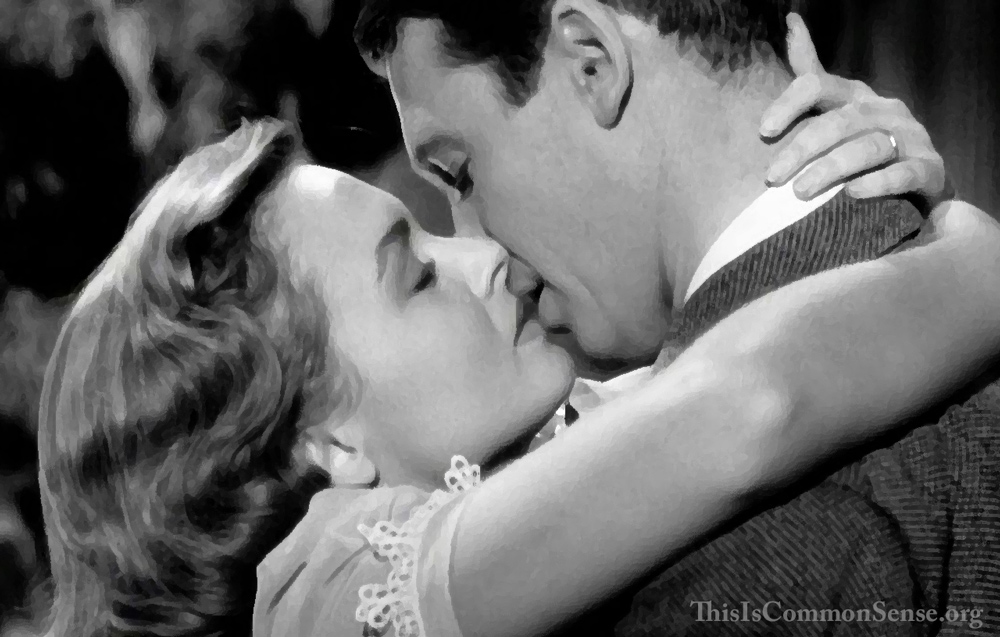
“I cannot express how much I love this movie,” Monica Hesse writes in her Christmas eve Washington Post column about It’s a Wonderful Life (Frank Capra, dir.; 1946).* Yet she mocks protagonist George Bailey as “the tortured Boy Scout-type” and contends that “Mary Bailey is the true hero.” Meaning that her husband George — beloved by many in fictional Bedford Falls — is not the “true hero.”

Puh-lease. 

Even Mr. Potter, the movie’s villain, acknowledges that Bailey is “no ordinary yokel.” George is bright, ambitious, hardworking and, most importantly, a good man — someone who cares about people.

He makes sacrifices: taking over his deceased father’s business instead of going to college with money he has saved; loaning that money to his brother to go in his stead; and once turning down ten times the salary so that folks in the town have “someplace to go without crawling to Potter.”

Hesse ignores all this to mark George as a deadbeat regularly bailed out by his wife, Mary. When in one scene “a market crash threatens to sink the Bailey Building & Loan,” Hesse smugly asks, “whose idea is it to donate George and Mary’s honeymoon funds to keep things afloat?”

Indeed. But George earned that money and, having just shared it with his new bride, would never take it back. Still, many spouses would lack Mary’s quick thinking. 

Hesse belittles George’s existential panic at impending bankruptcy and scandal as “his foul work-mood,” and highlights Mary as “the one who’s been home all day with a sick toddler.” 

As if a competition. 

Most perplexing for Hesse? “[T]he movie suggests that the saddest thing of all is that Mary Bailey became a librarian.” Well, not exactly. In the world the angel shows, in which George had never been born, it is that Mary “never married,” not the librarian gig, that rocks George.

But had Mary wed a wonderful fellow enjoying a relentlessly happy family, that would hardly demonstrate to George Bailey what the angel Clarence insists, that George’s life mattered.

“The entire movie celebrates the personal sacrifices of a nice man,” claims Hesse, “while ignoring the identical sacrifices of a nice woman.”

It’s a Wonderful Life is told from George’s perspective but doesn’t ignore Mary’s sacrifices at all. If it did, how on earth could Hesse recount them?

Moreover, George and Mary are more than merely “nice.” They have the courage and commitment to do for each other and the world around them . . . even under enormous stress. 

Both are heroes. Don’t let Monica Hesse or anyone tear them asunder. 

This is Common Sense. I’m Paul Jacob.


* If you are part of the less than 1 percent who have somehow dodged viewing the ubiquitous film, George’s uncle misplaces (into Potter’s evil hands) $8,000 of the company’s money, which would force the Bailey Building & Loan into bankruptcy likely followed by George’s criminal prosecution. Desperate and unable to come up with the money on Christmas eve, George considers suicide to save the business and his family with his life insurance money. But an angel intervenes and shows George what the world would be like without him. George decides he wants to live and get back to his wife and kids and, when the angel returns him to real life, Mary has rallied all his friends who contribute many times the amount of money needed. Lots of heroes found in this flick.

PDF for printing

See all recent commentary
(simplified and organized)
See recent popular posts
Categories
Today

First, First, First

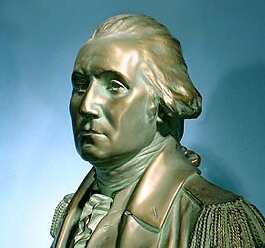
Henry Lee III’s eulogy to George Washington in Congress declared the former general and president to be “first in war, first in peace and first in the hearts of his countrymen.” Washington had died on December 14th, 1799, and Lee’s eulogy took place twelve days later.

Categories
Common Sense general freedom

Merry Christmas!

See all recent commentary
(simplified and organized)
See recent popular posts