This year’s most important election takes place tomorrow.
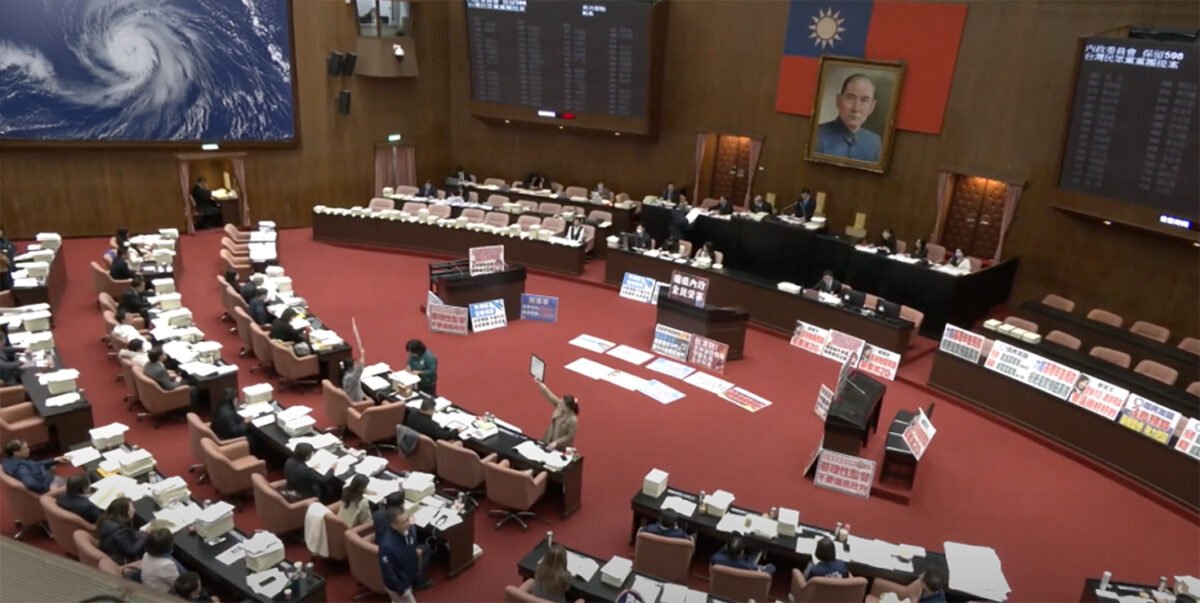
On Saturday, in Taiwan — Asia’s most democratic nation — more than 20 percent of the country’s unicameral legislators serving in the Legislative Yuan will face the voters in a massive, multi-step, typhoon-size recall campaign.
Coinciding with a real typhoon striking this island nation.
Which could impact turnout.
Which matters.
To successfully oust each officeholder, both a majority of the turnout must agree as well as for that majority to equal 25 percent of all the registered voters in the district.
“Supporters of the recall movement have portrayed their campaign as ‘anti-communist,’” reports CNN, “seeking to get rid of ‘pro-China’ opposition KMT lawmakers they perceive as collaborators of Beijing’s ruling Communist Party, which vows to ‘reunify’ Taiwan, by force if necessary.”
Taiwan has divided government. President Lai Ching-te heads the Democratic Progressive Party (DPP), which does not desire reunification with Chinese Communist Party-ruled China, either by force or surrender, and has been working to improve Taiwan’s military posture. The 113-seat Legislative Yuan, controlled by a coalition between the Kuomintang (KMT) and the smaller Taiwan’s People Party (TPP), has “undermined democratic institutions and national security by obstructing Lai’s administration,” including “freezing defense spending” when China’s military threats are escalating.
The KMT has 24 legislators up for recall tomorrow and another seven in a recall election next month. Meanwhile, KMT efforts to respond by launching recalls against DPP lawmakers completely fizzled.
Taiwanese billionaire Robert Tsao, a major backer of the recall effort, labeled the 31 KMT lawmakers being recalled “China’s ‘Trojan Horse’ in Taiwan.”
A KMT official recently called the recall “totally unconstitutional and undemocratic.”
Really? The main point of democracy is to allow the peaceful removal of government officials.
This is Common Sense. I’m Paul Jacob.
Illustration created with Krea and Firefly
See all recent commentary
(simplified and organized)
See recent popular posts
4 replies on “Democracy Defending Democracy”
I’m as appalled at Taiwanese who vote for the Kuomintang as I am at Easter Europeans who vote for Communist Parties.
Recalls elections are, of course, an option of more democratic systems, as a recall allows a widely unsatisfied δήμος to assert more immediate control over representation, though recall elections like elections of other sorts might be engineered to be undemocratic. I’m curious about what basis — if any — is given for the claim that this Taiwanese recall election is unconstitutional.
There really is zero basis for the KMT fellow’s claim. And I note they are not in court challenging this recall on those grounds.
Here are two parts of the current Republic of China – Taiwan constitution, which directly address the issue (and a link):
Chapter II – Rights and Duties of the People
Article 17
The people shall have the rights of election, recall, initiative, and referendum.
Chapter XII – Election, Recall, Initiative, and Referendum
Article 133
A person duly elected may be recalled by his constituency in accordance with law.
http://www.taiwandocuments.org/constitution01.htm
First, I must express my gratitude for your daily missives which are soundly reasoned with an impressive economy of words. I am a bit concerned with the word “reunification.” Perhaps I am incorrect, but I understand that Taiwan has never been truly a part of China, that it was first settled by the same Austronesian peoples who spread throughout the Pacific and of course some who settled Southeast China. Taiwan briefly came under the control of the Qing Dynasty but also have had some semblance of Dutch and Japanese rule. There has a been a large influx of Chinese first by Chiang Kai-shek’s army and then following the Korean War, Chinese POWs usually chose Taiwan over mainland China for resettlement. Many of the indigenous peoples of Taiwan have settled in the mountains and small fishing villages while the ethnic Chinese control the largest cities such as Taipei. I worked thoughout the region for about five years; the ethnic culture throughout the region has blossomed into outreach where delegations from other austronesian settled islands send delegations to meet with their ethnically related ‘cousins’ in Taiwan. The Chiang Kai-shek monument in Taipei has been de-emphasized to minimize the connection with China. There are many more scholarly than I who can better clarify and even correct any misunderstanding that I have. Again, please accept my appreciation for your always insightful expressions and your important drive for term limits.
Democrats only support democracy as long as they personally benefit. They are similar to capitalists in that way.