On Feb. 19, 1942, was a sad day for constitutional rights, with President Franklin D. Roosevelt signing Executive Order 9066, authorizing the Secretary of War to prescribe certain areas of the country as military zones. These zones were used to incarcerate Japanese Americans in internment camps.
Month: February 2015
“Is repealing the Affordable Care Act an issue of manhood?” asks Alan Rappeport in the New York Times. He’s referring to the “macho language” in a resolution introduced recently in Jefferson City, Missouri, by State Rep. Mike Moon.
Moon’s House Resolution 99 decimates the Affordable Care Act, or Obamacare, in a dozen whereas clauses, noting the legislation was
- “passed under questionable circumstances”;
- found constitutional only on the contradictory determination that it was both a tax and not a tax; and, most notably,
- resoundingly opposed by Missouri voters, who have twice trudged to the polls to overwhelming pass measures to block this federal legislation.
HR 99 resolves that, “the members of the Missouri House of Representatives, Ninety-eighth General Assembly, hereby insist that each member of the Missouri Congressional delegation endeavor with ‘manly firmness’ and resolve to totally and completely repeal the Affordable Care Act, settling for no less than a full repeal.”
Among today’s sophisticates, the phrase “manly firmness” elicits giggles, of course. Seasoned Democrats like U.S. Senator Claire McCaskill play the “war on women” card. She complained that those words come from “a point in time when women were chattels and didn’t have the right to vote. I think we can update our vocabulary.”
Lost on — or purposely ignored by — the senator? The fact that the phrase “manly firmness” comes from the Declaration of Independence, from the fifth listed grievance against King George III.
And firmness is exactly what’s needed: adult, strong, serious standing up as our representatives — rather than representing themselves — and defending our individual freedom and its corollary, constitutionally-limited government.
That’s what was needed back in 1776. It is every bit as desperately needed today.
This is Common Sense. I’m Paul Jacob.
Protesting the Nazis in Munich, in 1943
A brother-and-sister team of anti-Nazi activists were arrested on this date in 1943:
To download the full image, click it [above] to view it first in a separate window; download it from there.
Read their pamphlets at our Library on This Is Common Sense.
Hans and Sophie arrested
On Feb. 18, 1943, Hans and Sophie Scholl, a brother and sister, were arrested at the University of Munich for secretly (or not so secretly) putting out leaflets calling on Germans to revolt against Adolf Hitler and the Nazi regime. In the previous year Hans had founded a group of students, who called themselves “The White Rose.” The group wrote and distributed six leaflets aimed at educated Germans. The leaflets made their way across Germany and to several other occupied countries. The Allies later dropped them all over the Third Reich.
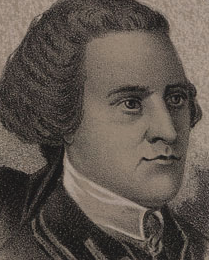
John Hancock
I mean not to boast; I would not excite envy, but manly emulation. We have all one common cause; let it, therefore, be our only contest, who shall most contribute to the security of the liberties of America.
President Obama wants a conversation about encryption. “I lean probably further in the direction of strong encryption” than do some in law enforcement, he says; but he knows the “pressure they’re under to keep us safe.”
We had a “conversation” about our right to robustly encrypt our stuff in the 1990s, after Philip Zimmermann (pictured) created Pretty Good Privacy software to easily render data invulnerable to intruders, including officials eager to bypass any encryption at will. The government threatened to prosecute Zimmerman on bogus charges, but eventually dropped the matter. PGP proceeded apace.
CNET writer Declan McCullagh said it all in a recent tweet: “Obama wants ‘public conversation’ about encryption? Sure: It’s here, we’re not inserting backdoors, get used to it.”
Twitter-user “vruz” adds: “Remember when we had to have a responsible dialogue on the NSA’s mass criminality? When Obama says ‘conversation,’ he means dilution of discourse to co-opt it and make it meaningless.” #ouch.
Contrary to the president’s implication, privacy and safety reinforce each other. Ability to protect our privacy makes us safer from those who would use our passwords, Social Security numbers, and home addresses against us.
Yes, terrorists can use encryption to hide nefarious plans — just as they can use curtains that way. And basements. And cones of silence. Many things deployable for benign purposes can also abet vicious ones. But does this mean that everything innocent people have and do should be easily accessible to government officials — or savvy cyber-criminals?
Or terrorists?
No.
This is Common Sense. I’m Paul Jacob.
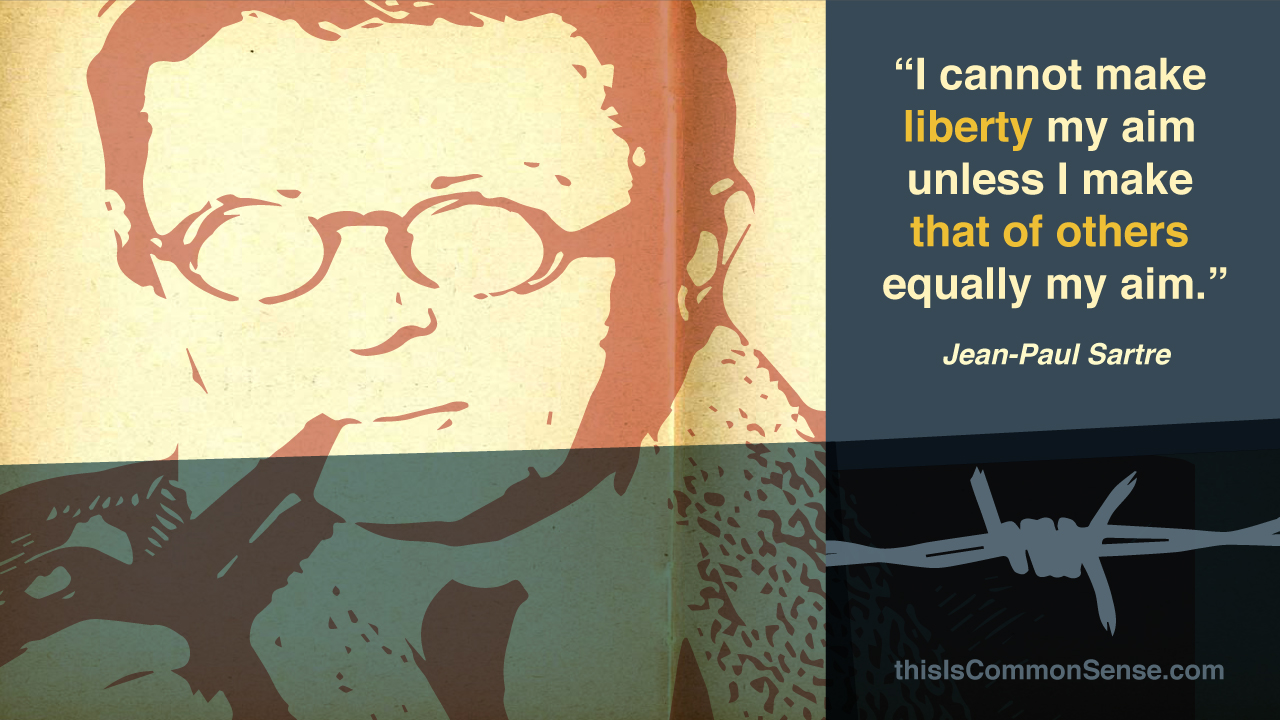
Sartre: Equal Liberty
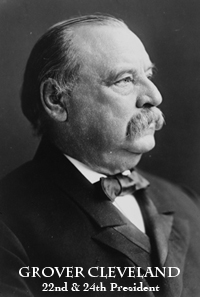
Grover Cleveland
Values supposed to be fixed are fast becoming conjectural, and loss and failure have invaded every branch of business.
President Barack Obama takes full credit for the job growth in 2014. Democrats on the Internet relentlessly push these growth rates with typically goofy superlatives like “highest ever” or “highest growth rate in decades.”
So, what did Obama and the Democrats do in 2013 and 2014 that led to the growth we saw last year?
Well, Obama refused to renegotiate with Republicans on any unemployment or budget reforms.
As 2013 ended, we heard Democrats complaining that stingy Republicans were letting federal government extensions of unemployment compensation (which had been re-extended many times) lapse altogether. Obama predicted disaster. The Keynesian economists who circle the Democratic Party like moths to a candle held to a simple prophecy: because of a hit to “aggregate demand,” unemployment would increase.
Instead, in 2014 employment bounced back.
In a droll quasi-opinion piece, “President Costanza’s Jobs Boom,” the Wall Street Journal reports that “job growth in 2014 was roughly 25 percent higher than any post-2009 year. Joblessness plunged to 5.6 percent from 6.7 percent. Net job creation averaged 246,000 a month.”
Citing a National Bureau of Economic Research study by economists Marcus Hagedorn, Iourii Manovskii and Kurt Mitman, which treated the abrupt policy change as a “natural experiment,” the Journal reveled in the knowledge that the increase in incentives from lapsed benefits led unemployed workers to (gasp!) seek jobs.
And they found them. Granted, many of the new jobs are not as good as their pre-bust jobs. But they are jobs, which is better than nothing.
So when your big-government promoting friends attribute 2014’s job growth to Democratic policies, ask which policies, precisely. And ask why Obama’s predictions of 2013 for disaster in 2014 didn’t pan out.
This is Common Sense. I’m Paul Jacob.
Silver Dollars are back
On Feb. 16, 1878, the Bland-Allison Act, which provided for a return to the minting of silver coins, became U.S. law. Today, the value of American money is secured only by public faith in the stability of the government, but during the 19th Century, money was backed by actual deposits of silver and gold.
Five years earlier, when Congress had stopped buying silver and minting silver coins — following the lead of European nations — a financial panic ensued. Reasons for the suspension, and at the heart of the panic, lay in the fact that the exchange value of silver and gold was fixed at a rate that favored silver producers. Had the United States Treasury let the two standards free float, making a distinction between silver dollars and gold dollars, none of the political strife over bimetallism would have occurred.
In 1893, in the midst of another financial panic, this time as a result of depletion of gold reserves in the U.S. Treasury, President Grover Cleveland called a special session of Congress to repeal the bimetallic standard. He was successful, though agrarian inflationists took over the Democratic Party and offered up, for the next election, William Jennings “Cross of Gold” Bryan as a counter to Cleveland’s old-fashioned fiscal conservative/social liberalism.