Categories
general freedom initiative, referendum, and recall local leaders nannyism political challengers Regulating Protest

Delivering a Double Standard

Former State Representative Matt Lynch got right to the point in his Cleveland Plain Dealer op-ed: “The people’s right to amend the Ohio Constitution through the ballot initiative is under attack.”

Created by the Ohio Legislature to consider constitutional amendments, the Ohio Constitutional Modernization Commission (OCMC) has a hidden purpose: provide cover for that same legislative body. As Lynch aptly notes, the OCMC “is filled with politicians and lobbyists. Thus, commission recommendations must be scrutinized for fidelity to the public good versus the special interests of political insiders.”

This Thursday at the capitol in Columbus, OCMC will consider whether to recommend that state legislators propose an amendment to the state constitution to make future amendments more difficult. That’s an awfully bad idea in itself. But, bizarrely, the greater difficulty would depend entirely on who proposes the amendment.

The working OCMC recommendation makes no change to the legislature’s ability to propose and pass constitutional amendments. What it would do is make it tougher for citizen-initiated amendments. Most unhelpfully, the recommendation would require only citizen-proposed amendments to garner a supermajority of 55 percent of the vote.

Consequence? Suppose a measure proposed by citizens — term limits, ethics reform, government transparency — was massively outspent by powerful interests, and yet still won 54.9 percent of the vote. It would lose.

Yes, the 45.1 percent of voters would defeat the 54.9 percent of voters.

Call it “New Math.”

The very same issue proposed by legislators would win . . . and be added to the state constitution.

The double standards are breathtaking,” writes Lynch,* adding, “and no other state has such unfair rules.”

This is Common Sense. I’m Paul Jacob.


* Sunday at Townhall, I also discussed this double standard. And the word may be getting out. Townhall always adorns my column with a photograph — this time featuring Ohio Attorney General Mike DeWine, also a Republican candidate for governor in 2018. DeWine’s campaign objected to being pictured, arguing they have no involvement with the OCMC. DeWine’s picture has been removed.


Printable PDF


Categories
general freedom moral hazard nannyism responsibility too much government

The $659,000 Non-Question

The so-called “Motor Voter” law of 1993 created a national mandate: when people obtain their drivers’ licenses at the Department of Motor Vehicles, ask them if they’d also like to register to vote.

The federal mandate is perhaps heavy-handed, but the underlying idea has merit.

Now a new idea is gaining ground, taking the notion (nudge, nudge) a step further. Let’s not bother asking people if they want to sign up to vote, the proposal runs. Government should simply register them. Without asking.

It is a form of paternalism.

“It flips the presumption, where right now they ask you if want to be registered,” argues D.C. Council member Charles Allen. “Instead of that, we’re just going to go ahead and get you registered, and that absolutely helps enfranchise voters.”

“Lawmakers in 32 states have introduced measures in the last year to automatically register drivers to vote,” reports the Washington Post.

Some folks contend there isn’t much difference between asking if someone wants to register and registering them without asking. Well, if there isn’t much difference, why spend the $659,000 that Washington, D.C. officials estimate it will cost over the next four years for their new “don’t-ask” program.

Of course, there is a difference in the two policies: sort of like between offering people something to eat and force-feeding them.

Some Americans have no desire to vote or be registered. It is surely no business of any state or local government to act as if their preferences don’t count.

And what good are a bunch of names on a voter list if they aren’t interested? Is someone going to vote for them?

This is Common Sense. I’m Paul Jacob.


Printable PDF


Categories
Accountability First Amendment rights incumbents local leaders Regulating Protest U.S. Constitution

Homer’s Recall Odyssey

Freedom of speech isn’t a free pass to avoid the consequences of what one says. Or does. Tell that to three members of the Homer, Alaska, city council — Donna Aderhold, David Lewis and Catriona Reynolds — who are the subject of a recall petition.

Well, a superior court judge just did.

Represented by the ACLU, the trio sued to block a recall petition with more than enough voter signatures. Their lawsuit challenged the city attorney’s acceptance of the legal rationale for the recall, claiming the recall attempt punishes the politicians for their speech.

“To conclude that anytime a recall petition is based in part or in whole on what a politician said is protected by the First Amendment,” Superior Court Judge Erin Marston ruled, “would be to eviscerate the recall statute to such an extent that the populace would almost never be able to seek recall of any of their elected officials.”

Now the recall moves forward.

In most of this Land of the Free, citizens lack the ability to recall their elected officials. In places that do have the process, it is rarely used. When it is used, it is often portrayed as voters throwing a temper tantrum.

Or an unfair election do-over.

Or mean-spirited ‘vendetta politics.’

Not so. The petition requirements make recalls very difficult. Recalls don’t happen without some serious problems with the current officeholder(s). And once a recall is triggered, there follows a democratic vote to decide whether citizens want to keep the sitting hireling or find someone new.

Seems pretty reasonable.

When politicians are recalled and removed, they deserve it.*

This is Common Sense. I’m Paul Jacob.


* The problem seems never to be that good politicians are being recalled, but that too many politicians who should be recalled are not. Back in 2003, the governor of California was recalled. He deserved it. In 2011, a whopping 88 percent of Miami-Dade County voted to recall Mayor Carlos Alvarez. He earned it, too.


Printable PDF


Categories
Accountability crime and punishment folly local leaders media and media people national politics & policies responsibility

The Early Vote Worm

Last week was consequential for Greg Gianforte. Awfully.

The Republican businessman won the special election for Montana’s lone seat in the U.S. House of Representatives. He also body-slammed a reporter. He now faces misdemeanor assault charges.

For which Gianforte apologized publicly . . . as he was declaring victory. Welcome to modern American politics.

Democrats claimed victory, nonetheless — with media cover to boot. “Republicans’ 7-point win in last night’s Montana election is great news for Democrats,” the progressive Vox headlined their report.

At Townhall.com on Sunday, I explained why that claim misses both the forest and the trees. Yes, Trump won Montana by 20 percentage points against Hillary Clinton’s mere 35.4 percent back in November, while Gianforte won last week by only 7 points. But Trump was lucky to be opposed by a very unpopular Hillary.

Moreover, at that same election wherein Trump trounced Secretary Clinton, Gianforte lost the governor’s race to a Democrat. Indeed, Gianforte performed 11 points better last week than back in November — winning, instead of losing.

How does that show Republican support slipping?

The message from the Montana special election is that early voting periods are far too long. Montana’s early voting began nearly four weeks before Election Day. The assault by Gianforte, with criminal charges, hardly mattered, because roughly two-thirds of Montanans had already voted when it occurred.*

Rather than a nearly month-long process, whereby a candidate can bank a majority of the vote before the campaign is over, let’s make Election Day a three or five-day period. Make it easy to vote, but let’s all vote together, with the same information.  

This is Common Sense. I’m Paul Jacob.

 

* This means not only that Gianforte may have “gotten away” with his violent outburst, but that those voters did not have time to adequately appraise Gianforte on information they would have possessed and been able to act upon, with a shorter voting period.


Printable PDF


Categories
Accountability initiative, referendum, and recall local leaders responsibility

The Maine Thing

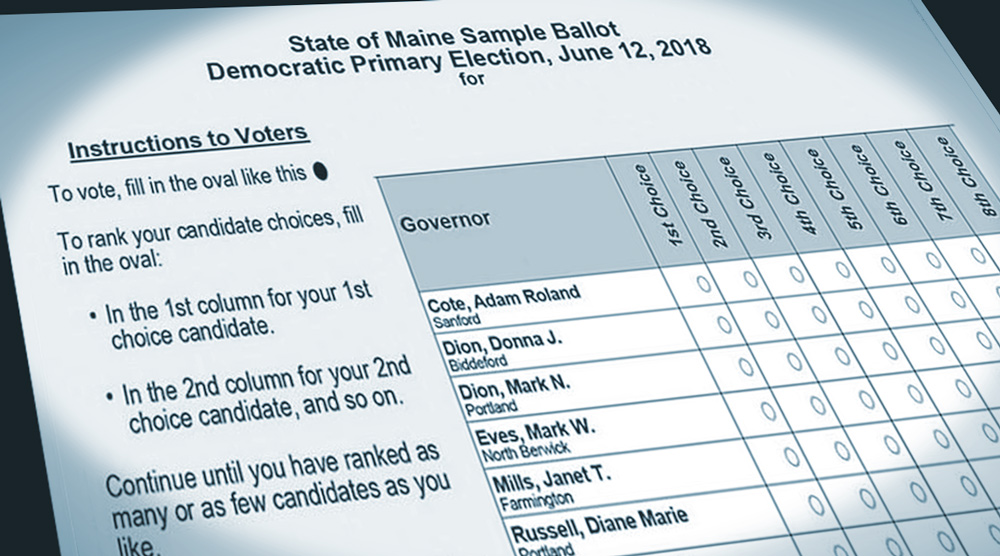
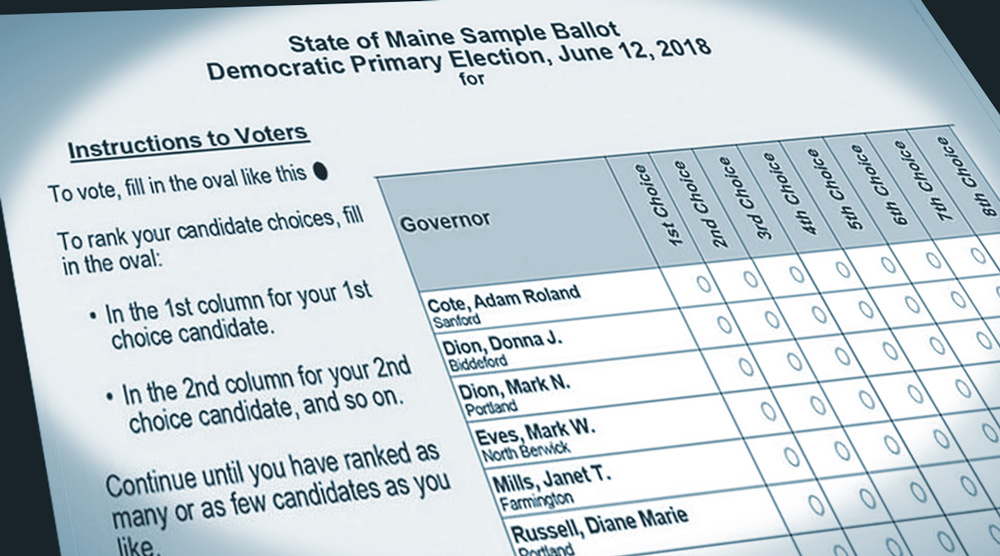
Ranked Choice Voting (RCV) allows voters to rank electoral candidates and not “waste” their vote in cases where their most favored candidate is* unlikely to win. RCV also requires a majority for election, not merely a plurality of the vote.

Last November, Mainers passed Question 5 to begin using this voting system for statewide races, state legislative races and congressional contests. Voters in Portland, the state’s largest city, already use ranked choice voting for several city offices.

Nonetheless, Gov. Paul LePage, who has won twice for governor without ever capturing a majority, opposes RCV, as do many state legislators, also elected under a different first-past-the-post plurality system.

Because Maine’s state constitution specifically mentions plurality winners for statewide officials and state legislators (in the General Election), legislative leaders asked the Maine Supreme Court for an advisory opinion on the constitutionality of the ballot measure. Earlier this week, the court ruled that Question 5 was not constitutional when applied to those specific offices and elections.

However, the constitutionality of RCV was not challenged regarding congressional elections or primary elections for the state legislature.

Now some legislators are proposing a constitutional amendment to enact the RCV that voters supported. Others are urging that the entire law be repealed — even the parts not ruled unconstitutional. They claim the new system is too confusing if not used for every office.

But Portland city voters use RCV for some offices and not others, without confusion.

Legislators should follow the court’s decision, sure, but also respect the vote of the people for every part of the measure not addressed by the court.

This is Common Sense. I’m Paul Jacob.


* Ranked Choice Voting also prevents wasted votes in cases where a voter merely expects or fears (even inaccurately) that his or her favorite candidate does not have enough support to get elected.


Printable PDF


Original cc Photo by Tim Evanson on Flickr


Categories
Accountability initiative, referendum, and recall moral hazard nannyism responsibility

Whose Constitution Is It, Anyway?

Last November’s biggest mistake? Colorado voters passing Amendment 71. It makes the Rocky Mountain State’s constitution exceedingly more difficult for voters to amend through the initiative petition process.

And more like it may be in the offing. Legislation is moving in Florida to require a 66.7 percent vote to amend the state constitution. Already, a 60 percent vote is required, but legislators remain fearful voters can muster that.

The Ohio Modernization Commission, a legislatively created mix of legislators and insiders, is recommending a new constitutional amendment to — you guessed it — make it tougher for voters to pass amendments. Future voter-initiated amendments must pass twice, by a 55 percent supermajority.

There are also efforts to weaken citizen initiatives in Arizona and Maine.*

The big money behind Colorado’s Amendment 71 told whopper after whopper to win. They pretended to love and revere the constitution. Finally, they put former Denver Broncos Super Bowl champion quarterback John Elway on television — spot after spot — telling voters the amendment “protects our constitution.”

But . . . from whom?

You see, politicians and special interests don’t have to amend the state constitution to spend money on themselves or their cronies. From their perch in the state capitol, they can do that with a simple statute.

But you and I need the ability to pass constitutional amendments. Why? Only through the constitution can we limit the power of those same politicians — the power of government. Legislators can overrule a mere statutory ballot initiative (and often do).

That’s what this battle is all about. Politicians mean to limit our power to limit theirs.

This is Common Sense. I’m Paul Jacob.


* Thankfully, South Dakota legislators defeated several bills aimed at making it tougher to place initiatives on the ballot.


Printable PDF


Categories
folly general freedom ideological culture nannyism privacy property rights too much government U.S. Constitution

Democratic Socialism. . .

Because BIG BROTHER is okay as long as enough people vote for him!


CLICK BELOW for a high resolution version of this image:

Democratic Socialism, Big Brother, socialism, vote, voting, egalitarian, meme, Jim Gill, Paul Jacob, Common Sense


Categories
media and media people national politics & policies political challengers responsibility too much government U.S. Constitution

Conscience Clear?

Today the Electoral College meets to elect the 45th President of these United States.

But if they fail to cast the required majority for a candidate, the contest goes into the House of Representatives, where each state gets one vote — Wyoming and California equally weighted — and a state’s vote can only be cast for one of the top three Electoral College vote-getters.

Of course, only two candidates won electoral votes, because only they won states. Donald Trump won 30 states comprising 306 electoral votes; Hillary Clinton won 20 states with 232.

That’s the arithmetic. But, as I explored at Townhall yesterday, nothing in the Constitution requires an elector pledged to Trump or Clinton to vote for that candidate.* They can vote their conscience.

That’s why in recent days, Nancy Pelosi’s daughter, Christine, a California elector, petitioned to have electors receive an intelligence briefing about Russian hacking — hoping to sway electors.

Her petition was denied.

Desperation showing, a group of Hollywood actors led by Martin Sheen starred in a Unite for America video talking down to — er, directly to — Republican electors. Asserting that the Electoral College was designed by “Hamilton himself” to prevent an “unfit” “demagogue” (they mean Mr. Trump) from attaining the presidency, the actors claim to “stand with” and “respect” GOP electors, who could be heroes in Hollywood (no honor more tempting!) if only they’d cast their vote for someone other than Trump.

Anyone! — who meets presidential qualifications. “I’m not asking you,” three actors in a row assure, “to vote for Hillary Clinton.”

As much as I support the idea of voting one’s conscience and as much fun as this election has been, I think we’ve all now had enough. Let’s prepare ourselves to help Mr. Trump do what’s right and stop him from doing what’s wrong . . . with a clear conscience.

This is Common Sense. I’m Paul Jacob.


* Some electors do sign a loyalty pledge to the candidate and there are state laws, almost certainly unconstitutional, which penalize electors who do not vote for the candidate they are pledged to.


Printable PDF

electoral, college, election, voting, popular, Hamilton, illustration


Original (cc) photo by Crosa on Flickr


Categories
Accountability ballot access general freedom incumbents initiative, referendum, and recall national politics & policies political challengers responsibility too much government U.S. Constitution

Votes Without Poison

Strange election. So . . . round up the usual suspects!

Immediately after Hillary dried her tears and conceded, out came the Tweets, then the analyses: the “third parties” are to blame!

Over the weekend, I focused* on one such election post-mortem. The basic idea is not altogether wrong: minor party efforts together may have cost the Democrat her Electoral College advantage this time around, just as Nader’s Green Party run spoiled Al Gore’s bid in 2000 and several past congressional races have been spoiled for the GOP by Libertarians.

Is there a problem here? Yes. But do not blame the minor party voters. It’s the way we count their votes that is “problematic.” The current ballot-and-count system turn voters most loyal to particular policy ideas into enemies of those very same ideas.

When we minor party voters turn away from a major party — usually because said party tends to corrupt or betray our ideas, or make only small steps toward our goals — our votes aren’t so much wasted as made poisonous.

Because the candidate least preferred may prevail.

But there’s a way out: On election day, voters in Maine showed how to cut through the Gordian Knot. Voting in approval for Question 5, Maine now establishes “ranked choice voting.”

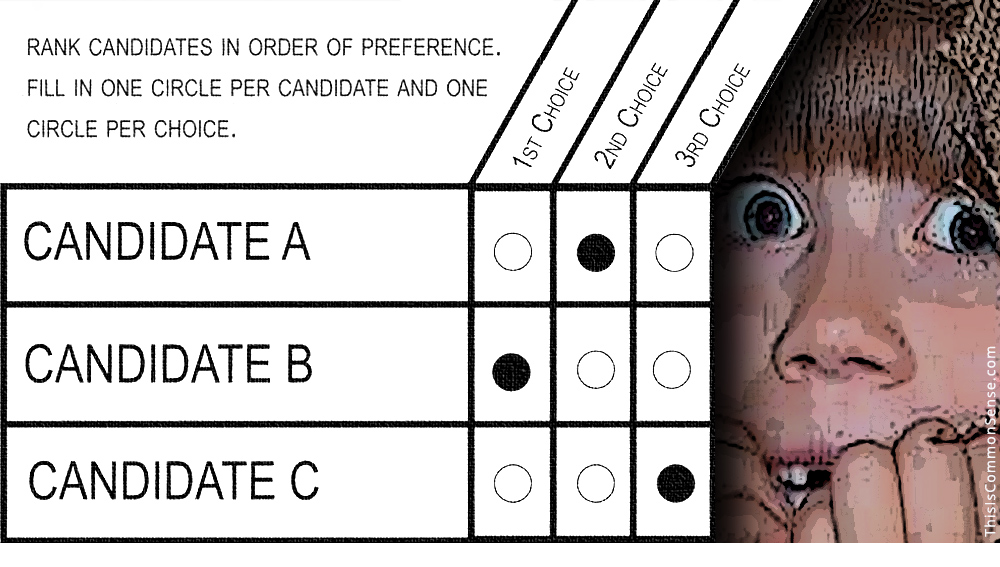
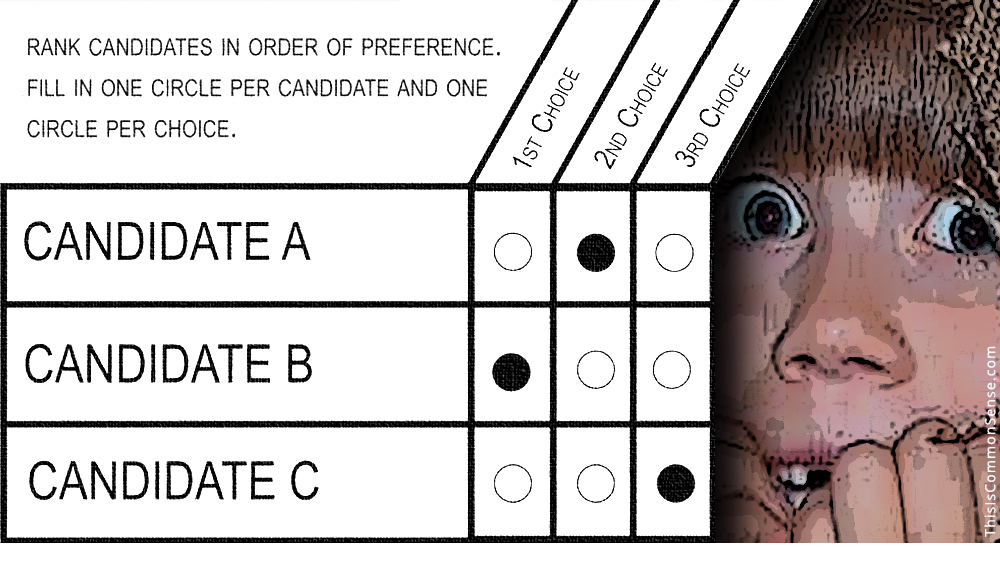
Under this system, you don’t “waste” your vote when expressing a preference for a minor party candidate. You rank your choices and, if your first choice proves unpopular, your second choice (or maybe your third) gets counted. So you don’t “poison” your cause.

Republicans and Democrats have more than enough reason, now, to adopt ranked choice voting across the country.

This is Common Sense. I’m Paul Jacob.


* See yesterday’s links page to my weekend Townhall column for the basic references. But there were many, many articles on the Minor Party Effect, including a skeptical one by Sasha Volokh’s.


Ask the next question.

Questions Answered:

What is the effect of minor parties on major party outcomes?

What causes those effects, voter intent or something else?

Is there a way to prevent this, short of further sewing up the ballot access system to minor parties?

The Next Question:

What might our elections look like if people spent more time discussing issues and ideas … and less about class, culture wars, and sex crimes?


Printable PDF

ranked choice, vote, voting, democracy, clown, illustration


Categories
Accountability general freedom ideological culture moral hazard national politics & policies political challengers responsibility too much government U.S. Constitution

The Wisdom of the Founders

“At a certain point, you have to let go for the democracy to work,” President Barack Obama told HBO’s Bill Maher last week, praising “the wisdom of the founders.”

“There has to be fresh legs,” he continued. “There have to be new people. And you have to have the humility to recognize that you’re a citizen and you go back to being a citizen after this office is over.”

Maher failed to ask Mr. Obama how this “fresh” viewpoint squared with his support for Mrs. Clinton. Nevertheless, let’s applaud the president’s endorsement of term limits.

Speaking of the founders, and limits on power, and this being Election Day, I’m reminded of a commentary in Forbes, back on Election Day four years ago, written by Ed Crane, the man who built the Cato Institute into one of the nation’s preeminent think tanks. Bemoaning the “interminable presidential race,” Crane wished for “a nation in which it really didn’t matter who was elected President, senator or congressman.”

“Don’t get me wrong, because I’m not saying it doesn’t,” explained Crane, “only that it shouldn’t.” He added, “I believe the Founders had a similar view.”

His point is simple: Getting to vote for your next president and senator and congressman is swell, but it’s important to have a Constitution that restrains those elected, so they “don’t have a heck of a lot of power over you or your neighbors.”

“We are a republic of limited governmental ­powers,” or should be, argued Crane. “Such a nation allows for sleep on election night.”

Instead of gnashing of teeth.

This is Common Sense. I’m Paul Jacob.


Printable PDF

Constitution, voting, democracy, Ed Crane, fear