Categories
Accountability general freedom government transparency

Less Oversight?

There are long-standing debates among those who oppose big government. One is whether we should promote every budget cut and any tax cut, or whether we should more-or-less carefully support only some cuts — on the grounds that some possible cuts might scuttle future reforms.

This came to mind upon hearing Michigan Governor Gretch Whitmer’s plan to reduce the budget of one of her state’s bureaucracies by 28 percent.

Hooray!

But wait a moment: the department to be cut is the Office of the Auditor General!

Whitmer’s proposal is to take the $30 million budget and bring it down to a lean $21.7 million.

The point of an auditor is to make sure that government does not misuse the money taken from taxpayers, allegedly for the public benefit. Take that away, and what do you have? 

Waste. Corruption — a recipe for it, anyway. Maybe an engraved invitation for it.

Is there any merit to this reduction? Democrats are not known to love budget cuts. 

They say Michigan’s auditor’s office has been “too partisan” — and certainly said things about Democrat programs that don’t make those programs look good!

“If there is ever a place in Lansing where we should rise above petty partisan politics, it should be oversight and ethics,” Rep. Tom Kunse (R-Clare) said, expressing a perspective I share.

So what’s really going on here? Well, the state is facing a $418 million surplus. That’s a lot of money to play with. What’s the likelihood that the party in charge wants to reduce the Auditor’s Office for any other reason than to reduce scrutiny of how they plan to spend that money?

This is Common Sense. I’m Paul Jacob.


PDF for printing

Illustration created with PicFinder and Firefly

See all recent commentary
(simplified and organized)
See recent popular posts

Categories
regulation subsidy

The Hail of It

Early yesterday, an out-of-control container ship ran into the Francis Scott Key Bridge over the Patapsco River in Baltimore. Early reports claimed that a dozen vehicles and 20 people went into the cold water, with only two survivors, so far, being rescued; last I heard, however, the total went down to six missing after the initial rescues.

It looks like an accident, and accidents happen, sometimes horrific ones. There’s a reason “thoughts and prayers” are mentioned at such times, all other talk seeming vastly inappropriate.

Nevertheless, President Joe Biden immediately promised that the federal government would pay to replace the bridge.

Eleven days earlier a more humdrum disaster gave us greater license to speculate. “Thousands of panels on a solar farm southwest of Houston, Texas, were damaged by a powerful hailstorm on March 15,” a Newsweek report informs us. “Aerial footage showed rows of cracked photovoltaic cells at the Fighting Jays Solar Farm near Needville in Fort Bend County. . . .” A vast array of solar panels, ruined by something not unheard-of in Texas: “baseball-sized hail stones” falling from the sky.

And seeping out of the panels? Toxic chemicals.

This is something that we, the voting public, must confront: the fact that most “green energy” replacements are fragile and often environmentally hazardous. Compared to natural gas they are ecological disasters.

While Joe Biden yammers about funding a new bridge, we need to force a more important conversation, about removing subsidies for pseudo-green alternative energy sources. 

To save us from the poorhouse as well as from environmental disaster.

This is Common Sense. I’m Paul Jacob.


PDF for printing

Illustration created with PicFinder and Firefly

See all recent commentary
(simplified and organized)
See recent popular posts

Categories
Accountability general freedom

The S-Word in California

Frédéric Bastiat called it “spoliation”; California’s Democratic politicians call it social justice.

A bill went into effect last week, offering complete medical coverage to an estimated 700,000 undocumented — illegal — immigrants.  The price tag? 3.1 billion dollars.

Well, not “price tag”: call it a subsidy tag.

California taxpayers will pay for it. Or perhaps U.S. taxpayers will end up with the bill, as Dagen McDowell insisted on Fox News, prophesying that the program “will turn into a national issue” that will, inevitably, “swamp the federal budget.” 

Ms. McDowell also noted that the state’s targeted sugar daddies, the wealthy, “are going to other states, so much that they’ve lost a congressional seat,” all of which must lead to insolvency.

Indeed, the state is running far into the red — the color of the ink on budget columns, not voting columns. The state faces not merely annual deficits and a huge debt, there is also this looming trillion-dollar debt implied by the unfunded liabilities of the state employee pensions.

There is an old pattern here, which is why I brought up an old author in the first sentence.

First we subsidize the poor. Then we extend the subsidies up the income ladder. Now we give huge subsidies to those who enter the country illegally.

It’s as if Californians have forgotten the nature of income redistribution: you have to have income to redistribute. At some point the wealth being taken from the productive vanishes, as society becomes unproductive and descends into ruin.

There are two meanings of Bastiat’s “spoliation”:

noun
1 the action of ruining or destroying something.
2 the action of taking goods or property from somewhere by illegal or unethical means.

The two are linked. 

This is Common Sense. I’m Paul Jacob.


PDF for printing

Illustration created with Midjourney and Firefly

See all recent commentary
(simplified and organized)
See recent popular posts

Categories
ideological culture national politics & policies

A New Speaker Conjures

The new House Speaker was a dark horse in the mad rush to fill the position vacated after Kevin McCarthy’s ouster in a historic political play. But Mike Johnson (R.-La.) appears to be a thoughtful man, known more for his prayers than backstabbing, and sporting an interesting set of principles. They are listed on his congressional web page; he calls them the seven “core principles” of conservatism:

  1. Individual Freedom
  2. Limited Government
  3. The Rule of Law
  4. Peace Through Strength
  5. Fiscal Responsibility
  6. Free Markets
  7. Human Dignity

Inspiring, but the devil can bog us in details — under each rubric his elaborations sound more like fantasied ideals than anything like current practice. And for a man who got ahead by having “no enemies,” any real advancement would hardly conjure up consensus and comity.

Johnson acknowledges current government failure — at least in his fifth principle, which he explains entirely in terms of political fault: “Because government has refused to live within its means, America is facing an unprecedented debt and spending crisis. Federal debt now exceeds $33.5 trillion, and our current fiscal path is unsustainable and dangerous, jeopardizing our nation’s economic growth, stability and the security of future generations.” He goes on to express a congressional “duty to resolve the crisis.”

Yet, only standard Republican talking points are offered as back-up, with zero acknowledgment of the bipartisan difficulty of reducing spending even a smidgen.

Truth is, each of his principles is honored by the federal government only in the breach. While we may hope and pray that the new Speaker takes all of these serious enough to work to change course, we have to wonder: Does he have a prayer? 

This is Common Sense. I’m Paul Jacob.


PDF for printing

Illustration created with Firefly and PicFinder

See all recent commentary
(simplified and organized)
See recent popular posts

Categories
national politics & policies

Leverage & Resistance

“Let’s be clear,” said Representative Thomas Massie (R-Ky.) yesterday, speaking of the difficulty Republicans in the House of Representatives have in finding a new Speaker, “January was a coronation, and it was difficult; this is a competition, and it’s going to be even more difficult.”

Asked about the Steve Scalise (R-La.) candidacy, Rep. Massie replied that at least 20 Republicans would never vote for Scalise as Speaker.

Wednesday, Scalise expressed his honor to have been nominated for the position. Thursday he withdrew his nomination. “There are still some people that have their own agendas. And I was very clear we have to have everybody put their agendas on the side and focus on what this country needs.”

This begs the question. What does the country need? Bad-mouthing the dozen or so who would not support his compromising techniques as pushing “their own agenda” is a rhetorical move, but it is by no means demonstrated. 

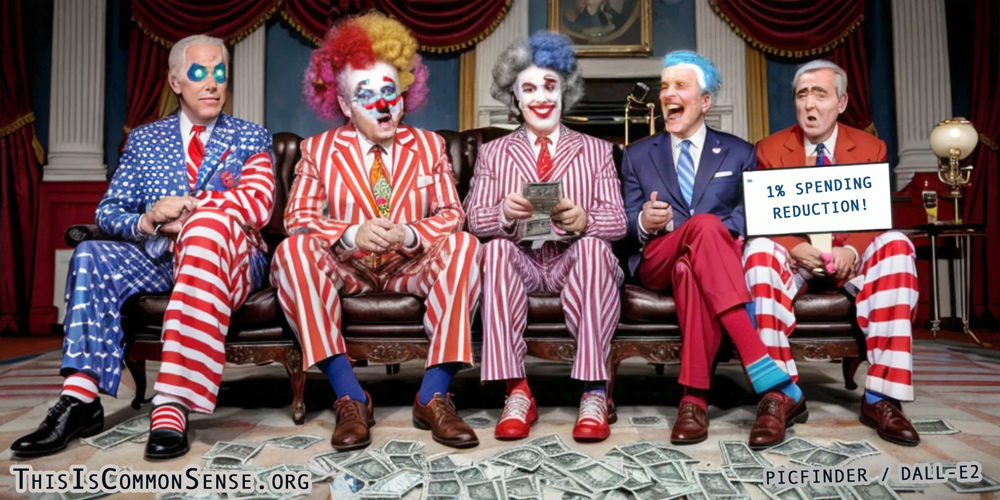
Massie made the point that the recently ousted Speaker (whose ouster he did not support) had negotiated a significant concession from the Biden Administration — a one percent reduction in spending for a debt limit increase — and that no candidate for Speaker who would not press this advantage further could be accepted.

The collapse of the Scalise campaign leaves only Rep. Jim Jordan (R-Oh.) in the offing. A far better option. As of this writing, on Thursday night, no one else has thrown a hat into the ring.

It’s a pretty contentious ring, with elbows getting thrown by the Republican Freedom Caucus types leveraging the power they have. The establishment GOP is reeling.

Which is not always a good thing.

And Democrats? Appalled.

Which is not necessarily a bad thing. With a $33 trillion debt and growing fast, should everyone blithely march towards oblivion, meekly following the leader in Washington’s favorite version of Kick the Can?

This is Common Sense. I’m Paul Jacob.


PDF for printing

Illustration created with PicFinder

See all recent commentary
(simplified and organized)
See recent popular posts

Categories
Accountability national politics & policies tax policy

Kick the Can

At first blush, it seems like the most pointless political move ever.

When Rep. Matt Gaetz (R.-Fla.) moved to oust Rep. Kevin McCarthy (R.-Cal.) from his role as Speaker of the House, lots of eyebrows were raised, and at least one pair of lips was licked. But did it make any sense?

This has never happened before, a House Speaker ousted by his own party mid-session.

That’s not an argument against the move, though. It was Gaetz who had blocked McCarthy back in January, through more than a dozen votes, allowing the moderate Republican to serve only with explicit conditions. Gaetz now says that McCarthy has failed to meet those conditions. Arguably, that’s accountability in action. Good?

Or mere revenge? After all, McCarthy had just made a deal with a sizable number of minority Democrats to fund the government and prevent a federal shutdown — thus kicking the overspending/insolvency can down the road again. Gaetz and his closest colleagues in the House made the same deal with the opposition party, ousting McCarthy. 

It’s a game of kick the can, however you look at it.

Gaetz argues that McCarthy did not do what was required to bring fiscal responsibility, such as un-package spending bills. “We told you how to use the power of the purse: individual, single-subject spending bills that would allow us to have specific review, programmatic analysis and,” explained Gaetz, “that would allow us to zero out the salaries of the bureaucrats who have broken bad, targeted President Trump or cut sweetheart deals for Hunter Biden.”

But the deed is done. McCarthy’s out. Now, who to replace him?

Funny that no one mentions the wild plan to put Trump into the job — you know, the plan first floated after Election 2020?

It was such a snickered-at notion, just a goofy way of taking 1600 Pennsylvania Avenue from Joe Biden.

Still, it was a plan. Only in the next few days and weeks will we learn if Gaetz really has one.

This is Common Sense. I’m Paul Jacob.


PDF for printing

Illustration created with Midjourney

See all recent commentary
(simplified and organized)
See recent popular posts

Categories
deficits and debt folly national politics & policies

On Trees

There’s an old saying — some say it’s an ancient “Chinese saying,” but I first heard it attributed to an Indian philosopher — to the effect that “the best time to plant a tree is thirty years ago; the second best time is today.”

Eric Boehm, writing in Reason, riffs on it regarding federal spending: “The best time to stop borrowing heavily was yesterday (or several years ago), but the second-best time would be today. Instead, Congress is likely to make this problem even worse — again — by continuing to spend like there’s no tomorrow.”

In November, the federal government ran a $249 billion deficit, which, Boehm informs, is up $56B from the previous November.

Talk about November chills.

But worse yet is that Congress is gearing up for more. The omnibus spending bill in the works “will add between $240 billion and $585 billion to this year’s budget deficit.”

After a lifetime of deficit spending, this may seem only worth a furrow above the eyes, not an actual arched brow. But it does make a mockery of President Joe Biden’s boast of decreasing deficits on his watch. As Boehm explains, that’s merely an artifact of the Trump Era humungoid pandemic giveaways. There had to be some sort of let up from that binge. Nevertheless, the “underlying figures showed all along that the deficit situation was continuing to worsen, and that President Joe Biden’s policies were adding trillions of dollars to the deficit over the long term.”

It’s almost as if they think “money grows on trees.”

Would that it were the case, though, since there are only a limited number of trees. Taxation and especially debt are, to politicians, closer to infinity.

This is Common Sense. I’m Paul Jacob.


Update: Senator Mitch McConnell said, yesterday: “I’m pretty proud of the fact that with a Democratic president, Democratic House, and Democratic Senate, we were able to achieve through this Omnibus spending bill essentially all of our priorities.” The Republican Leader predicted passage on the 22nd.

PDF for printing

Illustration created with DALL-E2, John Tenniel, Thomas Cole, JG

See all recent commentary
(simplified and organized)
See recent popular posts
Categories
crime and punishment folly insider corruption local leaders responsibility

First-Class Arrogance

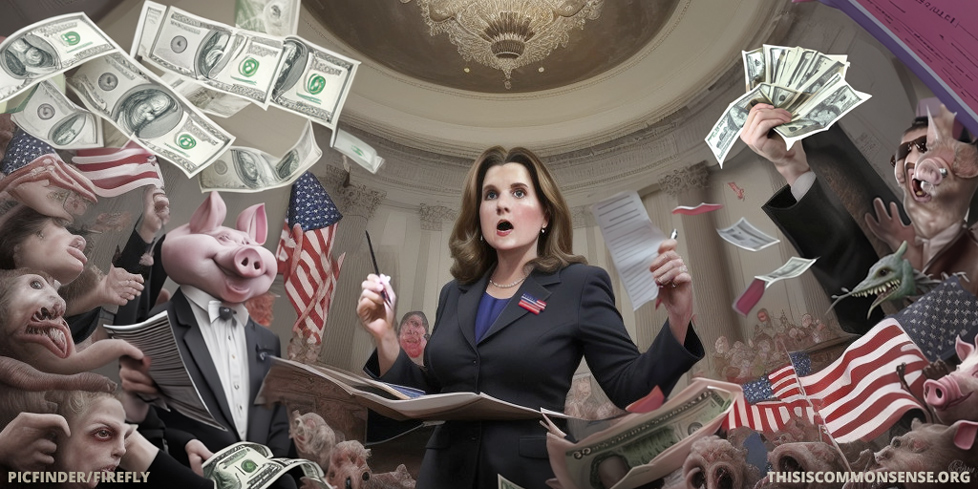
“One thing is clear,” New Orleans Mayor LaToya Cantrell declared, “I do my job, and I will continue to do it with distinction and integrity every step of the way.” 

She marshaled this self-righteousness in response to media inquiries as to why, as The Times-Picayune/The New Orleans Advocate reported, “Cantrell has charged the city of New Orleans $29,000 to travel first- or business-class instead of coach.”

Mayor Cantrell defiantly refuses to pay back “the exorbitant fees” she ran up “for the upgraded tickets, including an $18,000 first-class trip to France over the summer.”

But that’s precisely what City of New Orleans policy demands of her. “Employees are required to purchase the lowest airfare available,” it clearly states. “Employees who choose an upgrade from coach, economy, or business class flights are solely responsible for the difference in cost.” 

Yet, her excuse for upgraded jet-setting is priceless. 

“As all women know, our health and safety are often disregarded . . .” Cantrell offered. “As the mother of a young child whom I live for, I am going to protect myself by any reasonable means in order to ensure I am there to see her grow into the strong woman I am raising her to be,” she continued. “Anyone who wants to question how I protect myself just doesn’t understand the world black women walk in.”

Hmmm. Just how much safer is it in the airplane’s high-priced seats? 

Plus, a pity that the mayor didn’t show any consideration for those fearful souls flying with her. One of “Cantrell’s flights cost nine times that of an aide who accompanied her but flew in coach.”

There is good news, however. A recent poll of registered voters shows a majority (55.4%) support recalling Queen — er, Mayor Cantrell.

This is Common Sense. I’m Paul Jacob.


PDF for printing

Illustration created with DALL-E

See all recent commentary
(simplified and organized)
See recent popular posts

Categories
government transparency too much government

Last of the Big Spenders

The state government of California spends a lot of money. But how much and on what?

That information has, apparently, been a state secret. 

Until now.

For years, a watchdog group called OpenTheBooks.com has been working to discover and disclose government spending in the United States. Its efforts were enabled by 2006 legislation sponsored by Senators Tom Coburn and Barack Obama to establish a website, USASpending.gov, that details federal expenditures. Until his death in 2020, Coburn was the honorary chairman of OpenTheBooks.com.

The group reports that in 2021, it filed some 47,000 Freedom of Information Act requests to obtain data on some $12 trillion of government spending. So they’ve been busy.

California is now the fiftieth state whose spending is being made public in detail.

The state had long resisted requests for info about its spending. State controller Betty Yee said that it was impossible to comply with such requests because California has no central database of government payments. Compiling the data would be too darn hard.

The auditors at OpenTheBooks.com performed the chore instead, filing requests for public records with each of 469 state-government entities.

According to founder and CEO Adam Andrzejewski, “It was a historic knockdown, drag-out dogfight that lasted a decade and spanned the last two California controllers. Since 2005, the state invested $1.1 billion in accounting software, yet still couldn’t publish a complete record of state spending.”

Various budgetary items will doubtless prove controversial — now that they are publicly known.

This is Common Sense. I’m Paul Jacob.


PDF for printing

Illustration created with DALL-E

See all recent commentary
(simplified and organized)
See recent popular posts

Categories
deficits and debt

Sitting on the Volcano

“Wait, it gets worse.”

Over halfway through Eric Boehm’s Reason discussion of our government debt situation, he gets to a crucial point: “The federal government’s debt is particularly susceptible to rising interest rates . . . because so little of it is locked into long-term interest rates. If you have a 30-year fixed-rate mortgage on your house, rising interest rates won’t bother you much. But the federal government overwhelmingly relies on short-term debt, with an average maturity time of just 69 months.” 

So the standard approach to inflation, with the Federal Reserve raising interest rates, would hit the federal budget like an exploding volcano. 

When talking trillions, it’s hard to keep a sense of proportion. Boehm puts it this way: “A one percentage point increase in interest rates translates into a $30 trillion increase in interest costs.” 

Debt service is one of the reasons why the sages at the founding of America were, if not united in opposition to federal debt, overwhelmingly leery of it. But that leeriness did not stop federal borrowing. Only for one brief moment did the United States’ government not hold debt.

Borrowing was one thing when gold or silver fettered our finances to some limits. But paper and digital money have divorced us from a sense of reality.

We pretend that debt’s reality can be perpetually postponed, but we always “pay” — in lost prosperity; in inequality; in economic dislocation; in political unrest. But when the volcano erupts, then we really pay. 

As we awake to our indebtedness, let’s recognize that our political culture has allowed it to get so far out of hand. Fundamental political reform is imperative.

This is Common Sense. I’m Paul Jacob.


PDF for printing

See all recent commentary
(simplified and organized)
See recent popular posts