Categories
national politics & policies partisanship

Repeal Obamacare

Oy vey! Given the alternative of Donald Trump on the one hand and — now that Biden has bailed — a bad-as-Biden Biden-substitute on the other, Americans must re-level their look at the lesser of two evils.

It may be difficult to resist hoping that Trump gets elected this November to allow many of the Democrats’ worst initiatives be left to die on a withering vine. (Examples of the worst: Congress-bypassing regulations designed to penalize production of gas-powered cars and outlaw certain freelance or contract work.)

Still, the candidate and his party have many flaws.

We cannot forget that. Indeed, with their abandonment of the tiniest desire to reduce the size of the federal leviathan, remembrance should be easy. 

Shrink government? Radically reduce spending? Reduce debt? No such goal was seriously pursued in the first Trump administration, and no such goal is mentioned in the twenty-point Trump-Republican Party platform.

There’s talk of tax cuts, ending inflation (somehow), diverting spending from Democratic projects. Sure. But the platform insists that Social Security and Medicare programs not be modified in any way. 

In any way!

And about Obamacare — the biggest expansion of the medical state in recent years, which Republicans had once pledged to repeal — the platform is mute.

The 2016 platform said that improving healthcare “must start with repeal of the dishonestly named Affordable Care Act of 2010: Obamacare,” a declaration retained in 2020. Now it’s gone. Republicans seem to have succumbed to the strategy of turning Obamacare into yet another supposedly unassailable, supposedly inextirpable entitlement program.

Unfortunately, you don’t recover or expand liberty by accepting every expansion of serfdom.

This is Common Sense. I’m Paul Jacob.


PDF for printing

Illustration created with PicFinder and Firefly

See all recent commentary
(simplified and organized)
See recent popular posts

Categories
free trade & free markets international affairs repeal

The Milei Option

Argentina’s new president promised to take a chainsaw to the high taxes and controls that have been killing the country’s freedom and prosperity.

He has had successes. One of his decrees removed rent controls, and as a result the supply of rentals has jumped and rents have dropped.

But Milei cannot simply issue decrees to free up markets. He’s got to go through the legislature. And Argentina’s Senate recently rejected a mammoth Milei-issued emergency decree to deregulate the economy apparently in one fell swoop—revising or killing some 300 regulations.

The Financial Times reports that Milei’s coalition, La Libertad Avanza, “controls less than 10 per cent of Senate seats.” Many of the “centrist” senators could have helped pass Milei’s reforms over the objections of the adamantly leftist members. But these centrists profess to have constitutional reservations about the decree.

The real problem is probably that there is still a very large constituency for the subsidies and grift that have impoverished so many Argentinians.

The decree remains in effect until the House votes on it too. Milei’s administration is negotiating with the lawmakers of that chamber and with others who may have an impact on their vote.

If President Milei loses this fight in the near term, he must keep reminding voters why he can’t do more to lift them out of poverty and serfdom. His election to the presidency was a huge political change. But it’s not the only one Argentina needs.

This is Common Sense. I’m Paul Jacob.


PDF for printing

Illustration created with PicFinder and Firefly

See all recent commentary
(simplified and organized)
See recent popular posts

Categories
Accountability general freedom

The S-Word in California

Frédéric Bastiat called it “spoliation”; California’s Democratic politicians call it social justice.

A bill went into effect last week, offering complete medical coverage to an estimated 700,000 undocumented — illegal — immigrants.  The price tag? 3.1 billion dollars.

Well, not “price tag”: call it a subsidy tag.

California taxpayers will pay for it. Or perhaps U.S. taxpayers will end up with the bill, as Dagen McDowell insisted on Fox News, prophesying that the program “will turn into a national issue” that will, inevitably, “swamp the federal budget.” 

Ms. McDowell also noted that the state’s targeted sugar daddies, the wealthy, “are going to other states, so much that they’ve lost a congressional seat,” all of which must lead to insolvency.

Indeed, the state is running far into the red — the color of the ink on budget columns, not voting columns. The state faces not merely annual deficits and a huge debt, there is also this looming trillion-dollar debt implied by the unfunded liabilities of the state employee pensions.

There is an old pattern here, which is why I brought up an old author in the first sentence.

First we subsidize the poor. Then we extend the subsidies up the income ladder. Now we give huge subsidies to those who enter the country illegally.

It’s as if Californians have forgotten the nature of income redistribution: you have to have income to redistribute. At some point the wealth being taken from the productive vanishes, as society becomes unproductive and descends into ruin.

There are two meanings of Bastiat’s “spoliation”:

noun
1 the action of ruining or destroying something.
2 the action of taking goods or property from somewhere by illegal or unethical means.

The two are linked. 

This is Common Sense. I’m Paul Jacob.


PDF for printing

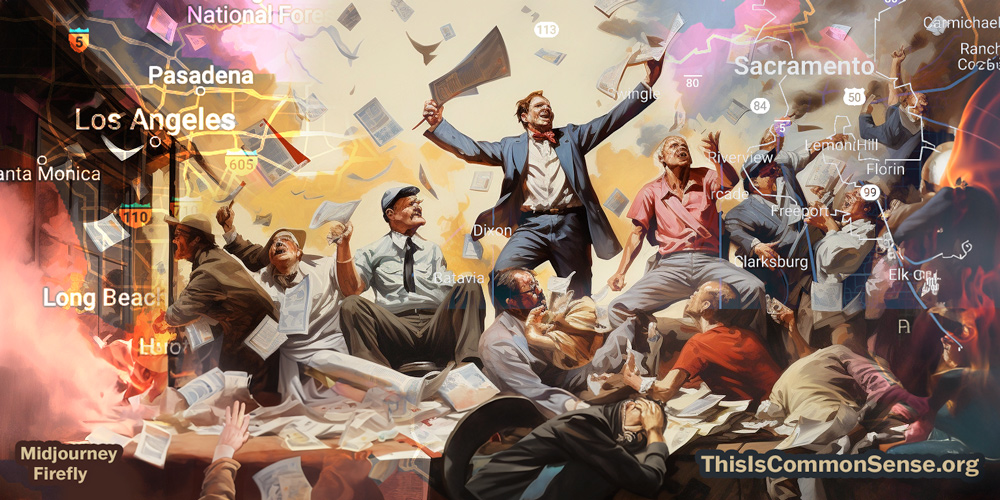
Illustration created with Midjourney and Firefly

See all recent commentary
(simplified and organized)
See recent popular posts
Categories
folly free trade & free markets too much government

Make Them Pay

Thanks to renewable-energy mandates and other regulations, California muddles along with crippled power markets in which rolling blackouts are routine when demand for electricity is high and sun and wind are unavailable.

Apparently, this and other burdens on energy usage in the Brownout State are insufficient to fully immobilize everybody who relies on things that need to function. So the state’s utilities are preparing to also impose socialist billing on its customers.

Pacific Gas & Electric, San Diego Gas & Electric, and Southern California Edison are proposing that the flat-rate component of power bills be based on income. Once regulators sign off, there is to be an ongoing transfer of wealth from richer to poorer.

The utilities aren’t acting independently. 

They’re obeying a legislative mandate.

In addition to a flat-rate component of utility bills that would be $15 for the poorest customers and $85 for the wealthiest customers, there would still be a component based on power consumption. So the impending looting of nonpoor customers could be worse.

The socialism isn’t full bore yet.

But I doubt that initial limits on this redistribution agenda would remain intact were the scheme implemented and to persist.

In addition to other objections, there is also the matter of how utilities will know their customers’ incomes. Will customers be required to report and prove these incomes? The central planners presumably regard this invasion of privacy as not worth fretting about. 

They’re too busy creating perfect equality . . . of brownouts.

This is Common Sense. I’m Paul Jacob.


PDF for printing

Illustration created with PicFinder.ai

See all recent commentary
(simplified and organized)
See recent popular posts

Categories
free trade & free markets moral hazard

Is It Still Capitalism?

Is it still capitalism if the capital is guaranteed?

“The U.S. government will guarantee all customer funds in Silicon Valley Bank (SVB) after a series of bad decisions and a run on deposits led to the bank’s collapse,” explains Elizabeth Nolan Brown in Reason

Technically, the bank isn’t being bailed out. Its customers are. And that’s a lot more popular than bailing out banks directly. There are more bank customers who vote than bankers who vote — though there is probably more political donations from banks directly seeking banking policy “correctives” than bank customers doing the same. That’s almost apodictically true.

The most bizarre element? While the FDIC, the federal agency that insures depositors of this and similar banks, is designed to guarantee depositors’ capital up to a certain limited amount ($250,000, more or less), the regulatory triumvirate of Treasury Secretary Janet Yellen, Federal Reserve Board Chair Jerome Powell, and FDIC Chair Martin Gruenberg declare that “all depositors of this institution will be made whole.” 

All.

Even the super-rich.

The key concept, here, is moral hazard — “The decision creates bad incentives for financial institutions and their customers” is how Ms. Brown puts it. We’ve been through all of this before. Is there really any question? The answers are in.

So, to the opening, Is it still capitalism if the capital is guaranteed? — if even Prince Harry’s fortune will be guaranteed — the answer is No.

Sorta. 

It’s a special kind of capitalism. State-dominated capitalism; Neo-mercantilism; f***-ism. Use whichever term.

As we contemplate a profit-and-loss system without loss, and how the losses will be made up within the financial system, just remember that the federal government playing the role of Savior is not itself costless, and . . . its debt keeps growing. And the Ultimate Result of all this still looms.

Immoral hazard.

This is Common Sense. I’m Paul Jacob.


PDF for printing

Illustration created with PicFinder.ai

See all recent commentary
(simplified and organized)
See recent popular posts

Categories
audio podcast

Listen: U-turn Time

The big stories of the week revolve around big government, which mean big theft, which is not unrelated to socialism:

Categories
general freedom ideological culture media and media people

Showcialism, Schmocialism

Americans have never gotten into “socialism” like the rest of the world. This places pushers of socialistic ideas in a tricky situation. So they often defend socialism in less than honest ways. 

William Neuman, formerly of the New York Times, is a current example of this. St. Martin’s has just published his Things Are Never So Bad That They Can’t Get Worse: Inside the Collapse of Venezuela, and boy, do we get a story.

Hugo Chávez called himself a socialist, repeatedly, but Neuman won’t accept it. Why? Venezuela was basically ruined by Chávez and his henchmen and successors. So the former New York Times reporter provides excuses. 

Which is not to say I have read his book, or will. I am entirely trusting a review by Jim Epstein, at Reason, and agreeing per a plethora of other examples with Epstien’s critique of Neuman’s denialism.

While Neuman insists that Chávez was, in effect, a SINO (Socialist In Name Only), using the s-word just as cover — “showcialismo” — Epstein takes us back to reality. “One classic definition of socialism is government control of the means of production. Chávez nationalized banks, oil companies, telecommunications, millions of acres of farmland, supermarkets, stores, the cement industry” and on and on. Now wonder, then, that “nationalization led to deterioration, abandonment, and collapse.”

Neuman cannot blame socialism, oh no. So he lamely argues it was just “bad management.”

But that is what socialism is, and must be. Even when managed by the very best experts, those experts must fail, in the end, because they lack the expertise that counts — the know-how that is spread out among all participants in society. 

Markets leverage that knowledge best.

This is Common Sense. I’m Paul Jacob.


PDF for printing

See all recent commentary
(simplified and organized)
See recent popular posts
Categories
Common Sense general freedom

A Fitter Course

The times may not seem to indicate jubilations and thanksgivings, but any time is a good time to practice gratitude — to those who deserve it, and on a more basic level, too — so, regardless of the pandemic, the misguided responses, social unrest, racial mistrust, the threat of totalitarianism and war, remember: things could be worse.

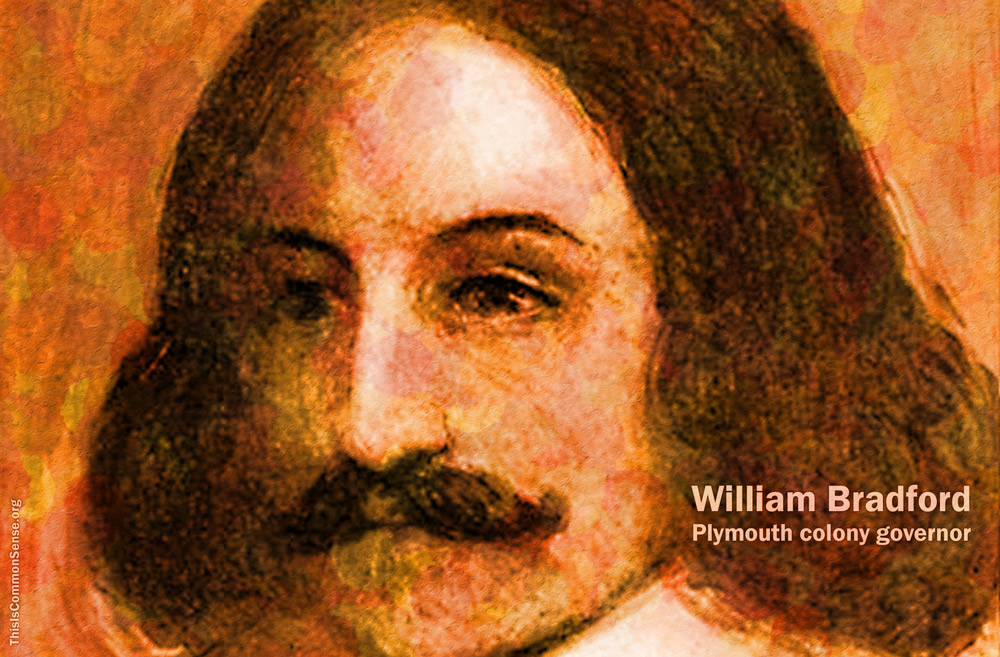
At Thanksgiving, especially, it might do us good to consult William Bradford’s account* of the History of “Plimoth Plantation,” a document that recounts how his fellow Pilgrim settlers established, endured, barely survived, recovered, and eventually thrived in Massachusetts.

By the spring of 1623 — a little over three years after first settlement in Plymouth — things were going badly. Bradford writes of the tragic situation:

[M]any sould away their cloathes and bed coverings; others (so base were they) became servants to [the] Indeans, and would cutt them woode & fetch them water, for a cap full of corne; others fell to plaine stealing, both night & day, from [the] Indeans, of which they greevosly complained. In [the] end, they came to that misery, that some starved & dyed with could & hunger.

The problem? The colony had been engaging in something very like communism.

The experience that was had in this comone course and condition, tried sundrie years, and that amongst godly and sober men, may well evince the vanitie of that conceite of Platos & other ancients, applauded by some of later times; — that [the] taking away of propertie, and bringing in comunitie into a comone wealth, would make them happy and florishing; as if they were wiser then God.

Bradford relates the consequences of common property:

For this comunitie (so farr as it was) was found to breed much confusion & discontent, and retard much imploymet that would have been to their benefite and comforte. For [the] yong-men that were most able and fitte for labour & service did repine that they should spend their time & streingth to worke for other mens wives and children, with out any recompence. The strong, or man of parts, had no more in devission of victails & cloaths, then he that was weake and not able to doe a quarter [the] other could; this was thought injuestice. The aged and graver men to be ranked and equalised in labours, and victails, cloaths, &c., with [the] meaner & yonger sorte, thought it some indignite & disrespect unto them. And for mens wives to be commanded to doe servise for other men, as dresing their meate, washing their cloaths, &c., they deemd it a kind of slaverie, neither could many husbands well brooke it.

Yes, the s-word: Slavery. Common property was mutual slavery.

The solution? The plan for society that Bradford attributed to God. He brooked no pleading that common property didn’t work because of corruption, sin. As he put it, “seeing all men have this corruption in them, God in his wisdome saw another course fiter for them.” The course? I’ll use a word of coined by Robert Poole, one of the founders of Reason magazine: Privatization.

Basically, what the Pilgrims privatized was land, and the fruits thereof, assigning to

every family a parcell of land, according to the proportion of their number for that end, only for present use (but made no devission for inheritance), and ranged all boys & youth under some familie. This had very good success; for it made all hands very industrious, so as much more corne was planted then other waise would have bene by any means [the] Govror any other could use, and saved him a great deall of trouble, and gave farr better contente. The women now wente willingly into [the] feild, and tooke their litle-ons with them to set corne, which before would aledg weaknes, and inabilitie; whom to have compelled would have bene thought great tiranie and oppression.

Thus began the years of bounty in Massachusetts. There’s much more in Bradford’s account worth reading, including the increasingly tragic relations with the native Americans. And, indeed, one learns from reading such first-hand accounts how imperfect a creature is man.

But it is obvious that some systems of property and governance work better than others, and, on the day that our government has set forth as a day of Thanksgiving, it is worth being thankful for living in a land that has upheld — to at least some degree — the system of private property that America’s Pilgrim’s learned to see as God’s “fitter course” for corruptible man.

This is Common Sense. I’m Paul Jacob.


* This episode of Common Sense is adapted from this site’s 2011 Thanksgiving message

PDF for printing

See all recent commentary
(simplified and organized)
See recent popular posts

Categories
ideological culture subsidy

Slackers, Unite!

International socialists may once have rallied around “workers, unite!” but today’s young “communists” are embracing a Non-Workers movement, demanding free stuff and/or a Universal Basic Income (UBI). 

This came to mind reading a recent New York Times’s op-ed, “Work Is a False Idol,” and an earlier report, “These Chinese Millennials Are ‘Chilling,’ and Beijing Isn’t Happy.” A new movement in China and elsewhere, known as “Lying Flat,” extols indolence.

Instead of a career? Working hard? 

Do nothing!

Sounds like early retirement.

Very early retirement, for this is a young adult malaise.

Cassady Rosenblum, who took the trouble to author the op-ed, quoted a poem that asked “what is it you plan to do/ with your one wild and precious life?” and answered: “Sit on the porch.”

This “Lying flat” slacker movement reminds me of a novel I haven’t read, but whose theme has stuck with me, nonetheless: Ivan Goncharov’s Oblomov. It is about a young nobleman who spends the book recumbent, or so I’m told.

“Oblomovism” was a cultural obsession before the Soviet Revolution and a problem afterward. If no one produces, how could anyone consume?

With the character Oblomov, his lethargy merely drained the capital of his family’s aristocratic past.

With the hero of the new “Lying Flat” movement, Luo Huazhong — author of the mortal classic, “Lying Flat Is Justice” — he lives off odd jobs and his savings. So far, at least, self-sufficient. 

With Ms. Rosenblum, it’s her parents’ porch, and, thereby, their savings.

Think of what would happen were a UBI put in place. More horizontal living and less production (for redistribution). 

Oblomovism triumphs and we all lose.

After all, “Lying flat” is the perfect term for the ultimate in do-nothingism: what you do in a coffin.

This is Common Sense. I’m Paul Jacob.


PDF for printing

See all recent commentary
(simplified and organized)
See recent popular posts

Categories
free trade & free markets international affairs

Embargo Socialism?

As the people of Cuba have revolted, this month, taking to the streets in huge marches, complete with waving of American flags, leftists in America — who love socialism and hate the Stars and Stripes — have been put in an awkward position. 

The Biden administration, in its continual prostration before progressives, initially attributed Cuban unrest to lack of COVID vaccine access. But then leftists began blaming the United States’ embargo for that and for Cuba’s sorry economic mess, blaming the U.S. as the cause of Cuban misery. 

Not Cuba’s Castro communist government! 

The problem is U.S. foreign policy, or so the memes assert. Some claim that the embargo amounts to a blockade of all international trade with Cuba.

Is this true?

“Embargo is the official term used by the U.S. government to describe the sanctions on Cuba,” Politifact explains. “While the nuances in the U.S. embargo can make it difficult for foreign companies to trade with the country, there is no evidence that they can’t,” concluding with “We rate this claim False.”

Indeed, other popular memes show that the U.S. is the only country on the planet not trading with the communist-run tyranny due south of Florida.

More interesting is the clarification of the embargo by Senator Marco Rubio. “There’s only two embargoes, here: the embargo against government-owned companies and the embargo that the Cuban regime imposes on its own people.”

It is entirely legal for Cubans and Americans to trade, says Florida’s senior U.S. senator. But the Cuban tyranny won’t let them.

All my life the U.S. has been engaged in an embargo against Cuban socialism. Against slavery. Against a government at war with its people. 

It has not yet “worked,” but I know why Cubans wave American flags.

This is Common Sense. I’m Paul Jacob.


PDF for printing

See all recent commentary
(simplified and organized)
See recent popular posts