Categories
Accountability general freedom local leaders term limits

Political Babes

Robert Dover is a freshman state senator in Nebraska’s unicameral legislature, appointed last year by the governor to fill a vacancy. Dover says that learning the ropes at the capitol has been like “drinking from a fire hose.”

I sure hope he’s found the bathrooms. 

But have no fear: This rookie has already overcome that lack of experience, sponsoring a constitutional amendment, which faster than a Nebraska minute has 40 of 49 state senators enthusiastically signed on. 

What has folks at the capitol so excited? His amendment, LR22CA, would dramatically weaken their current term limit by giving legislators an extra term, so they can serve 12 years, before taking a break, and not be limited to just eight.

“Dover,” the Nebraska Examiner informs, “said he quickly learned how term limits were a bad idea after talking with legislative veterans, state agency heads and lobbyists.”

“Everyone I talked to said it was a horrible thing,” he offered. “To a person, they said (term limits) took away from the consistency at the Capitol.”

By which he means, the senator elaborated — and as the Lincoln Journal Star reports — maintaining “the right relationships between senators or interest groups to strike compromise.” 

Yes, indeed: the longer politicians stay in office the more they do “compromise” with special interests. 

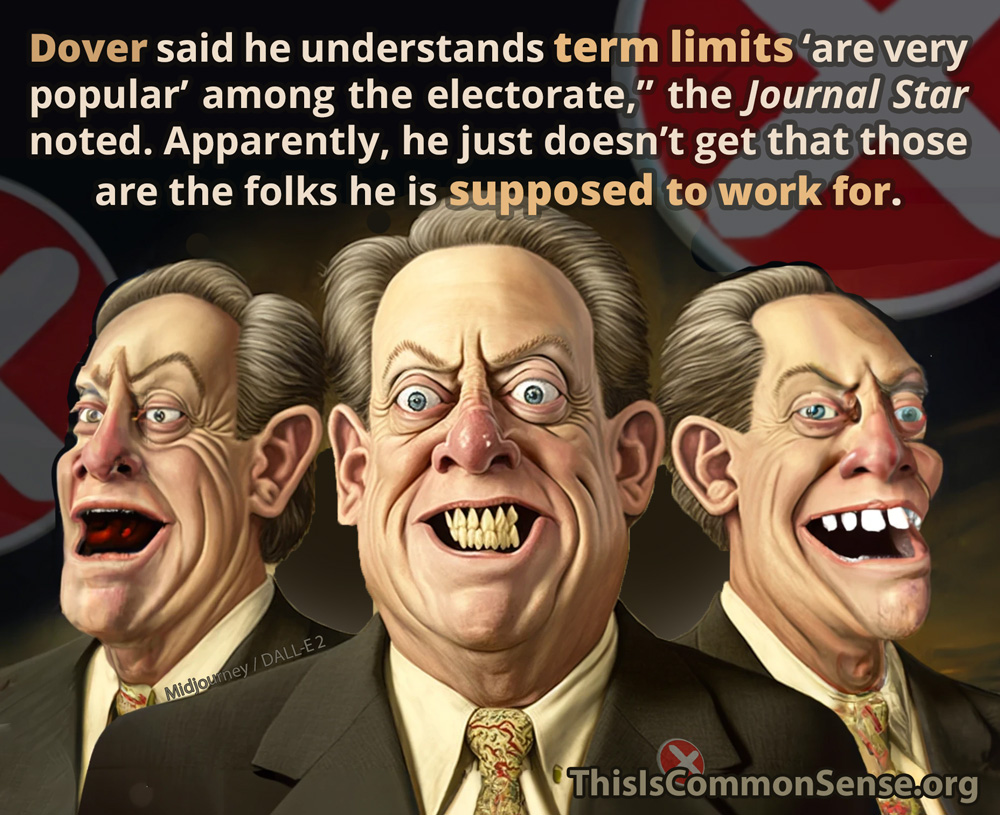
“Dover said he understands term limits ‘are very popular’ among the electorate,” the Journal Star noted. Apparently, he just doesn’t get that those are the folks he is supposed to work for. 

The senator complained that Liberty Initiative Fund, my organization, is sending postcards to voters across the state to inform them about his bill, calling our effort “a waste of money.”

That tells me it is money well spent

This is Common Sense. I’m Paul Jacob.


Note: Term limits have a long history of battling the political establishment in the Cornhusker State, which I wrote about back in 2011.

PDF for printing

Illustration created with Midjourney and DALL‑E 2

See all recent commentary
(simplified and organized)
See recent popular posts

Categories
initiative, referendum, and recall term limits

Unbelievable

There they go again!

You’d think after Nebraskans voted three separate times for eight-​year legislative term limits that the state’s legislators would finally accept the vote of the people they claim to serve.

But you’d be wrong.

The limits passed in ’92 and ’94 were struck down in court rulings that re-​wrote the state’s initiative petition requirements. Voters responded to that judicial tyranny by booting out a supreme court justice in a retention election for the very first time in state history. A second justice resigned the day after that 1996 spanking by voters.

In 2000, citizens gathered enough signatures to put the limits back on the ballot and again they passed.

But that hasn’t stopped State Sen. Tom Carlson and his fellow legislators from placing Amendment 3 on tomorrow’s ballot. If passed, Amendment 3 would allow Carlson & Co. to stay in office 50 percent longer.

Strange, we limit the president to eight years; George Washington stepped down after two four-​year terms to set that example. But somehow eight years isn’t enough time for a state senator.

In a last minute radio ad campaign by a purposely mis-​named Nebraskans to Preserve Term Limits, Sen. Carlson says that he and his gang “believe in term limits.” But seconds later Carlson mentions “coaches, teachers, doctors” and suggests, “It is unlikely we would consider limiting their service to eight years.”

Well, he’s right that we don’t limit brain surgeons to eight years. But then again, being a legislator isn’t brain surgery.

As Nebraska voters will remind members of the state’s Unicameral Legislature tomorrow — for a fourth time.

This is Common Sense. I’m Paul Jacob.

Categories
video

Video: Nebraska’s Trojan Horse

What the people fight against in Nebraska, another Trojan Horse:

Categories
initiative, referendum, and recall term limits

Nebraska Initiative: Open or Closed?

In 2008, State Senator DiAnna Schimek’s 20-​year legislative career came to an end, thanks to the term limits initiative enacted by Nebraska voters. Third time proved the charm; the state supreme court had struck down the first two citizen-​initiated term-​limit measures.

Without the initiative process, no term limits. That’s reason enough for Schimek and other pseudo-​solons to despise the initiative — not to mention that every initiative breaks legislators’ law-​making monopoly

In 2008, Sen. Schimek and her fellow unicamereleons realized the voters had won. Unable to overturn term limits a third time, they did the next worst thing: wreck the path by which such popular reforms could be instituted in the future.

Schimek introduced Legislative Bill 39, which re-​wrote the rules for petitioning initiative measures onto the ballot. Illuminatingly, more than 90 percent of state senators termed-​out that year supported Schimek’s parting shot to punish the initiative petition process. When the governor vetoed this frontal assault on a fundamental democratic check, legislators overrode his veto. 

Since passage of LB 39 in 2008, not a single citizen initiative has qualified for the ballot.

Then, on Tuesday, after a multi-​year legal challenge brought by Citizens in Charge and Nebraska citizens, a federal judge struck down the law’s ban on out-​of state petition circulators as unconstitutional.

One of the chains left around the neck of the Nebraska citizenry by Schimek and that last batch of career politicians has now been removed.

This is Common Sense. I’m Paul Jacob.

Categories
initiative, referendum, and recall local leaders

Will Vote for Work – $5

Richard Milhous Nixon once famously proclaimed, “I am not a crook.” He later became the only president to resign from office. 

The recall of Omaha, Nebraska, Mayor Jim Suttle brings that famous quip to mind. Many of the mayor’s defenders argue he shouldn’t be recalled because he hasn’t broken any laws. At a debate last week, restaurateur Nicole Jesse, co-​chair of the recall committee, explained, “Omahans deserve and expect more than just, ‘He’s not a criminal.’”

She charged that the mayor had “promised to lower property taxes,” but “he’s increased them twice. He told the Omaha Bar and Restaurant Association he would not impose a new tax. He turned around and did just that.”

Dave Nabity, head of Citizens for Omaha’s Future, says that the mayor’s character — or lack thereof — is the critical issue. He has criticized the mayor and his campaign organization for making false allegations of fraud against the recall effort (as I discussed weeks ago), and can now point to a newly launched police investigation into the mayor’s anti-​recall group, Forward Omaha, for fraudulent activity. The group allegedly drove busloads of homeless people to the polls after paying them $5 for “training” for a possible future job.

Mayor Suttle originally argued that the group’s actions were totally innocent and appropriate, but quickly changed his tune, issuing a statement that read, “The Mayor does not support this or any other type of voter manipulation.”

The recall election is tomorrow.

This is Common Sense. I’m Paul Jacob.

Categories
initiative, referendum, and recall

The Omaha Recall

A Wall Street Journal story on the campaign to recall the mayor of Omaha, Nebraska, quotes the head of the U.S. Conference of Mayors saying that recall petitions should be made more difficult because “the political climate is toxic.” 

Toxic to whom, betrayed citizens or out-​of-​touch politicians? 

You know whose side I’m on. I took three weeks off my regular duties to manage the recall’s petition drive.

Such efforts aren’t easy. We needed signatures equaling 35 percent of the vote for mayor. A group called “Omaha Forward” harassed our petitioners, regularly predicted our failure in the news media and hurled charges of fraud at us. When we turned in the necessary 37,000 signatures, certified by elections officials, the group filed a lawsuit to block the recall.

Just before Christmas, I traveled back to Omaha to testify at the trial over the petition. The mayor’s attorney called me “The Music Man,” an out-​of-​towner out to swindle good Nebraskans. But not one single signature verified by the county was invalidated. As the judge said in his decision, “Plaintiff introduced evidence to attack the credibility of certain circulators and a Paul Jacob, the coordinator for the paid circulators.… This Court found Paul Jacob credible and accepted his testimony as truthful.”

The recall of Omaha’s mayor is on the ballot, January 25. Whether he is removed from office or not, voters have demonstrated that they cannot be taken for granted. A lawful democratic process prevails.

This is Common Sense. I’m Paul Jacob.

Categories
initiative, referendum, and recall

But Not ‘By’ the People

Our ability to vote directly on the chief issues of our time is a vital political power, a right. I think so, and most Americans agree. 

But for some reason some of those elected to “represent” us don’t.

Last year, Missouri State Rep. Mike Parson introduced legislation to restrict petitioning to place initiatives on the ballot. Parson himself admitted that there might be unconstitutional parts to his bill. Thankfully, it failed. 

Now, this year, he’s back. Parson wants to double the number of petition signatures citizens must gather to place an issue on the ballot. Presently, citizens turn in more than 200,000 signatures to meet the state’s requirement. Parson wants to make that 400,000.

Why? Did voters really elect Mike Parson to block them from having a say-​so in their own government?

In Nebraska, Citizens in Charge is suing to overturn unconstitutional restrictions on the initiative process. Amy Miller with the ACLU, which is handling the case, said, “It’s hard not to see the restrictions as a deliberate effort on the part of legislators to keep independent candidates and grassroots initiatives off the ballot.”

Now Nebraska State Senator Bill Avery has introduced legislation to further increase the signature requirement for a constitutional amendment by 50 percent.

It all makes me realize how important it is to have a process whereby we citizens can overrule our so-​called representatives.

This is Common Sense. I’m Paul Jacob.

Categories
government transparency

Yes, Virginia, There Is a Nebraska

Government transparency is understandably popular. Voters want to know what their governments are doing.

So smart politicians promise us more transparency, more sunshine, more info. But, being politicians, sometimes they don’t deliver. And, when they do, they often spend a whole lot more than necessary.

That’s what is happening in Virginia. Bills to put the state budget online have passed both chambers of the legislature — unanimously.

But politicians estimate that the cost to get the job done will run over $3 million. Wow. That’s a lot. How does that compare with other states?

At the Tertium Quids blog, there’s a letter posted from Ed Martin, chief of staff to former Missouri Governor Matt Blunt. Martin points out that two years ago Blunt created the Missouri Accountability Portal by executive order.

The website is a national model with a searchable database of state expenditures. It’s garnered over 17 million hits from interested citizens. And it cost less than $200,000.

Then there’s Nebraska State Treasurer Shane Osborn. As the Washington Examiner recently reported, he put Nebraska spending online without the legislature passing a law. He just did it.

“I used my staff to compile the data,” Osborn said. “I just viewed it as my job.”

The grand cost of Osborn’s excellent transparency website? Only $38,000.

Sounds like there are millions of reasons for Virginia to learn from others.

This is Common Sense. I’m Paul Jacob.

Categories
general freedom

To the Dumpsters, Go

We have all heard of “dumpster babies,” abandoned newborns left to die by unfit parents.

And now, courtesy of Nebraska’s not-​too-​careful legislature, we have “dumpster teens” — near-​adult youngsters left with the state of Nebraska by their parents, following last July’s loosening of the state’s child neglect statute.

The legislature, trying to prevent dumpster babies, weakened penalties to irresponsible parents who at least show the tiniest responsibility by not leaving infants in dumpsters, or the like, to die, but rather leaving them at hospitals for someone else to take up care.

Little did they expect parents to abandon growing children, including teenagers.

Though unintended, the effects were, well, ludicrously predictable. The legislators had used the word “child” rather than defining it more narrowly to “newborns.”

A special session has now been convened, and the law tidied up to include only infants 30 days or younger. But not before dozens of young people were abandoned. Some parents travelled across state lines to get rid of their kids.

Strange that the same legislature that outlawed non-​residents from helping circulate petitions in Nebraska would allow non-​residents to drop off their unwanted children in the state. But I digress.

Nebraska legislators may have meant well, but they ignored a basic principle: Some obligations should not be made too easy to break.

This is Common Sense. I’m Paul Jacob.