Categories
national politics & policies political economy

The False Gospel of the Printing Press

It’s been a while since I’ve mentioned “Modern Monetary Theory,” popularly known as MMT.

While MMT is not popular here, it is gaining adherents outside the ranks of Common Sense readers like a new Ponzi scheme taking on suckers.

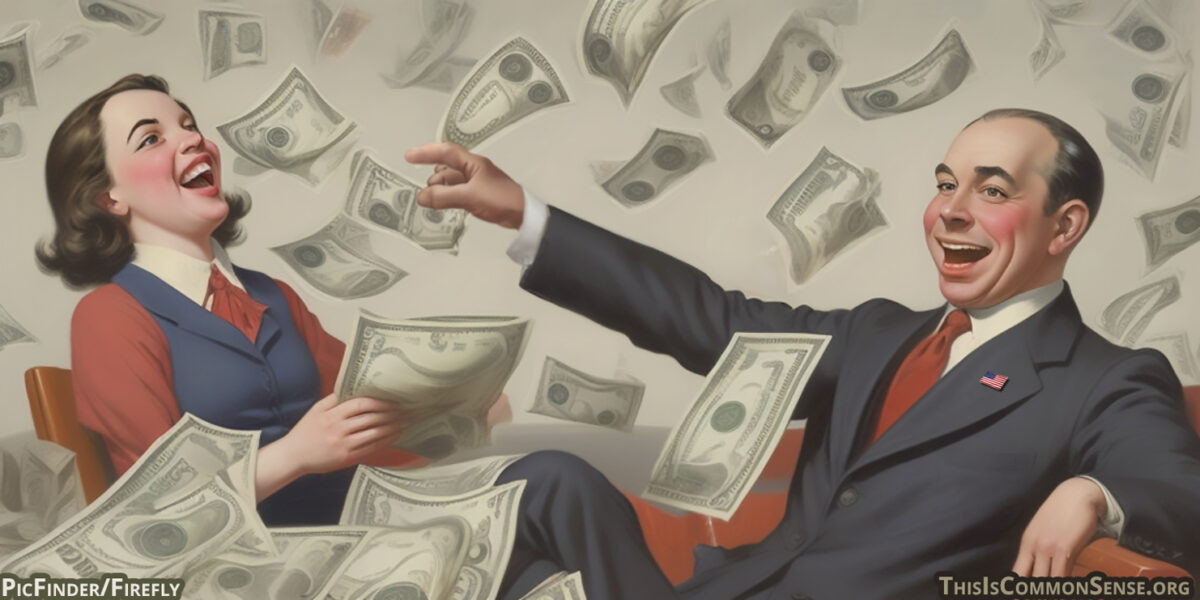
Modern Monetary Theorists go on and on about the gospel of printing money, like they just discovered that the Fed-​and-​Treasury act of borrowing within the banking system isn’t the only way to inflate the money supply.

You can indeed “just print money”!

Granted, the MMTers do a lot of fancy footwork, or silver-​tongue-​work — the closest they get to hard money — to avoid the infamous consequences of monetary inflation, “price inflation” being just one of them. They are so enamored of the money press that they’re like teenagers discovering sex: didn’t you old folks know about this great thing?

It would be comical were it not … inflationary.

At the present moment in history, of course, MMT is in a tricky situation: huge increases in the money supply during the COVID period resulted in no small amount of … huge price increases.

“Whatever you call it, MMT is printing money,” Matt Taibbi just wrote in a terrific May 18 piece, “and no matter how sure you might think you are that it will work, you aren’t, and can’t be. Sure, our leaders have been doing it, printing $4 trillion through multiple rounds of QE and $5.5 trillion more in the CARES Act, and sure, that last spree only inspired about 20% inflation so far. Still, any economist who says with a straight face he or she is sure this experiment won’t end with your kids using dollars as toilet paper is lying.”

Or just engaging in old-​fashioned money-crankism. 

The old get-​something-​for-​nothing racket. MMT’s just the latest form.

This is Common Sense. I’m Paul Jacob.


PDF for printing

Illustration created with PicFinder and Firefly

See all recent commentary
(simplified and organized)
See recent popular posts
Categories
general freedom international affairs national politics & policies too much government

To End the Great Declension

“Today begins a new era in Argentina,” said Javier Milei in his inaugural address as the new president of Argentina. “Today we end a long and sad history of decadence and decline and begin the road to the reconstruction of our country.”

President Milei has focused on a problem — the decadence of mass poverty — and identified it with a basic view of government: interventionism in markets, central control and bureaucratic proliferation. These, once established, start a cycle that must end in decay, decline. “The outgoing government has left us with hyperinflation, and it is our top priority to make every effort to avoid a catastrophe that would push poverty above 90 percent and indigence above 50 percent,” he explained.

Milei is not hesitant; gradualism’s not his bag, for the country does not “have margin for sterile discussions. Our country demands action and immediate action.”

At some point, the argument runs, you have to boldly cut government. Not just cut the rate of government growth, which is about all American Republicans have achieved — often allowing others to take the credit, as with Bill “The Era of Big Government Is Over” Clinton.

Milei’s first act as president was an executive order reducing the number of government ministries from 21 to nine. If this move actually succeeds in paring down the size of Argentina’s state apparatus and workforce, it will be something of a miracle.

In a country that needs miracles. 

Here in these United States, we may not have hyperinflation, as such, but we do face a crisis. The deficits are persistent, and majorities in both parties seem utterly unconcerned about the $34 trillion debt, rushing at us fast. Costing more to service than we spend on defense.

Only Vivek Ramaswamy has pushed specific ways to cut government.

But, unlike Milei in South America, here in North America Vivek’s just not that popular.

This is Common Sense. I’m Paul Jacob.


PDF for printing

Illustration created with PicFinder and Fireflly

See all recent commentary
(simplified and organized)
See recent popular posts
Categories
election law partisanship political challengers

Democratic Money for Republicans

“After years of claiming that money in politics is bad and Trumpists will destroy America,” writes Joe Lancaster in Reason, “Democrats spent millions to boost the people they are most afraid of.”

In a strategy that might be designated Too Clever by Half, “Throughout the 2022 primary season, groups affiliated with the Democratic Party funded ads to boost immoderate Republican candidates,” Lancaster explains. “The goal was to boost the least moderate candidates in the hopes that they would be easier to beat in a general election.”

The Senate Majority PAC bought ads for New Hampshire’s Republican U.S. Senate primary, for instance, calling Chuck Morse a “sleazy politician,” allowing a retired brigadier general to advance on to the general election — only to lose to the incumbent. Another Democratic PAC pushed “nearly $100,000 on ads proclaiming Republican House primary candidate Robert Burns ‘the ultra-​conservative candidate’ who ‘follows the Trump playbook.’” Burns went on to defeat his more moderate competitor and then be defeated in the general election.

That was the pattern around the country.

If this all sounds familiar, this is how we got Trump into the forefront in the first place. Hillary Clinton’s campaign infamously orchestrated the corporate news media’s fixation on Trump in 2015 and through to Trump’s winning the primary contest. And then, you will remember, the news media changed course and started the great anti-​Trump freak-out.

This time, however, it may have paid off. Or at least not horribly backfired, for the much-​prophesied Election Day 2022 “Red Wave” merely eroded the Democrats’ stranglehold on unified government. 

Washed away, instead, is the idea that Democrats truly fear these “mega-​MAGA Republicans” or care about democracy.

This is Common Sense. I’m Paul Jacob.


PDF for printing

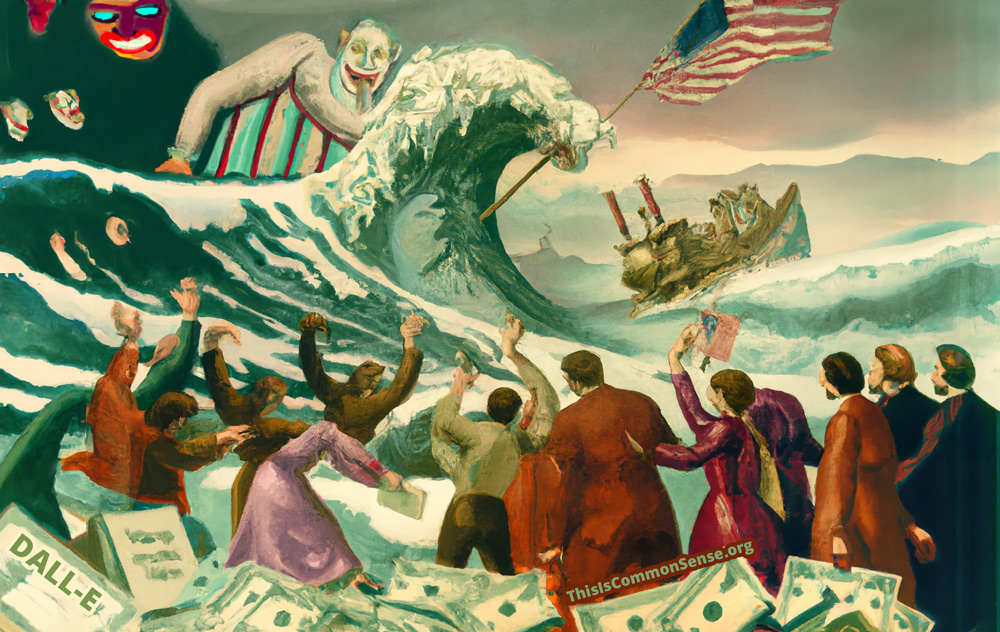
Illustration created with DALL‑E

See all recent commentary
(simplified and organized)
See recent popular posts
Categories
deficits and debt free trade & free markets national politics & policies too much government

Inflation Evasion…Depression

Going into the lockdowns and bailouts, a consensus of politicians and their court wizards, the economists, had belittled the specter of inflation.

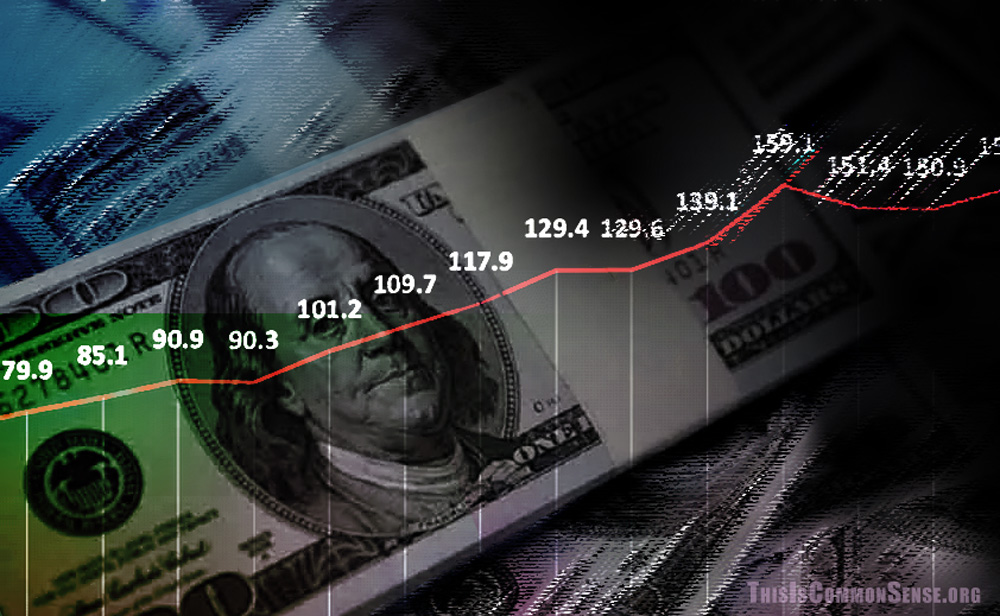
Nowadays, when folks use the term “inflation,” they really mean upward movement on the consumer price index (CPI). Some economists, who have a sense of history,* reserve the word not for price level increases, but for increases in the supply of money. And the two concepts are tightly linked. 

But a whole lot of people seek to blame CPI rate increases on anything but monetary policy, as Veronique de Rugy notes in an article at The American Spectator.

“Theories for why we shouldn’t worry abounded,” de Rugy writes. “It was caused by a base-​effect price increase, supply-​chain restraints, a drought in Taiwan — everything but the Fed’s expansionary policies and Congress’ overspending, in part because some of these experts had cheered for these actions all along.”

And then inflation came back.

Big time.

While expressing some humility and an unwillingness to make predictions, de Rugy insists that “the amount of money printed, borrowed, and spent during the last few years led to a one-​time price level rise, and we may have a way to go until we are done.” 

She also insists that the Pollyanna phrase “transitory inflation” is no comfort: “inflation was always going to be transitory. Even the inflation of the 1970s ended in the ’80s. What mattered is whether transitory inflation meant a few weeks, months, or years.”

And, I cautiously add, how de-​stabilizing it is. Consumers rightly worry about rising prices, but inflation doesn’t hit all sectors the same. Credit expansion leads to imbalances that are hard to correct. 

And the correction is “depression.”

This is Common Sense. I’m Paul Jacob.


* Including the history of their own discipline. Readers of Austrian economists such asF.A. Hayek get a better sense of past debates than from other economists.

PDF for printing

Categories
media and media people national politics & policies

Big Bucks Buy Votes

Want to know how Washington works? 

Or doesn’t work? 

Drafting legislation to provide COVID (and COVID lockdown) relief, President Joe Biden and Congress contemplate just how big to make the next round of government checks sent to “the inhabitants of America.”

And which folks to send the freshly printed moolah.

“Something very weird is happening,” explains Washington Post columnist Paul Waldman. “On one side you have Republicans and conservative Democrats saying people at higher incomes don’t deserve this government help. On the other side you have liberals advocating that higher-​income people should share in this largesse.” 

Including socialists Sen. Bernie Sanders and Rep. Alexandria Ocasio-Cortez.

“So if I were Biden,” Waldman advises, “this is the argument I’d make to [conservative Democratic Senator] Manchin:

1. People like it when you give them money. A lot.

2. The more people we give money to, the more people will be pleased with us.

3. That will improve our chances of keeping control of Congress in 2022 and the presidency in 2024.

4. If we keep control we’ll be able to do more of the things you want to do. If we lose control, we won’t be able to do anything.…”

Translation? Stay in power by buying votes

Seems the advice you’d get from a sleazy political consultant, not a newspaper columnist. 

Biden and senior Democrats have also unveiled a plan to pay parents up to a certain income over $50,000 per child from birth to 17 years of age.* One obvious benefit? “Its execution could also prove crucial to deciding Democrats’ ability to maintain control of Congress,” informs The Post, “given its likely direct impact on the lives of tens of millions of voters.”

This is our direct-​deposit Republic.

But not Common Sense. I’m Paul Jacob.


* The Democrats’ plan came just “days after Sen. Mitt Romney (R‑Utah) surprised policymakers with a proposal to send even more in direct cash per child to American families.”

PDF for printing

See all recent commentary
(simplified and organized)
See recent popular posts
Categories
ballot access initiative, referendum, and recall Voting

Worms for Early Bird Voting?

Election Day is six weeks away. Yet, in my home state of Virginia, voting began last week.

Is it responsible to cast a ballot so early? 

You may know with metaphysical certainty how you’re voting for president — even in the event of some major cataclysm — but have all the state rep and city council and ballot measure campaigns also played out fully enough for you?

Here in Virginia, we get few candidate races in our split-​up state and federal elections, much less ballot issues to decide. I could have made all my (very few) choices months ago. But I trust that in a more competitive and healthy representative democracy we would more want to hear out the candidates.

A lot can happen in six weeks. And you cannot change your vote once it’s cast.*

The new Democratic-​controlled Legislature — in reaction to the pandemic, to prevent crowding at the polls — expanded the early voting period this year. It started September 18 and ends October 31.** 

There are costs to expanding early voting — including making campaigns more expensive to run and win. Disabled from marshaling advertising into a two-​or-​three-​week period before the vote, campaigns are forced to sustain publicity for a month. Or longer. 

While better-​funded incumbents have little difficulty with the added cost, it cripples challengers. It especially handicaps grassroots ballot initiative proponents battling public employee unions or the Chamber of Commerce. 

Make the voting process comfortable and easy for citizens. But let’s be certain not to make it comfortable and easy for incumbents and special interests.

This is Common Sense. I’m Paul Jacob.


* In Sweden, you can change your early vote, informs my friend Bruno Kaufmann, a journalist and direct democracy advocate. They call it “second voting.” 

** Though several other states routinely allow more than six weeks of early voting.

PDF for printing

See all recent commentary
(simplified and organized)
See recent popular posts
Categories
ideological culture political economy

Cash Machine Cachet

Shutting down capitalism almost worldwide may prove to be the grandest disaster of all time. Folks on the margin of poverty in poor countries are already starving. Though scads of people seem to think we could ride out a lockdown indefinitely just by cashing government checks, the problem is that if we don’t produce, we cannot buy and consume products. 

It’s not about money, or profits as such: “It’s the productivity, stupid!” 

Elon Musk put it this way: “If you don’t make stuff, there’s no stuff.” 

A “universal basic income” won’t help if the re-​distributed money chases few-​to-​no goods.

So how did we come to believe that we can just shut down most business activity and still survive?

Maybe the idea seems plausible because many people already do not work to survive. As their numbers have increased, our civilization has forgotten that they survive upon the work of others. 

We guffaw at young children who, when their parents say something they want is too expensive, they innocently respond, ‘well, just go to the cash machine!’ But the more people rely upon checks and bank deposits from the government — for any reason — the harder it is to remember that the power to buy stuff doesn’t ultimately come from government. With taxation, redistribution and inflation thrown into the mix, even adults think of government as Cash Machine. 

And the Cash Machine as a model for the economy.

To fight a virus, the world has shut down production — as if we do not survive by producing goods in order to consume them.

Government has reduced capitalism — and us — to absurdity.

This is Common Sense. I’m Paul Jacob.


PDF for printing

cash machine, ATM, money,

Photo by Tax Credits

See all recent commentary
(simplified and organized)
See recent popular posts
Categories
First Amendment rights insider corruption national politics & policies

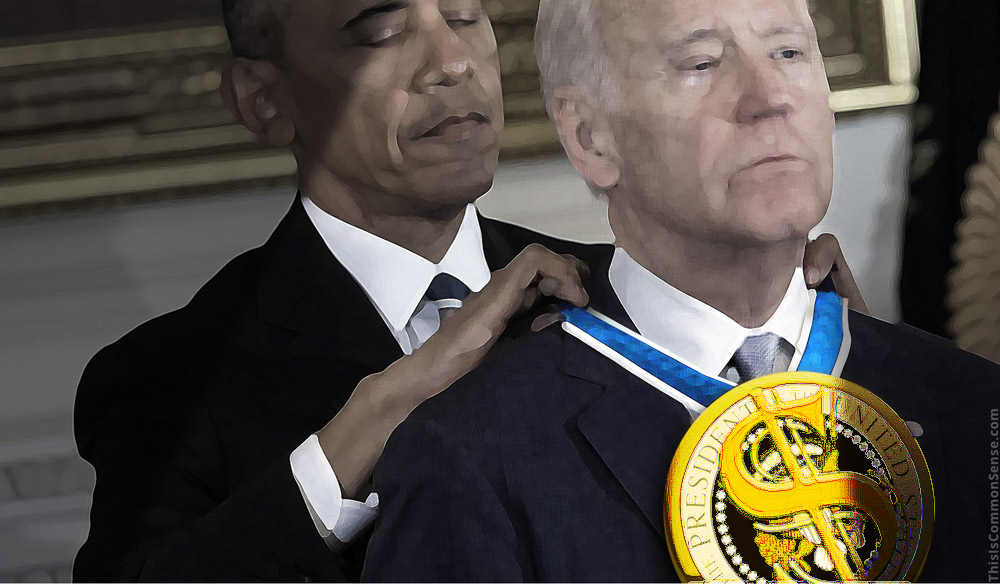
Worse Than Hypocrisy

“You shouldn’t accept any money from a Super PAC,” former Vice-​President Joe Biden claims he advised his presidential rival Sen. Bernie Sanders, “because [if you do] people can’t possibly trust you.”

Now it must be impossible to trust Mr. Biden.

“Joe Biden is apparently dropping his long-​held opposition to the creation of an outside group,” the media tepidly informed last week, “that would supply an infusion of money to benefit his campaign.”

That is: the dreaded Super PAC.

In his 2017 book, Biden claimed he would not have accepted such “outside” support had he entered the 2016 contest — even though he “knew there was big money out there for me.” 

Why not? “[I]n a system awash with money,” the former VEEP wrote, “the middle class didn’t have a fighting chance.” 

What changed? Now this drowsy Democrat actually needs campaign cash! 

“Biden has struggled to raise money, and last week, his campaign reported having $9 million on hand,” reports The Washington Post, “roughly a third as much as some of his top Democratic rivals.”

Necessity is the catalyst of hypocrisy?

“As president, Joe Biden will push to remove private money from our federal elections,” his campaign explained. “He will advocate for a constitutional amendment to overturn Citizens United and end the era of unbridled spending by Super PACs.”

Your private money and mine has as much right to engage in federal elections as Mr. Biden does. And I’ve warned  many times about the free-​speech repealing amendment the doddering Democrat frontrunner is pushing.

There may be worse things than hypocrisy, but there are few things worse than opposing First Amendment rights.

This is Common Sense. I’m Paul Jacob.


PDF for printing

Joe Biden, Obama, medal, money, campaign finance,

See all recent commentary
(simplified and organized)
See recent popular posts

Categories
national politics & policies too much government

Make Deficits Great Again?

Is Donald Trump really “draining the swamp”? 

It’s overflowing.

Stan Collender, writing last year in Forbes, noted just what a big spender the president really is. Now, an update: fiscal year 2019 sports a deficit of $1.09 trillion, up considerably from the $897 billion projected earlier this year; the next year is expected to nudge the deficit even higher, to $1.1 trillion.

The whys aren’t a mystery: it is politically difficult to cut an expected benefit to any constituency. It looks stingy — though it is the very opposite. Spending other people’s money — including taxpayers’ — is not generosity. For a politician, it is naked self-​interest. Buying votes.

Worse than merely corrupt, it’s corrupting — since the People are increasingly tempted to look to government to supply special voting bloc advantages rather than the mutual, universal advantage of liberty and justice for all.

Collender speculated that a $2 trillion deficit is “definitely within view” because “Trump is demanding that federal spending and the government’s red ink be increased even further.”

Judd Gregg, writing yesterday for The Hill, summarizes current GOP fiscal policy as “now the most profligate and debt-​driving party in the nation’s history.” 

He’s not wrong, but I question his next line: “Fiscal restraint is no longer part of the cloth the Republican Party wears.”

Careful wording. 

Republicans sometimes talk a good game, but are known to be big spenders when not opposing a Democratic president. The Class of 94 was effective against Bill Clinton. Under unified government in the aughts, though, under George W. Bush, they went on a spree.

Maybe Republicans just need a good enemy.

Bernie Sanders for President? 

Perhaps any socialist Democrat will do.

This is Common Sense. I’m Paul Jacob.


PDF for printing

money, case, window, floating, deficit, spending,

See all recent commentary
(simplified and organized)
See recent popular posts

Categories
national politics & policies political economy Popular

Re-​Packaging Nonsense as Wisdom

When committed to folly, clever people make it look wise.

An article last week in Forbes, “The Green New Deal: How We Will Pay For It Isn’t ‘A Thing’ — And Inflation Isn’t Either,” by Robert Hockett, says that “how could we pay for it?” challenges have already been answered best by Rep. Alexandria Ocasio-Cortez. 

She demands to know why only “useful ideas,” like hers, get challenged that way. “Where were the ‘pay-​fors’ for Bush’s $5 trillion wars and tax cuts, or for last year’s $2 trillion tax giveaway to billionaires?”

Where? Here!

And anywhere there’s common sense.

Hockney has his own retort, though, retrieving from the peanut gallery of economics an idiocy called “Modern Monetary Theory” (MMT). 

“Congress will authorize necessary spending, and Treasury will spend,” he writes. Government funds are “never ‘raised’ first” because “federal spending is what brings that money into existence.” 

Look, the United States has indeed come to rely upon debt financing. But it wasn’t always the rule. More importantly, the widespread and long-​term effects are where post-​gold standard monetary creation gets tricky. 

So are MMT advocates. Tricky, that is. What they hide are the dispersed costs, many of which we pay in higher prices.

Their main “contribution” — as stated in the National Review, of all places, yesterday — is that “When a government issues its own currency, as our federal government does, it is in a financial situation different from those of most institutions or households.”

Not really. When a household writes checks it knows will bounce, it does pretty much the same thing.

When governments rely upon debt money, someone is still getting ripped off. With government, though, it isn’t the businesses holding bad checks, it is all of us.

This is Common Sense. I’m Paul Jacob.


N.B. This episode of Common Sense has been corrected from the email version: the author of the Forbes article is not the painter David Hockney.


PDF for printing

green new deal, AOC, money, folly

See all recent commentary
(simplified and organized)
See recent popular posts