Categories
Accountability free trade & free markets insider corruption national politics & policies responsibility

United States of Corruption

When Hillary Clinton assured her insider sponsors (as we learned through WikiLeaks) that there would be a crucial difference between what she tells the people and what her actual policies would be, she was not merely admitting to a private and a public face.

The President is legally, and by honor, bound to serve the American people, not Goldman-​Sachs. What she was confessing to was more than the mere appearance of a conflict of interests.

She boasted a plan of betrayal.

In that light, President-​elect Donald Trump’s international business deals seem … what? His first diplomatic meeting — with Japanese Prime Minister Shinzo Abe — included his daughter and partner-​in-​business Ivanka.

It seems to at least wander into conflict-​of-​interest territory, if not stake claim and hoist up a flag proclaiming Trumpistan America!

So I was very pleased, yesterday, when the President-​elect vowed to step out from the running of his global business and branding empire.

Earlier, he had brushed off conflict-​of-​interest concerns, saying he could run his empire and … ours.

Apparently, his new White House appointees have convinced him that this business dealing while President was a huge problem. “I feel it is visually important,” he explained Wednesday morning, “as president, to in no way have a conflict of interest with my various businesses.”

Thanks, Steve Bannon?

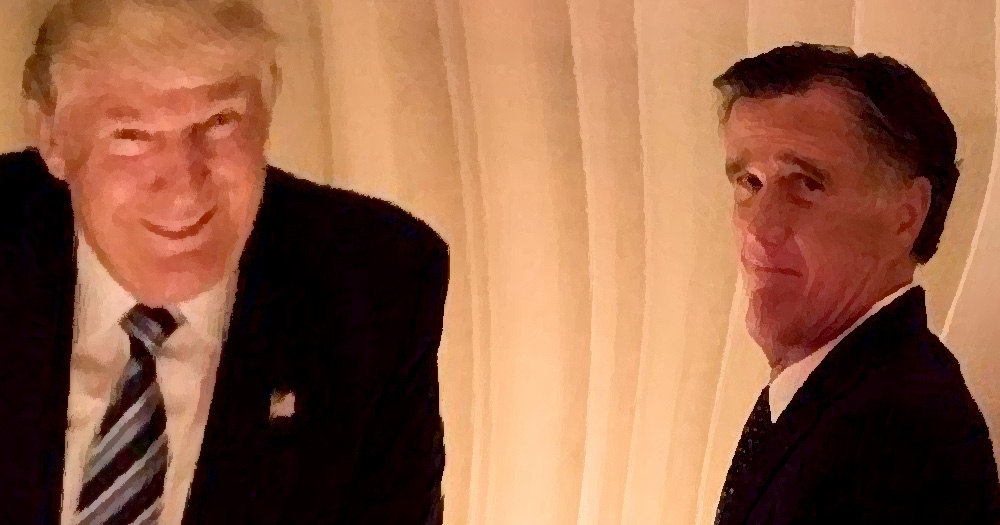
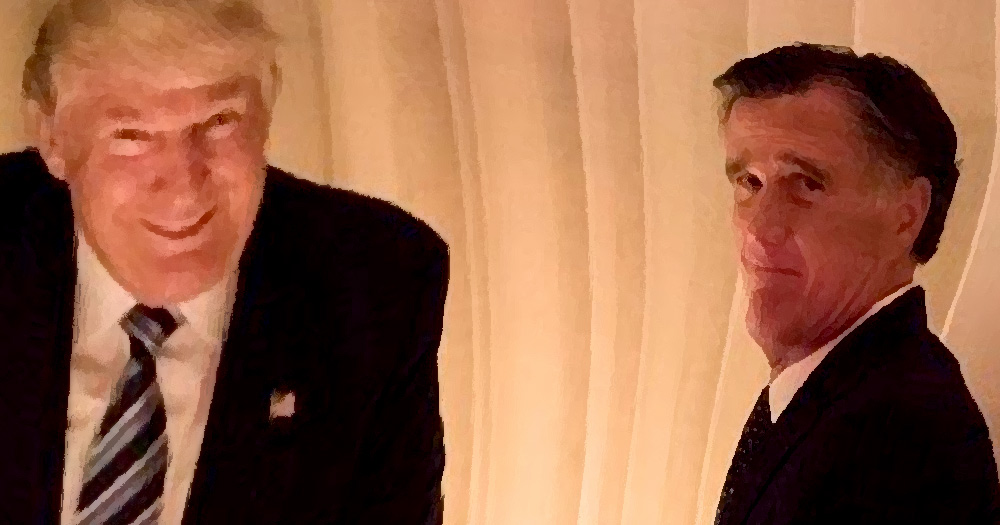
Or, maybe, Mitt Romney, with whom he dined* the night before?

I hope Mr. Trump follows through with this, as well as distance himself from business partner Ivanka as unofficial policy advisor.

Americans did not reject Corrupt Hillary only to wind up with a Corrupt Trump set.

This is Common Sense. I’m Paul Jacob.

Printable PDF

Romney, Trump, crow, corruption, dinner, illustration


Categories
ideological culture national politics & policies political challengers

Polled American!

More people view Mitt Romney unfavorably (49 percent) than view Barack Obama unfavorably (45 percent), according to the most recent Reason-​Rupe Poll. This, despite Romney being the challenger, while President Obama must live down his sorry record.

By this measure, and others in the poll, Obama’s re-​election seems ever more likely. And if you think that’s depressing, wait till you read about the general views of taxing the rich more. The “soak the rich” mentality remains quite strong. But some of this “the rich don’t pay their fair share” notion is based on misinformation. Get a load of this:

Last year, the government collected about $1.8 trillion dollars in income tax revenue. If you were to estimate, about what PERCENTAGE of this total tax revenue do you think the top 5 percent of households probably contributed? Would you say…

<1% . . . . . . . . . . . . . . . . . . .  3%

1% to less than 20% . . . . . . . 29%

20% to less than 40% . . . . . . 19%

40% to less than 60% . . . . . . 15%

60% to less than 80% . . . . . . 11%

80% or more . . . . . . . . . . . . . 8%

Don’t Know/​Refused . . . . . . . 16%

The truth is that America’s Top 5 percenters pay more than 60 percent of income taxes collected. The vast majority of those polled (66 percent) thought the Top 5 should pay less than they currently do.

I’m not going out on a limb, here, to infer a lesson: Were Americans to learn a few more truths about their government, about taxes, and (hey, why not?) real life, they might change their minds on a few crucial political notions.

Education — and by this I don’t mean schooling — is obviously important to political betterment.

This is Common Sense. I’m Paul Jacob.

Categories
ideological culture too much government

Togetherness

“We’re all in this together,” folks say. I’ve even said it. But are we?

Yesterday, I discussed Mitt Romney’s secretly recorded comments on the “47 percent” he believes are hell-​bent on supporting President Obama … and an apparently different 47 percent not paying federal income taxes. Romney expressed a not unreasonable fear that government bailouts and handouts and entitlements will cause dependency, and there will come a breaking point where those working and producing will be unable to shoulder that burden.

But Mr. Romney shouldn’t go along with the bifurcation of the American public facilitated by the structure of the federal income tax and the payroll taxes for Social Security and Medicare. Most people of all incomes are paying a lot more in taxes than they should have to, even when they do not pay federal income taxes.

Moreover, while no doubt some folks wallow in dependency through welfare or crony insider deals, the vast majority of Americans desire to stand on their own two feet. Part of the 47 percent not paying income taxes are people on Social Security, as noted in an online comment by John C. Bisely:

To lump Social Security in with the other parasites is very disturbing to me. I didn’t ask for SS, it was a government run insurance for my retirement that made sense, actually. The politicians used it as a cash cow and stole billions to buy votes — plus the fact, I gave them real dollars at the time I paid into it and they give me, inflated fiat!!!

Mr. Bisely, like most Americans, is not a parasite. He’s earned his way in this world. He deserves a less parasitic government.

This is Common Sense. I’m Paul Jacob.

Categories
ideological culture national politics & policies political challengers too much government

Bite the Hand

I’m not sure there’s much percentage in talking about percentages.

Divvying folks into groups, and then relying on people to “stay” within their group — behaving according to one’s specifications — seems … kind of creepy.

Last year’s “Occupy” movement, with its relentless pitching of the “99 percent,” demonstrated that creepy/​icky factor pretty well.

But Mitt Romney had to horn in on the action. “There are 47 percent of the people who will vote for the president no matter what,” he said. These wards of the state, he went on to say, believe that

  • they are victims
  • government has a responsibility to care for them
  • they are entitled to health care, to food, to housing, to you-name-it

Furthermore, “these are people who pay no income tax,” Romney stated. “I’ll never convince them they should take personal responsibility and care for their lives.”

Well, not all folks who are somehow “dependent on government” — a group ranging from Social Security retirees and the non-​working poor to federal employees and agribusinesses and Solyndras feeding at the federal trough — necessarily want to increase their own ranks. Not a few are savvy enough to notice that the system that feeds them would, if larded up with more recipients, be made less capable of feeding them.

As for the logic of “not biting the hand that feeds you,” the advice of the late Thomas Szasz is pertinent: “maybe you should, if it prevents you from feeding yourself.”

After all, many of the people who may qualify, technically, as being “dependent on government” would rather not be. And might like the option of being less encumbered by government “help.”

Mitt, I wouldn’t write them off yet.

This is Common Sense. I’m Paul Jacob.

Categories
national politics & policies political challengers

The Punisher Vote

As bad weather and thousands of good Republicans descend upon Florida, it’s worth keeping perspective: The best (and perhaps only) reason to vote for Mitt Romney is the same as the best/​only reason Americans had to vote for Barack Obama in 2008: to punish the party previously in power.

The excesses of united Republican government in the mid-​oughts, and the sheer irresponsibility and insider bias in the lame duck Bush years, as the GOP president panicked and turned Wall Street into the largest welfare queen class in America, required punishment.

Americans wanted a change. So they voted, understandably, for the man who promised change.

But what did they get?

Bush had pushed in a new welfare “entitlement” program; so did Obama and the Democrats. Bush had pushed bailouts for the wealthy and the protected; so did Obama and the Democrats. Bush had pushed war and occupation and “nation building”; so did Obama and the Democrats. Bush had presided over deficits and a rising debt; so did Obama and the Democrats.

Turnabout being not merely fair play, but the will of the pendulum to swing back, it seems like voting against Obama is what is in order. It seems almost ineluctable.

But, uh, there’s a problem. Is Romney electable?

Both major parties tend to throw up lackluster candidates when the opposition has an incumbent in the White House. Take three examples: Walter Mondale, Bob Dole, and John Kerry, paragons of pointlessness.

But, this time, a pointless challenger has history endow him with a point: Obama and the Democrats deserve to be punished.

Not much of a platform? True. But it’s something.

This is Common Sense. I’m Paul Jacob.

Categories
video

Video: Ryan’s “Path to Prosperity”

“Washington has not been telling you the truth,” says Rep. Paul Ryan — Mitt Romney’s selection for his running mate:

Consider what he offers, following up with the rest of the video in its second and third installments. 

But take caution. Rep. Ryan’s plan is very slow to take effect, if what you are aiming for is balanced budgets. And as David Boaz has argued, it’s a good example of Republican “me-​tooism,” of offering Democratic policy at an allegedly discounted price.

Contrary to what we are often told, there’s nothing radical about Ryan’s plan. Indeed, it’s so non-​radical, it makes him a perfect fit with Mitt Romney’s presidential bid. Of course, scuttlebutt has it that Romney will put forth his own, distinct plan, no doubt building on Ryan’s — and we will see what that is, whether it strengthens or weakens Ryan’s approach.

Categories
insider corruption too much government

Squelching the Revolution

During the months of primaries and caucuses, the popularity of Ron Paul was a fear expressed amongst both neoconservative and “mainstream” Republican insiders in hushed tones, rarely ever surfacing, but instead roiling under politics’ prudential lid. Now that Mitt Romney has sealed the nomination with enough delegates from the primary states, GOP insiders are trying to solidify their position.

Instead of magnanimously bringing Ron Paul’s supporters into the party to court them for the next four years, they seem to be doing their darnedest to keep them out. Take Romney’s gubernatorial state, Massachusetts.No Revolution

The GOP machine, there, has required that the Ron Paul nominees to the Tampa convention sign an affidavit to support Mitt. This is something new. Just for Ron Paul delegates. And of course some

libertarian-​leaning delegates balked at the notion of signing legal affidavits pledging what they had committed verbally at the caucuses where they were elected. Many later submitted them, but not until after the deadline.

As a result, the committee disqualified them, winnowing the number of Liberty delegates and alternates to the convention from 35 to 19.…

Not surprisingly, the duly elected delegates “feel cheated.”

A spokesman for the Massachusetts Republican Party would not say why the affidavits were required of delegates this year, and the chairman of the Allocations Committee would not agree to an interview. Instead, the chairman offered an e‑mailed statement saying that the Romney campaign, through its representative on his committee, had the right to reject delegates for “just cause.”

When I prophesy negative consequences of a Mitt Romney presidency, this sort of thing lingers in my mind. What is the GOP afraid of? Actual limits on government?

This is Common Sense. I’m Paul Jacob.

Categories
too much government

The Real Whopper

“Today, government at all levels consumes 37 percent of the total economy, or GDP,” Mitt Romney said earlier this month. “If Obamacare is allowed to stand, government will reach half of the American economy.”

Glenn Kessler’s Fact Checker column at the Washington Post slapped that statement with four “Pinocchios,” the worst possible condemnation for telling “whoppers.”

Yet, Kessler acknowledges Romney’s point. In 2011, local, state and federal “government expenditures amounted to 37.34 percent of the gross domestic product.” That percentage is expected to climb to just over 39 percent by 2020.

“But Romney goes way too far,” writes Kessler. Romney counts private medical expenditures, which will supposedly account for 10 percent of the projected 2020 economy. Romney’s campaign spokesperson argues Obamacare in part mandates that spending and thus the 10 percent is part of government’s “reach.”

Of course, the vast majority of all private payments for medical care — the 10 percent — would happen with or without Obamacare. So Romney’s figure does exaggerate. Still, government commandeering 37 or 39 percent of our economy seems a whopping amount.

Moreover, in making his case against including private health care spending, Kessler argues, under Romney’s notion of government reach, “a wide variety of industries, such as banking or housing, should also be counted as part of this government-​controlled economy.” Well, yes. Government spending accounts for nearly 40 percent of America’s GDP. Plus, government heavily regulates and interjects itself into major parts of the private sector.

Kessler thinks Romney’s statement is a real whopper, but Romney is on to something. What’s really whopping is government’s full reach, which includes over-reach.

This is Common Sense. I’m Paul Jacob.

Categories
initiative, referendum, and recall

Don’t Blame Me

Some folks are quick to blame the voters for the mess this country is in. Not me.

In 2008, Americans overwhelmingly opposed the TARP bailouts. Which candidate — Democrat Obama or Republican McCain — represented the majority of us on that central issue?

Neither.

This year, President Obama promises a significant tax increase and more government investment in crony capitalism. Republican nominee Mitt Romney pledges he won’t raise taxes and he’ll reduce at least the growth in spending via Rep. Paul Ryan’s plan.Initiative sign

But who would be surprised were Romney, even given a GOP Congress — especially given a GOP Congress — to fail miserably on his promises?

Voters choose candidates for the right reasons only to see those candidates, from both major parties, jettison their campaign promises, ad nauseam.

We aren’t mind readers. We’re simply not to blame for good-​faith decisions in a bad-​faith system.

We are to blame, however, for not taking the initiative to change the rottenness in the system.

Yet, how best to get outside this box, to effect real change, to take the initiative?

Why, the initiative, of course!

Twenty-​three states have viable processes for citizens to put initiative measures on state ballots. Even in states where no statewide initiative or referendum exists, like Texas and New York, most local jurisdictions have the initiative.

National changes can come from local action.

Increasingly, we must use the initiative not only to change the law, protect freedom, hold government accountable, reform the system, but also to set the political agenda directly from the grass roots.

This is Common Sense. I’m Paul Jacob.

Categories
political challengers

Ron Paul Switches Gears

The day before the official debut of Brian Doherty’s Ron Paul’s Revolution — the new book on the man, his crusade and his many enthusiastic supporters — Ron Paul slipped his 2012 presidential campaign into neutral:

Our campaign will continue to work in the state convention process. We will continue to take leadership positions, win delegates, and carry a strong message to the Republican National Convention that Liberty is the way of the future.

Moving forward, however, we will no longer spend resources campaigning in primaries in states that have not yet voted.

Ron Paul Revolution
The BBC puts Ron Paul’s delegate count at 104, with frontrunner Mitt Romney 178 short of a lock on the nomination — but that’s at present, before the upcoming primaries. As the BBC concisely summarized Dr. Paul’s campaign, he had some successes in “several contests, in states such as Maine and Nevada,” gaining “some delegates and sometimes a significant portion of the popular vote. But he was viewed by the Republican establishment as a candidate outside party orthodoxy, and he did not manage to win a single primary election.”

Talk to a Ron Paul organizer, and you can hear harrowing tales of how the Republican establishment treated Paul’s supporters as outsiders. Despite such ill treatment, chronicler Brian Doherty compares Ron Paul’s future influence on the party to that of the past influence of Barry Goldwater. “His fans understand that Ron Paul is not just out to win an election.”

Dr. Paul’s near-​term influence, though, is less obvious. In his 2008 outing he was shut out, and held his own very successful parallel rally. What he hopes to accomplish at the upcoming nominating convention remains to be seen. He concludes his letter with promise of further elaboration of his campaign’s delegate strategy. But his main thrust, in this letter and elsewhere, has been to build a long-​lasting movement.

This is Common Sense. I’m Paul Jacob.