Categories
general freedom international affairs media and media people

Europe, Land of the Free?

The Economist has declared Europe the Land of the Free.

One proof is that in Europe, no tech oligarchs are “spending their weekends feeding bits of the state ‘into the wood chipper.’”

This is an ill-​considered allusion to the efforts of Elon Musk and the Department of Government Efficiency to reduce the bloat and fraud in U.S. government spending. And the trillions in U.S. federal debt. Which are unsustainable. Because magic doesn’t work.

“Europeans can say almost anything they want, both in theory and in practice.” 

In Britain you can be arrested or jailed for praying, tweeting a wrong-​thinking tweet, reading from the Bible, holding up street signs.

Nor is freedom of speech safe in Germany. To prove the continent’s theoretical and practical freedom of speech, The Economist piles up carefully unelucidated half-​truths but declines to cite, for example, the conviction of German journalist David Bendels.

In February, Bendels, the editor in chief of Deutschland-​Kurier, published a satirical post slamming a German minister, Nancy Faeser, for opposing freedom of speech. An obviously doctored photo showed Faeser with a sign saying “I hate freedom of speech.” Faeser, who loves freedom of speech, filed a criminal complaint after being alerted by German police, who also love freedom of speech.

Bendels has been fined 1,500 pounds, given a suspended prison sentence of seven months, and ordered to apologize. 

He is appealing the verdict, and others are fighting the law under which he was prosecuted.

This is Common Sense. I’m Paul Jacob.


PDF for printing

Illustration created with Krea and Firefly

See all recent commentary
(simplified and organized)
See recent popular posts
Categories
First Amendment rights insider corruption

The Biden’s Four Ways

In response to controversies about pandemics, elections, and whatnot, Congress did not quite pass — nor President Biden quite sign — a new law abridging the freedom of speech, or of the press. (As far as I know.)

Biden’s government did act, regardless, with the force of law to shut people up. According to the Media Research Center’s new report on Biden censorship — ready to be shared with all who contend that his administration perfectly respected our freedom of speech — the cabal I call The Biden censored Americans using four approaches:

Direct action. For example, ordering a big tech firm or a judge to censor somebody. White house advisors, agency bureaucrats, and others exerted this kind of pressure.

Policy or rulemaking. Examples include the State Department’s agreement with foreign nations “to pressure Tech platforms to censor more” and Homeland Security’s attempt to create a Disinformation Governance Board to police speech.

Partnerships with state and private actors to censor speech. Biden’s National Security Council collaborated with the UK’s Counter Disinformation Unit to impose UK censorship on Americans.

Grants to organizations to attack and flag utterance of incorrect speech, which the government could then censor.

These were effectuated, by MRC’s count, with 57 initiatives.

As soon as he began his second term, President Trump issued executive orders to combat such muzzling of debate. Congress must do its part too.

No matter what defenses are put in place, though, we will see further attempts by government goons to gag us. We must be vigilant.

This is Common Sense. I’m Paul Jacob.


PDF for printing

Illustration created with Krea and Firefly

See all recent commentary
(simplified and organized)
See recent popular posts
Categories
First Amendment rights media and media people too much government

The Chirping Mockingbird

We are told that “there’s nothing to see” in the recent revelations about how USAID was subsidizing Politico

At Reason, Robby Soave pooh-​poohed the story: “some critics of USAID have seized on a misleading claim: Namely, that the organization was funneling millions of dollars to Politico. In reality, it appears that government agents were paying for subscriptions to Politico’s premium product. That may or may not be a worthwhile use of government funds (more on this in a moment), but at any rate, it does not represent some kind of direct subsidy to the news outlet.”

It could be, however, a subsidy with plausible deniability. 

The keyword may be: Mockingbird.

Remember the Church Committee investigations into the intel community, post-​Nixon? One of the revelations was of Operation Mockingbird, which was (“allegedly”) the CIA training and subsidizing of — and coordinating stories to — scores (perhaps hundreds) of individual journalists. 

One of the many things we don’t know about Mockingbird is if it ever ended. But one thing we do know is that programs begun by one agency not irregularly get taken up by others.

And speaking of multiple agencies — with more than a dozen dedicated to intelligence, why is government paying the private sector for information?

For all their massive appropriations, the basic job of intel agencies to inform (not lie to) representatives, government executives, and functionaries appears to be one they’ve skimped on.

Meanwhile, USAID’s massive subsidies to New Zealand news outfits has somehow received little interest. “Last week, Wikileaks reported that 25 NZ mainstream media outlets were given funding from USAID,” explains The Daily Blog. “We need an immediate explanation from our Mainstream Media Owners if they changed any editorial stance that aligned us with America while taking this money.”

Inquiring minds should be skeptical of underplaying of these revelations. Don’t we need a wall of separation between press and state?

This is Common Sense. I’m Paul Jacob.


PDF for printing

Illustration created with Flux and Firefly

See all recent commentary
(simplified and organized)
See recent popular posts
Categories
media and media people social media

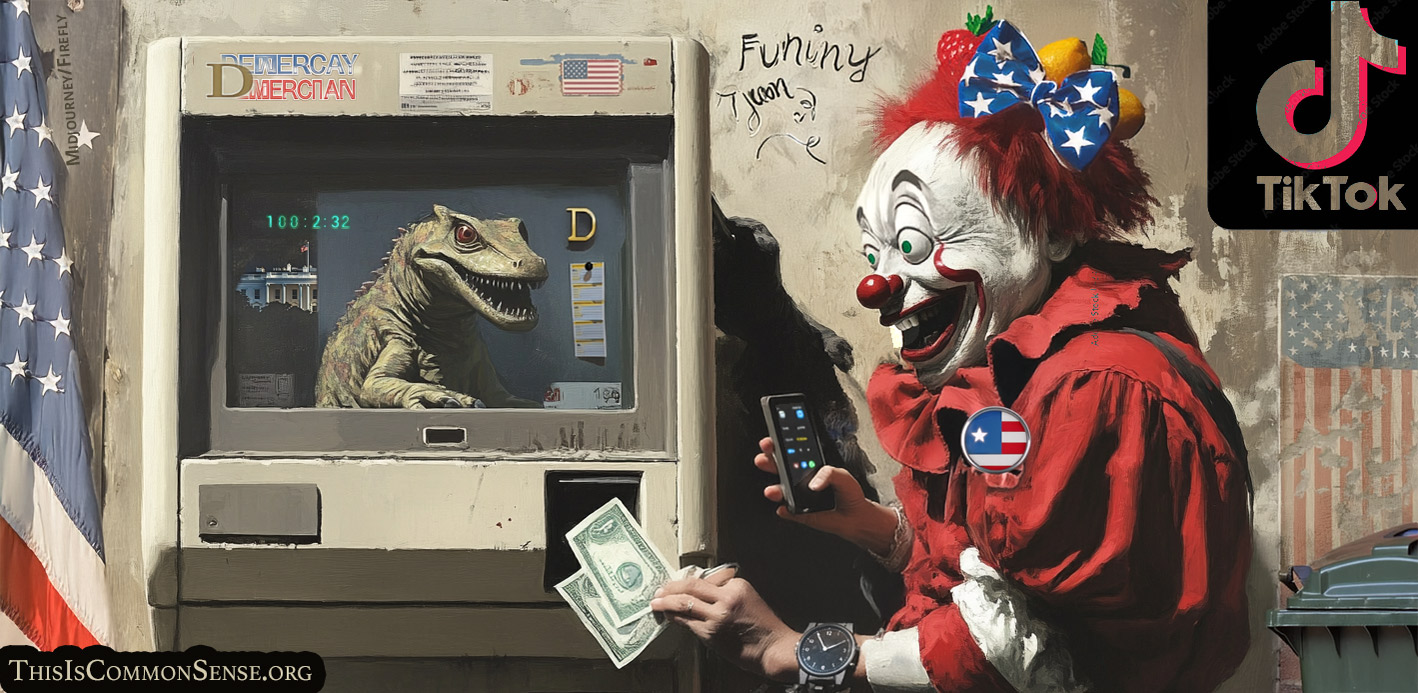
TikTok Astroturf

According to sociologist Jacques Ellul, propaganda is not rhetoric; it’s not you and me expressing our opinions and trying to persuade others; it’s not our letters to editors of newspapers or the “memes” we share online. Propaganda is the coordination of many forms of social influence, of many media. States are usually involved, or political parties (wannabe states) or huge interest groups (which can be bigger than many states).

If, however, you secretly get paid to push a message in a specific way, you may be a propagandist.

Take TikTok.

This is the video-​sharing social media site so popular with young people. It’s been controversial; I’ve discussed it before. But I’m no expert. Still, I was not surprised to learn that Democrats have been paying “social influencers” on that platform to serve up the Democratic Party line.

A TikToker named Madeline Pendleton made a video about how the Democrats offered “nearly $15,000” to talk about “how awesome the Democratic Party is.” She found the idea ridiculous, characterizing the offer as a way to distract attention from the party’s “genocide.” But she recognizes that it can be effective. Many of her “mutuals” on TikTok are indeed spouting the same lines that she was “pitched” by Democrats, and they did so within 48 hours of her receiving the offer.

She went on to say that she received two offers: one to make ongoing videos up to the election, and the other to scarify Heritage Foundation’s Project 2025, which she is no fan of, but thinks is not that big a deal.

“You guys should be aware that that when you see videos like that, the Democrats are actively paying people to talk about how awesome the Democrats are.”

Awesome propagandists, anyway.

This is Common Sense. I’m Paul Jacob.


PDF for printing

Illustration created with Midjourney and Firefly

See all recent commentary
(simplified and organized)
See recent popular posts
Categories
First Amendment rights insider corruption national politics & policies

Hillary Disinformation Hunt

Have you heard? It’s open season on disinformation.

Disinformation spewed by Hillary Clinton, that is.

Mrs. Clinton has escaped jail time for all her previous crimes, whether committed singly or in partnership with her husband. But now we are going to have a brand-​new crime to charge her with. And boy, is she a serial offender!!!!!!

The irony is, we would not even be able to charge anybody with this new category of crime — if indeed we’ll be able to; there’s still some controversy about it — but for the contempt of Hillary Clinton and politicians like her for the First Amendment rights that a large minority of Americans hold so dear.

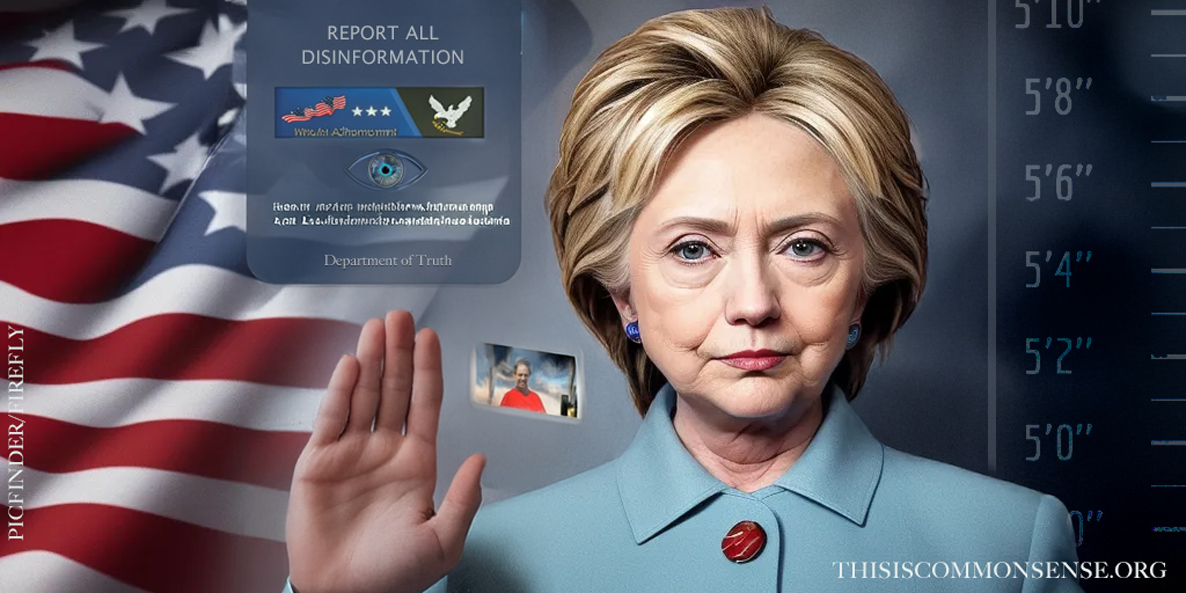
Hillary Clinton, on MSNBC: “I think it’s important to indict the Russians … who were engaged in direct election interference.… But I also think there are Americans who are engaged in this kind of propaganda, and whether they should be civilly or even in some cases criminally charged is something that would be a better deterrent.”

Yes, Hillary Clinton “got away with” everything else. But can she get away with all her lies and, let’s face it, downright disinformation, certainly heavily disseminated by her around election times? 

Heck, even if the new category of criminal offense won’t be applicable retroactively, thus giving her a free pass for the last umpteen years, are we in any danger of running out of actionable Hillary disinformation going forward? Does a leopard change its spots?

Maybe she’s counting on selective enforcement.

This is Common Sense. I’m Paul Jacob.


PDF for printing

Illustration created with PicFinder and Firefly

See all recent commentary
(simplified and organized)
See recent popular posts
Categories
First Amendment rights media and media people political challengers social media

The Ignorance of Censorship

Why is Tim Walz, Harris’s running mate, governor of Minnesota right now?

Perhaps because government censors — functioning through agents like Mark Zuckerberg’s Facebook — made it harder to hear his opponent, Dr. Scott Jensen, during Walz’s 2022 re-​election campaign.

A shift in a few percentage points would have tilted things in the challenger’s favor. But Jensen had made the government’s response to the pandemic — including the tyrannical policies of Walz’s state government — a central theme of his campaign.

And in those days (as in these), all-​out censorship of various deviations from the government line was de rigueur. Disagreement about COVID-​19, both the nature of the infection and the wisdom of the government’s response, was among the targets.

Jeffrey Tucker asks “Why Did Zuckerberg Choose Now to Confess” to the fact that Facebook had done so little, in Zuckerberg’s words, to resist repeated pressure “from the Biden administration, including the White House … to censor certain COVID-​19 content”?

The answer to the uninteresting question “why now?” is standard CYApolitical calculus. In any case, the confession isn’t quite exhaustive; Zuckerberg doesn’t acknowledge the extent of the censorship. As Tucker notes, “every single opponent of the terrible policies was deplatformed at all levels.”

The single COVID-​contrarian piece by Tucker himself that slipped through the social-​media censorship net “by mistake” got an atypical tsunami of response. So what if Dr. Jensen’s message and arguments had not been perpetually smothered by government-​pressured social-​media companies?

Jensen may still have lost (Walz got 52 percent) but the point of elections goes further than a horse race. Where there is free speech, voters can learn something.

This is Common Sense. I’m Paul Jacob.


PDF for printing

Illustration created with PicFinder and Firefly

See all recent commentary
(simplified and organized)
See recent popular posts
Categories
First Amendment rights national politics & policies

Say No to Reich-​Harris Reich

Freedom of speech is constantly embattled.

Just one example: government-​instigated stomping on social-​media speech in recent years, proof of which has been revealed thanks to litigation, freedom of information requests, and the purchase of Twitter by a friend of free speech.

But the embarrassing revelations have not caused our censors to retreat.

They’re not trying to censor people, they suggest, just trying to stop lies, hate, misinformation. And now Robert Reich, former Secretary of Labor, wants to arrest Elon Musk for resisting censorship as Twitter’s new owner.

Reich says: “Regulators around the world should threaten Musk with arrest if he doesn’t stop disseminating lies and hate on X.”

Reich has also said that we must regulate speech to “direct people’s attention … to a healthy public conversation that is most participatory.” As Jonathan Turley observes, “the ‘healthy public conversation’ with Robert Reich increasingly appears to be his talking and the rest of us listening.”

Would “regulators around the world” include U.S. regulators? Since the First Amendment has yet to be rescinded, perhaps Reich would prefer other countries to handle imprisoning Elon Musk for letting people speak “too” freely. But I’m guessing Reich would be fine with a U.S. arrest.

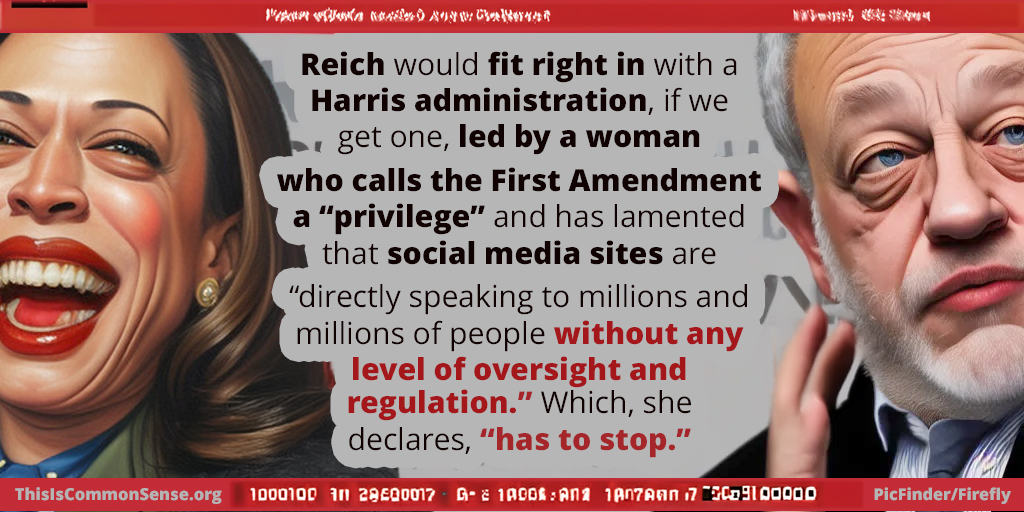
Reich would fit right in with a Harris administration, if we get one, led by a woman who calls the First Amendment a “privilege” and has lamented that social media sites are “directly speaking to millions and millions of people without any level of oversight and regulation.” Which, she declares, “has to stop.”

Something has to stop.

This is Common Sense. I’m Paul Jacob.


PDF for printing

Illustration created with PicFinder and Firefly

See all recent commentary
(simplified and organized)
See recent popular posts
Categories
First Amendment rights international affairs social media

Banned in Brazil

Twitter is being banned in Brazil by a “Supreme Court justice” who seems to be the de facto ruler of the country. Who is also threatening Brazilians with massive fines, $8,900 USD daily, if they try to reach Twitter through a VPN.

A VPN or virtual private network hides your IP address and encrypts your web traffic. VPNs protect privacy and let you visit sites otherwise inaccessible. Sites that purvey “disinformation,” i.e., criticism of the government, and other verboten content. VPNs combat censorship and surveillance.

The justice, Alexandre de Moraes, issued an edict to ban Twitter after Twitter owner Elon Musk refused to obey censorship orders.

Twitter had told users that it expected to be shut down by Justice de Moraes “because we would not comply with his illegal orders to censor his political opponents.”

Now Musk declares that an “unelected pseudo-​judge in Brazil is destroying [free speech] for political purposes.”

Twitter CEO Linda Yaccarino adds that according to Brazil’s own constitution, “censorship of a political, ideological and artistic nature is forbidden.… Until there is change in Brazil, X [Twitter] will be shut down.”

Dictatorships often issue “illegal orders” in the sense that these contradict constitutional provisions whose force has faded … or that were never intended to do anything but fool people to begin with. Such political systems are not truly constitutional.

Nor would the situation be any better were the “constitution” more honest, simply announcing that whatever the dictator says goes.

This is Common Sense. I’m Paul Jacob.


PDF for printing

Illustration created with Firefly

See all recent commentary
(simplified and organized)
See recent popular posts

Categories
First Amendment rights too much government

Deep State in a Corner

Once upon a time, the CIA and allied agencies pushed free speech as a norm. 

Overseas.

The rationale? Without some free speech and press rights, it was too hard to organize a populace to overthrow their government. Our spooks exported freedom of speech abroad not because they were so gung-​ho American; it was all about seeding revolutions.

But not here! 

The CIA couldn’t let others take advantage of American free speech like its agents leveraged free speech abroad. A change in government might mean … loss of jobs. Mission. Money.

What to do? Disinform at home. By corrupting journalism.

The Operation Mockingbird efforts in the 1960s helped intel insiders control information and manage “the consent of the governed,” and these early efforts grew into the close ties between the Deep State and credentialed journalists today. 

The connections, I’m told are many: it’s not just Anderson Cooper’s internship at the CIA. 

During the Cold War, the disinformation element found a plausible justification. Then, the Soviets had us at a disadvantage: we had trouble extracting reliable information from within the Iron Curtain, but they could grab all sorts of useful information from our open, comparatively free speech realm.

Disinformation: a strategic necessity. But the consequences?

 “We’ll know our disinformation program is complete,” William Casey explained to President Ronald Reagan, “when everything the American public believes is false.”

In the early days of the Internet, the Deep State pushed online speech platforms, the better to allow for foreign coups. Is there a social media space that hasn’t received surreptitious government subsidy? It’s hard to be sure. We’re supposed to assume our government protects us rather than controls us. 

But, increasingly, Internet-​connected Americans see government officials chiefly as manipulators.

Which is why the Deep State’s most ardent partisans (neocons; Democrats; plutocrats) now routinely attack free speech here, and why allies overseas are so thoroughly cracking down on “de-​stabilizing” opinions. It’s why Rumble is no longer available in Brazil and why Musk is pulling out Twitter personnel … and why France has arrested the CEO of Telegram.

Us catching on to the psy-​op game places the Deep State in a corner. All the disinformation agents have left is censorship and repression.

This is Common Sense. I’m Paul Jacob.


PDF for printing

Illustration created with Midjourney and Firefly

See all recent commentary
(simplified and organized)
See recent popular posts
Categories
First Amendment rights international affairs social media

Give Mr. Bean Another Hearing

Twelve years ago, Rowan Atkinson of “Mr. Bean” fame took a stand against a law that criminalizes “insulting” speech. He was participating in a campaign to reform Section 5 of the Public Order Act of 1986.

In his remarks launching the campaign, recently resurrected on Twitter, Atkinson said that his concern was less for himself as a person with a high public profile than “for those more vulnerable because of their lower profile. Like the man arrested in Oxford for calling a police horse gay. Or the teenager arrested for calling the Church of Scientology a cult. Or the café owner arrested for displaying passages from the Bible on a TV screen.”

And what about the thousands of cases that “weren’t quite ludicrous enough to attract media attention? Even for those actions that were withdrawn, people were arrested, questioned, taken to court and then released.… That is censoriousness of the most intimidating kind.…”

And he said more than this. Luckily it’s recorded.

This effectively delivered argument, forceful and often funny, by a well-​known personality, had its effect. The Reform Section 5 campaign succeeded. The law was amended.

But the victory, though important, was narrow. And, since that win, sweeping assaults on speech that offends somebody or other continue in Britain, the United States, and other Western countries where people should know better than to emulate the censorship of authoritarian governments to which we aspire to provide an alternative. We’re going to need a lot more funny speeches.

Because this threat to freedom is so serious.

This is Common Sense. I’m Paul Jacob.


PDF for printing

Illustration created with PicFinder and Firefly

See all recent commentary
(simplified and organized)
See recent popular posts