Categories
First Amendment rights international affairs

Brazilian Censors Banned!

The American government — after years of nurturing a censorship agenda in the South American country — is now penalizing Brazil’s super-censor Supreme Court justice, Alexandre de Moraes, along with various colleagues, for imposing censorship demands on U.S. companies.

The U.S. State Department revoked their visa privileges, preventing them from entering the United States. The general policy had been introduced May 28, when Secretary of State Rubio announced that it would apply to “foreign officials and [other] persons . . . complicit in censoring Americans.”

By then a UK police commissioner, Mark Rowley, had threatened to “come after” Americans who violate UK “hate speech” laws.

The Trump administration “will hold accountable foreign nationals who are responsible for censorship of protected expression in the United States,” Rubio says.

“Brazilian Supreme Federal Court Justice Alexandre de Moraes’s political witch hunt against Jair Bolsonaro created a persecution and censorship complex so sweeping that it not only violates basic rights of Brazilians, but also extends beyond Brazil’s shores to target Americans.”

Bolsonaro, a former president of Brazil, is on trial for allegedly seeking to overturn the country’s 2022 presidential election. He has been prohibited from posting on social media or communicating with others under investigation. 

One on this no-contact order is his own son, Eduardo Bolsonaro, currently living in the U.S.

Having ordered social media platforms Rumble and X(-Twitter) to censor opposition figures, Justice Moraes acted to block both services from operating in Brazil when the platforms disobeyed him.

“Free speech,” said X’s Elon Musk, “is the bedrock of democracy and an unelected pseudo-judge in Brazil is destroying it for political purposes.” 

It’s a wonderful thing to have our government once again defending democratic free speech — from its enemies foreign and domestic.

This is Common Sense. I’m Paul Jacob.


PDF for printing

Illustration created with Krea and Firefly

See all recent commentary
(simplified and organized)
See recent popular posts
Categories
general freedom ideological culture Voting

Thoughts on Nothingness

“Democracy has nothing to do with liberty,” the Libertarian Party announced on Facebook, “just as so many of the world’s greatest minds have warned.”

Huh? Just exactly which “greatest minds” are we talking about?

Not Aristotle!

The party’s statement introduced a meme quoting Hans-Hermann Hoppe, the “Austrian school economist and libertarian/anarcho-capitalist philosopher,” Professor Emeritus of Economics at UNLV and Distinguished Fellow with the Ludwig von Mises Institute. It read: “Democracy allows for A and B to band together to rip off C. This is not justice, but a moral outrage.”

Dr. Hoppe has a point, of course. The ‘will of the people’ can be just plain wrong . . . even, at times, malevolent.  A democratic vote can lead to the tyranny of the majority and even to a tyranny of the minority, as those politicians promising to serve ‘We the People’ end up serving themselves and their cronies.

I’ve not read Professor Hoppe’s Democracy: The God That Failed, where he sort of argues for monarchy over democracy, but I offer two points: (1) no one in their right mind talks of democracy without including the protections of basic individual rights, which have become the hallmark of democratic countries across the globe, and (2) no one in the real world thinks democracy is God.

Still, we won’t trade it for monarchy

My issue with this social media post, however, is really with the Libertarian Party’s comment that “democracy” — including the democratic means the party has purportedly been employing across the country for decades — has provided no past benefit and offers no future hope for sustaining or expanding our freedom.

So, don’t vote Libertarian this November?

I’ll take that under advisement.

This is Common Sense. I’m Paul Jacob.


PDF for printing

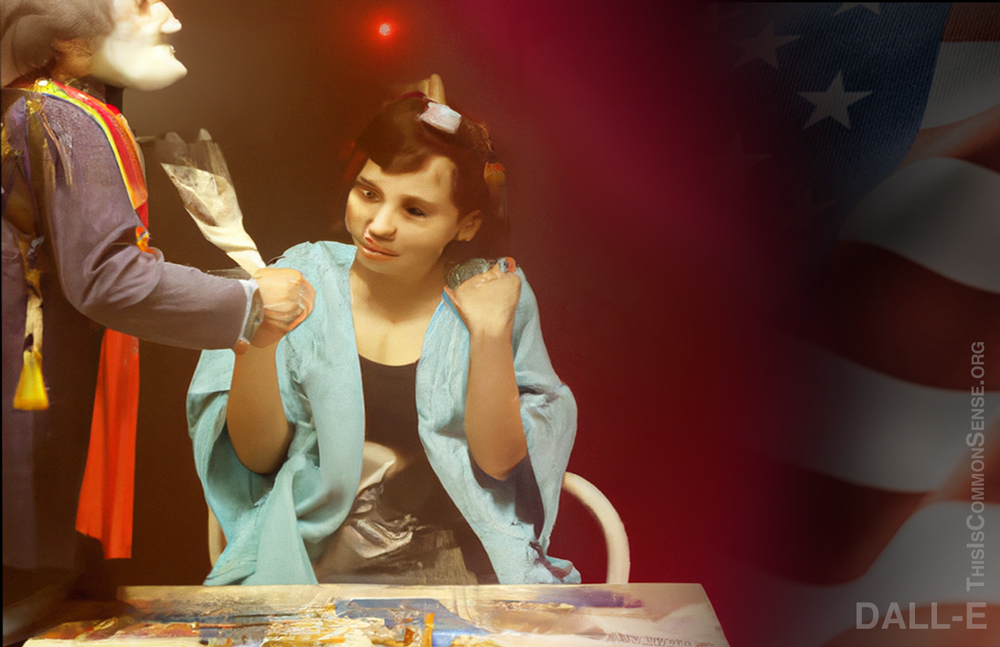
“Liberty Playing Cards with Aristotle” by DALL-E (note that the AI has chosen to show Lady Liberty as bruised and beaten. Her torch appears to be made of tissue.-)

See all recent commentary
(simplified and organized)
See recent popular posts

Categories
audio podcast

Listen: U-turn Time

The big stories of the week revolve around big government, which mean big theft, which is not unrelated to socialism:

Categories
general freedom too much government

Diners’ Rebellion

Italy was hit hard by COVID-19, and harder by the lockdowns. 

The lockdown idea — with which we are more than familiar in America — rests upon the notion that the best way to fight a new contagion is to rob it of hosts, and the best way to do that is to enforce anti-social edicts, forbidding normal human interaction thereby (the rationale goes) limiting spread of the disease. 

But Italians are not, say, Scandinavians. While folks up north (and in much of America) tend to maintain a more extensive baseline social distance, by custom enforcing a fairly wide personal space, in Italy folks tend to be much more hands-on, requiring close human contact for everyday happiness. So even had lockdowns worked, they would have been traumatic. But lockdown results have been dubious at best.

So Italians are rebelling.

Specifically, restaurateurs.

And their patrons.

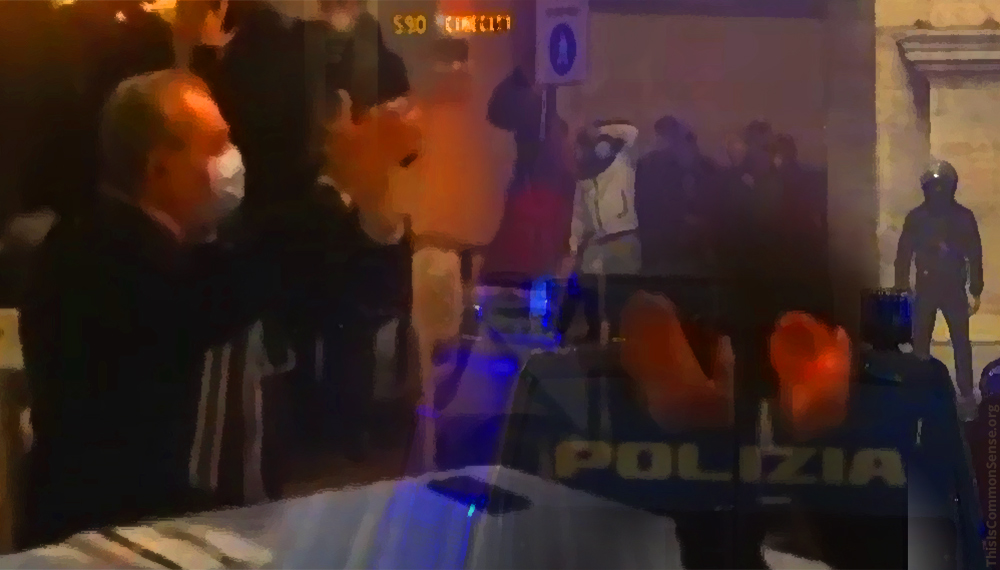
“Thousands of restaurants have opened in Italy in defiance of the country’s strict Chinese coronavirus lockdown regulations,” we read at Breitbart. “The mass civil disobedience campaign —  launched under the hashtag #IoApro (#IOpen) — has seen as many as 50,000 restaurants opening despite evening curfew restrictions.”

My favorite video has diners in Bologna shouting police out of an illegally open restaurant with chants of “Libertà!”

News outfits in America do not appear to be giving much attention to the anti-lockdown movement in Italy — or elsewhere in Europe. It is almost as if the story does not fit The Narrative, which (do I have this right?) has Europeans more accepting of government paternalism, leaving Americans as the more uncooperative, unruly individualists to be controlled by a browbeating press.

But lockdown protests here are nothing like that in Europe.

Makes me a bit sad for America, actually.

This is Common Sense. I’m Paul Jacob.


PDF for printing

See all recent commentary
(simplified and organized)
See recent popular posts
Categories
general freedom media and media people

The Four Froms

Liberty was a straightforward concept.

Once. 

Then The New York Times got ahold of it back in April with a featured editorial: “The America We Need.” 

“Our society was especially vulnerable to this pandemic,” the paper alleges, “because so many Americans lack the essential liberty to protect their own lives and the lives of their families.”

The fight against the Wuhan virus has been deficient due to a deficit of . . . “essential liberty”? 

This isn’t the Merriam-Webster definition of “liberty,” i.e. the “quality or state of being free” or “freedom from physical restraint.” Dump that retro “narrow and negative definition,” advises the editorial; it represents an “impoverished view of freedom” that “has perpetuated the nation’s defining racial inequalities and kept the poor trapped in poverty.”

Freedom of speech, religion, the press, etc., are all negative. Trade them in for a “broad and muscular conception of liberty: that government should provide all Americans with the freedom that comes from a stable and prosperous life.”

Prosperity for all! For free! Come on down!

Noting the “extraordinary nature of the crisis,” the editorial calls for “permanent changes in the social contract” to take the nation “beyond the threadbare nature of the American safety net.”

Free stuff from the government, housing, healthcare — all very positive ideas of liberty. 

But what about these positives’ negatives?

“A government big enough to give you everything you want,” former President Gerald Ford once explained to Congress, “is a government big enough to take from you everything you have.”

The cost of “positive freedom” is our freedom from dependence, from interference, from coercive control, from . . . oppression.

Positively negative, if you ask me.

This is Common Sense. I’m Paul Jacob.


PDF for printing

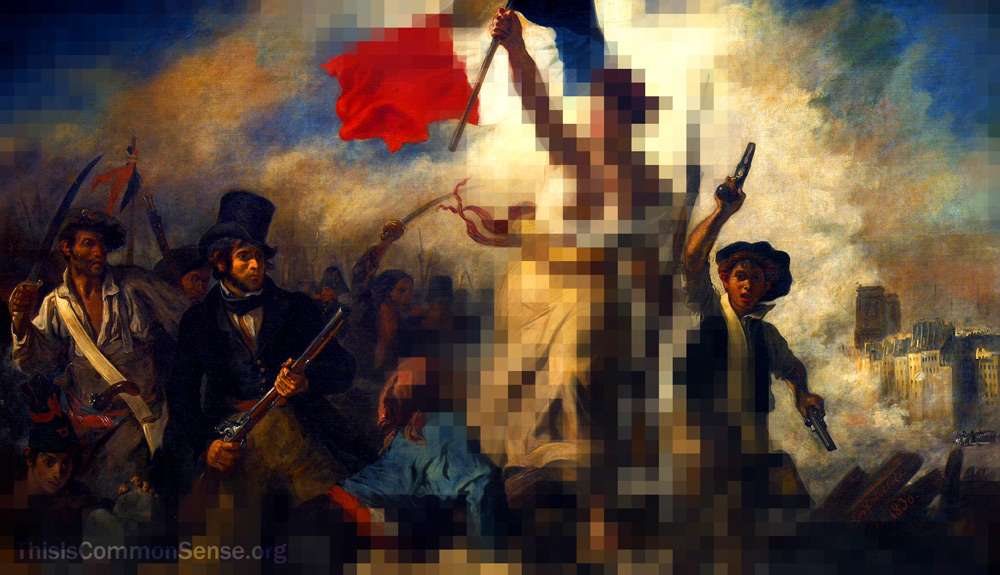
Illustration adapted from Liberty Leading the People (La liberté guidant le people) by Eugène Delacroix (1830)

See all recent commentary
(simplified and organized)
See recent popular posts
Categories
general freedom ideological culture Popular

America, the Debatable?

“A divided America gathers for Fourth,” The Washington Post headlined its lead story about the Independence Day celebration on the National Mall.* 

Give me two minutes to unite us.

On the night of July 3rd, stuck in horrendous holiday traffic, I stumbled upon a National Public Radio broadcast discussing the punk rock song, “’Merican,” by Descendants. The operative lyrics being:

I’m proud and ashamed
Every fourth of July
You got to know the truth
Before you say that you got pride

“Truth,” now that’s heavy, man. What’s the truth about ’Merica — er, America?

It is certainly true that our government — in our name — has done some terrible things. And, accordingly, to suggest that criticism is unpatriotic is, well, to miss the point of why I feel very proud to be an American. 

On the 150th anniversary of the Declaration of Independence, President Calvin Coolidge called July 4, 1776 “one of the greatest days in history” and “not because it was proposed to establish a new nation, but because it was proposed to establish a nation on new principles.” Those being “that all men are created equal, . . . endowed with certain inalienable rights, and that . . . the just powers of government must be derived from the consent of the governed.”

What this offers us is a standard to criticize America.

That is why it seems strange to witness folks criticizing current policy and behavior based on principles derived from the Declaration, yet, in the same breath, spurning America in the process. When America is wrong, let us right it — in true American style.

We may be divided on many issues, but on the ideals set forth in the Declaration of Independence we should all stand united.

This is Common Sense. I’m Paul Jacob.


* This was the headline in the print edition dropped on my driveway July 5th; the online version carried a different headline: “Trump’s Fourth of July celebration thrills supporters, angers opponents.”

** Love him or despise him, Rep. Justin Amash made a similar point in his op-ed about leaving the GOP to become an independent: “Our country’s founders established a constitutional republic . . . so ordered around liberty that, in succeeding generations, the Constitution itself would strike back against the biases and blind spots of its authors.

PDF for printing

liberty, freedom, independence, debate, American,

See all recent commentary
(simplified and organized)
See recent popular posts
Categories
general freedom U.S. Constitution

Why We Fought

When I was young, we were instructed to revere the men dubbed by President Warren Harding as “the Founding Fathers.” Reverence has since gone out of fashion.

Even today’s freedom-minded often express a general iffiness about America’s separation from England.

Now, I’m so deep-seatedly anti-monarchical, so resolutely anti-royal that I tend to shake my head at this sort of stuff. Yet people I very much admire might be called Revolution Liberty Skeptics.

“Can anyone tell me why American independence was worth fighting for?” asks economist Bryan Caplan. He says “it’s hard to get a decent answer” on specific policies improved by the secession from the Empire, at least liberty-wise.

He speculates, for example, that separation “allowed American slavery to avoid earlier — and peaceful — abolition.”

Historian Jeffrey Rogers Hummel ably answers him, noting that before “the American Revolution, every New World colony, British or otherwise, legally sanctioned slavery, and nearly every colony counted enslaved people among its population. As late as 1770, nearly twice as many Africans were in bondage throughout the colony of New York as within Georgia, although slaves were a much larger percentage of Georgia’s population.” Vermont, which did not join the union until 1791, abolished slavery in 1777. By 1804, gradual emancipation had begun in all the remaining northern states that had not abolished slavery outright.*

Do we really think all this would’ve happened under British rule?

As Hummel reminds us, “emancipation had to start somewhere.”

It started in the country that put liberty up front.**

Scoffing at the Revolution now won’t put liberty further forward.

This is Common Sense. I’m Paul Jacob.


* New York’s gradualist plan declared all children of slaves born after July 4, 1799, to be free after ages 25 and 28 years, female and male, respectively.

** Hummel makes good points on other freedoms, too.


Categories
Accountability First Amendment rights folly general freedom ideological culture media and media people moral hazard nannyism national politics & policies Regulating Protest too much government U.S. Constitution

Freedom “Weaponized”

Justice Elena Kagan has a way with words. The conservative majority on the court, she said after two recent rulings, is “weaponizing the First Amendment.”

What a phrase! But what does it mean?

“Conservative groups, borrowing and building on arguments developed by liberals,” explains The New York Times, “have used the First Amendment to justify unlimited campaign spending, discrimination against gay couples and attacks on the regulation of tobacco, pharmaceuticals and guns.”

First: if “liberals” now find themselves not supporting the idea of particular freedoms, or freedom in general, are they really “liberal”?

Second: “borrowing arguments” is what we expect to happen. Logic isn’t partisan.

Third: the point of the Bill of Rights is to “weaponize” the defense of freedom.

Remember, it is freedom of speech; freedom of the press; freedom of association; freedom of exercising one’s religion. The First Amendment weaponizes their defense by disallowing Congress from legislating against them.

Now, it has long been a “problem” that these listed freedoms blend together. They all work together or don’t work at all. And each points to freedom more broadly.

Kagan wants to read freedoms narrowly — though liberals historically have, indeed, read them broadly.

She’s objecting to two recent rulings. The first prohibits states from requiring pregnancy centers to talk up abortion options to their clients. An obvious free speech issue. The second prohibits governments from backing unions in their extraction of “agency fees” from non-members. An incontrovertible issue of freedom of association.

Kagan and The New York Times apparently think that “liberalism” means defending some freedoms in some contexts, but denying freedom in others.

This is Common Sense. I’m Paul Jacob.


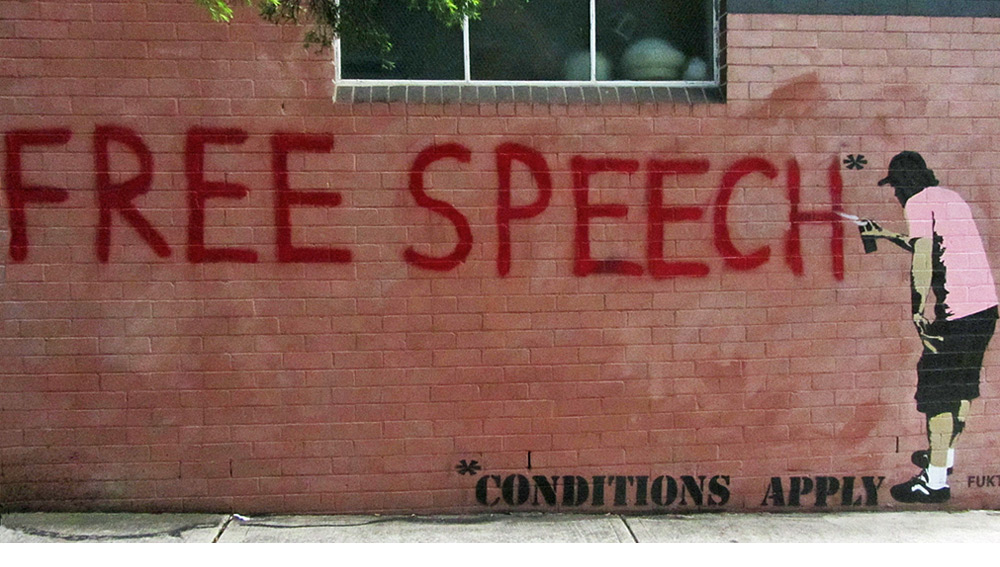
Illustration by Newtown grafitti


Categories
First Amendment rights general freedom media and media people moral hazard national politics & policies Regulating Protest too much government

Crossing the Twitter Rubicon

No sooner had I upbraided media folks for overreacting to various presidential peccadillos regarding Puerto Rico, when Donald J. Trump, in his running media battle, crossed a line with this week’s most notorious tweet.

He first complained, perhaps correctly, that, “Fake @NBCNews made up a story that I wanted a ‘tenfold’ increase in our U.S. nuclear arsenal. Pure fiction, made up to demean.” But then the chief executive officer of the United States of America tweeted this: “With all of the Fake News coming out of NBC and the Networks, at what point is it appropriate to challenge their License?”

The answer to his question is: never.

The Federal Communications Commission licenses the network affiliates of ABC, NBC and CBS across the country — not the networks themselves — to broadcast their television signals using public airwaves. Still, through those affiliates a tyrannical FCC could no doubt damage the networks.

Government licensing of media outlets is anathema to the First Amendment. And the thought of the POTUS actively threatening the ability of NBC or other networks to report the news as they freely decide is . . . well, unthinkable.

I don’t buy the accusations that Trump is undermining freedom of the press by criticizing the press — even arguing by tweet, “The FAKE NEWS media (failing @nytimes, @CNN, @NBCNews and many more) . . . is the enemy of the American People!” The president is as free to criticize the media as the media is free to criticize the president.

It might be his duty.

But considering the use of official government power to potentially “shut down NBC and other American networks,” as UK’s Independent reported, or just to temper their coverage?

Despotism.

This is Common Sense. I’m Paul Jacob. 


PDF for printing


Categories
meme too much government

Freedom, not Force