Categories
Accountability crime and punishment moral hazard nannyism national politics & policies property rights too much government U.S. Constitution

Watcha Gonna Do?

At a White House meeting last week between President Trump and law enforcement officials, a Texas sheriff raised a concern about legislation introduced by a state senator to require a conviction before police could take someone’s property.

Mr. Trump asked for that senator’s name, adding, “We’ll destroy his career.” The room erupted with laughter.

“That joke by President Trump,” Fox News’s Rick Schmitt said on Monday, “has the libertarian wing of the Republican Party raising their eyebrows, instead of laughing.”

Not to mention the civil libertarians in the Democratic Party and the Libertarian Party itself.

Civil asset forfeiture, as we’ve discussed, allows police to take people’s cash, cars, houses and other stuff without ever convicting anyone of a crime — or even bringing charges. The person must sue to regain their property.

Lawyers aren’t free.

Two bedrock principles are at stake:

  1. that innocent-until-proven-guilty thing, and
  2. Our right to property.

Since police departments can keep the proceeds of their seizures, they’re incentivized to take a break from protecting us — to, instead, rob us.

“Our country is founded on liberties,” offered Jeanne Zaino, a professor at Ionia College. “[G]overnmental overreach is not something that is natural for Republicans to embrace.”

Schmitt acknowledged that “Libertarians would hate this. They don’t want big government. But they don’t have a lot of pull.”

Libertarian-leaning Republicans like Sen. Rand Paul and Rep. Justin Amash are trying to end civil forfeiture, but the president will likely veto their legislation.*

Let’s not wait. Activists in three Michigan cities put the issue on last November’s ballot and won. You can, too.

This is Common Sense. I’m Paul Jacob.


* FoxNews.com reported that, “Trump signaled he would fight reforms in Congress, saying politicians could ‘get beat up really badly by the voters’ if they pursue laws to limit police authority.”
Printable PDF


Categories
Accountability free trade & free markets national politics & policies responsibility

No Set Prices?

“Paul,” an old boss of mine used to say, “there are no set prices.”

He meant that when a vendor said it would cost x, my choice wasn’t just yes or no. Negotiate. I could say, “Boy, I’d sure like that, but golly, I can’t afford to pay x. Any chance you’d consider 4/5ths of x?”

It was amazing how often I bought what was priced at x for less than x.*

Consider government waste — from the Pentagon’s $400 hammers to millions in cost overruns for weapons systems. Politicians pay lip service to getting waste under control, but actually do something about it?

Yeah, right.

That’s why I took notice last December when then President-Elect Trump tweeted “Cancel order!” in response to the high price of a future Air Force One from Boeing. Then, Trump sent Lockheed stock down 3 percent with another tweet:

Based on the tremendous cost and cost overruns of the Lockheed Martin F-35, I have asked Boeing to price-out a comparable F-18 Super Hornet!

“Mr. Trump . . . would like to squeeze Lockheed for a better deal . . .” the New York Times explained, adding that Trump had “sent shock waves through the military industry.”

Sen. Richard Blumenthal from Connecticut, where the F-35’s engines are manufactured, responded, “The suggestion that costs are out of control is just plain wrong.”

Well, last week, CNN reported that, “Defense giant Lockheed Martin has agreed to sell 90 new F-35 fighter jets to the US Defense Department . . . a deal that amounts to more than $700 million in savings over the last batch of aircraft delivered.”

There are no set prices.

This is Common Sense. I’m skinflint Paul Jacob. 

* Even when a vendor wouldn’t budge on price, I could always call back a day later and say I’d finagled a way to afford it. Even then, the message that cost mattered likely started any future negotiations from a better position. 


Printable PDF

Categories
Accountability folly ideological culture national politics & policies

The Shadow of Incompetence and Racism

Just when you thought it was safe to ignore Hillary Clinton . . .

Out from the Land of Might Have Been blurps the “news from nowhere” as to what Mrs. Clinton’s cabinet would have been. Some are calling it the “ghost cabinet,” the sadder version of a shadow cabinet.

And top on the list? Secretary of State John Podesta!

Mrs. Clinton’s own recklessness regarding secrets and security protocols while she was Secretary of State was apparently not enough. It turns out she aspires to insecurity, for she had planned to give her old job to the man who protected his computer with the immortal, hard-to-guess password “p@ssw0rd.”

The sheer effrontery here — or is it just witless, callous incompetence? — is astounding.

And the insanity* gets better. At least, if the public source for this information, former Politico chief political reporter Mike Allen (now of start-up news source Axios) can be trusted, “The Environmental Protection Agency and/or the Department of Education were to go to an African-American candidate. . . .”

Ah, tokenism!

Notice what is not mentioned: who. Just the what. The only admitted qualification being: skin-color.

Democrats are obsessed with racism these days. They never tire of charging anyone they disagree with as racist. And yet selecting someone because of their race is . . . suspiciously close to being racist.

Of course, Democrats do not see it that way.

They live in a race-based bubble. But like the Podesta-Clinton security measures, it may have just been hacked — er, compromised.

This is Common Sense. I’m Paul Jacob.


* Other names have been leaked. Here is a list courtesy of The Daily Caller:

Attorney General — Current AG Loretta Lynch

Treasury Department — Facebook COO Sheryl Sandberg

Labor Department — Starbucks CEO Howard Schultz

Defense Department — Michèle Flournoy, a former Defense Department official

Health and Human Services — Center for American Progress executive director Neera Tanden


Printable PDF

Hillary Clinton, Podesta, list, quota, illustration


Categories
Accountability crime and punishment general freedom moral hazard national politics & policies privacy responsibility

In Plain Sight

The Berlin terrorist attack just a little over a week ago fit a noteworthy pattern. German authorities had investigated Anis Amri — the Tunisian man who drove that large truck into a crowded Christmas market, killing 12 and wounding 56 others — and found “links with Islamic extremists.”

Later killed in Milan, Italy, Amri had been wanted in Tunisia for “hijacking a van” and jailed in Italy for arson and a “violent assault at his migrant reception center.” And yet with all that known or easily knowable, the German authorities couldn’t prevent him from killing innocent Germans.

It’s not just a European phenomenon, either.

Consider Omar Mateen, this country’s worst mass shooter, having massacred 49 people in Orlando’s Pulse nightclub. The FBI had spent ten months looking into Mateen.

Years before the Boston Marathon bombing, the FBI had tracked Tamerlan Tsarnaev, one of the bombers.*

“In case after case . . . authorities have come forward after the fact to say that they had enough cause to place the suspect under surveillance well before the violence,” the Washington Post recently noted. This was the case with the majority of recent lone-wolf terrorism plots.

“If any lesson can be learned from studying the perpetrators of recent attacks,” a report in The Intercept concluded, “it is that there needs to be a greater investment in conducting targeted surveillance of known terror suspects and a move away from the constant knee-jerk expansion of dragnet surveillance . . .”

Yet intelligence agencies are still grabbing our metadata in violation of the Fourth Amendment. That needs to stop.

The fact that known threats are consistently not being stopped suggests curtailing mass surveillance won’t hurt our security, but improve it.

This is Common Sense. I’m Paul Jacob.


* The same is true regarding the Ft. Hood (work-place) shooter, Nidal Hasan. Likewise, Abdulhakim Mujahid Muhammad (formerly Carlos Bledsoe), who was under the active eye of the FBI after returning from Yemen . . . until he opened fire on a Little Rock, Arkansas, recruiting station killing one soldier and wounding another. Ditto Ahmad Khan Rahami, the less deadly bomber in New York City and New Jersey.


Printable PDF

terrorism, surveillance, privacy, fingerprint, targeted, illustration


Categories
ideological culture media and media people national politics & policies political challengers

Democracy — Oh, My!

The President-elect has had some difficulty booking celebrity acts for his inauguration. And instead of taking this as a cue to trim down on celebratory excess, his team has extended the guest performer list to include New York’s world-famous chorus line dancers, the Rockettes.

The leggy, sequined showgirls might seem a perfect fit for the President-elect’s celebration — more, say, than a ballet troupe, or a string quartet — but one among the Rockettes protested.  Being a part of a performing team might seem a dream job, but not for Phoebe Pearl. She was, she wrote on Instagram, “overwhelmed with emotion,” and not in a good way. She felt “embarrassed and disappointed” that the gig “has been decided” for her.

She feels . . . coerced.

Dan Avery, writing before Christmas, characterizes the contract as a matter of “force.”

Welcome, Ms. Pearl, to the world that most American workers already know.

But the silliness reached high pitch with actor George Takei, who tweeted: “The members of the Rockettes and the Mormon Tabernacle are like all of us: Forced to go along with something horrible they didn’t choose.”

Democracy — oh, my!

Most people have had to put up with democratic results they did not like. Are Democrats only now understanding this?

To a degree, I sympathize. Which is why I want limits placed on government. Perhaps Democrats should have thought of this every time they cheered as their elected candidates increased presidential power. Did they not realize that someday they might lose?

And if you want a right of refusal, make sure it is in your contract.

The Rockette does not have a leg to stand on.

This is Common Sense. I’m Paul Jacob.


Printable PDF

Rockettes, democracy, inauguration, Trump, media, entertainment, illustration, association, voluntary


Categories
crime and punishment general freedom ideological culture media and media people Second Amendment rights

The Truth About Gun Control

Confucius said that our first task is to “rectify the language.”

That amounts to word control, but we probably should not take that too literally. We cannot “control the language.” Instead, we should take caution: error often rests upon improper word choice.

Take as an example not word control, but . . .

Gun control.

Which, Thomas Sowell reminds us, isn’t what it seems to be. “The fatal fallacy of gun-control laws in general is the assumption that such laws actually control guns,” Sowell wrote on the first day of winter. “What such laws actually do is increase the number of disarmed and defenseless victims.”

A new wisdom? No. Sowell, in 2016, is disabusing The New York Times for its inanities regarding the bearing of arms. In 1925, H. L. Mencken took on The Nation.

Gun control, Mencken wrote, “would not take pistols out of the hands of rogues and fools; it would simply take them out of the hands of honest men.”

Sowell argues that, no matter how irrational spree and mass murderers may seem, they “are usually rational enough to attack schools, churches, and other places where there is far less likelihood of someone being on the scene who is armed.”

Mencken noted that the gunman of his day “has great advantages everywhere. He has artillery in his pocket, and he may assume that, in the large cities, at least two-thirds of his prospective victims are unarmed. But if the Nation’s proposed law (or amendment) were passed and enforced, he could assume safely that all of them were unarmed.”

Maybe, following Confucius*, we should call laws against concealed carry not “gun control” but “citizen disarmament.”

This is Common Sense. I’m Paul Jacob.

* “Confucius” is the Western name for Kong Qui (551-479 B.C.E.), the great Chinese sage. He was often referred to by the honorific Kong Fuzi, meaning “Grand Master Kong,” which Jesuit missionaries to China in the 16th-century Latinized to “Confucius.”


Printable PDF

gun, control, gun control, freedom, Confucius, disarm, defense, Mencken, illustration
Categories
media and media people national politics & policies political challengers responsibility too much government U.S. Constitution

Conscience Clear?

Today the Electoral College meets to elect the 45th President of these United States.

But if they fail to cast the required majority for a candidate, the contest goes into the House of Representatives, where each state gets one vote — Wyoming and California equally weighted — and a state’s vote can only be cast for one of the top three Electoral College vote-getters.

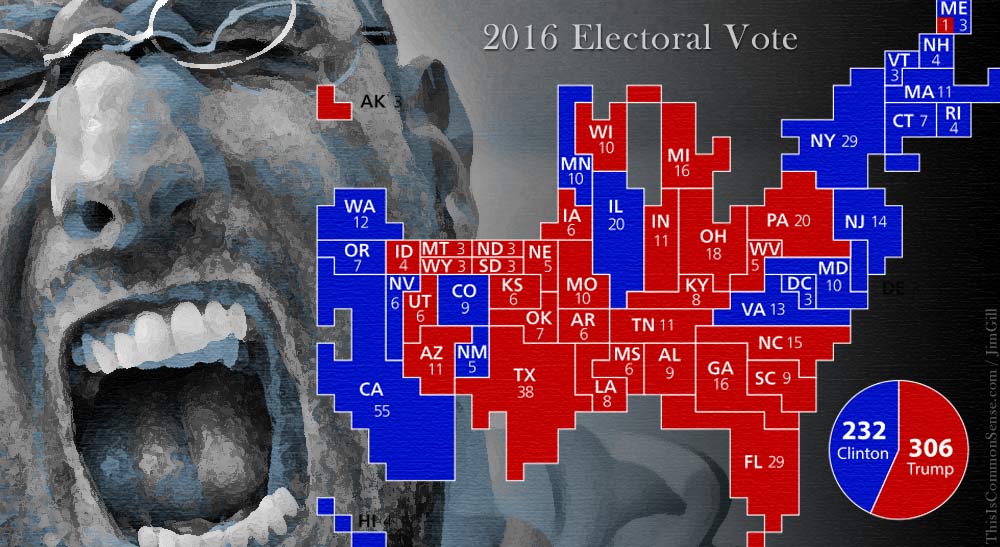
Of course, only two candidates won electoral votes, because only they won states. Donald Trump won 30 states comprising 306 electoral votes; Hillary Clinton won 20 states with 232.

That’s the arithmetic. But, as I explored at Townhall yesterday, nothing in the Constitution requires an elector pledged to Trump or Clinton to vote for that candidate.* They can vote their conscience.

That’s why in recent days, Nancy Pelosi’s daughter, Christine, a California elector, petitioned to have electors receive an intelligence briefing about Russian hacking — hoping to sway electors.

Her petition was denied.

Desperation showing, a group of Hollywood actors led by Martin Sheen starred in a Unite for America video talking down to — er, directly to — Republican electors. Asserting that the Electoral College was designed by “Hamilton himself” to prevent an “unfit” “demagogue” (they mean Mr. Trump) from attaining the presidency, the actors claim to “stand with” and “respect” GOP electors, who could be heroes in Hollywood (no honor more tempting!) if only they’d cast their vote for someone other than Trump.

Anyone! — who meets presidential qualifications. “I’m not asking you,” three actors in a row assure, “to vote for Hillary Clinton.”

As much as I support the idea of voting one’s conscience and as much fun as this election has been, I think we’ve all now had enough. Let’s prepare ourselves to help Mr. Trump do what’s right and stop him from doing what’s wrong . . . with a clear conscience.

This is Common Sense. I’m Paul Jacob.


* Some electors do sign a loyalty pledge to the candidate and there are state laws, almost certainly unconstitutional, which penalize electors who do not vote for the candidate they are pledged to.


Printable PDF

electoral, college, election, voting, popular, Hamilton, illustration


Original (cc) photo by Crosa on Flickr


Categories
Accountability ideological culture media and media people moral hazard nannyism national politics & policies

The Revenge of the Gatekeepers

We saw glimmerings last year when Twitter began to selectively enforce “policy” against some (Milo Yiannoupolis) and not against others (the hordes of leftists who threatened to assassinate Donald Trump).

You could see it in Hillary Clinton’s campaign; after Trump won, it loomed to eclipse all reason.

And on Thursday I noted Congress’s reaction.

I refer to the hysteria over non-Democratic “memes” and “fake news” that trumped the erstwhile gatekeepers of the Fourth Estate and the political classes — including the lobbying and bureaucratic cliques — and stymied the ascension of Mrs. Clinton to the Most Powerful Office in the Whole Wide World.

Now Facebook has come on board with a way to combat this freewheeling flow of ideas.

Fact-checking.

Hayley Tsukayama, writing in the Washington Post, explained the new program:

The social network is going to partner with the Poynter International Fact-Checking Network, which includes groups such as Snopes, to evaluate articles flagged by Facebook users.

If those articles don’t pass the smell test for the fact-checkers, Facebook will pass on that evaluation with a little label whenever they are posted or shared, along with a link to the organization that debunked the story.

The problem, here, is not a First Amendment issue: Facebook is not the government; when it tampers with your communications, it does not break the law.

The problem is that the Internet’s self-proclaimed fact-checkers are not exactly fair-minded, or even capable of sticking to the facts. I quoted Nietzsche yesterday (“there are no facts, only interpretations”), today I will merely reference Ben Shapiro, who has a history with false fact-checkers, and riff off of Juvenal: who will fact check the fact checkers? (Obvious, I know.)

Meanwhile, the folks behind new social media service minds.com offer an innovative posting promotion system, and promise never to sneakily favor some ideas over others.

The proper response to a business firm’s discriminatory policy is to provide market pressure.

This is Common Sense. I’m Paul Jacob.


Printable PDF

watchers, watchmen, media, fake news, fact check, illustration


Categories
Common Sense

Effrontery Propaganda?

Buried within another, more innocuous-sounding piece of legislation*, the Countering Disinformation and Propaganda Act passed the U.S. Senate last week. Introduced in March, the corresponding House bill is still in committee.

Designed to “counter foreign disinformation and propaganda,” especially but not limited to Russia’s, the law, if enacted, would set up what amounts to the ultimate fact-checking outfit. But since, in politics, Nietzsche’s Law of Hermeneutics** holds — “there are no facts, only interpretations” — what it really would be is an anti-propaganda propaganda house, described by critics as a “Ministry of Truth.”

From Senate sponsors Rob Portman (R-OH) and Chris Murphy (D-CT), however, it sounds a lot more noble. It seeks to develop “a whole-of-government strategy for countering foreign propaganda and disinformation” as well as “leverage expertise from outside government to create more adaptive and responsive U.S. strategy options.”***

You can see why government insiders would be concerned. After all, information (mis- and dis- and even correct) travels fast these days.

That is the way of memes — “mind viruses,” popularly called**** — in this age of the Internet.

One related meme is the phrase “effrontery propaganda,” repeated in Internet postings, which characterizes the Countering Disinformation and Propaganda Act’s mission as that of developing and disseminating “‘fact-based narratives” to counter effrontery propaganda.”

Insiders in government and major media do see as “effrontery” the memes that so strongly captured our imaginations in 2016. But is it fakery that really bothers them? Or mere effectiveness?

In any case, effrontery is precisely the right word for any centralized, government-run propaganda outfit.

This is Common Sense. I’m Paul Jacob.


* Titled a “report”!

** This being about propaganda, I hone my philosophical chops and chutzpah by dubbing the infamous F. A. Nietzsche saying as a “law.” On the order of Murphy’s and Parkinson’s so-called laws. Why not? Maybe it’ll catch on.

*** Specifically, the Senate version of the bill would expand “the authority, resources, and mandate of the Global Engagement Center” — an existing institution — to handle state actors (Russia, Russia, Russia, and China) as well as “help train local journalists” and seek to influence (and fund) NGOs and think tanks.

**** Richard Dawkins, in The Selfish Gene (1976; 40th Anniversary Edition, 2016), proposed a new science, memetics. Which has since been developed. See The Meme Machine, for example, by Susan Blackmore (Oxford University Press, 1999).


Printable PDF

fake news, congress, ministry of truth, censorship, illustration


Categories
government transparency ideological culture national politics & policies U.S. Constitution

A Funny Thing Happened on the Way to a Reform

Going into the presidential race, last year, Donald Trump was far from a typical Republican.

His rich man braggadocio, his prior support for abortion, and much else, put him culturally at odds with the social conservative wing of the GOP. He dared heap scorn on neoconservative foreign policy strategy, sacrosanct since Reagan on the right. He has supported many Democratic programs, not the least of which is the Gephardtian protectionism that pulled in so many moderate Democrats.

Besides, as he has famously stated, Democrats loved him, asked him for money, and (not coincidentally) gave him praise . . . right up until he started his campaign under the Republican banner. Then he was excoriated as sexist, racist, xenophobic, Ugly Americanist. Ivanka, his eldest daughter — extraordinarily close to him — was a registered as a Democrat recently enough that she couldn’t even vote for him in the primary.

Ideologically, he has been all over the map.

So one might reasonably think he would govern as a centrist. A non-humble Jimmy Carter retread, perhaps.

But he has assembled the most conservative cabinet in our lifetime. Far more conservative than Ronald Reagan’s. Predictably, Democrats are freaking out.

Why the move “rightward”?

Well, if all the Democratic leadership plus most of the moderate Republican leadership have come out strongly against you — in high moral dudgeon — what point is there to appease them?

The cost of the Trump anathematization strategy may become all too clear in Trump’s first Hundred Days.

This is Common Sense. I’m Paul Jacob.


Printable PDF

Trump, protest, conservative, centrist, right, illustration