Categories
ideological culture partisanship

Partisan Pride Divide

“How proud are you to be an American?” a new NBC News poll asked.

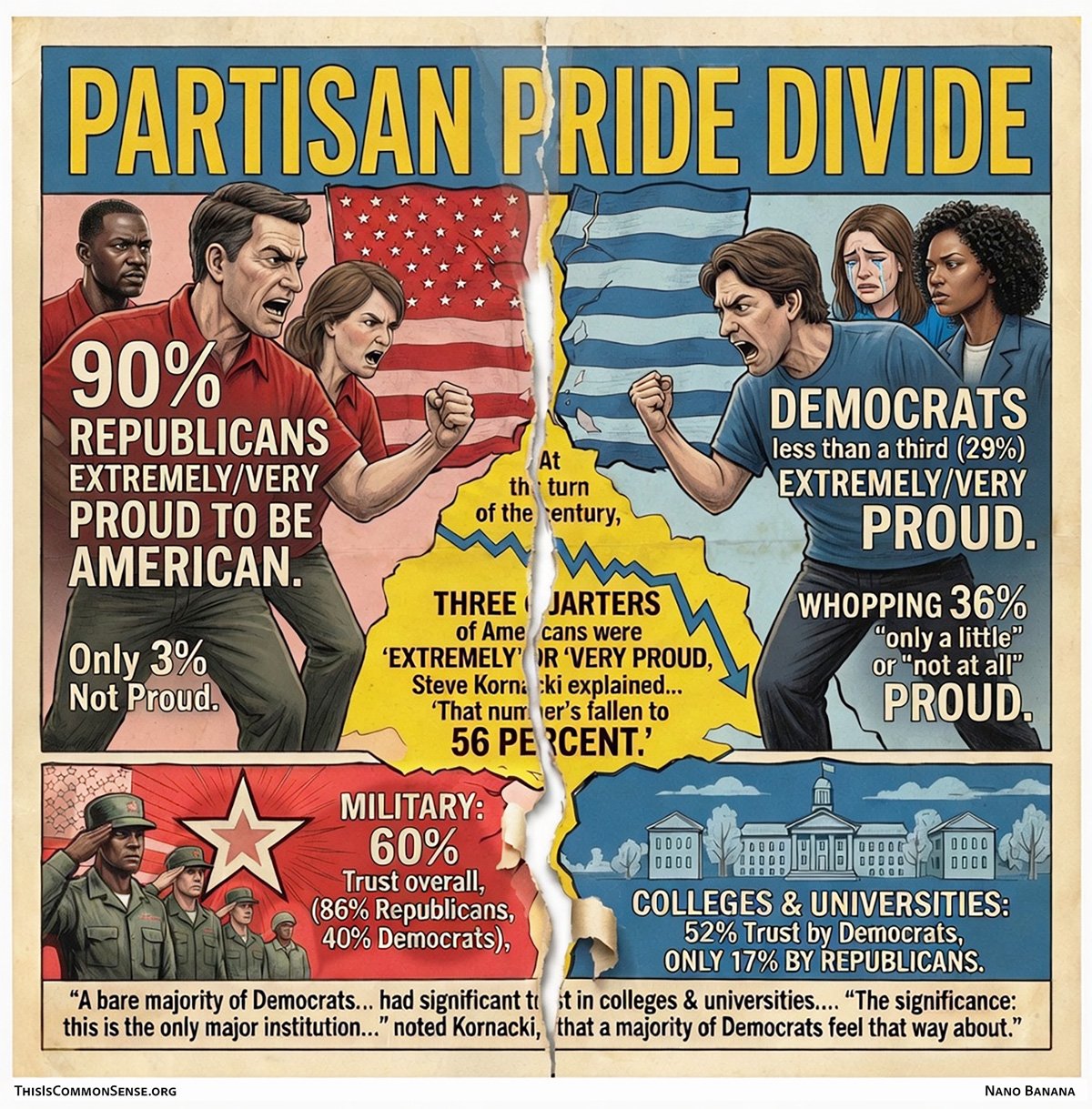
“At the turn of the century, three quarters of Americans were ‘extremely’ or ‘very proud,’” Steve Kornacki explained to Meet the Press host Kristen Welker yesterday. “That number’s fallen to 56 percent.”

It is a sizable drop, leading Kornacki to inquire, “What’s behind this?” before supplying an answer: “it’s partisan.”

Boy, is it. Fully 90 percent of Republicans are “extremely” or “very proud” to be Americans, with just a mere 3 percent “only a little” or “not at all” proud. Compare that to Democrats, less than a third (29%) of whom are “extremely” or “very proud” to be Americans with a whopping 36 percent “only a little” or “not at all” proud.

There is a significant divide between those 65 years old and older, 75 percent feeling pride, and the 18 to 34 age group, with only 36 percent feeling it. But those differences pale in comparison to party identification.

In analyzing the poll at NBCNews.com, Jonathan Allen points out that Americans “have little faith in their institutions.” 

The military is the only institution mentioned in the survey that received overall majority support — 60 percent had a “great deal” or “quite a bit of trust,” including 86 percent of Republicans but only 40 percent of Democrats.

A bare majority of Democrats, 52 percent, had significant trust in colleges & universities, while only 17 percent of Republicans shared that trust. “The significance: this is the only major institution,” noted Kornacki, “that a majority of Democrats feel that way about.”

Institutions often disappoint and our government has done things for which the proper emotion is shame, not pride. But the principles of individual liberty, equality and justice, proclaimed here 250 years ago, have been, as Tom Paine predicted, “an asylum for mankind.”

A source of pride.

This is Common Sense. I’m Paul Jacob.


PDF for printing

Illustration created wth Nano Banana and Grok Imagine

See all recent commentary
(simplified and organized)
See recent popular posts

Categories
education and schooling free trade & free markets too much government

That Was Fast

Ah, Minnesota. The home of “nice” Big Government. And in keeping with that, last week the state produced a grand example of mindlessly intrusive regulation. That’s the “Big Government” part. The “nice” part is how quickly the government conceded it was wrong.

I read about it first at Reason’s Hit & Run, where Katherine Mangu-Ward proclaimed “Minnesota Bans Free Online College Courses from Coursera. I Give Up.” She briefly related the burgeoning online industry of offering college course lectures free to the public (minus the accreditation), and how one of them was singled out for prohibition from the state’s Office of Higher Education: “Coursera is unwelcome in the state because it never got permission to operate there.”

Ms. Mangu-Ward’s conclusion was simple:

Idiots.

A day later, however, the story had radically changed. Minnesota’s bureaucrats had rethought their position, as related by this particular bureau’s bigwig, Larry Pogemiller: “Obviously, our office encourages lifelong learning and wants Minnesotans to take advantage of educational materials available on the Internet, particularly if they’re free.”

Obviously.

Pogemiller went on to promise that, when the legislature “convenes in January, my intent is to work with the Governor and Legislature to appropriately update the statute to meet modern-day circumstances.”

The regulators of Minnesota’s higher education proved that they could learn a new lesson. How well? We’ll see, as online schooling continues to gain its foothold — and accreditation, too.

Gerard Piel famously wrote of the “acceleration of history.” With the Internet, we see the feedback time from bad policy to removal of said policy cut down to a mere day.

This is Common Sense. I’m Paul Jacob.

Categories
education and schooling too much government

Explaining the Next Bust

Is the long-cycle “higher education boom” now beginning to go bust?

Like financial bubbles fed by subsidy and the Federal Reserve’s limbo-low interest rates, American colleges and universities are plagued with too much government attention —particularly by policy that says “everybody should go to college.”

But common sense tells us that not everybody profits by going to college, that sending ill-prepared, unqualified and even uninterested young non-scholars to college, largely so they can “earn higher incomes” is absurd. Pushing the vast majority of American humanity through the university mill cannot ineluctably yield increasing returns. With diminishing returns, increasing government attention can only feed a dangerously unsustainable bubble.

And once it bursts, Americans will demand explanations.

Look to the theory of “signaling,” which posits that a (or the) chief use for schooling is not learning but a demonstration: Getting a college degree shows (“signals”) employers that the persevering student possesses virtues useful in “the real world.”

We’ve come to rely on those crude signals, but as economist Bryan Caplan argues, businesses could adapt to a very different information market: “Ending government subsidies for education wouldn’t create a new working-class generation; it would lead businesses to massively expand the employment of interns to take advantage of the large pool of talented, young people who can’t afford tuition.”

Gee, learning one’s trade for free sounds better than going into debt to “signal” employers that one would likely be able to produce for them.

This is Common Sense. I’m Paul Jacob.

Categories
education and schooling free trade & free markets too much government

Take That Money

I didn’t notice it right away, but President Obama included some strange stuff about student loans in his State of the Union address. He called the current system an “unwarranted” taxpayer subsidy to banks.

Well, yeah. His solution? Another unwarranted taxpayer subsidy.

The president seeks to give families a $10,000 tax credit for sending kids to college. He also insists that no student spend more than 10 percent of his income to pay back loans, and that the unpaid portion of loans be forgiven after 20 years.

Further, if the former student happens to work for the government, the loan would be forgiven in half that time — just ten years!

This amounts to a huge special favor to government workers, of course. It may sound nice and patriotic when the president calls it “public service,” but it seems less so when you realize that government workers now earn, on average, more than private sector workers. Perhaps the fact that public employee unions are a big spending political powerhouse for Obama and Democrats matters in some small way.

Alas, more vote buying.

The president used an interesting phrase, explaining what he’s up to. He instructs us to “take that money” now loaned by banks and “give to families.” This is pseudo-specific. It’s not the same money.

But a politician obscuring the real source of wealth is nothing new.

This is Common Sense. I’m Paul Jacob.