Categories
ideological culture

Blue in Paris

The Olympics is about athletic excellence. There’s also a patriotic-​nationalistic component that uneasily fits with the games. And then there are the rites and glamorous “artistic” ceremonies that start the quadrennial shindig — an uneasy mix we usually ignore as we focus on the contests.

But it was hard to ignore the bizarre showpieces at the opening ceremonies in Paris, for the “Games of the XXXIII Olympiad.”

“The ceremony received a mixed reception,” Wikipedia records, “with many praising the performances of Gojira, Aya Nakamura, Celine Dion and Lady Gaga, while criticism was directed at the length, poor weather conditions, technical issues, and some elements of the production itself.” The Guardian, however, titled its coverage “Most French newspapers praise the Olympics spectacle but far-​right commentators reject ‘woke propaganda’” — but that begs a question: were the “woke” parts really propaganda? 

I mean, can repellent things be propagandistic?

Celebratory for the woke, sure; but at some even low level of repellence the effect becomes merely off-​putting. And then … repulsive.

Sure, most woke media was enthusiastic — “artistic audacity” was a phrase used by the New York Times. But, as The Guardian summarized, the British were “less flattering. ‘La Farce’ was the verdict of the Daily Mail, describing it as a ‘surreal opening ceremony dubbed “the worst ever,”’ while for the Times it was ‘a damp squib of a show.’”

At issue on social media was a drag-​queen parody of The Last Supper — mischaracterized by the woke and Wikipedia as “a bacchanalian feast.” Bacchus himself, though — or Dionysus or whoever — was portrayed by a pudgy near-​naked male singer painted in blue. 

Ugh.

It is wrong to purposely offend someone’s religion. Not illegal. Just wrong. And it informs Christians that yet another major institution of official society does not like us.

Someone might not unreasonably suggest Christians need to present politically. God helps those who help themselves.

Or we could go back to the old ways, where the artists didn’t flaunt their sexualities or heresies or even pride — not horning in on the athletes’ attention at an athletic contest.

This is Common Sense. I’m Paul Jacob.


PDF for printing

See all recent commentary
(simplified and organized)
See recent popular posts
Categories
First Amendment rights general freedom social media

Rumble Resists

In a world of almost universal assaults on freedom of speech, it is heartening when an avowed defender of it refuses to relent under pressure.

Rumble’s reason for being is to help people “control the value of their own creations.” The company creates “technologies that are immune to cancel culture.” Their mission is “to protect a free and open internet.”

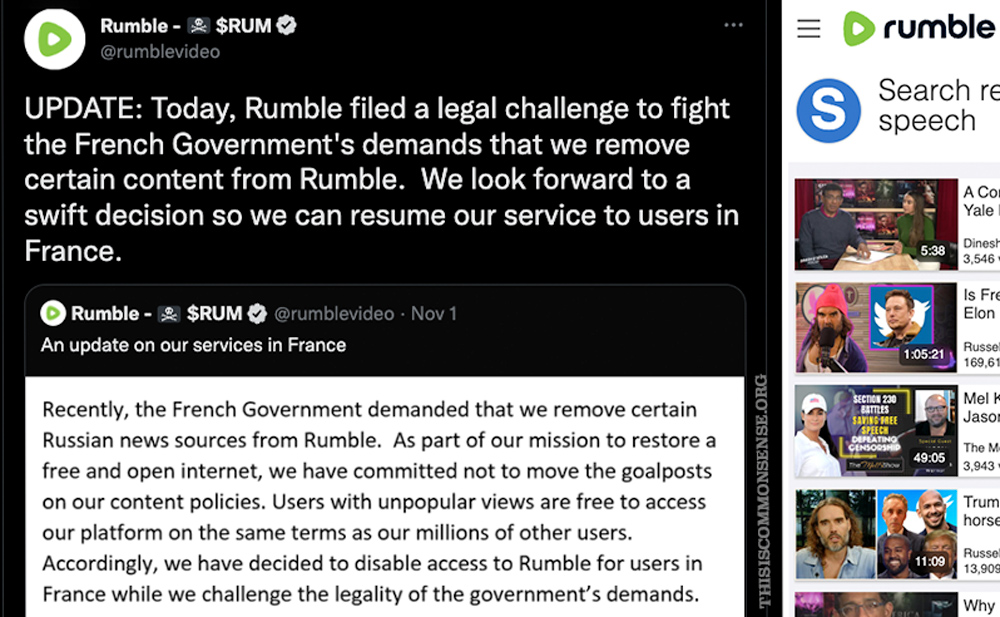
A mission statement is one thing. Abiding by it in the face of major opposition is another. But Rumble has just told the French government to get lost for demanding that it deplatform certain sources of Russian news.

Stressing its policy that users with unpopular views “are free to access our platform on the same terms as our millions of other users,” Rumble has disabled access for users in France rather than acquiesce to the government’s censorship demands. Rumble will go back online there if it wins a lawsuit challenging the legality of the demands.

Like Elon Musk, who said that he wouldn’t block Russian news sources at the behest of governments “unless at gunpoint,” Rumble CEO Chris Pavlovski says “I won’t move our goal posts for any foreign government.”

Rumble started out in 2013. By late 2021, Rumble​.com was being visited by an average of 36 million active users per month.

If Rumble loses France, it loses less than 1 percent of its current users — but also an opportunity for substantial growth. 

On the other hand, it holds on to what it is.

And what its customers value. 

This is Common Sense. I’m Paul Jacob.


Note: This Week in Common Sense, the weekend wrap-​up of this program, is published on Rumble as a video nearly every week. Last weekend’s episode is “It’s a Funny World.”

PDF for printing

See all recent commentary
(simplified and organized)
See recent popular posts
Categories
general freedom too much government

Les Climate Lockdowns

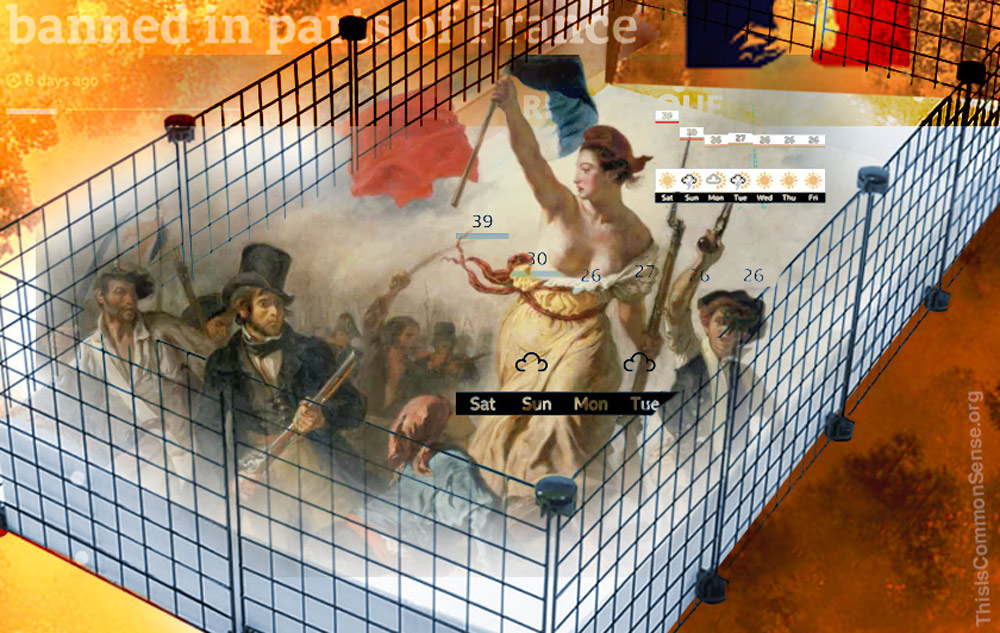
It’s hot outside. In southern France, very hot. Obviously (?), then, regional governments there are justified in prohibiting various outdoor activities.

Following the pandemic-​lockdown model, it is apparently now acceptable to annul the rights of French citizens if some persons may be hurt by the heat. Once again, adults are being treated as if not responsible for making their own judgments about personal risks.

In the Bordeaux area of France — the Gironde department, a “department” being a sort of county — officials recently banned various outdoor events, including concerts and commemorations of resistance to Germany during World War Two.

The department also prohibited indoor events in places that lack air conditioning.

“Everyone now faces a health risk,” one official explained, as if summer were a new thing.

We care about weather when deciding whether to proceed with events we have planned. We think nothing of calling off a parade on account of rain. By “we” I mean the organizers, who may or may not be a government entity.

But there’s a big difference between deciding oneself to cancel an event one is responsible for and a government’s decision to outlaw events produced by others.

Summer is just starting. Next comes winter. Cold.

Governments seem to be regarding the COVID-​19 lockdowns as evidence of just how much pushing around we’ll accept in the name of eliminating all risk but the risk to freedom.

A lot, seems to be the conclusion. 

We must show them otherwise. 

This is Common Sense. I’m Paul Jacob.


PDF for printing

See all recent commentary
(simplified and organized)
See recent popular posts
Categories
ideological culture initiative, referendum, and recall

Who Rules the French?

The petition that Priscillia Ludosky posted on Change​.org many weeks ago was labeled “For a Drop in Fuel Prices at the Pump!” Now more than a million people have signed it. 

“Taxation as a whole represents about two-​thirds of the price of fuel,” the French activist informed.

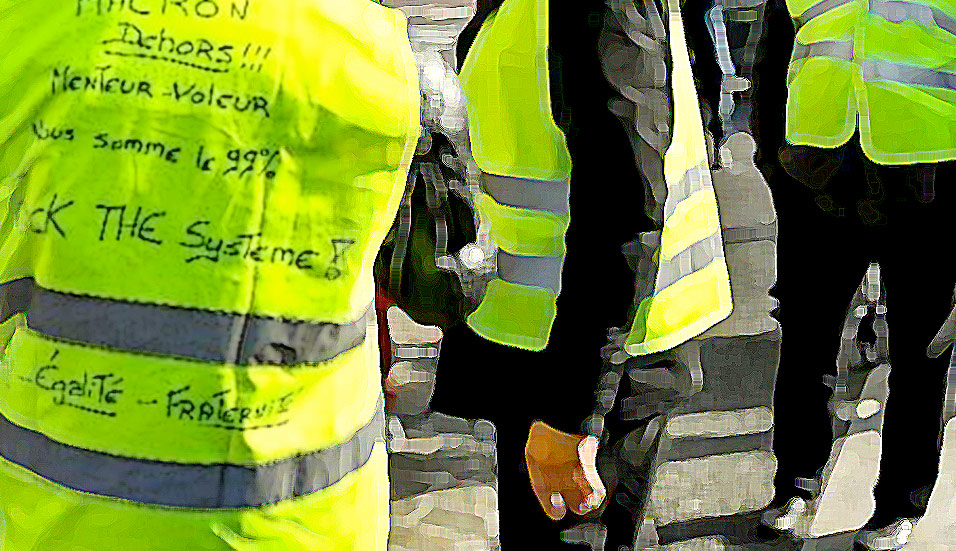
Sparked by the tax hike, working people have joined massive weekend protests in Paris and throughout France — five weeks running— against the Macron government.

The Gilets Jaunes or “Yellow Vest” movement has already forced the removal of the fuel levies. While French President Emmanuel Macron’s approval rating has plummeted down into the low 20s, polls show support for the protesters by two out of three French citizens.

“[E]lected officials take advantage of power to become aristocrats of public money,” Ms. Ludosky told protesters via bullhorn last weekend.

This movement is about a lot more than the price of fuel. 

“The citizens’ initiative referendum,” noted France 24, an English language news channel, “now one of the main demands of Yellow Vest protesters in France. The RIC [Référendum Initiative Citoyenne] would in theory allow the people to propose a law, get rid of one, change the constitution or demand the resignation of an elected official.”

For the last ten years, France has had a national initiative and referendum process, but citizens are dependent on the support of legislators, none of whom have taken the initiative — pun intended.

“The idea is that once 700K people ask for it,” the report continued, “there would have to be a national referendum on the issue.”

An essential democratic check on power that the French — and all people — must have. 

This is Common Sense. I’m Paul Jacob.


PDF for printing

yellow vests, jackets, France, protests, taxes, nationalism

See all recent commentary
(simplified and organized)
See recent popular posts
Categories
video

It’s (not) a Gas: the “Yellow Jacket” Riots

While in America we are not immune to government-​induced too-​high prices for fuel, in France it is worse. The rioting there got a rise out of the now much-​despised President Macron, this week. But is all the tumult over just gasoline prices? It has become much more.

And dangerous. But what should we expect? The French people have been treated very poorly by their government:

Categories
ideological culture tax policy

Class War in France

The French have a talent for riot, public protest, and street-​based insurrection.* The current mayhem in Paris has been escalating every weekend since starting in mid-November.

Why weekends? This is a working-person revolt.

“Rioters ran amok across central Paris on Saturday, torching cars and buildings, looting shops, smashing windows and clashing with police in the worst unrest in more than a decade, posing a dire challenge to Emmanuel Macron’s presidency,” Yahoo News informs us. “The authorities were caught off guard by the escalation in violence after two weeks of nationwide protests against fuel taxes and living costs…”

Yes, this is a tax revolt.

You see, the taxes are part of a carbon emissions reduction program — the kind of taxes that Democrats are eager to put into place in America. Leftists and environmentalists worldwide should pay special attention.

The gambit, of course, is this: cityfolk tend not to mind such taxes less because they do not take the hit immediately. People outside cities, on the other hand, drive everywhere, often for their jobs. In Paris, well, not so much. The city has even enacted an ordinance to outlaw all but electric automobiles by 2030.

It’s called the “yellow vests [jackets] movement” to symbolize the government’s anti-​driver mindset: “all motorists had been required by law — since 2008 — to have high-​visibility vests in their vehicles when driving.”

Sure, push around ordinary motorists.

The protest movement has been largely made up of these people, since many businesses and professionals get exemptions from the taxes.

It’s a class war thing. You might think Macron and other elitists in government would understand their own country.

But no.

So, why?

It’s a big government thing.

This is Common Sense. I’m Paul Jacob.


* Maybe that is why the street violence of “refugees” and children of Middle-​Eastern and North African migrants have been taken with as much tolerance as it has been: the rioters have seemed so very French.

PDF for printing


» See popular posts from Common Sense with Paul Jacob HERE.


Categories
Accountability free trade & free markets general freedom local leaders moral hazard Regulating Protest responsibility

Less Bullying, S’il Vous Plaît

I oppose unions. Or, to speak more precisely, I oppose those tactics too often used by unions intended to render societies hostage to their demands — as we’re seeing in France.

For the last few months, a series of strikes has been conducted by various unionized workers in protest of reforms proposed by President Emmanuel Macron. Rail workers are a major focus of the fracas.

Ultimately SNCF, France’s state-​owned railway company, should be privatized. But reducing too-​generous pay and benefits, including automatic annual pay raises, is a step in the right direction. The Macron administration hopes to begin opening up the state railways to competition by 2023. The unions and their allies are willing to cripple the French economy to prevent any reforms.

It’s fine for employees to voluntarily get together to ask for better working conditions, or even to go on strike to protest terms of employment they regard as unfair. It’s fine, that is, if they also understand that employers have an equal right to replace them if willing and able to do so. 

Workers should only peacefully petition employers. Nobody has an inalienable right to a particular job or to a particular wage higher than they can voluntarily negotiate.

According to the BBC, “Just over 11% of the French workforce is unionised,” one of the lowest levels in the EU. May the decline there and everywhere accelerate until unions cease bullying the entire French society, or any society.

This is Common Sense. I’m Paul Jacob.


PDF for printing


Categories
Accountability folly general freedom ideological culture media and media people moral hazard nannyism political challengers responsibility too much government

French Beacon

“Since the French Revolution,” the New York Times pontificated online, “the nation has often been viewed as a beacon of democratic ideals.”

Really? Can a nation of constitutional turnovers — kings and republics and revolutions and foreign occupation — be a beacon? Most often we in America compare our Revolution to France’s, focusing on The Terror: mob rule and proto-totalitarianism.

On Friday, “the staff of the centrist candidate Emmanuel Macron said… that the campaign had been targeted by a ‘massive and coordinated’ hacking operation, one with the potential to destabilize the nation’s democracy before voters go to the polls on Sunday.” A few minutes later, the campaigns fell under the country’s election gag rule, unable to debate immediately prior to the voting. The government told the media not to look at what was dug up in the “hack” (which everybody said was by Russians). Though Macron’s putative Islamization plan is worth looking at, surely.

Much talk (at the Times and elsewhere) of how the hack destabilized democracy. No talk, for some reason, about how the election regulation gag rule did. 

The idea that information might destabilize democracy? Awkward. 

Still, we can see how an info-dump’s timing might destabilize an election.

But since Macron won by a large margin, the Late Exposure Strategy may have backfired, Russians or no.

The most obvious oddity in reportage? The continued reference to former Socialist Party hack Macron as “centrist” while Le Pen is called “far right” ad nauseam. Macron is pro-​EU; Le Pen is nationalist. Neither are reliably for freedom. The fact that Macron packaged his En Marche ! Party as centrist doesn’t make it so.

This is Common Sense. I’m Paul Jacob.


Printable PDF


Categories
ideological culture political challengers too much government

Forwards ! Backwards ?

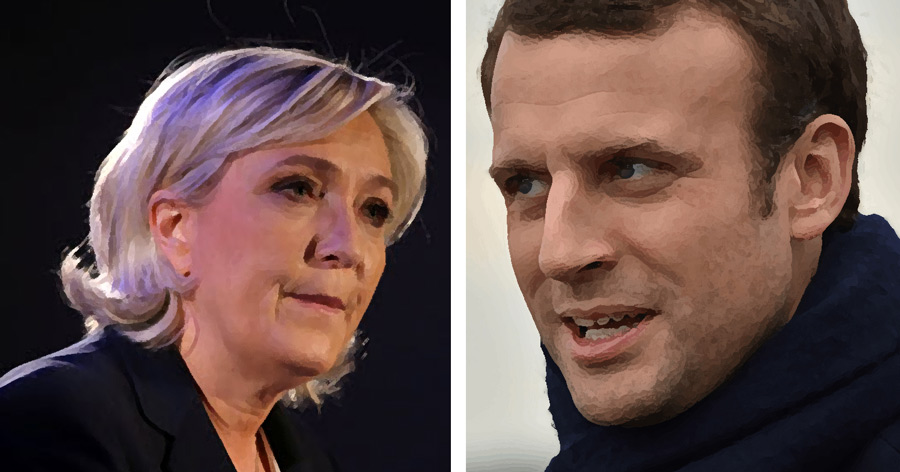
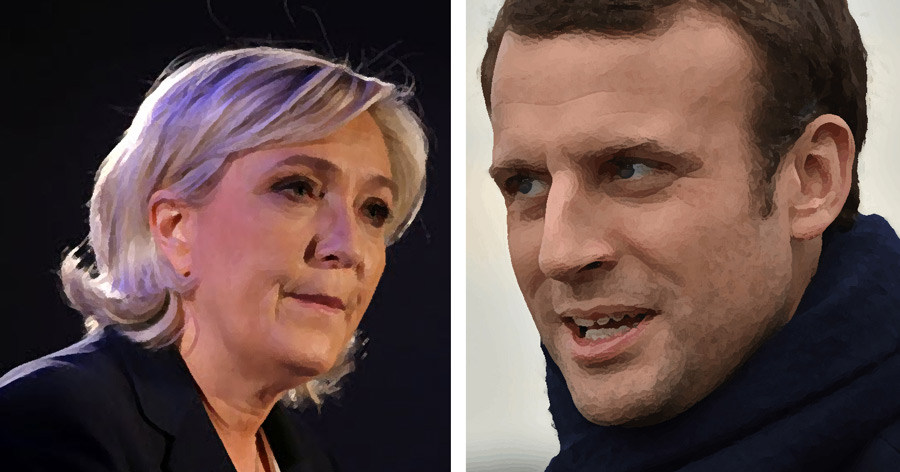
France held an election over the weekend. Emmanuel Macron and Marine Le Pen came out on top, and will face each other in a runoff on May 7th.

Current polling puts Macron over Le Pen, 62 – 38. But a SkyNews reporter cautions: there is no certainty.

We in America have reason to respect that cautionary note. Our last election was an upset against the establishment candidate in favor of a wild card often dubbed “far right” and even “fascist” — which is precisely what Ms. Le Pen is being called.

Indeed, pitting a Big Government “centrist” (Macron) against an anti-​immigrant protectionist (Le Pen) in the context of an economic slump and rising terrorism, and with neither candidate having much contact with limited-​government principle, eerily echoes the 2016 U.S. presidential race.

But, on closer inspection, the parallels between the American and French contests appear inexact. Macron’s En Marche ! party* was created just over a year ago, while Le Pen’s National Front has continually found itself on the margins of power, despite its rise in popularity.**

Still, it is hard not to suspect that Ms. Le Pen could come from behind to upset the status quo. Macron is not invulnerable. The man worked, after all, in Hollande’s government, and Le Pen has characterized him as a socialist in a snazzy suit.

Macron is way ahead in the polls. And TV experts talk about how reliable modern polling is, while we in America … snicker.

But, since France lacks an Electoral College, can Le Pen really “Trump” the odds?

France will be in for a bumpy fortnight.

This is Common Sense. I’m Paul Jacob.


* Amusingly, the party’s initials are identical to those of its founder, Emmanuel Macron. “En Marche !” (the extra space is there in party material) translates into English as “Forward!” or “On the Move!” and is formally designated as the Association pour le renouvellement de la vie politique (the Association for the Renewal of Politics). 

** All the established, formerly governing parties are on the outs.


Printable PDF


Categories
too much government

Is “Less Big” Possible?

The idea of a streamlined welfare state is utterly foreign in today’s political climate. Offering some social services, but not others? Anathema — at least to our “progressives.”

It is also, even more obviously, not nurtured by current political process.

After all, we’ve witnessed two major expansions in “welfare” programs in the last decade, the bipartisan Medicare “Part D” and the Democrats’ “Obamacare.” The first was underfunded from the start, and the second was and remains a mess. Both are financial time bombs.

But if you think America has it bad, it’s worse in France.

Jean Tirole, the new (just announced) Nobel Laureate in Economics, calls the condition of the French labor market “catastrophic.” And he thinks France’s government has to be smaller.

Now, he’s no heir to J.-B. Say and Fredéric Bastiat. He does not support an extremely limited government, a “nightwatchman” state. He says he likes France’s basic model. But it has grown too far in size and scope:

Tirole remarked that northern European countries, as well as Canada and Australia, had proven you could keep a welfare social model with smaller government. In contrast, he said France’s “big state” threatened its social policies because there will not be “enough money to pay for it in the long run.”

He’s basically just demanding that government live within its means.

It’s not too far from common Tea Party sentiment.

But tell that to your average progressive pol. Or blogger. Or activist. Given protective cover for ever-​growing spending by the likes of New York Times’s Nobel columnist, Paul Krugman, any idea of federal spending cutbacks have been and remain off limits.

Maybe Professor Tirole can convince them.

This is Common Sense. I’m Paul Jacob.