Categories
Accountability budgets & spending cuts national politics & policies too much government

Blame Rand Paul?

“The Republican plan adds about $2 trillion to the debt,” Senator Rand Paul explained at the beginning of the month, referring to the Continuing Resolution (CR) which remains, to this day, unresolved. “I’m opposed to deficit spending,” he added, insisting that he would “vote for something with less deficit, but not a $2 trillion deficit.”

Most of the shutdown screaming blames President Donald Trump, but Trump’s a big advocate for the CR. Trouble is, it requires a 60 percent Yea vote in the Senate. All but three Democrats voting Nay ensure that the CR will continue to fail.

So, Sen. Paul’s continuing Nay vote isn’t the cause really; a switch on his part wouldn’t allow the bill to pass. The folks worried about losing their SNAP benefits (just about the only Americans not in government who’ve noticed the shutdown) shouldn’t blame anyone other than those nay-​saying Democrats.

From the beginning, Paul has noted a different irony — his alignment with the bulk of Democrats in opposing the CR. He’s against its continuation of old spending expectations; Democrats, on the other hand, demand even more, especially securing the renewal of Obamacare subsidies.

While the CR failed a 13th time, yesterday, Rep. Rosa DeLauro (D‑Ct.) said that lawmakers had set aside a USDA contingency fund “for exactly these kinds of purposes” — that is, to fund SNAP during the shutdown. The White House insists it lacks legal authorization for this, and, besides, November’s food subsidy requires $9 billion, and the fund falls short by four.

It appears that the tens of millions who may not get their EBT cards filled at the beginning of November remain unaware of what the battle is really about.

But they may be getting a clue: it’s not about them.

This is Common Sense. I’m Paul Jacob.


PDF for printing

Illustration created with Krea and Firefly

See all recent commentary
(simplified and organized)
See recent popular posts

Categories
education and schooling litigation U.S. Constitution

Education Function Injunction

When President Jimmy Carter broke his 1976 campaign pledge by adding another Cabinet-​level department to the federal roster, he swore that a “separate Cabinet-​level department will enable the Federal government to be a true partner with State, local, and private education institutions in sustaining and improving the quality of our education system.”

On March 20, 2025, President Donald Trump signed an executive order aimed at shutting down Carter’s Department of Education, fulfilling his campaign promise to reduce federal involvement in education.

This was popular because everybody who’s not a bureaucrat or a teachers’ union agent knows that federal involvement in schooling, since Carter’s time, has been, not just a waste, but a detriment.

Still, teacher union-​dominated Democrats are swiping at the administration with numerous lawsuits. U.S. District Judge Myong Joun in Boston issued a preliminary injunction blocking Trump’s layoffs and transfers, ruling that they amounted to an unlawful attempt to dismantle the department without congressional approval. 

Earlier this month, the 1st U.S. Circuit Court of Appeals upheld Joun’s injunction, rejecting the Trump administration’s request to pause the order while appealing. 

Two days later, the Trump administration, through Solicitor General D. John Sauer, filed an emergency appeal with the U.S. Supreme Court. The plea? Lift the injunction and allow the layoffs and reorganization to proceed. Trump’s team argued that the lower court had overstepped its authority and that the layoffs were a lawful personnel action to streamline the department, not an attempt to abolish it without Congress. 

The injunction sent DOE functionaries back to work. Nothing’s been resolved.

Not even the rationales for Carter’s “greatest achievement” (to quote the title of a USA Today op-​ed). Carter had promised to reduce the number of departments, for efficiency’s sake. When creating the DOE, he said the move would increase efficiency. 

Instead, it merely increased education spending while academic achievement has plummeted.

This is Common Sense. I’m Paul Jacob.


PDF for printing

Illustration created with Krea and Firefly

See all recent commentary
(simplified and organized)
See recent popular posts

Categories
deficits and debt national politics & policies

Elon’s Out

“Elon Musk says he is ‘disappointed’ by the price tag of the domestic policy bill passed by Republicans in the House last week and heavily backed by President Trump,” explains CBS News. 

The “price tag” is indeed a whopper, if by price we mean what Donald Trump’s ballyhooed “Big, Beautiful Bill” (the One Big Beautiful Bill Act orBBB) added to the debt: an expected $3.3 trillion over ten years.

“I think a bill can be big or it can be beautiful,” Mr. Musk claims, laughing, in an upcoming CBS News Sunday Morning interview — a portion leaked as a teaser by CBS on Tuesday. “But I don’t know if it can be both. My personal opinion.”

An opinion shared by many — just not those “in government.”

Which is apt, since Musk is out. He expressed his “personal opinion” as he was exiting the Department of Government Efficiency (DOGE). The exit isn’t the big story. We knew from the beginning that Musk’s time at DOGE was not going to last forever. 

Which highlights the up-​in-​the-​air aspect of DOGE’s mission and future.

Note that Musk is capable of artful politics. His official statement appeared on X: “As my scheduled time as a Special Government Employee comes to an end, I would like to thank President [Donald Trump] for the opportunity to reduce wasteful spending.” 

This rosy view of his exit may mask much muck. “Musk made himself a total pariah,” first-​ousted Trump strategist Steve Bannon told The Free Press. “He had access, admiration, unlimited resources — and by his own actions toward people, blew it all.”

How did he blow it? By actually doing something?

Musk concluded his official exit statement by hazarding that DOGE’s “mission will only strengthen over time as it becomes a way of life throughout the government.” That’s precisely what’s in doubt.

This is Common Sense. I’m Paul Jacob.


PDF for printing

Illustration created with Krea and Fireflly

See all recent commentary
(simplified and organized)
See recent popular posts

Categories
budgets & spending cuts deficits and debt

The Continuing Crisis

By law, we have one job,” Rep. Tim Burchett (R‑Tenn.) asserted the last time he opposed the continuing resolution” (CR) on the federal budget. 

What is that one job”? It is to pass twelve appropriations bills and a budget. We arent doing that, which is why we are $33 trillion in debt.”

You noticed the typo. But it wasn’t. Sure, $33 trillion isn’t right. Yesterday, the official public debt of the federal government was $36.6 trillion, with just a smidge of rounding up. Those first two paragraphs are from 2023; one can almost cut and paste old copy about Washington’s CR fiascos and place them in new pieces and get away with it, clean. 

On Tuesday, the House passed a continuing resolution to keep the federal government chugging along, with its usual substitute authorization for spending rather than a real budget.

In another old Common Sense column from right before Christmas, I celebrated the possible “torpedoing” of a CR, and its replacement with a more modest one — but what about the CR that now heads for a Friday vote in the Senate?

The resolution cuts $20 billion from IRS enforcement, $7 billion from fiscal year 2024 levels, $13 billion in non-​defense discretionary spending but added $6 billion to defense. Last year’s earmarks were nipped, but what’s happening with USAid is less clear. Secretary of State Marco Rubio says that “83% of programs” have been closed in the agency; Elon Musk declares that “the important parts of USAID should always have been with Dept of State” — but that plan is not implemented in this CR.

Meanwhile, Rep. Thomas Massie was the sole Republican No vote, continuing his dissent: “Congress just locked in a large portion of the Biden agenda for the first nine months of Trump’s presidency.” And then Trump threatened to primary him!

Massie is up against Republicans who think the resolution’s cuts are big enough. And Democrats who think they are way too big.

This is Common Sense. I’m Paul Jacob.


PDF for printing

Illustration created with Krea and Firefly

See all recent commentary
(simplified and organized)
See recent popular posts

Categories
Accountability government transparency national politics & policies

Fire or Promote the Best?

Things looked bad recently for Leland Dudek, an employee of the Social Security Administration.

Dudek almost got fired for helping the DOGE team understand how SSA’s systems work so that DOGE could zero in on wasteful or fraudulent payments.

On social media, Dudek wrote: “At 4:30pm EST, my boss called me to tell me I had been placed on administrative leave pending an Investigation. They want to fire me for cooperating with DOGE …

“I confess. I helped DOGE understand SSA. I mailed myself publicly accessible documents and explained them to DOGE.… I moved contractor money around to add data science resources to my anti-​fraud team.… I asked where the fat was and is in our contracts so we can make the right tough choices.”

An investigation? Administrative leave? For helping, as an executive-​branch employee, the head of the executive branch to find and extirpate waste and fraud? SSA managers may have been confused about whether Donald Trump really is the president.

The suspense didn’t last long.

Dudek was not fired. Instead, the SSA commissioner was fired and Dudek became acting commissioner. 

“There are many good civil servants,” says Senator Mike Lee, “who have been quietly frustrated for years with politically motivated mismanagement [and] who possess an encyclopedic knowledge of the problems with their agencies. Put them in charge, hand them scalpels and flamethrowers.”

Could we have at long last found the cure for dimwitted obstructionism? A certain reality TV star had words for it: “You’re fired!”

This is Common Sense. I’m Paul Jacob.


PDF for printing

Illustration created with Krea and Firefly

See all recent commentary
(simplified and organized)
See recent popular posts

Categories
deficits and debt meme

Just Imagine

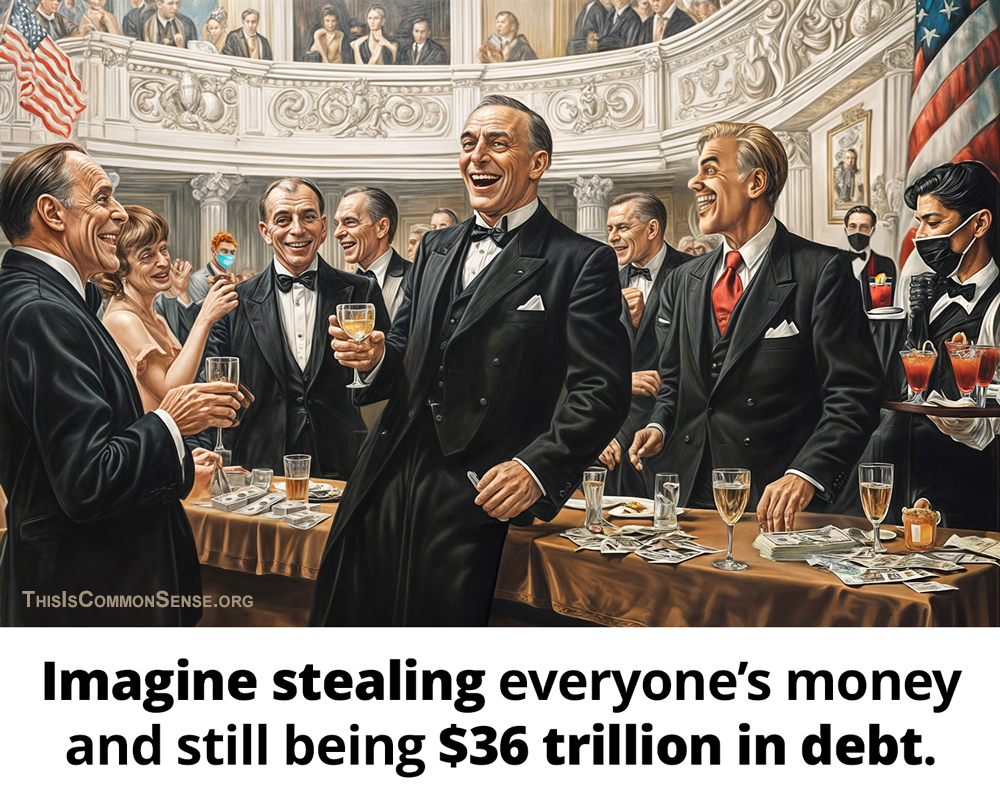
Imagine stealing everyone’s money and still being $36 trillion in debt.

Categories
deficits and debt national politics & policies too much government

The Biggest

Trump’s riding high, in the first week of his second term — but not regarding the biggest problem he faces, inflation and economic instability.

“When bondholders don’t see a credible fiscal path to be repaid for current and future government debt,” writes Veronique de Rugy at Reason, “they expect that eventually the central bank will create new money to buy those government bonds, leading to higher inflation.

“Recent inflation wasn’t just about money supply; it reflected the market’s adjustment to unsustainable fiscal policy.”

Winning, for Trump, cannot equate to Spending.

While Ms. de Rugy tries to explain this all in terms of a big-​picture economic analysis, she does not quite reach back in time far enough. We had stagflation way back when I was young. It was cured then not by decreased spending but by Paul Volcker of the Federal Reserve putting the brakes on money-​and-​credit expansion. He stopped inflation. 

A pure recession immediately followed, followed by recovery in the new administration, Ronald Reagan’s, who helped reduce the rate of growth of government (and not much else).

Inflation could, theoretically, be handled by the Fed alone, now, as then.

Except — the federal government can hardly now afford to service existing debt, which would skyrocket with the nitty-​gritty of the Fed’s cure, higher interest rates. 

Today, debt service (paying just the interest) approaches One Trillion Per Annum. 

“A crucial tipping point was reached in 2024 when the interest expense on the federal debt exceeded the defense budget for the first time,” Nick Giambruno summarizes at The International Man. “It’s on track to exceed Social Security and become the BIGGEST item in the federal budget.” 

Increasing it yet more would cripple the government.

The only way out, if there is one, is a radical decrease in spending and deficits, as de Rugy advises. Trump’s path to success is somehow accomplishing that.

This is Common Sense. I’m Paul Jacob.


PDF for printing

Illustration created with Flux and Firefly

See all recent commentary
(simplified and organized)
See recent popular posts
Categories
national politics & policies porkbarrel politics

The Biggest Gift of All

We received an early Christmas present from the incoming Trump administration.

The gift? The torpedoing of a continuing resolution (CR) supported by House Speaker Johnson that was full of concessions to the Democrat side of the aisle. Aside from the drunken-​sailor spending, the 1,500-plus-page legislation — just something to tide the government over for a few months — contained many other horrific elements that made it worthy of deletion.

Trump, Vance, and Musk are among those who volubly criticized the pork and other bad provisions of the CR.

Senator Rand Paul said: “I had hoped to see @SpeakerJohnson grow a spine, but this bill full of pork shows he is a weak, weak man. The debt will continue to grow. Ultimately the dollar will fail. Democrats are clueless and Big Gov Republicans are complicit.”

Ostensibly designed to continue funding the federal government after the money had run out, the bill’s poisonous elements included a pay increase for members of Congress and a provision to make it almost impossible for the Trump Justice Department to investigate wrongdoing in the House (such as the evidence-​destroying way the J6 investigation was conducted).

Another provision would have extended the life of a State Department’s Global Engagement Center, a censorship office that Republicans have been trying to kill for years. Some Republicans, that is. The ones in favor of freedom of speech. The GEC funds efforts to suppress speech.

But the worst of it was stopped. The CR monstrosity became a much more manageable, much smaller CR; “the government was saved” — and, more importantly, we were saved some of the awful things packed into the earlier resolution.

Still, a lot of people (mainly Democrats) didn’t like their Christmas gift.

And dashed were the holiday dreams of members of Congress, stuck another term at current levels of remuneration.

Ho ho ho.

This is Common Sense. I’m Paul Jacob.


PDF for printing

Illustration created with Flux and Firefly

See all recent commentary
(simplified and organized)
See recent popular posts
Categories
national politics & policies partisanship

Repeal Obamacare

Oy vey! Given the alternative of Donald Trump on the one hand and — now that Biden has bailed — a bad-​as-​Biden Biden-​substitute on the other, Americans must re-​level their look at the lesser of two evils.

It may be difficult to resist hoping that Trump gets elected this November to allow many of the Democrats’ worst initiatives be left to die on a withering vine. (Examples of the worst: Congress-​bypassing regulations designed to penalize production of gas-​powered cars and outlaw certain freelance or contract work.)

Still, the candidate and his party have many flaws.

We cannot forget that. Indeed, with their abandonment of the tiniest desire to reduce the size of the federal leviathan, remembrance should be easy. 

Shrink government? Radically reduce spending? Reduce debt? No such goal was seriously pursued in the first Trump administration, and no such goal is mentioned in the twenty-​point Trump-​Republican Party platform.

There’s talk of tax cuts, ending inflation (somehow), diverting spending from Democratic projects. Sure. But the platform insists that Social Security and Medicare programs not be modified in any way. 

In any way!

And about Obamacare — the biggest expansion of the medical state in recent years, which Republicans had once pledged to repeal — the platform is mute.

The 2016 platform said that improving healthcare “must start with repeal of the dishonestly named Affordable Care Act of 2010: Obamacare,” a declaration retained in 2020. Now it’s gone. Republicans seem to have succumbed to the strategy of turning Obamacare into yet another supposedly unassailable, supposedly inextirpable entitlement program.

Unfortunately, you don’t recover or expand liberty by accepting every expansion of serfdom.

This is Common Sense. I’m Paul Jacob.


PDF for printing

Illustration created with PicFinder and Firefly

See all recent commentary
(simplified and organized)
See recent popular posts

Categories
education and schooling national politics & policies tax policy

Trump to Ax Tip Tax

When Biden panders to his lower-​income supporters, he targets zeroing out their student debt and regulating credit card companies with further restrictions on their ability to charge for overdrafts and the like.

When Trump panders to his lower-​income supporters, he promises to exempt tips from income taxation, as he did recently in Las Vegas.

This may be the most obvious difference between left- and right-​styles in politicking to the masses, good-ol’-fashioned vote-​buying or its twin: leftists forgive debts and add regulations, rightists reduce taxes.

Like me, you may, at first blanch, prefer the latter form of pandering, but Eric Boehm, at Reason, offers some reasons not to look so kindly on Trump’s pandering. First, and most obviously: “Reducing revenue without identifying offsetting spending cuts means Trump is merely promising to borrow more heavily.”

A bigger challenge comes later: “On the surface, that sounds great. But there’s already one likely unintended consequence: A lot more income will suddenly be reported as tips. Any time a government gives preferential tax treatment to one type of economic activity, you tend to get a lot more of that type of economic activity. Does that mean we’ll have an entirely tip-​based economy?” The answer is a likely No.

Oddly, Mr. Boehm doesn’t address one obvious element: Tips aren’t wages and they aren’t profits. Tips are gifts. They aren’t determined by employers and they aren’t specified by employees. And gifts aren’t taxed as income like other income is.

So letting people who accept tips in the course of their labors not pay taxes on them is really, really hard to object to.

In fact, I don’t object.

This is Common Sense. I’m Paul Jacob.


PDF for printing

Illustration created with PicFinder and Firefly

See all recent commentary
(simplified and organized)
See recent popular posts