Categories
defense & war general freedom international affairs

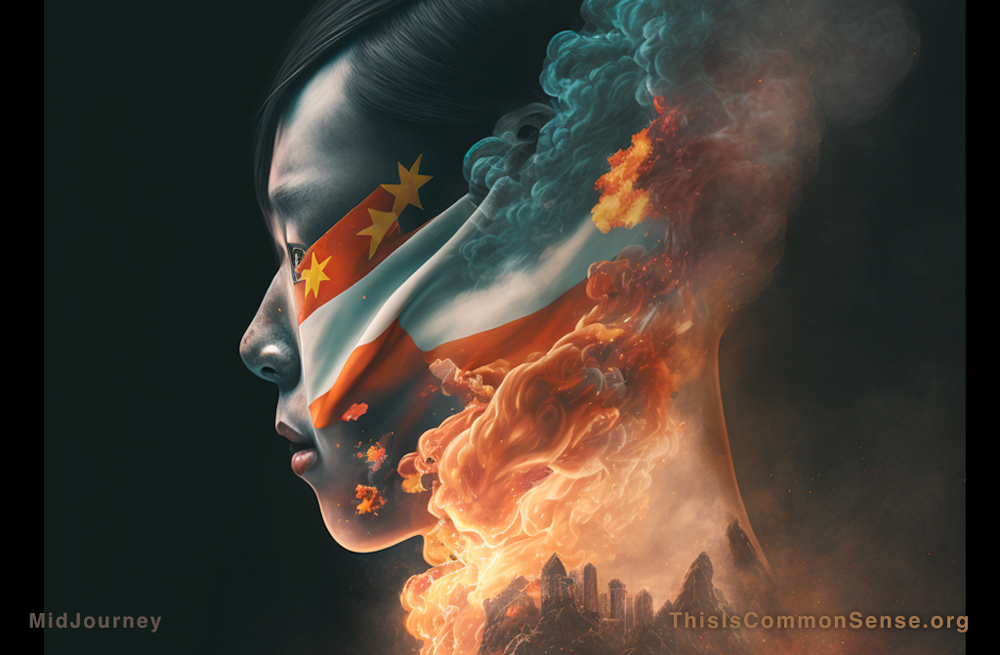
Playing With Fire?

In merely the last month . . . 

Belligerently attempting to enforce China’s illegal claim to virtually the entire South China Sea, a People’s Liberation Army jet intercepted a U.S. Air Force reconnaissance aircraft over international waters, coming within 20 feet, forcing the U.S. pilot to take evasive action to avoid a crash. 

And a war.

Which China’s continually threatened invasion of Taiwan would definitely precipitate. The sort of military assault that the PLA practiced this week, Reuters reported, sending 57 aircraft and four ships into “the sea and airspace around Taiwan, focused on land strikes and sea assaults.”  

Yet talk of a deadly conflict with China is not limited to Southeast Asia.

“Is India Getting Ready For A War With China?” was the headline of Peter Suciu’s 19fortyfive.com story last month detailing a clash between these two nuclear-armed, billion-plus-people nations sharing a disputed 2,100-mile border.*

The good news? The world may be waking up to the enormous threat posed by the Chinese Communist Party. 

Japan has announced it will double military spending — and deploy U.S. tomahawk missiles “capable of striking targets deep inside of North Korea and China.” To better counter the Chinazi threat to itself and neighboring Taiwan, the Japanese also have made “path-breaking” agreements to cooperate with the U.S. and the United Kingdom.

Take a smidgen of comfort, too, in the recent Center for Strategic and International Studies’ war games, which saw Taiwan, Japan and the U.S. “rapidly cripple the Chinese amphibious fleet” in beating back a Chinese invasion of the democratic island nation.

In renewing “its longstanding threat to attack Taiwan,” the CCP warned that foreign countries were “playing with fire.”

Correction: we’re no longer just “playing.”

This is Common Sense. I’m Paul Jacob.  


* CNN explained that the tensions between the two countries increased “sharply in June 2020 when hand-to-hand fighting . . . resulted in the deaths of at least 20 Indian and four Chinese soldiers in Aksai Chin-Ladakh.”

PDF for printing

Illustration created with Midjourney

See all recent commentary
(simplified and organized)
See recent popular posts
Categories
general freedom international affairs

What Is and Is Not Sinister

“Is this just human stupidity?”

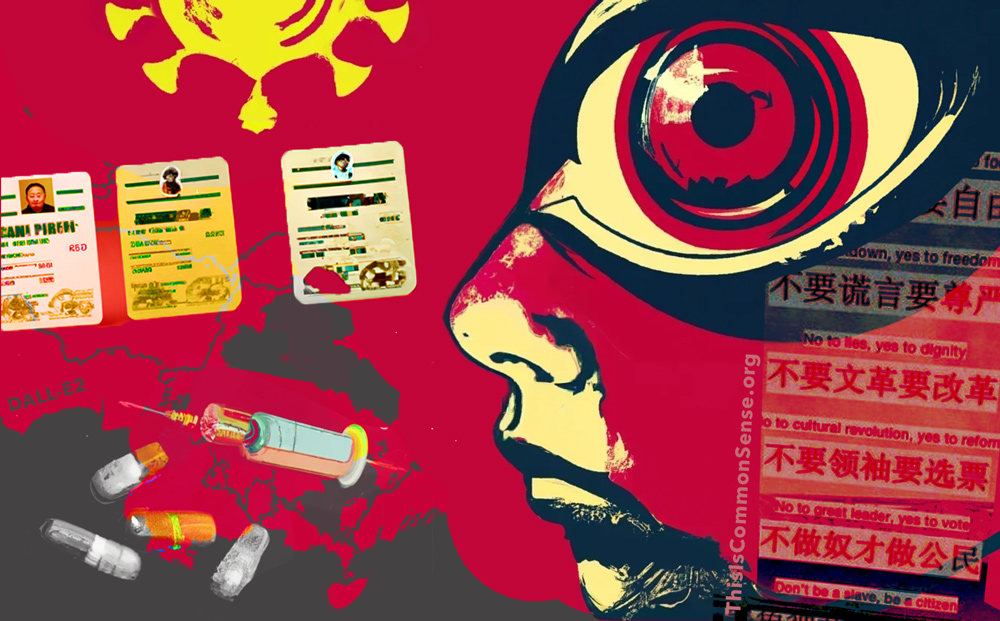
asked that, last week, regarding the flourishing of the Omicron variants of SARS-CoV-2 in China. The Communist-run country is undergoing a huge spike in infections, millions of infections, after years now of totalitarian tracking and quarantine protocols.

I had mentioned the regime’s lack of interest in encouraging the growth of natural immunity, in its various forms. Instead of helping people cope with the new disease, the Chinazis thought they could corral their society to prevent the spread.

That broke down completely, this winter.

But was the quarantine policy and its breakdown just plain old stupidity? Folly in familiar forms?  “Or is it something more sinister?”

Well, yesterday Dr. John Campbell focused his regular online talk on how the totalitarian quarantines fell apart.

The Chinese infection rate had been relatively low — to the extent that we can trust statistics from a lying regime — because of the thoroughgoing nature of the quarantine policies, which immiserated millions, and caused numerous deaths, just as lockdowns would do in almost any society.

While acknowledging the protests that swept China, Campbell argues that a bigger factor in ending the policy was the fact that many Chinese were bribing officials to obtain negative results on the mandatory tests, thereby gaining license to go about as normal. And spread the disease — quite rapidly — in a low-immunity society, low in part because the CCP chose the Zero COVID policy . . . rather than a strategy of a freer society.

Still, in China and America, the totalitarian itch remains. The dream of zero transmission seems “rational” to many people, especially those who demand that The State solve every problem. It hasn’t worked anywhere, though. 

And not just due to the chronic bribery and corruption fostered by authoritarian societies, but because isn’t good medical or political science.

This is Common Sense. I’m Paul Jacob.


PDF for printing

Illustration created with DALL-E2

See all recent commentary
(simplified and organized)
See recent popular posts
Categories
ideological culture international affairs Regulating Protest

Making Symbolism Count

“Governments do unconscionable things every day; it is in their nature,” writes Katherine Mangu-Ward in the February Reason. “But not all transgressions are equal.”

Ms. Mangu-Ward’s piece is entitled “Bodies Against the State,” and though she doesn’t quite come out and say it, not all protests are equal, either, with some deserving more respect than others.

“In China, crowds of people line the streets,” Mangu-Ward writes. “They are holding blank sheets of paper.” This is something I’ve written about, too, in “Point Blank Protest” back in November. “The police nonetheless know what they mean. The leaders of the Chinese Communist Party know what they mean. The world knows what they mean.”

Helpfully, she explains: “the protesters’ goal is to make manifest the implied violence that authoritarian states use to keep order.”

Of course, in China, even more than here (not all transgressions being equal), the state’s violence is too often more than merely implied. 

And in America, the symbolism of protests has been marred by too much violence — something Mangu-Ward mangles in her piece. But the point of pitting oneself symbolically against state crimes remains important, as she explains: “The most perfect and enduring image of a person weaponizing his body against the state was taken after the brutal suppression of protests in Tiananmen Square in 1989. The unknown Chinese man standing in front of a tank didn’t have to hold a sign for the entire world to know exactly what the problem was.”

The art of protest needs some perfecting in the west. When our protests run to riot, their symbolic impact becomes confused, and adds to our ideological strife, clarifying nothing — quite unlike Tank Man, and the blank paper protests.

This is Common Sense. I’m Paul Jacob.


PDF for printing

Illustration created with DALL-E2

See all recent commentary
(simplified and organized)
See recent popular posts

Categories
crime and punishment general freedom international affairs

The Zero Tolerance Policy That Failed

Since the beginning of the coronavirus pandemic, China’s behavior has been . . . opaque. Unhelpful. Suspicious. The Chinese Communist Government may have been involved in the creation of the virus, but, if so, 

  1. it was likely created with the help of Fauci and U.S. taxpayers, and
  2. could have been deliberately or accidentally leaked to the Wuhan population. In any case,
  3. the lack of transparency early on meant a worldwide spread of the contagion. 

That latter neglect may be especially galling to all of us outside of China, but it was no comfort inside China either, since as the disease hit the Chinese their leaders quickly resorted to nazi-like tactics. Most specifically, the government stuck to a Zero-COVID policy, which was astoundingly cruel and totalitarian.

That policy has been shown to have zero efficacy. “As many as 37 million people are contracting COVID-19 in a single day in China,” The Epoch Times informs us, “according to leaked minutes from a meeting of the country’s top health body confirmed by multiple news outlets.”

What’s gone wrong? Well, “the regime’s stringent zero-COVID policy has left the Chinese public with little natural immunity against COVID-19’s highly contagious Omicron variant, which appears to be spinning out of control in the country.”

Alas, both in China and in the West, the notion of natural immunity was evaded. America’s government-funded experts have discouraged discussion of it, and the Chinese rulers thought it more important to prevent any form of spread. Hence totalitarian lockdowns.

All pointless, now, as hospitals and morgues are flooded with COVID patients from a weakened populace.

Is this just human stupidity? Or is it something more sinister?

This is Common Sense. I’m Paul Jacob.


PDF for printing (coming soon)

Illustration created with DALL-E2

See all recent commentary
(simplified and organized)
See recent popular posts
Categories
defense & war general freedom international affairs

An Invisibility Cloak We Can Use

It’s not quite the magical invisibility cloak worn by Harry Potter. But it’s the next best thing.

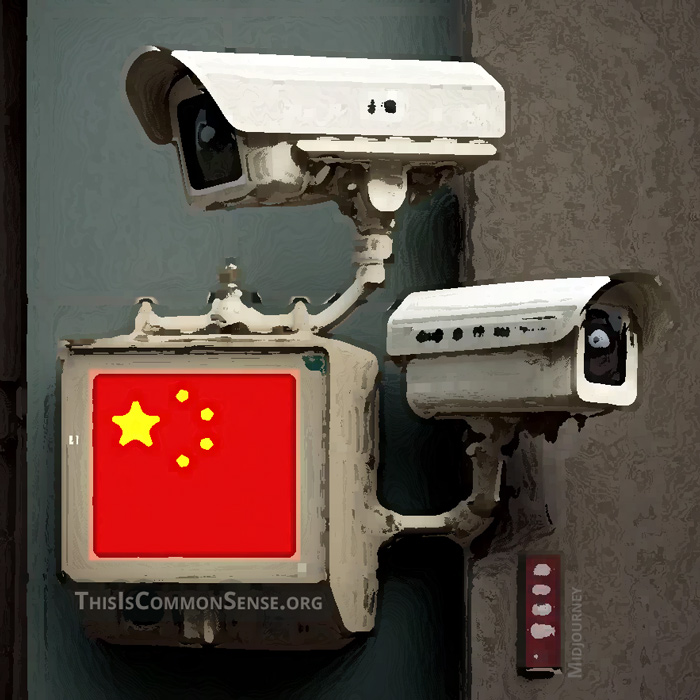
Chinese students have created apparel that human eyes can see but that hides the wearer from security cameras and recognition software.

The InvisDefense coat looks ordinary. So it won’t by itself arouse the suspicion of other people on the street. But it is designed in such a way as to foil the kind of cameras that, for example, try to identify who is protesting Chinazi lockdown insanity.

During the day, the printed pattern of the InvisDefense coat blinds cameras. At night, the coat emits heat signals that disrupt infrared. It was invented by Chinese graduate students at Wuhan University under the guidance of computer science professor Wang Zheng. Their coat won first prize in an innovation contest sponsored by Huawei.

Wang observes that “many surveillance devices can detect human bodies. Cameras on the road have pedestrian detection functions. And smart cars can identify pedestrians, roads, and obstacles. Our InvisDefense allows the camera to capture you. But it cannot tell if you are human. . . .

“We use algorithms to design the least conspicuous patterns that can disable computer vision.”

And the coat costs only seventy bucks or so.

I’m not always a fan of the algorithms. In this case, shout Hooray for algorithms and for those who put them to such good use by inventing the InvisDefense coat. 

I hope these students sell about eight billion of them.

This is Common Sense. I’m Paul Jacob.


PDF for printing

Illustration created with DALL-E2

See all recent commentary
(simplified and organized)
See recent popular posts
Categories
general freedom international affairs Regulating Protest social media

Rotten Apple

Apple Inc. has a good side and a bad side.

A strong work ethic, oodles of innovativeness, much neat technology.

But a taste for censorship and a willingness to abet the censorious efforts of China’s totalitarians.

One manifestation of Apple’s contempt for unfettered discourse? Its apparent threat to kick the Twitter app off the iOS platform now that Twitter is run by someone friendlier to freedom of speech than the previous management.

Obnoxious though this would be, it’s not half as horrible as knowingly facilitating Chinazi repression. Yet Apple has recently crippled the iPhone AirDrop feature that protestors in China have used to share files like videos of the surging protests against the government’s insane zero-COVID mega-lockdown policies.

Because of a new iOS update, iPhone users in China — and only in China — can now only send files to persons not on their contact list for just ten minutes, hampering the ability of protesters and others to evade Chinese government censorship.

The company’s officers read the news. If Apple really didn’t intend to do this, all it has to do is roll out another update pronto to restore full AirDrop functionality.

Reclaim the Net notes, however, that Apple has often helped the Chinese Communist Party conduct its censorship: for one thing, by removing thousands of apps from its Chinese store at their behest. The deleted apps include VPN apps that helped users evade China’s wide-ranging and determined censorship of the Internet.

Think Different, Apple, not in lockstep with tyrants.

This is Common Sense. I’m Paul Jacob.


PDF for printing

Illustration created with DALL-E2

See all recent commentary
(simplified and organized)
See recent popular posts
Categories
general freedom international affairs public opinion

Point Blank Protest

“Protests spread to cities and college campuses around China on Saturday night,” reports The New York Times, “reflecting rising public anger at the country’s draconian Covid controls, with some in a crowd in Shanghai directing their fury at the Communist Party and its top leader, Xi Jinping.”

Reuters informs that this “wave of anger was triggered by an apartment fire that killed 10 people on Thursday in Urumqi, a far western city where some people had been locked down for as long as 100 days, fueling speculation that COVID lockdown measures may have impeded residents’ escape.”

Demonstrations are rare in China; “room for dissent has been all-but eliminated under President Xi Jinping,” reminds Reuters. Yet, a month ago, a lone “Bridge Man” in Beijing unfurled anti-government banners in a crowded intersection.

“Go on strike at school and work, remove dictator and national traitor Xi Jinping!” the man, now in CCP custody, yelled through a loudspeaker. “We want to eat, we want freedom, we want to vote!” 

Yes, vote. Xi Jinping was just elected to a term-limit busting third term, but by the Communist Party — not the Chinese people.

In a numberof videos, students hold “up blank sheets of paper in silent protest, a tactic used in part to evade censorship or arrest.” In 2020, Hong Kong activists did this to avoid prosecution under the national security law imposed by Beijing. 

Across social media, people have been posting pictures of themselves with blank pieces of paper in solidarity. “By Sunday morning, the hashtag ‘white paper exercise’ was blocked on Weibo,” notes Reuters.

“If you fear a blank sheet of paper,” posited a Weibo user, “you are weak inside.”

A blank page, on the other hand, displays surprising strength, as well as meaning — for people to one day freely write their own stories.

This is Common Sense. I’m Paul Jacob. 


PDF for printing

Illustration created with DALL-E 2

See all recent commentary
(simplified and organized)
See recent popular posts
Categories
defense & war general freedom international affairs

Stuck in the Middle with US?

Is Taiwan, the island democracy of 24 million, really caught in the nation-state equivalent of a lovers’ triangle?

“Taiwan is caught in the middle of escalating tensions between the U.S. and China,” is how National Public Radio headlined its recent story about Communist Party-ruled China “speeding up its plans to seize Taiwan.”

“Entangled in a geopolitical power struggle between the US and China, the wants of the Taiwanese people get overshadowed,” informs CNA, the Singapore-based English language news network, pitching its weekly hour-long news program, Insight, which sought to present “the Taiwanese perspective to being caught between giants.”

Nothing new. 

“As China challenges the global dominance of the United States,” NBC News reported back in 2020, “tiny Taiwan finds itself stuck, rather uncomfortably, smack dab in the middle of the conflict between the two international giants.”

The Taiwanese are no doubt uncomfortable. In a recent survey, nearly 40 percent now believe a Chinese military invasion, killing tens of thousands or hundreds of thousands or more, to be likely. 

They are not torn, however, between two superpowers. Taiwan is — most assuredly — not preparing to defend against an armed attack by the United States. 

In fact, Taiwan is coordinating its national defense efforts with the U.S., hoping and praying for direct U.S. help in defending themselves from totalitarian China.

Taiwan is not stuck with us. Nor we with them. We are simply allies in deeply valuing societies where individual lives matter. 

Against a superpower for whom they don’t

This is Common Sense. I’m Paul Jacob.


PDF for printing

Illustration created with DALL-E

See all recent commentary
(simplified and organized)
See recent popular posts
Categories
defense & war general freedom international affairs

Getting Guns to Good Guys

No sooner had President Biden shared his somewhat soothing takeaway from a three-hour meeting with Chinese ruler Xi Jinping — Joe doesn’t think there is an “imminent” threat of China invading Taiwan — then here comes a report that Russian missiles have killed two people.

Not in Ukraine, where Russia is “arguably” at war, but in neighboring Poland, a NATO country.

I’ve repeatedly suggested we review all the military alliances and commitments our politicians and diplomats have entered into . . . “on our behalf.” But there comes a time (and it seems fast approaching) when it is too late for review and the U.S. will have to stand up and meet the commitments it has made.

While I have little doubt in the current generation of volunteer soldiers, I cannot say that about my generation of generals and politicians and bureaucrats. “We cannot manufacture and produce weapon systems fast enough,” Rep. Michael McCaul (R-Tex.) told Full Measure host Sharyl Attkisson.

Pointing to $3 billion in U.S. arms sales to threatened Taiwan, McCaul complained that it has been “three years and we haven’t delivered one of these weapon systems into Taiwan. . . . Remember, in Taiwan, they actually have purchased these weapons.” 

One step to fix this mess is the Taiwan Policy Act of 2022 (S.4428), which would allow the U.S. to transfer significant weaponry, “essentially to do for Taipei what is being done for Kyiv — but before the bullets start flying.”

Our best opportunity to keep Chinese guns silent.

This is Common Sense. I’m Paul Jacob.


PDF for printing

Illustration created with DALL-E

See all recent commentary
(simplified and organized)
See recent popular posts
Categories
general freedom international affairs media and media people

Tyranny Without Limits

This weekend, at the 20th National Congress of the Chinese Communist Party (CCP), a unanimous vote of elite communist party officials gave President Xi Jinping his third five-year term.

But the story that made the headlines focused on the physical removal from the main chamber of Hu Jintao, the previous Chinese leader (2003–2013), on the final day. No one is sure what it means, but we cannot unsee the pattern.

“In 10 years of ruling China, Xi Jinping has expunged political rivals, replacing them with allies,” notes The New York Times. “He has wiped out civil society, giving citizens no recourse for help but his government. He has muzzled dissent, saturating public conversation with propaganda about his greatness.”

The Times forgot to mention the genocide against Uyghurs or the full extent of CCP censorship or repression or the stepped-up harassment and threats to invade democratic Taiwan, but the article does convey that Xi is a thug of totalitarian proportions. 

“What is happening is potentially very dangerous,” Willy Wo-Lap Lam, a political scientist at the Chinese University in Hong Kong, argued back when the limit was repealed, “because the reason why Mao Zedong made one mistake after another was because China at the time was a one-man show.” 

Those “mistakes” cost millions of Chinese their lives. One-man totalitarian rule is bad news for everybody everywhere. Xi’s personal power makes China more repressive at home as well as more dangerous and aggressive abroad. 

“For Xi Jinping, whatever he says is the law,” Lam added. “There are no longer any checks and balances.”

Lam meant internally, but, for better or worse, we are likely to see what checks and balances and defenses there are outside of communist-run China. 

This is Common Sense. I’m Paul Jacob.


PDF for printing

See all recent commentary
(simplified and organized)
See recent popular posts