Categories
Today

Slavery Ends

On August 1, 1834, Great Britain’s Slavery Abolition Act of 1833 took force, freeing slaves throughout the British empire.

Technically, it freed slaves under the age of six. On the August 1 date in 1838 and 1840, the rest of the empire’s slaves were freed, practically speaking.

August 1 births include Francis Scott Key (1779), composer of the poem “The Star-Spangled Banner”; American authors Richard Henry Dana, Jr. (1815) and Herman Melville (1819); and Thomas E. Woods, Jr. (1972), historian and popularizer of Austrian economics, podcaster of the Tom Woods Show.

Categories
audio podcast

Listen: Rights Still Matter

Paul Jacob sets the Antipodes aright:

Categories
Thought

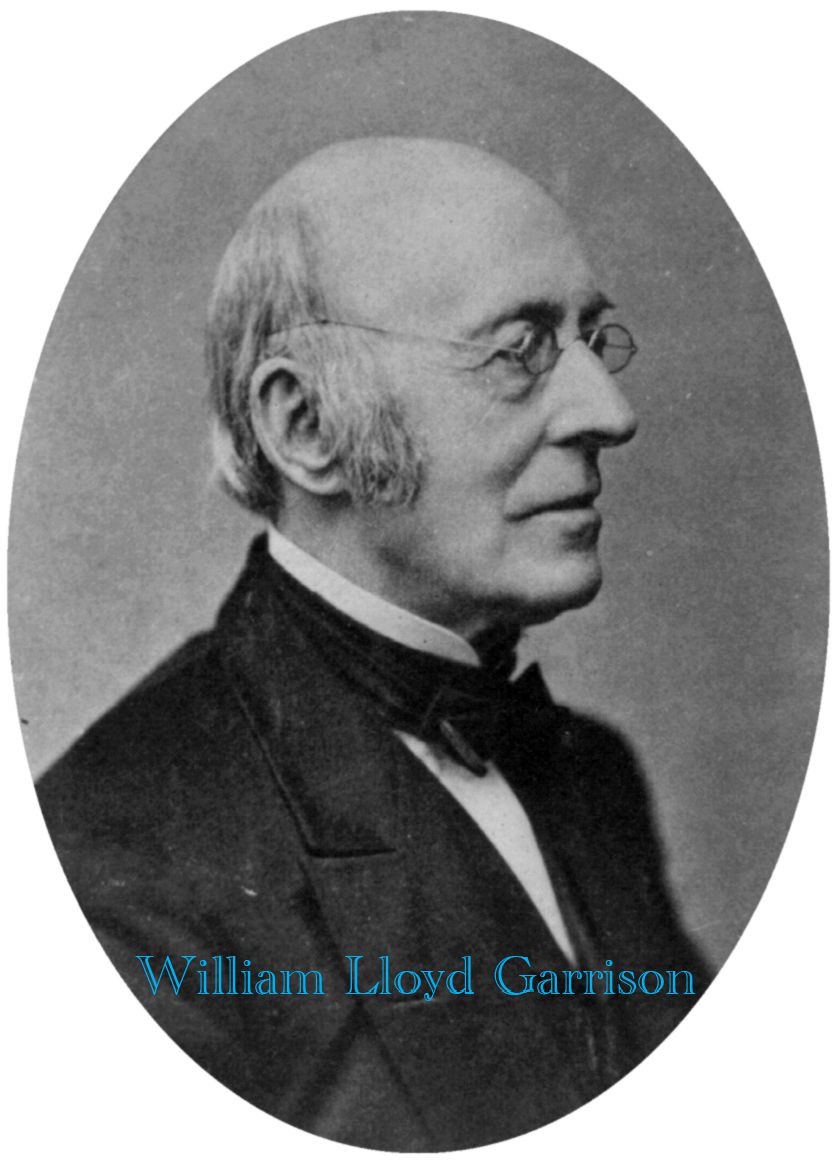
William Lloyd Garrison

Enslave the liberty of but one human being and the liberties of the world are put in peril.

Categories
Today

Pelted with Flowers

On July 31, 1703, Daniel Defoe — who would later become famous as the author of Robinson Crusoe and other literary works — was placed in a pillory for the crime of seditious libel. The sedition pertained to a satirical pamphlet he had published, “The Shortest-Way with the Dissenters; Or, Proposals for the Establishment of the Church.” The mob pelted him with flowers.

On the same date in 1912, Milton Friedman was born. Friedman became one of the most influential economists of the 20th century, and one of the most effective advocates of free markets, as well. His books include Capitalism and Freedom and two famous collaborations, A Monetary History of the United States (with Anna Schwartz) and Free to Choose (with his wife, Rose Friedman).

Categories
free trade & free markets national politics & policies

First, Fire All the Freelancers

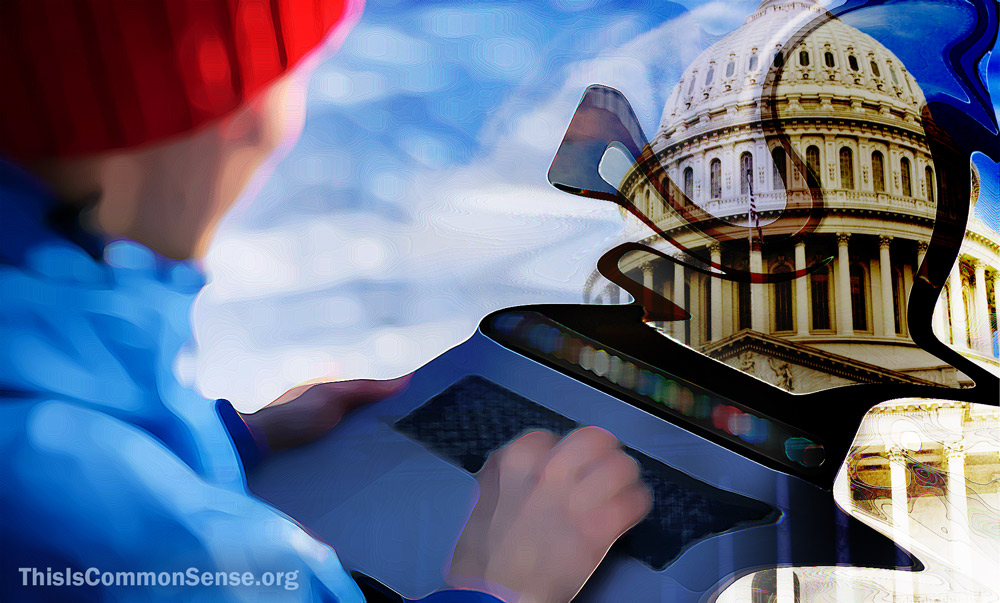
Congress is about to make the lives of an awful lot of people an awful lot harder.

So what else is new?

But the legislation in play does seem new — in suddenness and scope. 

It would impose massive newfangled regimentation on how we make a living. And it would kill the livelihoods of millions of people.

I refer to people who do gigs and freelance assignments for a living. One might ask why Democrats have it in for this kind of worker. Is it to appease unions? Is it the result of the same ideological forces that drove Karl Marx to despise the professional classes, needing to turn everyone into a prole? 

After all, this anti-freelancer agenda is not new. Similar legislation, called AB5, was tried a few years ago in California, instituted at the behest of activists eager to reduce competition with union work and remove chances for non-9-to-5 ways of making a living.

The premier target was ride-share companies Uber and Lyft. But many were caught in the net. AB5 created havoc throughout the state. Even socialist freelancers hated its mass murder of options and opportunity.

AB5-style congressional legislation to outlaw gig or freelance work except under very restricted circumstances is now being discussed in the U.S. Senate after having passed the U.S. House. It would also give unions many ugly new weapons to use to impose themselves on employees and employers.

In California, AB5 was mostly repealed by a citizen initiative.

Will there be a national citizen initiative to also promptly repeal the Protecting the Right to Organize Act? Unlikely, since Americans currently lack the right to enact national citizen initiatives.

This is Common Sense. I’m Paul Jacob.


PDF for printing

See all recent commentary
(simplified and organized)
See recent popular posts

Categories
Thought

Alexis de Tocqueville

The advantages which freedom brings are only shown by the lapse of time; and it is always easy to mistake the cause in which they originate.

Categories
Today

Out the Window!

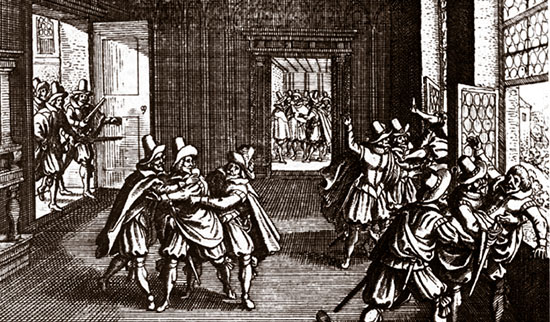
July 30, 1419, the First Defenestration of Prague: Jan Želivský, a Hussite priest at the church of the Virgin Mary of the Snows, led his congregation on a procession through the streets of Prague to the New Town Hall, on Charles Square. While they were marching, a stone was thrown at Želivský from the window of the town hall. The mob, enraged, stormed the hall. Once inside, the group threw the judge, the burgomaster, and some thirteen members of the town council out of the window and into the street, where they were killed by the fall or dispatched by the mob.

King Wenceslaus IV of Bohemia, upon hearing this news, was so stunned, the legend goes, that he died soon after.

On July 30, 1619, the first representative assembly in the Americas, the House of Burgesses, convened for the first time in Jamestown, Virginia. On the same date in 1676, Nathaniel Bacon issued the “Declaration of the People of Virginia,” beginning Bacon’s Rebellion against the rule of Governor William Berkeley.

On this date in 1863, representatives of the United States and tribal leaders (including the Shoshone’s Chief Pocatello) signed the Treaty of Box Elder.

July 30 birthdays include Henry Ford (1863), Gen. Smedley Butler (1881), C. Northcote Parkinson (1909), and former California Governor Arnold Schwarzenegger (1947).

Vanuatuans celebrate Independence Day on July 30.
Categories
First Amendment rights Fourth Amendment rights general freedom

Lockdowns Down Under

“Australia is suffering a surge of authoritarianism, in part because of its lack of constitutional protections for liberty,” writes J.D. Tuccille at Reason.

Sydney, Australia, is going through another major round of lockdowns. When you see the popular reaction — the mass protests demonstrate how unpopular the lockdowns are — you might be inclined to think there’s hope.

But Mr. Tuccille finds the hope in Americans’ great historic fortune: we have a Bill of Rights.

Australian politicians, on the other hand, express thankfulness that Australia doesn’t have any deep constitutional limits to their powers.

While it is the current Aussie prime minister who plays tyrant today, Aussie tyranny was cogently expressed by a previous holder of the position, John Howard, whom Tuccille quotes — chillingly: 

  1. “The essence of my objection to a Bill of Rights is that, contrary to its very description, it reduces the rights of citizens to determine matters over which they should continue to exercise control.” 
  2. “I also reject a Bill of Rights framework because it elevates rights to the detriment of responsibilities.”

That first point is not made much less bizarre by the prime minister’s elaboration, expressed in a sentence Tuccille did not include, that a Bill of Rights must fail because it delivers “authority to unelected judges, accountable to no one except in the barest theoretical sense.” Yet, lacking a listing of rights, there are few things a beleaguered citizen can do but bend to the cop’s bludgeon and prime minister’s edict. (Hooray for judges?)

That second point is an old canard. Rights and responsibilities go hand in hand; every right has a flip-side duty.

In the context of a pandemic: people with rights oblige others to negotiate masks and vaccines and the like.

Where? On private property: outside of government. On public property: in legislatures. 

Alas?

This is Common Sense. I’m Paul Jacob.


PDF for printing

See all recent commentary
(simplified and organized)
See recent popular posts

Categories
First Amendment rights Fourth Amendment rights general freedom

Lockdowns Down Under

“Australia is suffering a surge of authoritarianism, in part because of its lack of constitutional protections for liberty,” writes J.D. Tuccille at Reason.

Sydney, Australia, is going through another major round of lockdowns. When you see the popular reaction — the mass protests demonstrate how unpopular the lockdowns are — you might be inclined to think there’s hope.

But Mr. Tuccille finds the hope in Americans’ great historic fortune: we have a Bill of Rights.

Australian politicians, on the other hand, express thankfulness that Australia doesn’t have any deep constitutional limits to their powers.

While it is the current Aussie prime minister who plays tyrant today, Aussie tyranny was cogently expressed by a previous holder of the position, John Howard, whom Tuccille quotes — chillingly: 

  1. “The essence of my objection to a Bill of Rights is that, contrary to its very description, it reduces the rights of citizens to determine matters over which they should continue to exercise control.” 
  2. “I also reject a Bill of Rights framework because it elevates rights to the detriment of responsibilities.”

That first point is not made much less bizarre by the prime minister’s elaboration, expressed in a sentence Tuccille did not include, that a Bill of Rights must fail because it delivers “authority to unelected judges, accountable to no one except in the barest theoretical sense.” Yet, lacking a listing of rights, there are few things a beleaguered citizen can do but bend to the cop’s bludgeon and prime minister’s edict. (Hooray for judges?)

That second point is an old canard. Rights and responsibilities go hand in hand; every right has a flip-side duty.

In the context of a pandemic: people with rights oblige others to negotiate masks and vaccines and the like.

Where? On private property: outside of government. On public property: in legislatures. 

Alas?

This is Common Sense. I’m Paul Jacob.


PDF for printing

See all recent commentary
(simplified and organized)
See recent popular posts

Categories
Thought

Murray N. Rothbard

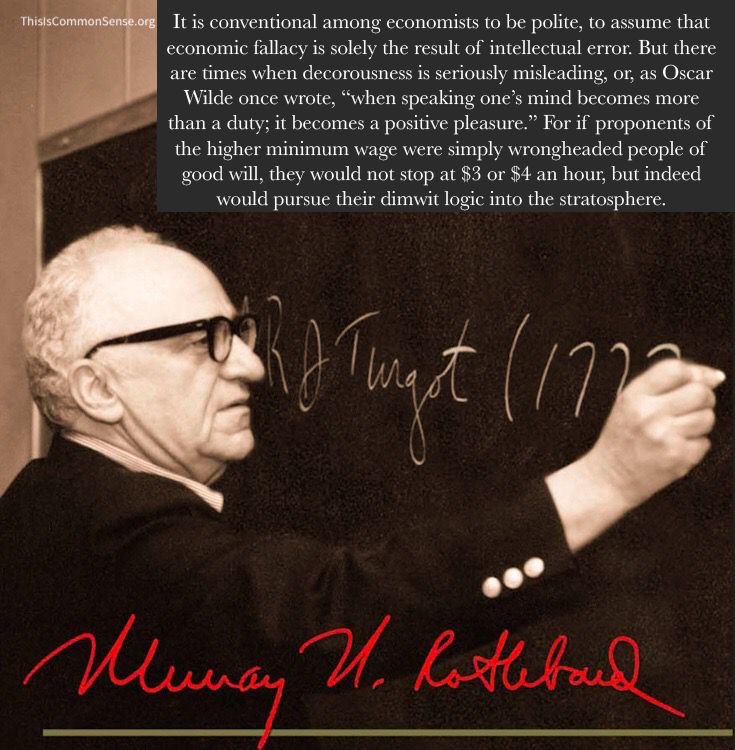
[I]f the minimum wage is such a wonderful anti-poverty measure, and can have no unemployment-raising effects, why are you such pikers? Why you are helping the working poor by such piddling amounts? Why stop at $4.55 an hour? Why not $10 an hour? $100? $1,000?
It is obvious that the minimum wage advocates do not pursue their own logic, because if they push it to such heights, virtually the entire labor force will be disemployed. In short, you can have as much unemployment as you want, simply by pushing the legally minimum wage high enough.

Murray N. Rothbard, Making Economic Sense (1995).