Categories
Thought

Herbert Spencer

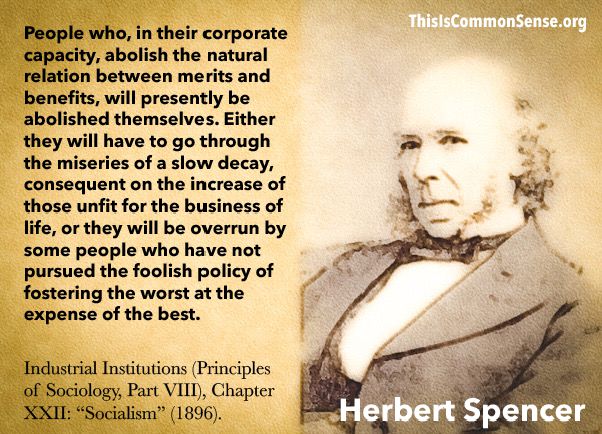
[P]eople who, in their corporate capacity, abolish the natural relation between merits and benefits, will presently be abolished themselves. Either they will have to go through the miseries of a slow decay, consequent on the increase of those unfit for the business of life, or they will be overrun by some people who have not pursued the foolish policy of fostering the worst at the expense of the best.

Herbert Spencer, Principles of Sociology, Vol. III: Part VIII, Industrial Institutions (1896), Chapter XXII: “Socialism.”
Categories
Today

A Prohibition Overturned

On August 4, 2010, in Perry v. Schwarzenegger, Judge Vaughn Walker overturned California’s Proposition 8, the ballot initiative prohibiting same-sex marriage that had passed two years earlier by the state’s voters.

Categories
ideological culture media and media people

Objectivity’s So Passé

“Will More Media Bias Save Democracy?” James Bovard headlined his latest column. 

At issue? Yet another call for journalists to abandon objectivity, and, as Bovard puts it, “take sides on the barricades.” This time it comes from Washington Post media columnist Margaret Sullivan, who suggests reporters use a “‘pro-democracy’ frame.” 

But as Mr. Bovard explains: “Most Washington journalists reflexively presume that being pro-government is the same as being pro-democracy.” 

And even worse, when differentiated, “most Washington press poohbahs show more affection for Leviathan than democracy.”

For instance, “The Washington Post devotes far more newshole to publishing leaks from FBI officials,” he points out, “than to exposing FBI abuses.”

Of course, activist journalists might frame “democracy” in their own way or choose to advance another cause.

“Journalists need to be overt and candid advocates for social justice,” argued Stanford Communications Professor Ted Glasser during last year’s presidential contest, “and it’s hard to do that under the constraints of objectivity.”

Howard University Communications Professor Nikole Hannah-Jones of New York Times’ 1619 Project infamy advocates that “all journalism is activism,” and condemns “even-handedness, both sideism.”

Five years ago this month, during the Trump vs. Clinton presidential campaign, The New York Times offered readers a front-page commentary wherein former media columnist Jim Rutenberg argued that America’s news hounds must “throw out the textbook American journalism has been using” and become “oppositional” to candidate Trump.

Though Mr. Trump triggered massive media partisanship, which continues to worsen, it is not new. Indeed, at this point, with the public’s trust in media flushing into the toilet bowl of history, objectivity would seem almost transformational.

This is Common Sense. I’m Paul Jacob.


PDF for printing

objectivity

See all recent commentary
(simplified and organized)
See recent popular posts
Categories
Thought

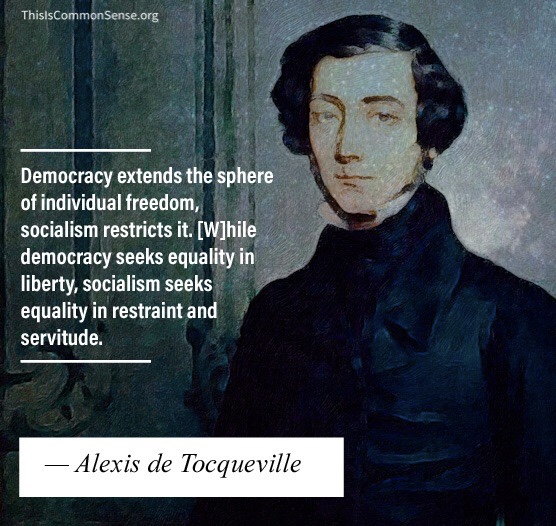
Alexis de Tocqueville

La démocratie étend la sphère de l’indépendance individuelle, le socialisme la resserre. La démocratie donne toute sa valeur possible à chaque homme, le socialisme fait de chaque homme un agent, un instrument, un chiffre. La démocratie et le socialisme ne se tiennent que par un mot, l’égalité; mais remarquez la différence : la démocratie veut l’égalité dans la liberté, et le socialisme veut l’égalité dans la gêne et dans la servitude.

Alexis de Tocqueville, “Discours prononcé à l’assemblée constituante le 12 Septembre 1848 sur la question du droit au travail,” Oeuvres complètes, vol. IX, p. 546.

Democracy extends the sphere of individual freedom, socialism restricts it. Democracy attaches all possible value to each man; socialism makes each man a mere agent, a mere number. Democracy and socialism have nothing in common but one word: equality. But notice the difference: while democracy seeks equality in liberty, socialism seeks equality in restraint and servitude.

Alexis de Tocqueville, quoted in F.A. Hayek, The Road to Serfdom (1944).
Categories
Today

Aleksandr Solzhenitsyn

On August 3, 2008, Aleksandr Solzhenitsyn died at age 90.

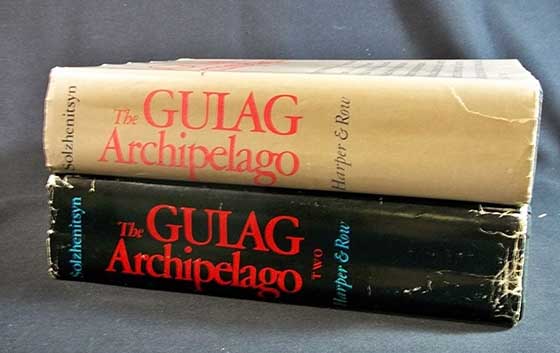
Solzhenitsyn’s novels, such as One Day in the Life of Ivan Denisovich and Cancer Ward, explored life under totalitarian Communism, and remain classics of modern literature. His huge survey of Soviet concentration camps, The Gulag Archipelago, was an important contribution to the demise of Communism as a popular ideology, showing just how horrifying the repression in the Soviet Union had become.

Categories
insider corruption term limits

A Plutocrat’s Expensive Friend

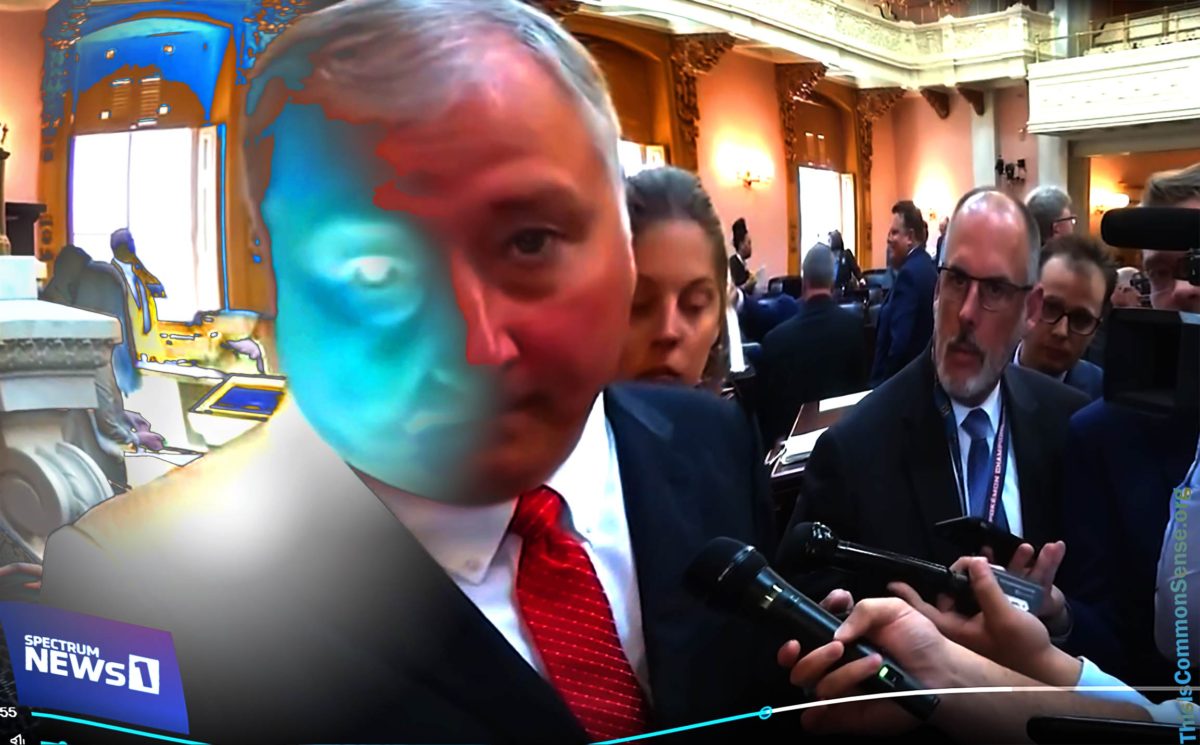
An “expensive friend” — in documents obtained by federal prosecutors, that’s how former FirstEnergy CEO Chuck Jones sized up former Ohio Speaker of the House Larry Householder.

What made the Speaker so Big Ticket?

“Republican Larry Householder hatched a plan to cement his hold on power for an additional 16 years,” The Columbus Dispatch reported, “and Akron-based FirstEnergy Corp. invested $2 million into the effort.”

Their scheme?

Petition a citizen initiative onto the ballot to slap lifetime term limits on legislators, rather than the current eight-year consecutive limits, as bait to hook pro-limits voters — emphasizing this toughening part, while hiding the fact that the eight-year limits in each chamber would be doubled to a 16-year limit in either.

The initiative would also set a brand-new clock, wiping out all past service so that Householder could command the House, uninterrupted, for 16 more years. 

“He told me he’ll retire from [the House],” Jones joked with an associate, “but get a lot done in 16 more years.”

The pandemic stopped Householder’s scam. And then, last July, the FBI dropped the other shoe, arresting him for racketeering. Now awaiting trial, Householder has been pushed out as Speaker and then expelled from the House completely — the first time in over 150 years.

FirstEnergy fired CEO Jones — who, according to The Washington Post, “prosecutors continue to investigate” for his “involvement in a $60 million bribery scheme secretly funded by the company to win a $1 billion legislative bailout.”

Mr. Householder never liked term limits, but his corrupt attempts to thwart them serve as evidence of their importance.

This is Common Sense. I’m Paul Jacob.


PDF for printing

See all recent commentary
(simplified and organized)
See recent popular posts

Categories
Thought

William Lloyd Garrison

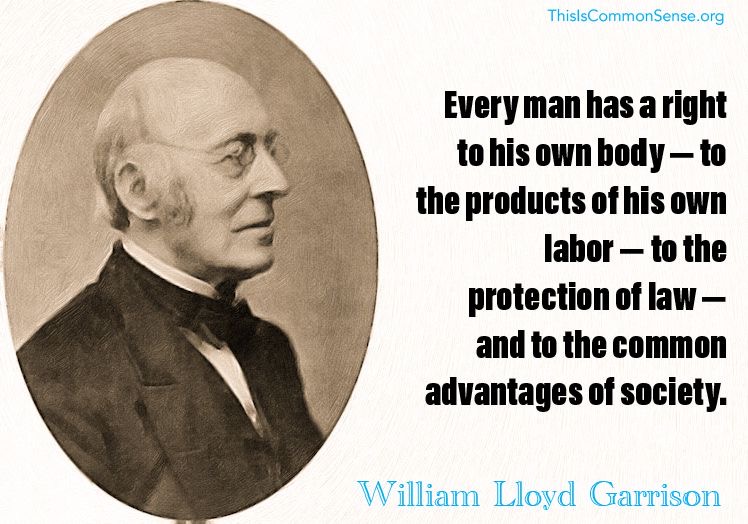
The right to enjoy liberty is inalienable. To invade it is to usurp the prerogative of Jehovah. Every man has a right to his own body — to the products of his own labor — to the protection of law — and to the common advantages of society. It is piracy to buy or steal a native African, and subject him to servitude. Surely, the sin is as great to enslave an American as an African.

William Lloyd Garrison, “Declaration of Sentiments of the American Anti-Slavery Convention,” speech in Philadelphia (December 6, 1833).
Categories
Today

Declaration signed!

The Declaration of Independence was signed by members of the Continental Congress of the United States, on August 2, 1776.

Categories
by Paul Jacob video

Watch: Yes, Rights Still Matter

Paul Jacob reminds politicians of that which they tend to forget:

Categories
Thought

James Madison

Religion & Govt. will both exist in greater purity, the less they are mixed together.