Categories
Common Sense

George Mason

Introduced by George Mason at the Virginia Convention in the Capitol in Williamsburg.
Unanimously adopted June 12, 1776:

A DECLARATION OF RIGHTS made by the representatives of the good people of Virginia, assembled in full and free Convention, which rights do pertain to them, and their posterity, as the basis and foundation of government.

  1. THAT all men are by nature equally free and independent, and have certain inherent rights, of which, when they enter into a state of society, they cannot, by any compact, deprive or divest their posterity; namely, the enjoyment of life and liberty, with the means of acquiring and possessing property, and pursuing and obtaining happiness and safety.
  2. That all power is vested in, and consequently derived from, the people; that magistrates are their trustees and servants, and at all times amenable to them.
  3. That government is, or ought to be, instituted for the common benefit, protection, and security, of the people, nation, or community; of all the various modes and forms of government that is best, which is capable of producing the greatest degree of happiness and safety, and is most effectually secured against the danger of mal-administration; and that whenever any government shall be found inadequate or contrary to these purposes, a majority of the community hath an indubitable, unalienable, and indefeasible right, to reform, alter, or abolish it, in such manner as shall be judged most conducive to the publick weal.
  4. That no man, or set of men, are entitled to exclusive or separate emoluments or privileges from the community, but in consideration of publick services; which, not being descendible, neither ought the offices of magistrate, legislator, or judge, to be hereditary.
  5. That the legislative and executive powers of the state should be separate and distinct from the judicative; and, that the members of the two first may be restrained from oppression, by feeling and participating the burthens of the people, they should, at fixed periods, be reduced to a private station, return into that body from which they were originally taken, and the vacancies be supplied by frequent, certain, and regular elections, in which all, or any part of the former members, to be again eligible, or ineligible, as the laws shall direct.
  6. That elections of members to serve as representatives of the people, in assembly, ought to be free; and that all men, having sufficient evidence of permanent common interest with, and attachment to, the community have the right of suffrage, and cannot be taxed or deprived of their property for publick uses without their own consent, or that of their representatives so elected, nor bound by any law to which they have not, in like manner, assented, for the publick good.
  7. That all power of suspending laws, or the execution of laws, by any authority without consent of the representatives of the people, is injurious to their rights, and ought not to be exercised.
  8. That in all capital or criminal prosecutions a man hath a right to demand the cause and nature of his accusation, to be confronted with the accusers and witnesses, to call for evidence in his favour, and to a speedy trial by an impartial jury of his vicinage, without whose unanimous consent he cannot be found guilty, nor can he be compelled to give evidence against himself; that no man be deprived of his liberty except by the law of the land, or the judgement of his peers.
  9. That excessive bail ought not to be required, nor excessive fines imposed, nor cruel and unusual punishments inflicted.
  10. That general warrants, whereby any officer or messenger may be commanded to search suspected places without evidence of a fact committed, or to seize any person or persons not named, or whose offence is not particularly described and supported by evidence, are grievous and oppressive, and ought not to be granted.
  11. That in controversies respecting property, and in suits between man and man, the ancient trial by jury is preferable to any other, and ought to be held sacred.
  12. That the freedom of the press is one of the greatest bulwarks of liberty, and can never be restrained but by despotick governments.
  13. That a well regulated militia, composed of the body of the people, trained to arms, is the proper, natural, and safe defence of a free state; that standing armies, in time of peace, should be avoided, as dangerous to liberty; and that, in all cases, the military should be under strict subordination to, and be governed by, the civil power.
  14. That the people have a right to uniform government; and therefore, that no government separate from, or independent of, the government of Virginia, ought to be erected or established within the limits thereof.
  15. That no free government, or the blessings of liberty, can be preserved to any people but by a firm adherence to justice, moderation, temperance, frugality, and virtue, and by frequent recurrence to fundamental principles.
  16. That religion, or the duty which we owe to our CREATOR and the manner of discharging it, can be directed only by reason and conviction, not by force or violence; and therefore all men are equally entitled to the free exercise of religion, according to the dictates of conscience; and that it is the mutual duty of all to practice Christian forbearance, love, and charity towards each other.

Categories
Common Sense

Joseph Addison

A day, an hour, of virtuous liberty
Is worth a whole eternity in bondage.

Joseph Addison, Cato, A Tragedy (1713), Act II, scene

Categories
Common Sense

Abigail Adams

I am more and more convinced that man is a dangerous creature; and that power, whether vested in many or a few, is ever grasping, and, like the grave, cries, ‘Give, give!’ The great fish swallow up the small; and he who is most strenuous for the rights of the people, when vested with power, is as eager after the prerogatives of government. You tell me of degrees of perfection to which human nature is capable of arriving, and I believe it, but at the same time lament that our admiration should arise from the scarcity of the instances.

Categories
Common Sense

Corruption Beyond Imagination

“Two Baltimore detectives were convicted Monday of robbery and racketeering,” the Washington Post reported, “in a trial that laid bare shocking crimes committed by an elite police unit and surfaced new allegations of widespread corruption in the city’s police department.”

Assistant U.S. Attorney Leo Wise presented the jury with “things more horrible in some cases than you ever could have imagined.”

Test your imagination:

  • Four police officers, already convicted, testified to routinely violating the rights of citizens in order to steal cash and property worth hundreds of thousands of dollars.
  • Officers left the scene of an accident they caused without summoning assistance for those injured, and then covered up their involvement.
  • Detectives “doubled their salaries by lying to claim extravagant overtime when they were actually at bars or . . . out of the country on vacation.”
  • There was an allegation of murder against one policeman and a charge that another high police official covered it up.

A total of eight officers of the Gun Trace Task Force have now been convicted of or pleaded guilty to felonies.

Where was Internal Affairs? “The head of internal affairs has been transferred” the Post informed, after he was “implicated in misconduct during trial testimony.”

We could sic the feds on them! Oh, wait, “[m]ost of the behavior charged in the case took place even as the [Baltimore police] department was already under federal investigation by the Justice Department . . .”

Prospects for reform?

Last Wednesday, Mayor Catherine Pugh claimed to having been “too busy to follow the trial closely or read Baltimore Sun coverage…”

Baltimore, we’ve got a problem.

This is Common Sense. I’m Paul Jacob.


PDF for printing


Categories
Common Sense

A Revolutionary Turn-around

Donald J. Trump, 45th President under the Constitution of these United States, may be re-establishing some constitutional order.

“The president has the power to veto half-baked legislation,” explains Josh Blackman at the National Review. “If Trump returned a bill to Congress, stating in his message that it failed to include sufficient guidelines, there would be a paradigm shift in Washington, D.C.” And, in recent speeches at the Federalist Society, Blackman notes, administration lawyers appear to be advancing just such a shift:

  1. Congress must no longer delegate legislative power to the executive branch;
  2. Informal “guidance documents” must no longer be used to deprive people of the due process of law; and
  3. The courts’ rubber-stamping of executive diktats must end.

Couple this agenda with Trump’s just-in-office executive order instructing that two old rules be stricken for every new rule concocted, and we could be witnessing an almost-revolutionary turn-around here.

Why is this happening?

Not, I think, because Trump is an originalist or strict constructionist. “Donald Trump did not campaign for president as the guy who would reverse the mostly unbroken, century-old trend of the executive power assuming more and more power in the face of an increasingly self-marginalizing Congress,” Matt Welch reminds us over at Reason.

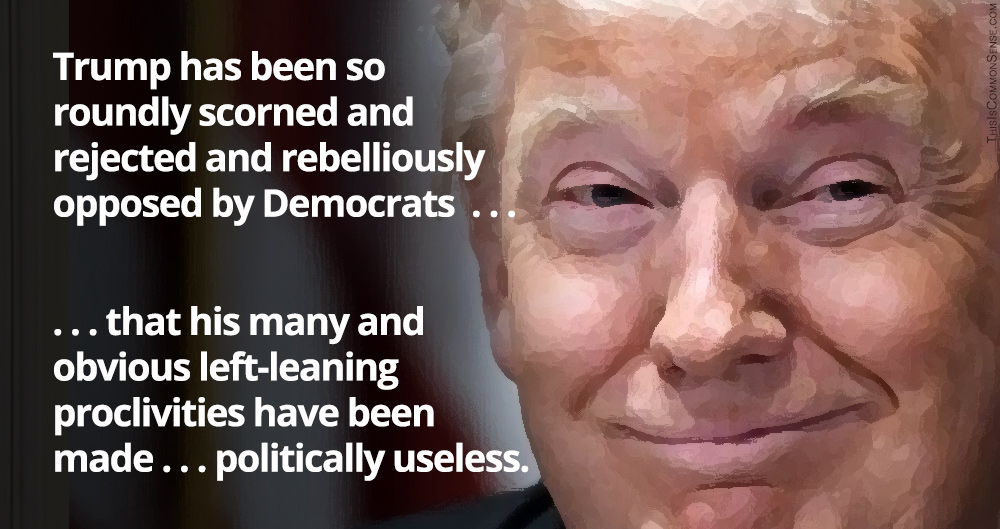
Maybe it is because Trump has been so roundly scorned and rejected and rebelliously opposed by Democrats in general and the far left in particular — including, especially, most major media figures — that the mogul-turned-politician’s many and obvious left-leaning proclivities have been made . . . politically useless. His opposition on the left has sent him right . . . to good policy.

On this issue, anyway.

This is Common Sense. I’m Paul Jacob.


PDF for printing


Categories
Accountability Common Sense incumbents initiative, referendum, and recall local leaders moral hazard national politics & policies responsibility term limits

Agreeable America

Americans actually agree on a lot of things; it’s a pity that today’s media and political debates play up the discord.

Or so argues A. Barton Hinkle at The Richmond Times-Dispatch. Sure, he admits, “[a] lot of people seem willing to tear your head off over the smallest thing.” But “on some topics, the public is of one mind, or as close to that as you can get.”

Hinkle notes that “Nine out of 10 Americans think a background check should be required for every firearm purchase.”  A few percentage points fewer wish to keep “Dreamers” in the country; a mere one point fewer disapprove of civil asset forfeiture. Medical marijuana is approved of by 83 percent of Americans.

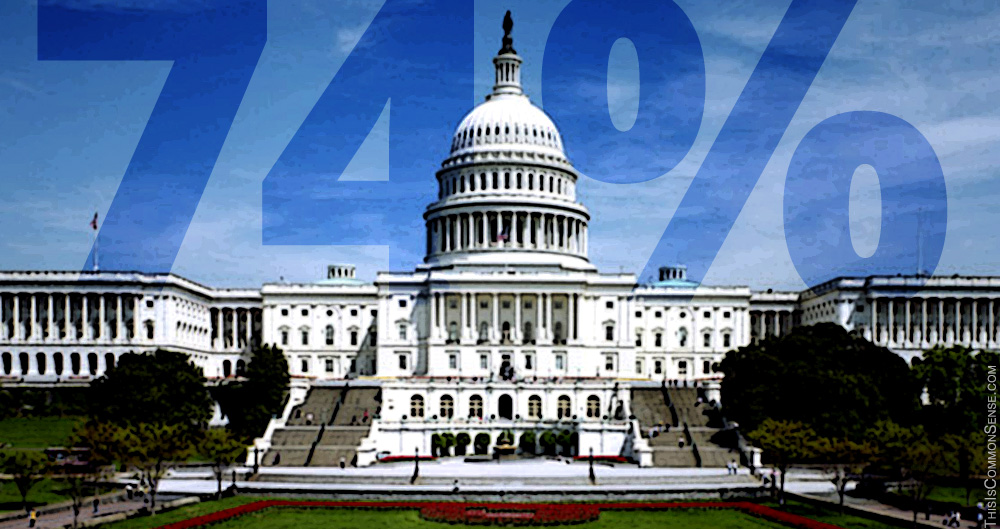
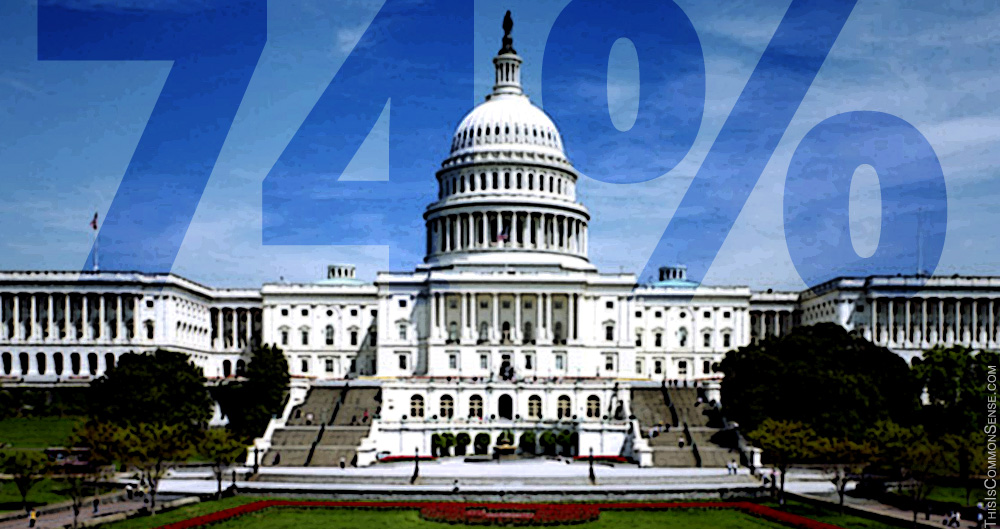
Not on Hinkle’s list? American agreement on term limits. A year ago, a Rasmussen Poll found support for limiting congressional terms at 74 percent of likely voters, with only 13 percent opposed and 13 percent undecided. This overwhelming public support has been consistent for many decades.

But consistently ignored by Congress. Not so surprisingly.

Can Americans put their united oomph behind their overwhelming agreement? U.S. Term Limits thinks so.

The group isn’t depending on cajoling the Congress, either. They’re mobilizing concerned citizens to convince 34 state legislatures to call a Term Limits Convention.* The convention’s purpose is to propose a constitutional amendment for congressional term limits, which then still requires 38 states to ratify it.

Rather than brewing up a civil war over tweets and “microaggressions,” join the Term Limits Team.

Let’s agree to agree. And make our representatives agree, too.

This is Common Sense. I’m Paul Jacob.

* As Article V of the U.S. Constitution states, “The Congress . . . on the application of the legislatures of two thirds of the several states, shall call a convention for proposing amendments, which, in either case, shall be valid to all intents and purposes, as part of this Constitution, when ratified by the legislatures of three fourths of the several states . . .


PDF for printing


Categories
Accountability Common Sense folly general freedom media and media people moral hazard nannyism national politics & policies responsibility term limits too much government

It’s the Stupid Spending

These United States are approaching a crisis. Mounting debt seems increasingly unpayable. Sovereign default and financial chaos are “in the offing” — drifting from the (future) horizon to the (present) shore.

The costs of our debt load have been accommodated as astute economists predicted, with the weakest recovery in American history.

Seven years ago I wrote:

According to increasing numbers of Americans, it’s the level of spending by government that must decrease. We must balance budgets. Soon.

One could play sloganeer and say “It’s the spending, stupid”; or, twist that, to say “It’s the stupid spending.” But however you formulate the problem, what the new Republican House must do is find a way to cut spending.

They haven’t. Is there any reason, even with super-duper businessman Donald Trump riding herd, that they will make net cuts?

We can expect gross spending to increase and the debt to balloon even bigger.

Why?

Well, we are trapped.

Even the politicians themselves feel trapped.

You see, once the government begins a program, a constituency comes to depend upon it, and resists being “betrayed.” And the media supplies a steady stream of sob stories about the brutality of “austerity.” Politicians fear the passion of voters reacting to a specific hyped human need more than the general desire for less spending. So politicians increase the stupid spending.

Well, if the politicians are trapped, release them. Free them.

How? Term limits.

Congressional term limits would un-trap not just the pols — it’d free the voters, too. Let’s end the pretense that sending the same politicians to Washington term after term can produce local prosperity. Oh, the power of incumbency may lavish benefits on career congressmen, but it doesn’t pay off for the rest if us.

This is Common Sense. I’m Paul Jacob.


* It was President Harry Truman who said that term limits would “help to cure senility and seniority — both terrible legislative diseases.”


PDF for printing


Illustration: Gustave Doré, Avaricious and Prodigal”


Categories
Common Sense

The Immovable Non-movers

You can’t suspend the law of gravity. Nor, apparently, the laws of bureaucratic lethargy and inertia.

Diana Rickert was a policy analyst with the Illinois Policy Institute who accepted a job with the administration of Illinois Governor Bruce Rauner.

She lasted six weeks.

The assignment: combine and streamline several governmental departments. After years of “railing against government,” she felt she must accept this opportunity to improve government from the inside. Or else forever wonder whether she might have made a difference.

She’s learned her answer. She could not. Not as an insider. Not without the authority, at a minimum, to fire useless employees, who abound in Illinois’s state government.

And whose uselessness doesn’t always preclude outrageous expectations about salary and position.

Whether trying to get working computers or to get workers to work on simple but unfamiliar tasks, Diana and the few others eager to get stuff done were constantly thwarted by the apathy and sense of entitlement of the majority — and by endless arcane and senseless rules. Rather than imply tacit acceptance of such a broken, unfixable system, she resigned.

All this sounds familiar, an inevitable feature of government bureaucracy with its glued-in vested interests and lack of market-style profit incentives. Old news if you’ve ever been to the DMV.

So what’s the answer? Give up?

No. Illinois is “ready for change,” Diana Rickert says. But it’s outsiders who will have to change it — from the outside . . . “because the insiders never will.”

This is Common Sense. I’m Paul Jacob.


PDF for printing


Categories
Accountability Common Sense general freedom media and media people national politics & policies Regulating Protest responsibility

Time for Action

More protests during the national anthem; more opposition to those protests by the Trump administration; more recriminations about the administration’s opposition to the protests. Ah, modern times.

Let’s review:

  1. NFL players have a constitutional right to take a knee during the national anthem.
  2. NFL owners do have or could have (depending on who you believe) a contractual right to require players to stand for the national anthem or face action.
  3. Presidents have a right to suggest that owners fire NFL players who take a knee during the anthem, though I’d really prefer they not use the term SOB — though again they have a right to say it.  
  4. Vice-Presidents have a right to leave an NFL game if NFL players take a knee during the anthem or, believe it or not, for any reason they feel like. And under our free system, they can even go further, and plan their reaction ahead of time depending on what action players take.*
  5. NFL fans have a right to continue to be fans or not.

I love football, but haven’t followed the NFL for decades.

I love rights even more. And I think we certainly ought to be talking about and, more importantly, working on criminal justice reform. Let’s not lose sight of that in the controversy over the NFL protests.

Perhaps, the time for protest is ending. The time for action is now.

This is Common Sense. I’m Paul Jacob.


* Did Vice-President Mike Pence leave the Colts-49ers game as a PR stunt? Well, every move the president or the VP make is a public relations stunt. If that’s the primary attack on the VEEP’s actions, he has turned the corner and is in the clear.


PDF for printing


Categories
Common Sense

What Would George Orwell Have Thought of Antifa?

One of many questions asked of Mr. David Ramsay Steele, whose new book on the author of Animal Farm and Nineteen Eighty-Four takes a thorough and gimlet-eyed view of Orwell’s worldview:

An excerpt (under 11 minutes) from the interview: “Orwell’s Anti-Fascism (David Ramsay Steele)

Mr. Steele’s book on Amazon: Orwell Your Orwell: A Worldview on the Slab

The above interview on Vimeo: “Orwell’s Worldview on the Slab (David Ramsay Steele)