Categories
Accountability local leaders tax policy

Balking in Baltimore

So far, the besieged businessmen of the Fells Point area of Baltimore are only threatening to withhold payments of taxes and fees to the city.

If and when they follow through, the plan is to place the withheld funds in escrow. The money would then be turned over to the city government if and only if the city again meets minimal standards of performance. 

Tax resistance? Sure. But not in the usual mode.

Fells Point shop owners are rebelling against a “culture of lawlessness” in their streets, streets managed or mismanaged by the city. They want police to do more — be free to do more — about crime.

In a letter to Baltimore Mayor Brandon Scott and other officials submitted not long after several shootings in the area, thirty-seven Fells Point businessmen demand that the city “Pick up the trash. . . . Enforce traffic and parking laws. . . . Stop illegal open-air alcohol and drug sales. . . . Empower police to responsibly do their job. . . . Please do your job so we can get back to doing ours.”

What will happen? I fear that, despite this worthy protest, city officials will continue to turn a blind eye. I fear that they will regard the protest as a PR problem, one that will go away and allow them to go on with the usual business of government — the way they see it. Their evasive initial responses to the letter are not encouraging.

Baltimore businesspeople are not trying to dodge city taxes here. They understand very well that one cannot expect to get something for nothing. They just want to get something.

This is Common Sense. I’m Paul Jacob.


PDF for printing

See all recent commentary
(simplified and organized)
See recent popular posts

Categories
national politics & policies tax policy

The Six-Trillion Dollar Man

“Mr. Biden is making a six-trillion dollar bet that promoting popular programs will be popular,” offered NBC Meet the Press host Chuck Todd on Sunday, “and that he’ll be rewarded for getting things done, long before the actual bill comes due.”

That “Six trillion dollars”? New splurging “on social spending, infrastructure, climate change, health care and more.” 

The host intoned that this constitutes the “return of big government.” 

“We have to prove democracy still works, that our government still works,” Joe Biden, the 47th president, implored Congress last week, “and we can deliver for our people.”

Spend = Deliver. 
Deliver = Democracy. 
Democracy = Spend!

So goes a federal “democracy” wherein voters never get a straight, democratic choice on how much government should spend and tax.* Instead, politicians opt for their beloved “deficits forever” method. Purchase votes today — “People like it when you give them money” — and leave for future generations of voters the tax burden needed to pay that bill. No pain, all gain. 

Smart re-election strategy, some say. 

“Democratic strategists are betting that the infighting in the Republican Party, the extremism on display during the Jan. 6 attack . . . and the sheer scale of the trillion dollar programs Democrats have pushed through this year,” reports The Washington Post, “leads to a reorienting of partisan divisions that can overcome historical patterns.” Meaning Democrats avoid the traditional loss of congressional seats for a president’s party.

“Will voters care about the scope of Mr. Biden’s plans?” Todd inquired. “. . . care about the price tag?” 

Likely to the degree they notice paying that price. 

“President Trump and the Republicans may have made it a bit easier for Mr. Biden by spending big themselves,” reminded Todd.

He’s not wrong there.

This is Common Sense. I’m Paul Jacob.


* Colorado voters have such a choice: a vote on any tax increase and on government spending increases. It’s called the Taxpayer Bill of Rights (TABOR) and was passed by citizen initiative back in 1992. The politicians and lobbyists just hate it, as I detail here

PDF for printing

Photo by Anno Málie

See all recent commentary
(simplified and organized)
See recent popular posts
Categories
education and schooling tax policy

Race, Ignorance, Racism

Not spending millions more to hire and train swarms of Internal Revenue Service agents to poke, audit, investigate and squeeze more tax dollars from wealthier Americans would be — you knew this was coming — racist

That’s the new argument for siccing the IRS on wealthier Americans; they’re more likely to be white than black.

“The federal government is losing billions in unpaid taxes,” informs a Washington Post headline, “in part due to racial disparities in the tax code.”

What racially based inequalities, precisely?

“The inequity rests on long-established tax breaks that favor White Americans over Black Americans in three areas — marriage, homeownership and retirement, according to Dorothy A. Brown, an Emory University law professor,” writes Post columnist Joe Davidson. Because, for instance, “White people . . . are much more likely to be homeowners,” and more likely than blacks “to work for companies that offer tax favored retirement plans.”

Davidson offered no further discussion of marriage.

One can argue for or against hiring more IRS agents. (I’m against.) But to calculate the merits based on the skin color of the people most likely to be investigated is . . . racist.

Where does such skewed logic lead?

“The Virginia Department of Education (VDOE) is moving to eliminate all accelerated math options prior to 11th grade,” Fox News reports, “effectively keeping higher-achieving students from advancing as they usually would in the school system.”

This statewide policy designed to hurt so many individual students — and to help none — is predicated on closing a racial gap in math performance. By knee-capping the higher performing students of all races.*

So which is worse? That it’s a human rights violation . . . or that it is so incredibly stupid?

This is Common Sense. I’m Paul Jacob. 


* As a candidate in this year’s Virginia House elections explained to The Federalist, the proposed statewide policy “is incredibly belittling, arrogant, and racist in assuming that children of color cannot reach advanced classes in math.”

PDF for printing

Screenshot from Harrison Bergeron

See all recent commentary
(simplified and organized)
See recent popular posts
Categories
tax policy

Just Never Satisfied

The top federal income tax rate is currently 37 percent.

It’s been higher — 94 percent at one point during the Second World War, 91 percent in the 1950s . . . on income above a certain threshold.

Back in the 1890s, the federal government briefly taxed income at 2 percent. It was quickly struck down by the U.S. Supreme Court as unconstitutional. 

Those were the days.

In 1913, the 16th Amendment was ratified, giving Congress “power to lay and collect taxes on incomes” overriding the constitutional provisions that the high court had cited in 1895. The first federal rates were 1 percent for the lowest income bracket, 7 percent for the top bracket, on income above $500,000.*

By 1916, the lowest percentage was 2, the highest 25, on income above $2,000,000.

The good news: skyward tax rates aren’t set in stone. The bad news: once a precedent for a new tax has been established, you can expect worse to come.

So what happens if California Assemblyman Rob Bonda gets his way? He seeks a tax of “just” 0.4 percent on the accumulated wealth of “just” “the top 0.15%” wealthiest Californians, “about 30,000 people.” If these wealthiest leave the state, they would still be subject to the tax for ten years(!). 

Presumably, this latter, and quite brazen, aspect of an already brazen tax would be subject to constitutional challenges.

If Bonda’s proposal is enacted and upheld, would the scope of its reach stay put at 0.4 percent of holdings and 0.15 percent of Californian taxpayers?

It would not.

This is Common Sense. I’m Paul Jacob.


* That was a lot of money back then — worth $13 million today.

PDF for printing

Categories
deficits and debt tax policy too much government

No Shock and Awe

They’ve crunched the numbers and the shocking truth is . . . Democratic Presidential candidate Joe Biden wants to raise taxes and debt.

The word “shocking” needs quotation marks, of course, for sheer lack of any shock whatsoever.

Also not shocking is who pays.

You see, “80 to 90 percent of the total proposed tax increases in Biden’s plan would fall on the top five percent of earners,” according to the Committee for a Responsible Federal Budget. That is the target taxpayer cohort, anyway. Economists know a hidden truth: the incidence of a tax’s burden shifts. All taxes siphon off production, but — because production is engaged in for consumption’s sake — in the end consumers pay.

In politics, of course, the idea is not to acknowledge this, instead focusing on the targets, tempting voters to get on board with spending and taxing and borrowing just so long as some other (preferably non-voting) people pay. 

“While tax burdens would rise by 0.2 to 0.6 percent for most households, they would rise by 2.3 to 5.7 percent for the top 20 percent of earners and by 13.0 to 17.8 percent for those in the top 1 percent in 2021.” The Democrats would have the highest earners in America pay an extra “$300,000 per year” and call that a benefit . . . to those who would pay less.

Meanwhile, the “additional revenue that would be raised through Biden’s tax plan would only pay for a portion of his overall spending agenda.” It would take “$6 trillion more . . . to stabilize debt-to-GDP at today’s near-record levels.”

According to the CRFB, because of pandemic panic spending, and before any proposed Biden add-ons, “debt will grow from 79 percent of GDP before the crisis to 101 percent by the end of 2020 and 118 percent of GDP by 2030.”

Have our politicians set out to revise Ben Franklin’s maxim? There is nothing more certain than death and taxes — and debt.

This is Common Sense. I’m Paul Jacob.


PDF for printing

See all recent commentary
(simplified and organized)
See recent popular posts
Categories
tax policy too much government

California Schemin’

Is California a failed state? It has an electric grid problem. And a vagrancy problem. Both of which stem from the bizarre ideological blind spots of a political class “benefiting” from the state’s high legislator/citizen ratio, which insulates politicians from feedback.

Driving them power mad.

And one form of madness flowers in political greed, hubris and overreach.

“A pack of Democratic lawmakers in California are proposing a wealth tax for the state’s richest citizens, forcing them to pay more essentially just for owning a lot of stuff,” writes Scott Shackford at Reason. “They also, amazingly, want the tax to follow Californians who flee the state in response, attempting to make them continue paying taxes on wealth that’s not even in the state.”

Rob Bonta, Oakland’s Democrat in the Assembly, says the Golden State needs more gold, and he has made a startling observation. Wait for it. “Rich people have money,” Shackford summarizes, and Bonta wants to take it. To expand services.

But surely service expansion is not only not the only option, it is often the worst option. 

Take the state’s rolling blackouts. Was that caused by not enough or really bad legislation? President Trump points his finger at the Democratic-controlled Assembly: “In California, Democrats have intentionally implemented rolling blackouts — forcing Americans in the dark. Democrats are unable to keep up with energy demand,” the president tweeted on Tuesday. But the New York Post identifies as a cause not “intentionally implemented” blackouts, but “inadequate transmission and an over-reliance on renewable energy and issues with natural gas plants during high heat.”

Bad policy. Not too few “services.”

And the proposal to tax the richest Californians — or former Californians — to pay for more disastrous programs? 

Hubris and greed.

Not Common Sense. I’m Paul Jacob.


PDF for printing

See all recent commentary
(simplified and organized)
See recent popular posts
Categories
initiative, referendum, and recall tax policy

Extraordinarily Unusual

“It’s a government-on-government fight,” reports Seattle-based KOMO News, as the Pierce County Council voted 4-3 to provide assistance in defending Initiative 976 in court.

The ballot measure, which limits car license fees among other provisions, passed 53 to 47 percent statewide last month, including a whopping 66 percent affirmative vote in Pierce County. And — you guessed it — I-976 was immediately swarmed by life-devouring locusts — er, I mean, sued by “a handful of counties, cities, transportation agencies, and one transit rider.”

In short, many governments seek to undo a vote of the people . . . along with a lone citizen to serve as fig leaf.

Against only one government, Pierce County, now joining the voters.

Late last month, a judge in King County, one of only four counties (out of the state’s 39) to vote against I-976, issued a preliminary injunction blocking implementation of the initiative, while the case is being adjudicated.   

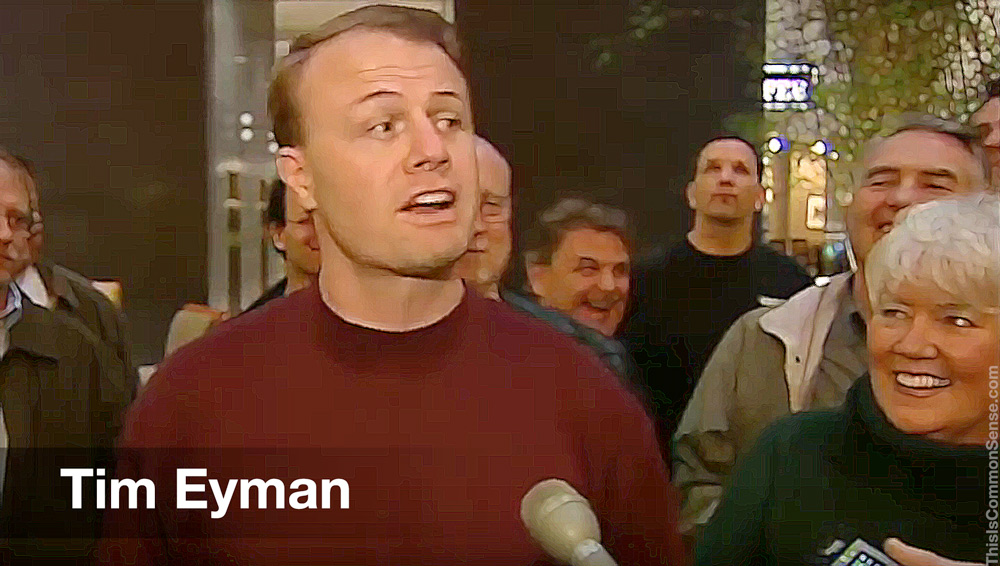
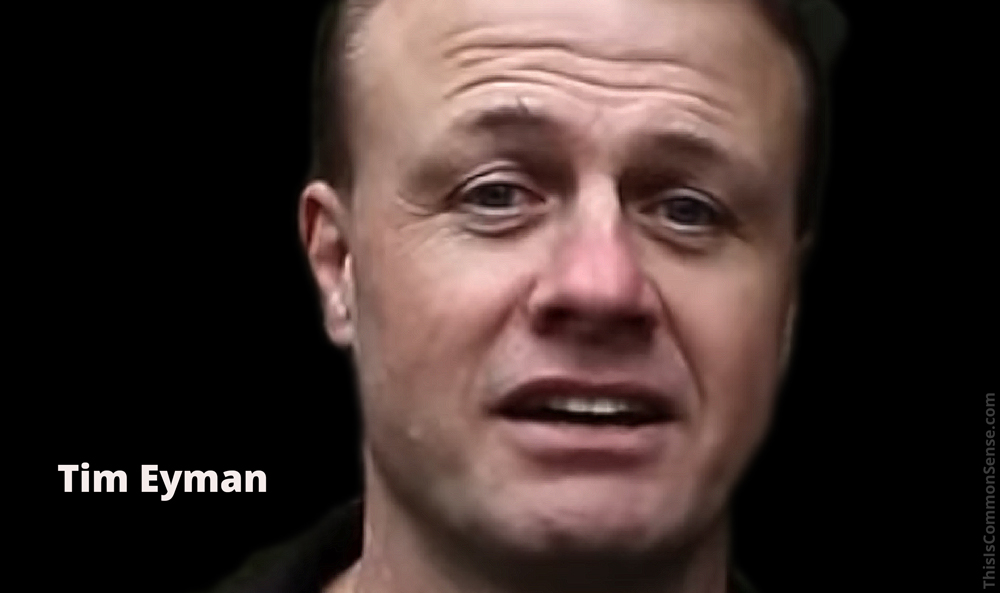
The voter-approved measure does have Attorney General Bob Ferguson lawyering on its behalf. But Mr. Ferguson has been engaged in a multi-year civil lawsuit against Tim Eyman, the sponsor of 976. The two aren’t friends. And the AG is no friend of lower taxes, either. No surprise, then, for Eyman to talk of “sabotage” and Ferguson’s mere pro forma defense: “he truly doesn’t want it to succeed.”

This isn’t a government-on-government fight, but governments-versus-voters. With the wonderful exception of Pierce County, where political representation still lives.

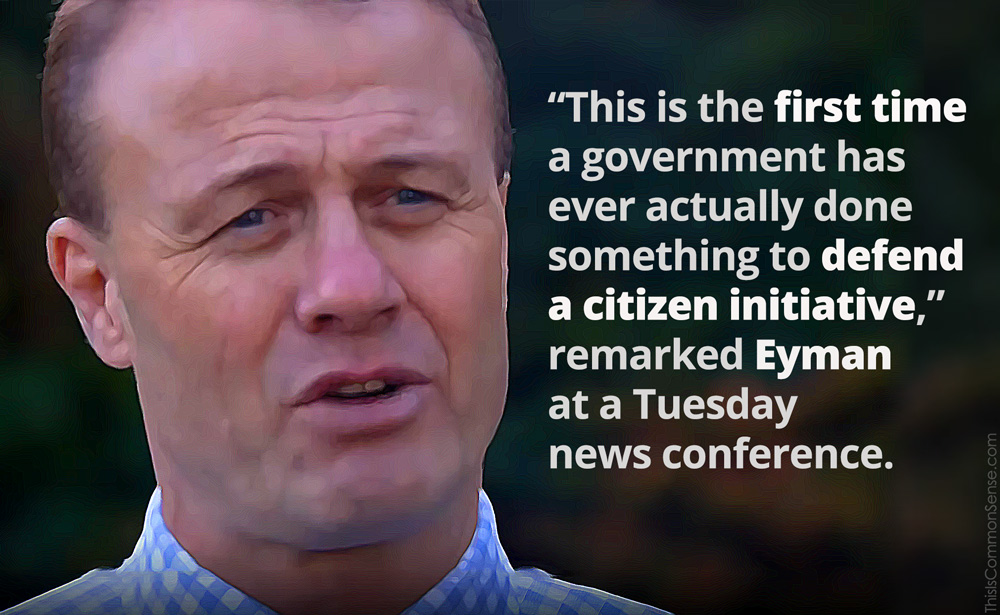
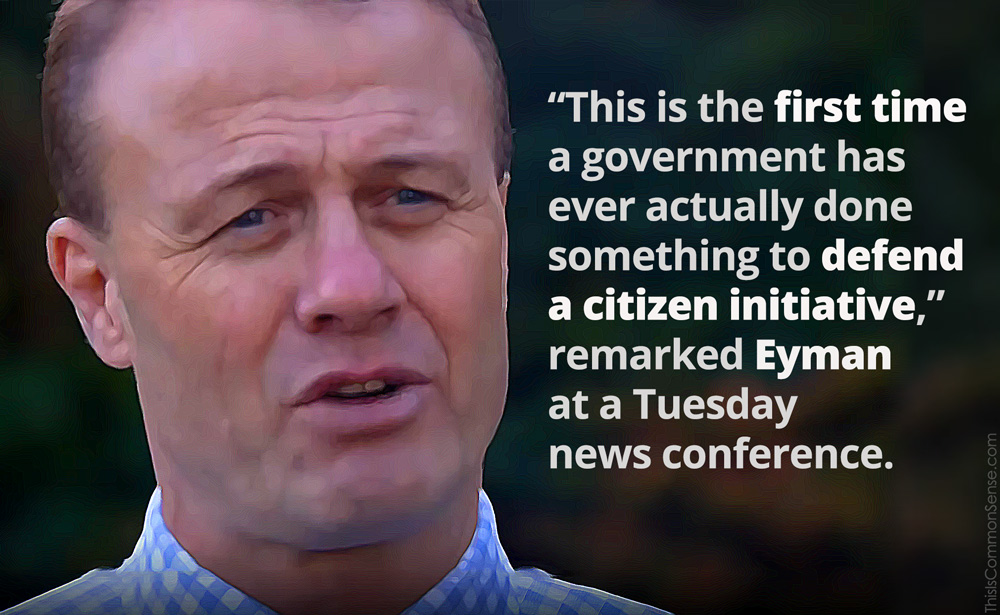
“This is the first time a government has ever actually done something to defend a citizen initiative,” remarked Eyman at a Tuesday news conference. 

“It is really extraordinarily unusual,” he added.

That’s how out-of-control government in our “democracy” is. 

This is Common Sense. I’m Paul Jacob.


PDF for printing

Tim Eyman

See all recent commentary
(simplified and organized)
See recent popular posts

Categories
initiative, referendum, and recall tax policy

My Favorite Control Group

Tim Eyman strikes again. 

In deep blue Washington State, the ballot measure activist celebrated another Election Day victory last week with Initiative 976, limiting vehicle taxes. Not to mention Referendum 88, whereby voters kept a ban on government use of racial preferences, enacted via an initiative Eyman had co-authored two decades ago.

And still, there were a dozen more issues on last Tuesday’s statewide ballot thanks to Mr. Eyman’s 2007 initiative, I-960, which mandates “advisory votes on taxes enacted without voter approval.” (Also thanks to state legislators, I guess, for racking up 12 new tax increases this year without bothering to ask voters!)

Yet, perhaps it matters not at all. Nearly two million votes cast on each of these measures? Three supported by a majority? Nine rejected? Two esteemed Evergreen State newspaper columnists pooh-pooh them as “meaningless.”

“The Legislature has never taken the voters’ advice when they say a tax should be repealed,” writes Spokane Spokesman Review columnist Jim Camden. 

That’s a failing of the Legislature, Jim,* not these advisory measures . . . which you seem to acknowledge when you write that these votes at least “provide a good control group for any experiment on the voters’ knee jerk reaction to higher taxes.”

If legislators cared to know. 

While dumping on the dozen measures as “an empty remnant of an earlier initiative,” The Columbian’s Greg Jayne notices that “their presence on the ballot this year reminded voters, over and over again, of the Legislature’s spendthrift ways.”

Helping create an anti-tax mood that spurred support for I-976.

Not bad for being meaningless.

This is Common Sense. I’m Paul Jacob.


* I use his first name because I know Mr. Camden from decades ago when he was a reporter covering House Speaker Tom Foley, who after suing to overturn the 1992 citizen initiative for term limits became the only Speaker defeated for reelection since the Civil War. 

PDF for printing

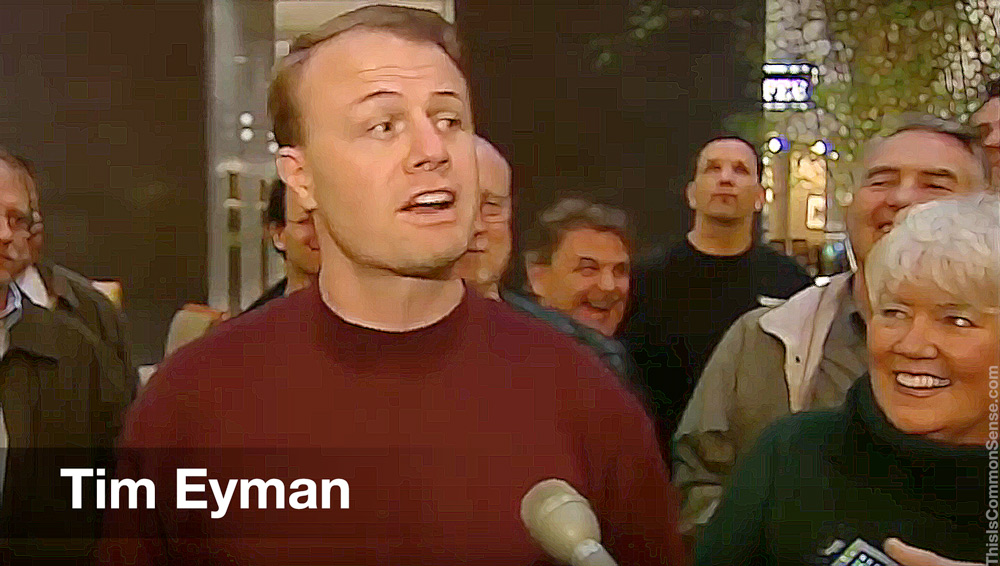
Tim Eyman

See all recent commentary
(simplified and organized)
See recent popular posts
Categories
initiative, referendum, and recall tax policy

Blue Colorado Big Spenders

“The Trump years may have cemented Colorado’s blue-state status — time will tell,” writes Alex Burness in the Denver Post, “but voters in the Centennial State continue to hold a hard line on anything that has even a whiff [of] new tax.”

Burness is talking about Proposition CC, a measure placed on Tuesday’s ballot by the state’s Democratic-controlled legislature, which would have allowed state government to keep and spend $37 million annually coming into government coffers over the state’s constitutional spending cap, rather than refunding those dollars to taxpayers as required by the Taxpayer Bill of Rights passed back in the 1990s.

The elite supporters of Proposition CC devoted more than $4 million to promoting the measure, outspending opponents better than two-to-one and arguing that government desperately needed the money for education and transportation. Opponents cried foul over the official ballot summary voters read, which began with the words “Without a tax increase . . .”

 “But the measure lost,” Burness informs, “and it wasn’t close.”

“The measure’s failure amounts to a significant victory for supporters of the Taxpayer’s Bill of Rights,” Colorado Public Radio reports. “That constitutional amendment requires voter approval for all tax increases, sets a revenue limit for every government in the state and requires any surpluses be returned to taxpayers.”

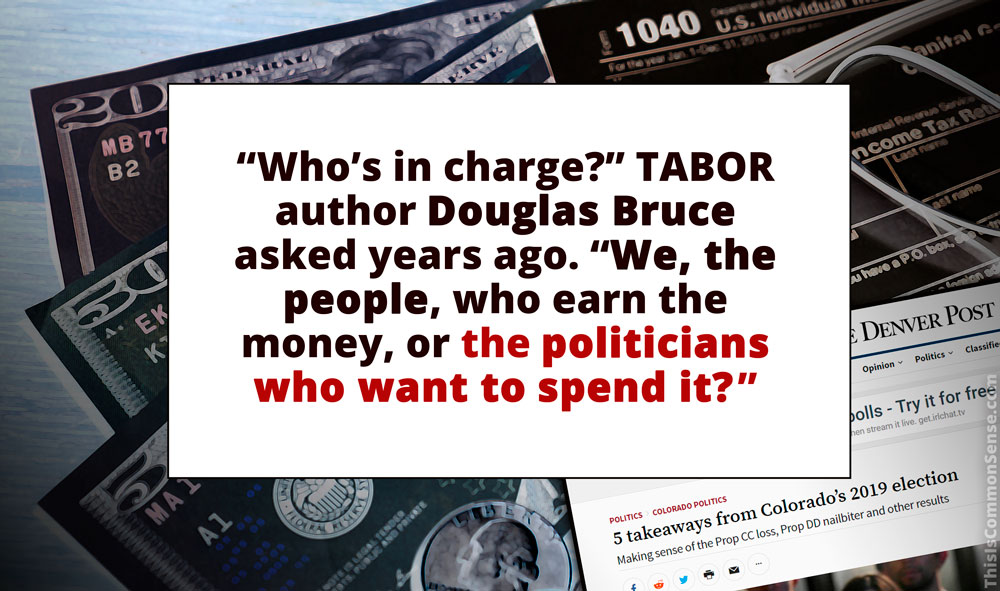
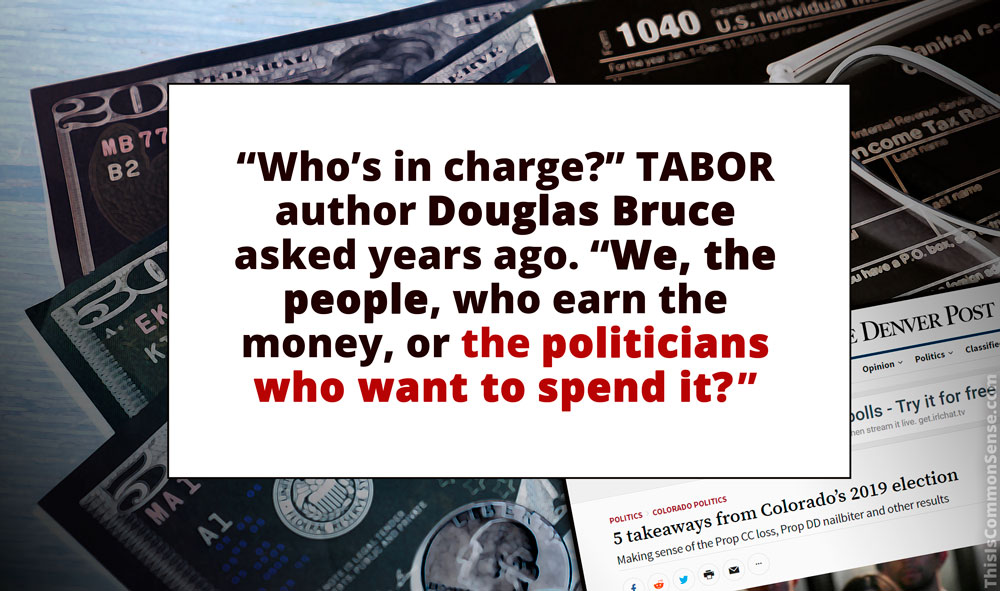
“Who’s in charge?” TABOR author Douglas Bruce asked years ago. “We, the people, who earn the money, or the politicians who want to spend it?”

The answer from supposedly blue-leaning Colorado voters was unequivocal.

This is Common Sense. I’m Paul Jacob.


PDF for printing

Colorado, elections, taxes, Bruce,

Photo credit: Pictures of Money

See all recent commentary
(simplified and organized)
See recent popular posts

Categories
initiative, referendum, and recall tax policy

The Legislature That Couldn’t Tax Straight

“If you lost count of how many new and higher taxes state lawmakers passed this year,” begins Jerry Cornfield’s recent column in the Everett Herald, “it was 12.”

Cornfield doesn’t appear too distressed about the tax hikes, however, worrying instead that Evergreen State voters will be “awash in tax advisory measures this fall.”

That’s because for every tax increase the Washington State Legislature enacts without putting it to a vote of the people of Washington, an advisory vote is mandated by Initiative 960, passed by voters back in 2007.

So 12 tax increases = 12 tax advisory votes. 

“We wouldn’t be talking about advisory votes and providing Eyman a platform for politicial [sic] ministering,” Mr. Cornfield complains, “had Democratic lawmakers gotten rid of them by passing Senate Bill 5224.”

Seems odd somehow that a newspaper columnist would be berating politicians for not passing a law to silence voters regarding tax hikes. Democrats could have done so without a single Republican vote. SB-5224 did pass the Senate, but it was blocked in the House by the Democratic Speaker — “democratic,” thankfully, in more ways than one.

Eyman is Tim Eyman, the state’s anti-tax initiative leader. His group, Voters Want More Choices, spearheaded Initiative 960, which from 2008 to 2018 required 19 tax advisory votes. Voters have expressed opposition to 12 of the 19 tax increases passed by the legislature — 63 percent — and support for seven. 

“It’s a tax increase report card,” explains Eyman, “and the Legislature this year gets an F.” 

A grade that was certainly earned.

This is Common Sense. I’m Paul Jacob.


PDF for printing

Tim Eyman, Senate Bill 5224, taxes, vote, democracy,

See all recent commentary
(simplified and organized)
See recent popular posts