Categories
folly government transparency national politics & policies political challengers responsibility

No Innocence Abroad

After establishing, during the big Super Bowl day interview, that President Donald Trump respects Russian leader Vladimir Putin, Bill O’Reilly asked why.

After all, the Fox News star challenged, “Putin’s a killer.”*

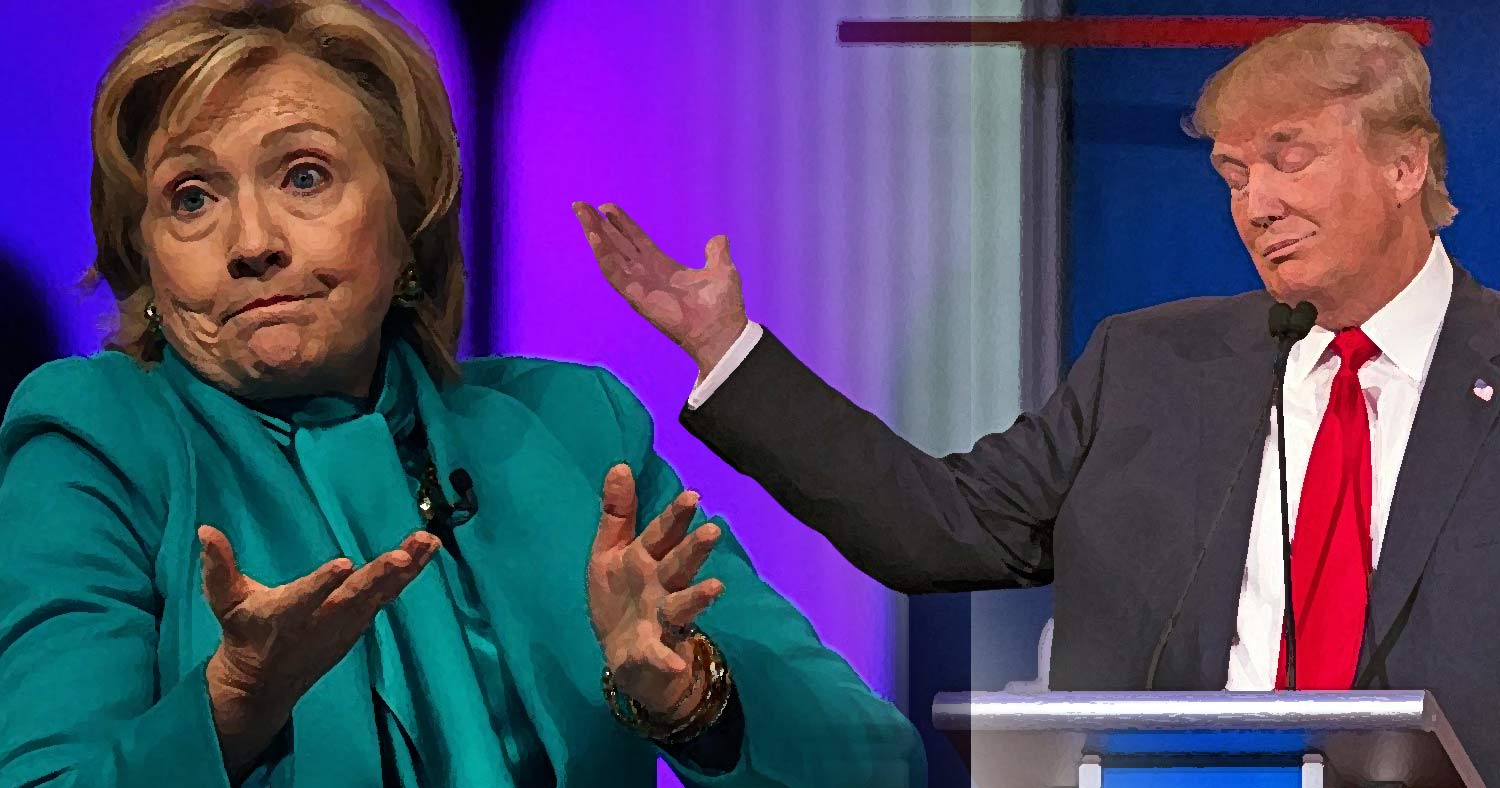
“We’ve got a lot of killers,” Trump replied. “What, you think our country’s so innocent?”

This disturbed just about everyone. On the left, it was more evidence of Russian influence. The right recoiled at Trump doing the leftist thing, equating our moral failings with the much worse failings of others.

“I don’t think there’s any equivalency between the way that the Russians conduct themselves,” insisted Senate Majority Leader Mitch McConnell (R-Ky), “and the way the United States does.”

But is that really what Trump said? He merely pooh-poohed America’s innocence.**

And not without cause. His predecessor, after all, holds the world record (not Nobel-worthy) in drone-striking the innocent as well as the guilty in seven countries . . . none of which the U.S. has declared war upon.

But wait: if “we’ve got killers” is the new acceptable-in-public truth, then why not “we’ve got currency manipulators”?

Yes, I’m shifting focus from east of Eastern Europe onto the Far East. According to a different Fox report, “Trump accused China and Japan of currency manipulation, saying they play ‘the devaluation market and we sit there like a bunch of dummies.’”

Despite incoherent objections from Japan***, let’s not forget the obvious: the U.S. manipulates currency, too. What do you think the Federal Reserve is for?

I mention this not to rub Trump’s nose in hypocrisy. It’s to establish an estoppel principle here.

How may we object when others do that which we do ourselves?

This is Common Sense. I’m Paul Jacob.

* The Russian State is asking for an apology from O’Reilly. Not for a retraction on the grounds of truth, mind you, but an apology. O’Reilly wryly balks.

** Which certainly doesn’t absolve Vladimir Putin of guilt.

*** Yoshihide Suga, a spokesperson for the Japanese Government, insists that “the aim of monetary policies that have pulled the yen lower is to spur inflation, not devalue the currency.” Nice distinction. Thanks.


Printable PDF

Categories
ballot access folly general freedom government transparency national politics & policies political challengers

Trumping Popular Vote?

A friend, who loves to talk football, sometimes boasts that his team “crushed” the other team, gaining more yards and rolling up more first downs, before dejectedly acknowledging that his team didn’t score as many points as its opponent. They lost.

When a Democrat gloats that Donald Trump lost the popular vote, I am reminded of my friend’s funny football foible.

It helps to gain yards in football, sure, just as it helps to gain votes in a presidential contest. But you win a game by putting the most points on the scoreboard, just as you’re elected president by winning a majority in the Electoral College.

Going forward, we can discuss whether a state’s votes should be awarded proportionally or winner-take-all and whether national popular vote should instead be the metric for victory. But the 2016 rules were the rules.

“I would’ve won the popular vote if I was campaigning for the popular vote,” President Trump told ABC News anchor David Muir this week. “I would’ve gone to California, where I didn’t go at all.”

Still, Mr. Trump should appreciate that not only didn’t he garner a majority, he lost by 3 million votes to Hillary Clinton, who was well short of a majority, herself.

Trump continues to claim “a massive landslide” in the Electoral College. He may have “shocked the world,” but in 58 presidential elections thus far, 45 winners gained a greater percentage in the Electoral College.

Again this week, Pres. Trump repeated his belief that “millions of illegal votes” prevented him from winning the popular vote. Specific evidence? None. But he wants an investigation.

This could be a long four years.

This is Common Sense. I’m Paul Jacob.


Printable PDF


Categories
ideological culture media and media people national politics & policies political challengers

Democracy — Oh, My!

The President-elect has had some difficulty booking celebrity acts for his inauguration. And instead of taking this as a cue to trim down on celebratory excess, his team has extended the guest performer list to include New York’s world-famous chorus line dancers, the Rockettes.

The leggy, sequined showgirls might seem a perfect fit for the President-elect’s celebration — more, say, than a ballet troupe, or a string quartet — but one among the Rockettes protested.  Being a part of a performing team might seem a dream job, but not for Phoebe Pearl. She was, she wrote on Instagram, “overwhelmed with emotion,” and not in a good way. She felt “embarrassed and disappointed” that the gig “has been decided” for her.

She feels . . . coerced.

Dan Avery, writing before Christmas, characterizes the contract as a matter of “force.”

Welcome, Ms. Pearl, to the world that most American workers already know.

But the silliness reached high pitch with actor George Takei, who tweeted: “The members of the Rockettes and the Mormon Tabernacle are like all of us: Forced to go along with something horrible they didn’t choose.”

Democracy — oh, my!

Most people have had to put up with democratic results they did not like. Are Democrats only now understanding this?

To a degree, I sympathize. Which is why I want limits placed on government. Perhaps Democrats should have thought of this every time they cheered as their elected candidates increased presidential power. Did they not realize that someday they might lose?

And if you want a right of refusal, make sure it is in your contract.

The Rockette does not have a leg to stand on.

This is Common Sense. I’m Paul Jacob.


Printable PDF

Rockettes, democracy, inauguration, Trump, media, entertainment, illustration, association, voluntary


Categories
general freedom individual achievement national politics & policies political challengers responsibility U.S. Constitution

Capturing Christmas

The festival of Hanukkah begins tomorrow at sundown; Christmas is on Sunday. It’s the most wonderful time of the year, a time to spend with family and friends, to appreciate what’s most important in life.

And maybe even to forget about politics for a bit. But remember one political or historical thing this holiday season: in addition to its religious significance for Christians, Americans share an excellent historical reason to celebrate on Christmas day.

Back in January of 1776, Thomas Paine published his runaway bestseller and our namesake, “Common Sense.” His pamphlet was read publicly throughout the colonies, galvanizing opinion in favor of the Revolution that had begun the previous year at Lexington and Concord with the shot heard ’round the world.

Later, in July, the Declaration of Independence was written, signed and proclaimed to the new nation by the Continental Congress.

But by December of the same year, the prospects for the American cause were looking bleak.

British forces, along with their mercenary Hessian reinforcements, had manhandled the Continental Army. Gen. George Washington’s troops were routed at Long Island, pushed out of Manhattan, forced to retreat across the Hudson to New Jersey, and then run out of Jersey across the Delaware River to Pennsylvania “exhausted, demoralized and uncertain of [their] future.”

Soon, the British believed, the American revolt would be extinguished.

“To compound Washington’s problems,” recounts the EyeWitnesstoHistory.com website, “the enlistments of the majority of the militias under his command were due to expire at the end of the month and the troops return to their homes.”

Yet, on Christmas night, Washington marshaled his ragtag soldiers and crossed the icy Delaware, then marched his men nine miles to Trenton. In the wee hours of that Dec. 26th morning, the Continentals attacked, catching more than 1,000 Hessian soldiers by surprise and capturing nearly all of them.

In strictly military terms, the victory was not terribly significant. But in terms of American morale, as well as the perception of important potential allies (think France), the military success was absolutely the perfect Christmas gift for the new Republic.

Our Republic, always in the hearts and hopes of the people dedicated to liberty and justice for all, continues to this day.

And today, you and I are left to defend it — just like the barefoot minutemen who walked through the snows at Valley Forge and faced their world’s most powerful military force.

Without smart phones.

If on this happy and historic holiday you too want to launch a surprise attack against modern day tyranny and Big Brother government, to give a gift that will protect and grow freedom, there’s a link here to speed your way across the Delaware and right to the donate page of Citizens in Charge Foundation.

Perhaps you’d like to join Team 1776 by making a monthly pledge of $17.76, or to make a one-time contribution to keep Common Sense coming.

While you’re still free to do so.

Or maybe you’re all gifted out for now. Still, be sure to share the good news — er, the other good news, the Christmas story about initiative, daring, courage . . . about the battle won by the forces of freedom 240 years ago. Post this commentary on Facebook, Google+, Minds, Instagram, email it to a friend, you name it — or just mention it to loved ones while you’re relaxing after dinner.

And best wishes for a safe and happy 2017. Let’s hope we freedom-loving folks find even more success.

Merry Christmas, America! Happy Hanukkah! Peace and good will to all.


Printable PDF

Christmas, Common Sense, American, freedom, Paul Jacob, patriotic, citizen, illustration, Christmas Card


Categories
general freedom ideological culture media and media people national politics & policies political challengers responsibility too much government

Whack the Bob

It’s a truism in politics: the pendulum swings. Now, around the world, we see a deep swing rightward:

  • Brexit, and the collapse of Britain’s Labour Party;
  • Donald Trump, and the routing of the Democrats;
  • German Chancellor Angela Merkel’s turnaround on Muslim refugee acceptance; and,
  • in France, the rise of the National Front’s Marine Le Pen.

Over the weekend, the Washington Post reported on events in Poland. There, the Law and Justice Party is not only making sweeping changes of a pro-family, religious conservative nature, it has also grown in popularity.

Fearing an anti-intellectual “neo-Dark Age,” the Post finds cause for that worry in the fact that the Poles are downplaying evolutionary science in government school curricula.*

Before the big freak out, note the why of this: the dominant progressive-left paradigm has proven itself incapable of dealing with the challenges of the present age — most being caused by their own policies. Worse yet, those on the vanguard left have become moral scolds and petty language tyrants.

Yes, political correctness is one of the big offenders, here.

So, of course there’s a backlash.

But, turnabout being fair play, if the move to the “right” goes too far — as it probably will — we can expect another swing leftward.

Isn’t it time to give that pendulum bob a whack, to initiate something like an equilibrium position? Many of today’s problems are caused by partisans trying to force their kind of change down others’ throats. There is an alternative: limit government, setting it to just a few tasks, letting society evolve naturally, without forced central planning.

That would be “evolutionary,” and thus neither rightist nor revolutionary-left. Call it neo-Enlightenment.

This is Common Sense. I’m Paul Jacob.


* Poland’s new government has become scary, by reducing transparency, limiting press access, purging the government news network of anti-rightist journalists, hiking subsidies to traditional families and the elderly, shelving the gay marriage issue and allowing local governments to cut back on granting public protest permits. Not all of these are equally frightening, of course. Why should any government be allowed to maintain a government-run news agency? (Ideological purges come with the territory.)


Printable PDF

pendulum, noose, politics, left, right, change, Republicans, Democrats


Categories
media and media people national politics & policies political challengers responsibility too much government U.S. Constitution

Conscience Clear?

Today the Electoral College meets to elect the 45th President of these United States.

But if they fail to cast the required majority for a candidate, the contest goes into the House of Representatives, where each state gets one vote — Wyoming and California equally weighted — and a state’s vote can only be cast for one of the top three Electoral College vote-getters.

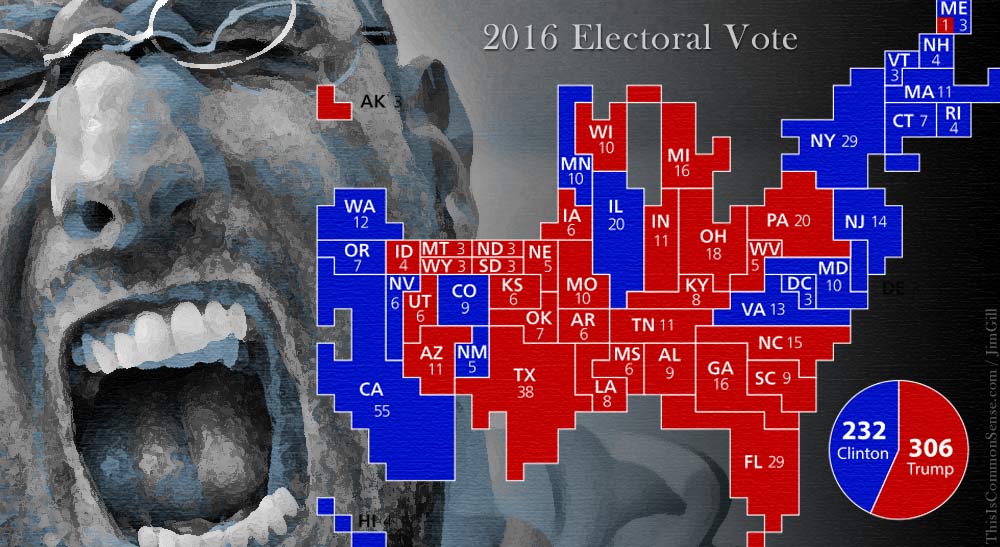
Of course, only two candidates won electoral votes, because only they won states. Donald Trump won 30 states comprising 306 electoral votes; Hillary Clinton won 20 states with 232.

That’s the arithmetic. But, as I explored at Townhall yesterday, nothing in the Constitution requires an elector pledged to Trump or Clinton to vote for that candidate.* They can vote their conscience.

That’s why in recent days, Nancy Pelosi’s daughter, Christine, a California elector, petitioned to have electors receive an intelligence briefing about Russian hacking — hoping to sway electors.

Her petition was denied.

Desperation showing, a group of Hollywood actors led by Martin Sheen starred in a Unite for America video talking down to — er, directly to — Republican electors. Asserting that the Electoral College was designed by “Hamilton himself” to prevent an “unfit” “demagogue” (they mean Mr. Trump) from attaining the presidency, the actors claim to “stand with” and “respect” GOP electors, who could be heroes in Hollywood (no honor more tempting!) if only they’d cast their vote for someone other than Trump.

Anyone! — who meets presidential qualifications. “I’m not asking you,” three actors in a row assure, “to vote for Hillary Clinton.”

As much as I support the idea of voting one’s conscience and as much fun as this election has been, I think we’ve all now had enough. Let’s prepare ourselves to help Mr. Trump do what’s right and stop him from doing what’s wrong . . . with a clear conscience.

This is Common Sense. I’m Paul Jacob.


* Some electors do sign a loyalty pledge to the candidate and there are state laws, almost certainly unconstitutional, which penalize electors who do not vote for the candidate they are pledged to.


Printable PDF

electoral, college, election, voting, popular, Hamilton, illustration


Original (cc) photo by Crosa on Flickr


Categories
initiative, referendum, and recall nannyism political challengers Regulating Protest

Irony in Spain

When I arrived at the Donostia-San Sebastián City Hall, in the beautiful Basque Country of Spain, I wondered what all the ruckus was about. There were hundreds of noisy protesters waving long, colorful banners.

My goodness, how interesting to witness acts of political agitation on the public square in another country, I thought. Then, atop the crowd some 20 feet opposite the protest, I spied Daniel Schily, a key activist, funder and cheerleading motivator of the direct democracy movement in Germany.

After greeting, he drily brought me up to date: “They’re protesting us.”

“No, really,” I asked, “what are they protesting?”

“Really,” he said, seemingly sincere. “They’re protesting the Global Forum.”

I stood there dumbstruck, for a moment, before I noticed one sign written in English: “Global Forum on Modern Direct Democracy,” with a very large, black, bold question mark beside it.

Schily wasn’t kidding.

In almost no time, I met up with friends from Bulgaria, South Korea, Uruguay, Chile — fellow activists, all. We had gathered in this “cultural capital of Europe” precisely because of our belief that all people have a right to not only speak out, but effect change, through ballot initiatives and referendums.

It turned out that the protestors hailed from the Satorralaia neighborhood movement. Their beef? Even after gathering nearly 9,000 signatures on petitions requesting a public referendum on a proposed through-station for the mass-transit metro system project, the city government shrugs.

The same city council that helped organize our forum, ignoring citizens while claiming the city is “The World Capital of Democracy.”

Government. What more proof do we need that it could use more checks and balances from the people themselves?

This is Common Sense. I’m Paul Jacob.


N.B. This is a Common Sense digest version of Paul’s weekend column. For more information, see Saturday’s and Sunday’s posts. Paul was in transit home when this entry was being prepared for the Web; he may offer further reports from his trip in the near future.


Printable PDF

Spain, Paul Jacob, Common Sense, initiative, democracy


Categories
ideological culture national politics & policies political challengers

Double Bubble America

The “unexpected” Donald Trump presidential victory has put the folks at The Gray Lady a bit out of sorts.

Heather Wilhelm at the National Review pokes and prods at the absurdities of the New York Times’s cultural cluelessness. And ably enough. So I’ll stick to The Times’s recent “six views” of America’s ideological divide:

Julie Turkewitz recognizes two well-insulated informational bubbles at play. Nothing too controversial — or very deep.

Campbell Robertson muses upon the dominance of the “elites” against which Trump’s insurgents rebel, noting that “the elites are the still the ones who get to decide who gets to be elite.”

Laurie Goodstein takes on religious culture, making much of divergent spiritual outlooks, left and right.

Julia Preston peers at immigration and the prospect of sending a message by building a “wall.”

In the manner of the other five, Sheryl Gay Stolberg digs up real-world people — as does our speechifier-in-chief, Barack Obama — to lightly probe questions of assimilation versus multiculturalism.

Manny Fernandez concludes with a (yawn) discussion of giving and taking offense.

They all miss the underlying structural basis for the divide.

On one side: folks working in the private sector — or local governments and charities, or at home — who have seen the world pass them by in terms of income and security.

On the other: government workers and consultants (and other college grads) who make more, on average, than their “real world” counterparts.

The latter has advanced as a class; the former remain in stasis . . . at best.

A mystery?

No — it’s the predictable result of what Thomas Jefferson called “the parasite institutions now consuming us.”

This is Common Sense. I’m Paul Jacob.


Printable PDF

bubble, Trump, election, reasons, explanations, illustration


Original (cc) photo by diana MĂRGĂRIT at Flickr


Categories
Accountability general freedom initiative, referendum, and recall moral hazard national politics & policies political challengers term limits too much government U.S. Constitution

Fear and Freedom

“If Libertarian Gary Johnson doesn’t win the presidency,” I posted to Facebook last Monday, “I’m leaving the country.”

Well, Johnson didn’t win. And I wasn’t kidding. I’m writing this from a Parisian café.

Of course, I was also tongue-in-cheek, since — spoiler alert! — I am coming home next week.

This week, I’m speaking at the Global Forum on Modern Direct Democracy in San Sebastián, Spain — a gathering of pro-initiative folks from all over the world. We want people’s votes to count, even if we disagree with their candidate or issue.

Which brings us back to Donald J. Trump’s surprise victory. Protests have broken out in several cities — some violent. And some folks say they’re scared of what Trump may do as president. Sure, one can snicker at these fearful responses as liberal whining. And to the extent they’re talking about university professors canceling tests and coddling “traumatized” students . . . well, no argument here.

Still, I don’t just sympathize when I hear people fear a politician with power, I empathize.

For a long time, I’ve been worried by out-of-control presidential power — from unconstitutionally making laws through executive orders to making war without any real check on that power. Scary. Whether that president is George W or Obama or Hillary or Trump.

Government is a monopoly on force. Therefore, by definition, government is frightening.

Democracy is often an antidote to tyranny, a check on power, but not always. That’s why folks who truly appreciate democracy believe in individual rights that transcend any vote-getting public decision mechanism.

Scared by President-Elect Donald Trump? Protect yourself: enact greater limits on government.

This is Common Sense. I’m Paul Jacob.


Ask the next question.

Questions Answered:

Is fear a natural byproduct of government?

Which presidential powers lack sufficient checks and balances?

What is more important: individual freedom or democratic decision-making?

Is democracy a check on power or an enhancement?

The Next Question:

How do we go about creating greater limits on political power?


Printable PDF

Protect Yourself, limited government, meme


Categories
Accountability ballot access general freedom incumbents initiative, referendum, and recall national politics & policies political challengers responsibility too much government U.S. Constitution

Votes Without Poison

Strange election. So . . . round up the usual suspects!

Immediately after Hillary dried her tears and conceded, out came the Tweets, then the analyses: the “third parties” are to blame!

Over the weekend, I focused* on one such election post-mortem. The basic idea is not altogether wrong: minor party efforts together may have cost the Democrat her Electoral College advantage this time around, just as Nader’s Green Party run spoiled Al Gore’s bid in 2000 and several past congressional races have been spoiled for the GOP by Libertarians.

Is there a problem here? Yes. But do not blame the minor party voters. It’s the way we count their votes that is “problematic.” The current ballot-and-count system turn voters most loyal to particular policy ideas into enemies of those very same ideas.

When we minor party voters turn away from a major party — usually because said party tends to corrupt or betray our ideas, or make only small steps toward our goals — our votes aren’t so much wasted as made poisonous.

Because the candidate least preferred may prevail.

But there’s a way out: On election day, voters in Maine showed how to cut through the Gordian Knot. Voting in approval for Question 5, Maine now establishes “ranked choice voting.”

Under this system, you don’t “waste” your vote when expressing a preference for a minor party candidate. You rank your choices and, if your first choice proves unpopular, your second choice (or maybe your third) gets counted. So you don’t “poison” your cause.

Republicans and Democrats have more than enough reason, now, to adopt ranked choice voting across the country.

This is Common Sense. I’m Paul Jacob.


* See yesterday’s links page to my weekend Townhall column for the basic references. But there were many, many articles on the Minor Party Effect, including a skeptical one by Sasha Volokh’s.


Ask the next question.

Questions Answered:

What is the effect of minor parties on major party outcomes?

What causes those effects, voter intent or something else?

Is there a way to prevent this, short of further sewing up the ballot access system to minor parties?

The Next Question:

What might our elections look like if people spent more time discussing issues and ideas … and less about class, culture wars, and sex crimes?


Printable PDF

ranked choice, vote, voting, democracy, clown, illustration